Man to Man:
▪︎ Wake up early whether you like it or not. Sleep is a luxury you earn.
▪︎ Cut porn. It's frying your discipline and making you soft.
▪︎ Lift heavy weights 4 to 6 days a week. Track numbers. If they're not going up, you're lying.
▪︎ Eat boring food. Same meals. Protein first. Pleasure later.
▪︎ Stop explaining yourself. Explanations are for people above you.
▪︎ Learn one high-income skill and go all in. No backup plans. Backups make cowards.
▪︎ Kill useless friendships. If they don't push money, discipline or growth, they're dead weight.
▪︎ Get comfortable being alone. Loneliness is training, not a problem.
▪︎ Read contracts, finance, power, psychology. Fiction won't save you.
▪︎ Build an emergency fund. No one rescues grown men.
▪︎ Stop chasing women. Build a life that attracts them accidentally.
▪︎ Control your temper. Emotional men get manipulated.
▪︎ Dress clean and simple. No logos. No noise. Let silence flex.
▪︎ Learn to say no without guilt.
▪︎ Track your time like money. Wasted hours are stolen years.
▪︎ Fix your posture. Weak body language bleeds into weak decisions.
▪︎ Quit alcohol if you can't control it. If it controls you, it owns you.
▪︎ Learn how to fight or learn how to run fast. Ideally both.
▪︎ Pay your debts aggressively. Owing money kills respect.
▪︎ Keep your mouth shut about plans. Execute first.
▪︎ Accept that no one cares about your struggles. Act accordingly.
▪︎ Build something that pays you while you sleep. If not, you're replaceable.
▪︎ Call your parents. One day you won't be able to.
▪︎ Stop waiting for motivation. Operate on schedule.
▪︎ Become physically dangerous but mentally calm.
▪︎ Respect yourself so hard the world has no choice but to adjust.
That's it. No inspiration. Just work.
In medical school, we are taught a golden rule: "When you hear hoofbeats, think horses, not zebras." It is a reminder to look for the common explanation before the exotic one. But after decades in cardiology, I’ve learned that if a patient is still suffering after the "horses" have been ruled out, a doctor must have the courage—and the curiosity—to go hunting for the zebra.
Sarah was a thirty-four-year-old marathon runner and a devoted mother who came to me after six months of being told she was "fine." She had been bounced from one specialist to another, each one pointing to her normal EKG and standard blood tests as proof that her crushing fatigue and racing heart were simply the result of "new mom stress." By the time she reached my office, she didn't just look tired; she looked invisible, as if the medical system had stopped seeing the woman and only saw the data.
Instead of re-reading the normal test results that had already failed her, I asked Sarah to walk me through her life. We talked about her training and her family, eventually landing on a backpacking trip she took to the Mendoza province of rural Argentina. She described staying in a charming, rustic cottage made of sun-dried mud bricks. She mentioned waking up one morning with a strangely swollen, purple eyelid that she assumed was a simple spider bite.
As she spoke, a memory surfaced from a biography I had read years ago about Charles Darwin. Most people know Darwin for his theories on evolution, but medical historians have long puzzled over the mysterious, debilitating illness that plagued him for decades after he returned from his voyage on the HMS Beagle. Darwin had written in his journals about being bitten by the "great black bug of the Pampas" while sleeping in mud-walled huts in South America. He spent the rest of his life suffering from heart palpitations and exhaustion that the Victorian doctors of his time could never explain.
I realized then that Sarah wasn't suffering from stress; she was likely hosting the same "silent killer" that may have haunted Darwin: Chagas Disease.
The "Kissing Bug" lives in the cracks of those mud-brick walls. It bites its victims—often near the eyes or mouth—while they sleep, passing a parasite called Trypanosoma cruzi into the blood. The danger of Chagas is that the initial symptoms disappear quickly, but the parasite can hide in the body for years, slowly weaving itself into the muscle and electrical "wiring" of the heart.
To confirm this, I moved beyond the standard tests. I ordered a specialized "Strain Rate" ultrasound, which doesn't just look at whether the heart is pumping, but at how the individual muscle fibers are stretching. We saw that while her heart looked strong to the naked eye, the fibers were "stuttering," a sign of early parasite-induced scarring. A specific blood test for the parasite's antibodies confirmed the diagnosis.
Treatment required a difficult, sixty-day course of anti-parasitic medication to stop the infection, paired with a protective heart regimen to keep her electrical system stable while the inflammation settled. Because we caught it before her heart was physically damaged or enlarged, the recovery was a success.
Months later, Sarah returned to my office, her vibrant energy restored. She brought me a leather-bound copy of The Voyage of the Beagle with a note tucked inside. She wrote that while other doctors had looked at her charts, I had looked at her. This case remains a vital reminder for my memoir: in a world of high-tech scans and AI, the most sophisticated diagnostic tool we possess is still the human story. When we truly listen, we don't just find the disease—we find the patient.
Good morning.
Copied
Why so many global CEOs are Indian is the wrong question. The real question is what kind of system produces them.
This isn’t about Indians being genetically smarter or IITs magically creating genius. It’s only about selection pressure. India is not a talent factory. India is a high-pressure talent filter.
Most Indians are born into middle class or lower middle class families. There is no safety net, no fallback plan, no cushion. From the day you’re born there is an unspoken contract. Do well or the whole family stays stuck.
Education isn’t optional. It’s survival, now add population. Five to ten lakh people fighting for a few thousand seats. Even after years of preparation, effort doesn’t guarantee success. You still have to win against insane odds.
What comes out of this system is not creativity. It’s endurance. People who can sit for long hours, delay gratification for a decade, operate under pressure without breaking, and don’t feel entitled to comfort.
That profile matters - Large global companies don’t reward raw brilliance at the top. They reward people who can survive complexity, politics, scale, and boredom for 20 to 30 years straight.
That’s why Indian origin leaders show up disproportionately in operator roles. CEOs, presidents, heads of massive systems, not founders.
They didn’t rise because they were the loudest or flashiest. They rose because they had already been trained by a brutal system that rewards consistency over brilliance.
Compare that to a child born in a developed country. There is pressure, yes. But there is also a safety net. More options. Less existential fear. That environment is great for creativity and risk taking. It produces founders and innovators.
India produces survivors who become operators. That’s the difference most people miss. And let’s be clear, this system is not something to romanticize.
For every one person who makes it, millions burn out. Talent gets wasted. Mental health gets crushed. The system is inefficient and cruel. But it does one thing extremely well. It filters for people who can endure.
That’s why Indians don’t dominate early stage innovation globally, but they dominate long-run leadership in established systems.
So no, Indians aren’t exceptional because of IQ. They’re exceptional because they were never allowed to be comfortable.
The uncomfortable question is not why this works. The real question is whether this is the only way we should be producing leaders. And whether the cost is worth it.
-Jasveer Singh
India too needs to attract its best talent and that can only happen if companies invest in talent through R&D. Our private sector R&D spending is pathetically low by any standard for a G20 nation . I hope the government nudges them to do more. The government itself is taking steps through the ANRF and other initiatives.
Kannada journalist Ajit had coined the perfect analogy for this
When any t£rror attack is being discussed, the blame goes to intelligence failure & not ideology of perpetrator
When Gandhi’s assassination is discussed, the blame is on ideology, not intelligence failure
Tilak Varma Said - "When we were 20/3, pakistani wicket keeper Mohammad Haris said, This is not Mumbai, This is not IPL, You can't chase this total with our premium pace attack".
- What's your take 😁 #INDvsPAK
Rinku Singh's BANGER 🗣️
"Match was Live and we won fair and square, or otherwise you know what they claim if this final wasn't Live". 😅
- What's your take 😆 #INDvPAK
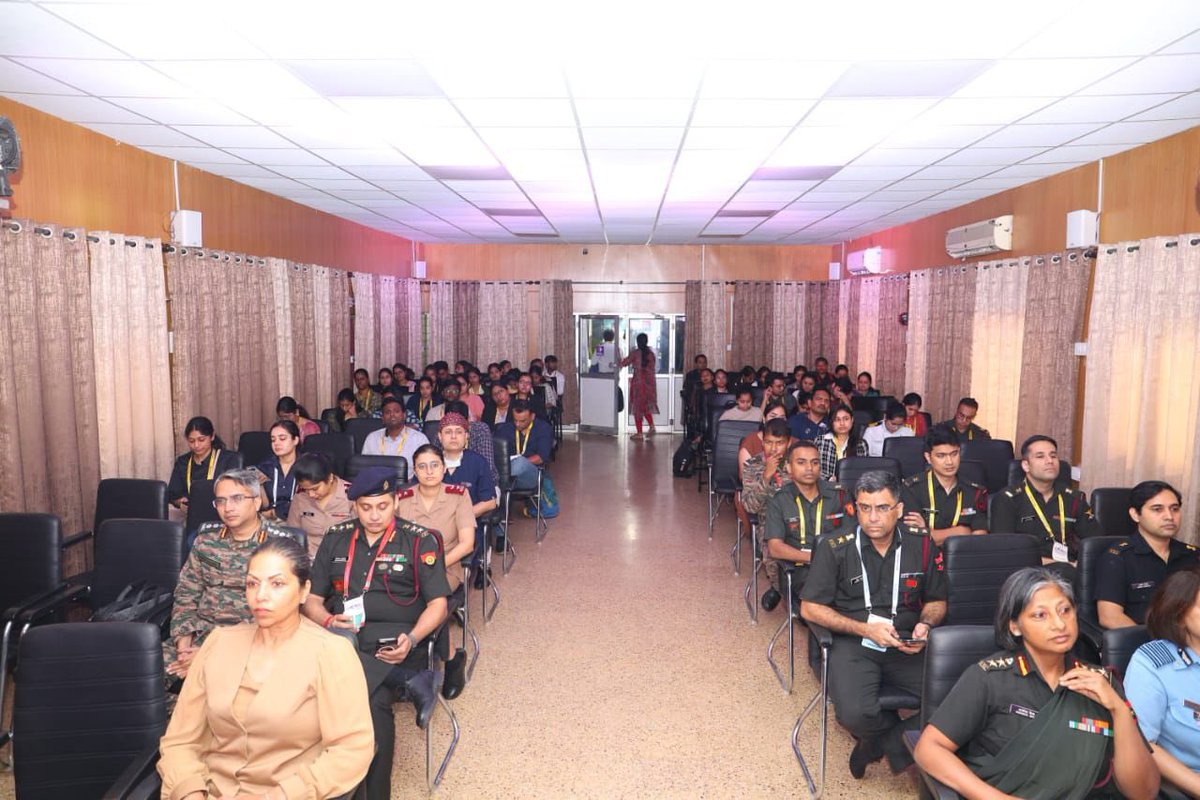
The Association of Physicians of India (API) – Armed Forces Medical Services (AFMS) National Pulmonology Conference was held at the Army Institute of Cardio Thoracic Sciences (AICTS), #SouthernCommand, #Pune. Over three days, the event brought together 250 eminent faculty members and 600 delegates from leading institutes, featuring seven hands-on workshops that engaged more than 300 students from across the country.
This was followed by two days of lectures and panel discussions attended by over 700 delegates, reflecting the scale and success of the conference. The concluding session included an address by Air Marshal Sandeep Thareja, SM, VSM, Director General of Medical Services (Air), which was widely appreciated.
#IndianArmy
#MilitaryCivilFusion
#NationBuilding
#YearOfReforms
@adgpi@dgafms_mod@SpokespersonMoD@PRODefPune
Key takeaways from IAF Chief speech:
1. S-400 shot down five Pakistani jets. One AWACS/ELINT was hit mid-air, another at Bholari destroyed, plus US's F-16s on the ground were hit.
2. India likely kept this information confidential to avoid denting the reputation of US-made F-16s and straining ties with US, which were not bad at that time. Such calls aren’t about ego; deciding what to reveal, what to withhold, and for how long requires careful strategic judgement. I’m sure keeping it under wraps then was the prudent choice.
3. There was absolutely no pressure from the govt to hold back as claimed by Indian opposition.
4. Timing matters, and this revelation makes it clear the govt has no intention of pampering Trump. That’s excellent.
5. The Chief expressed disappointment that despite the success in Balakot, they couldn’t convince their own people. This highlights how negative politics and opposition forces siding with the enemy can erode the morale of our armed forces.
Thank you for your attention to this matter. Jai Hind.
@adityajakki Absolute champion. Not playing kuldeep in last test matche and playing extra allrounder was in the end difference between both the teams. On this pitch spinners aren't that much effective and late order runs are always important. It was sundar's inning which made difference