Futurist. AGI/ASI by 2030. Posting about AI,AGI,ASI, Singularity, Post Scarcity, LEV,tech & sci progress. 300 000BC - 2029 = Dark Ages. 2030 - Golden Age Begins
Feeling the AGI/ASI, few observations
1. Opus 5.5 really gives strong vibes of AGI (maybe not fully there, but we're very close, like 80%-90%).
For example, few breakthoughs in training humanoids are needed. We need to move this intelligence into physical world.
2. I don't think Anthropic has discovered any magical formula.
3. Which means, SpaceXAI, Google, and others will soon follow. This prediction is based on the amount of compute they already have + additional compute being added all the time.
4. Never was more confident that Anthropic, SpaceXAI, Google, OpenAI, likely Meta, basically all big US AGI labs will have proper AGI in 2027.
5. And from there we'll move quickly to ASI territory (likely also in 2027).
It looks like few GW of compute are enough for strong AGI, now imagine what we will able to do with 10-20GW of compute which are rapidly coming online.
And then with 100GW-200GW...
2027 will be an utterly insane year.
"Most researchers would agree that AI research is certainly much less intellectually demanding than solving the Riemann Hypothesis. The models are clearly going to be intelligent enough to automate all of AI research and be clearly superhuman at improving themselves—along with massively accelerating biological research, weapons research, economics research, and more. The implications are enormous."
I still can't believe the Riemann hypothesis was solved.
Pure math alone isn't that exciting to me. It's about what this means: to me, it's confirmation that ASI is here, and it will quickly revolutionize everything.
I was celebrating this weekend, because imo, solving the Riemann hypothesis marks, in a way, the beginning of the post ASI world.
As hard as it is to imagine, ASI will keep getting smarter.
Even before the end of this year, we'll see breakthroughs far more impressive than solving the Riemann hypothesis.
Compute capacity is growing every day. I'm pretty sure Anthropic, OpenAI, and Google are cooking hard, and we'll see plenty of mind blowing things in December.
2027 - a new era begins.
ASI and robotics will make almost everything insanely cheap.
Keep in mind that math SI is already here. We'll soon direct this ultra intelligence toward manufacturing, engineering, and innovation.
ASI will figure out how to make almost any product orders of magnitude better, robots will mass manufacture them around the clock, using abundant energy (new energy tech which btw. will also be improved by ASI).
Prices of various goods will fall dramatically. 100s to 1000s of times.
From our perspective, they'll basically be free.
Things only very rich people can afford today will become normal for everyone, and it will happen much faster than most people think.
This future is just around the corner.
AI will solve all diseases. I have no doubt about it. Progress is accelerating.
Another day (hour), another medical AI model (open source). Nice to see so much progress in this field lately.
"model combines medical image understanding, report generation and medical reasoning with multimodal search and tool use"
another one (anti aging AI model) in comments below.
Meet LingSante-3.1-air-VL, an open-source multimodal medical model with 124B total and 5.5B active parameters. It combines medical image understanding, report generation and medical reasoning with multimodal search and tool use.
In our evaluation, it leads the compared models on AFUMED-Derm, AFUMED-Report, MIMIC-CXR and medical VQA (averaged across benchmarks), ahead of GPT-6.1 Sol, Gemini 3.8 Flash on all four.
It also demonstrates strong general-purpose capabilities, scoring higher than GPT-6.1 Sol on BrowseComp-VL and Gemini 3.8 Flash on AndroidWorld, alongside competitive performance on MMSearch. Explore LingSante-3.1-air-VL and build with it.
Great to see Europe/Poland working on anti-aging AI.
Poland's Thalamus Reasoning model ranked 1st among 29 models on LongevityBench, a benchmark evaluating language models in aging research.
"The model has just 9B parameters. Instead of learning from text written about biology, it reads biological data directly"
this is pretty big
Jakub Pachocki, Chief Scientist at OpenAI:
"We have recently witnessed unprecedented acceleration in another domain. For more than a year, we have been posing open problems in mathematics to our models as one of the ways of evaluating them. Once we upgraded to a model of log-perplexity ~0.76, it started producing groundbreaking results."
"For many of us that have previously worked in mathematics and adjacent fields, seeing the resolutions to questions we’ve long thought about coming out of the model one after another in a single Slack thread felt deeply surreal."
"Having experienced that allows us to extrapolate—such a sudden transformation is plausible in deep learning research too. While this field relies more on experimentation, there is a long history of simple insights being missed for years; and so as soon as 2027 we could conceivably see a similar avalanche of fundamental pretraining advancements."
"Given that the main way new surprising capabilities emerge is by progress on compression, a measure rooted in perplexity could give us a shared benchmark for general intelligence, regardless of the degree of automation of the development process."
"Extrapolating from recent progress, we should expect further transformative capabilities as we enter the ~0.68-0.7 log-perplexity window"
We decided to provide more transparency into pretraining progress at OpenAI for the sake of moving toward shared safety bars. In “Perplexity and Intelligence” I argue for common limits based on perplexity and other measurements, with progress beyond them gated on our ability to understand AI behavior.
https://t.co/XX35m5vq89
Great to see Europe/Poland working on anti-aging AI.
Poland's Thalamus Reasoning model ranked 1st among 29 models on LongevityBench, a benchmark evaluating language models in aging research.
"The model has just 9B parameters. Instead of learning from text written about biology, it reads biological data directly"
this is pretty big
Polish 🇵🇱 AI Tops Global Longevity Benchmark, Beating 28 Rival Models
Warsaw-based https://t.co/s6ErAGuejt reports that its Thalamus Reasoning model ranked first of 29 models on LongevityBench, a benchmark for language models in aging research.
The model has just 9B parameters. Instead of learning from text written about biology, it reads biological data directly: 110,000 methylation arrays, 160 Olink proteomics studies, and data from sources such as GTEx, TCGA, and DepMap.
https://t.co/s6ErAGuejt is also open-sourcing a version of Thalamus Reasoning for researchers.
Congrats to the whole team.
https://t.co/0AukEHQYTn
wow
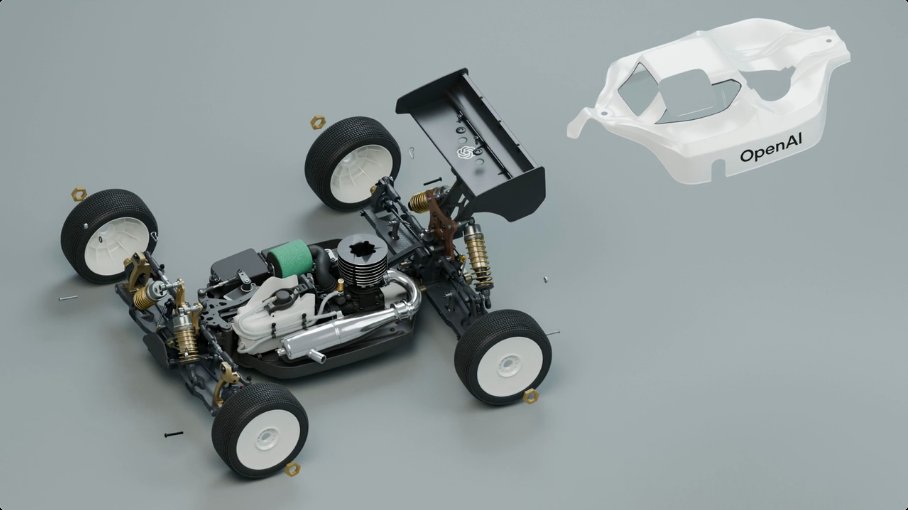
engineering AGI is here
GPT‑6.2 Astra can model a mechanical system part by part, giving engineers a way to show how it goes together and test how design changes affect its behavior.
"We asked GPT‑6.2 Astra to model a radio-controlled buggy and engine using public photos and build manuals. It modeled the individual components, created an animated assembly guide, and produced an illustrated parts catalog. This shows how Astra can accelerate physical engineering product development and documentation."
this deserves way more attention
Jeff Bezos says his engineering AI company, Prometheus, designed a Mars helicopter resembling NASA's from a single prompt, exploring multiple aircraft designs. This new AI can complete engineering work in 12 hours that would take 10-20 people 6 to 9 months 👀
Strong engineering AI will shock the world far more than people expect. This will be orders of magnitude bigger than Riemann hypothesis. Extremely practical. You'll literally ask AI to design any type complex machine, and it'll do it effortlessly.
This will be a crucial element of the economic singularity and start of double digit gdp growth.
Superintelligent AI will be able to design machines more complex than anything we have today, many of them will be built specifically to boost productivity.
We saw small peak from Astra 6.2 few days ago (link in comments). Jeff Bezos company is focused on developing a superintelligent AI engineer.
Just a few days ago people were protesting in San Francisco with slogans like "No AI in healthcare." Meanwhile, today, even small AI models can outperform some of the best doctors at diagnosing certain diseases.
I can understand the anger and fear of people who have recently lost their jobs to AI, especially those facing serious financial difficulties or struggling with debt.
But opposing better healthcare? Opposing AI that will dramatically increase the chances of correctly diagnosing and treating diseases?
Technology that will literally save billions of lives?
This I simply cannot understand. But like I said, anti AI voices are just noise
meanwhile medical AI is accelerating
New open weight model for healthcare, outperforms GPT-6 Astra, Claude Opus 5.5 and Gemini 4 Argon on many benchmarks.
Today, we release LingSante-3.1-flash, an open-weight MoE model with 560B total parameters and 25B activations per token. It unifies diverse medical capabilities while retaining general capabilities, including complex medical reasoning, long-horizon workflow execution, and professional behavior alignment.
LingSante-3.1-flash moves beyond medical QA toward real-world healthcare problem. The model leads on HealthBench Professional (65.72), HLE (text-only, with tools: 72.22) and BrowseComp (with context: 94.10), outperforming GPT-6 Astra, Claude Opus 5.5 and Gemini 4 Argon on all three. LingSante-3.1-flash also performs well on professional long-horizon medical workflows, such as PhysicianBench (57) and EHR-Complex (74.40).
Together, these results establish LingSante-3.1-flash as the leading open-weight models for healthcare.
The weights are available. Explore LingSante and build with it.
More below ↓