I STILL DON'T UNDERSTAND WHY PEOPLE RUN ONE AGENT FOR EVERYTHING
one bot doing content, growth, code and ops is not a company, it's a tired intern
here's the fix: one specialist per role, and they hand work to each other
CONTENT
- markitdown → https://t.co/Oehr1MhTpS
- humanizer → https://t.co/iNw5OwcGtI
- marketingskills → https://t.co/LmW64qlxrU
- claude-seo → https://t.co/rIFxFEZw6Q
GROWTH
- social-media-skills → https://t.co/JaKrK91e1V
- last30days-skill → https://t.co/8fkASEYyuX
- agent-reach → https://t.co/RvCjE8BUBy
BUILD
- superpowers → https://t.co/kfoUlDTNJd
- agent-skills → https://t.co/BImQEbzdvy
- taste-skill → https://t.co/UrMpZcaJLL
OPS / MEMORY
- notion mcp → official
- github-mcp-server → https://t.co/XjcSjpqvQz
- claude-mem → https://t.co/wh5VUVDt08
the setup is dumber than it looks:
1. pick the role you're missing
2. give it one harness: model + skills + tools + memory
3. point it at real context
4. let it hand off to the next bot
you don't need 35 tools
you need the right 6 for the roles you actually run
(save this, then build your first specialist)
Hermes Agent can now seamlessly browse as you.
Turn on real-profile browsing and your agent acts with your logins, from a managed copy of your existing Chrome profile.
🚨Si usas Obsidian, esto te va a gustar
Alguien desarrollo una herramienta llamada Vault Graph
Lo que hace es simple pero potente:
Te muestra todas tus notas en forma de un gran círculo
• Cada punto es una nota
• Cada porción del círculo es una carpeta
• Las notas más importantes (más conectadas) quedan en el centro
• Las menos conectadas quedan en el borde
Así puedes ver de un vistazo cómo está organizado todo tu conocimiento
También puedes:
- Filtrar carpetas
- Ver cómo ha crecido tu vault con el tiempo
- Explorar las conexiones entre notas
Funciona como plugin de Obsidian o como un archivo HTML que abres sin internet
Gratis y de código abierto (el repo está en los comentarios)
¿Te gustaría ver todo tu segundo cerebro en un solo círculo?
Andrej Karpathy called it a compiler, not a storage system, this diagram shows the architecture he described.
Most people who build a second brain treat it like a filing cabinet, they drop notes in, they search when needed, the library gets bigger over time but never smarter.
Compiled wiki works differently, raw holds the source materials, unstructured, immutable., ground truth. Wiki is where the model converts everything in raw into structured, linked, evergreen knowledge. The human reads it, the model writes it. Output is where finished work lands, built from compiled knowledge, not from memory.
At the center: CLAUDE.md. identity, preferences, goals, project context. The model reads it before every session - automatically, you never explain yourself again.
The loop closes through update, every new source gets ingested, compiled, linked, and integrated. The system improves with every cycle.
5 automations run the whole thing, ingest captures and extracts, write retrieves and drafts, manage links decisions to context, review summarizes and reflects.
System improves with every cycle, automatically. Retrieval answers questions, compilation builds understanding.
Read the article below. Build the compiler, not the cabinet.
300 agents without shared context is just parallelized confusion.
All 300 agents are useless if the research dies inside 300 separate documents.
the real unlock is what happens after the search.
in K3 graph-native setup:
300 agents
140 linked sources
100% traceable claims
9 contradictions surfaced
and every new source changes the graph.
now imagine that happening across 8��10 active research clusters at once.
instead of 300 isolated summaries, you get one shared structure:
source → entity → relationship → evidence → contradiction → verification
the math gets ugly fast.
100 entities = 4,950 possible pairwise relationships.
that’s why “just run more agents” stops being enough.
you need a graph that can keep track of what connects to what.
full breakdown in the article below.
grokbot it's an agent with its own identity, its own computer, and it stays on when you're not
here's what "active AI employee" actually looks like in the demo:
- chief of staff agent - checks in on your other agents, reads your calendar, dispatches tasks to the right one automatically
- shopping agent - logged into your accounts, books tickets, buys groceries, reports back
- marketing agent - signed into your actual linkedin, browses your past posts for tone, then writes and publishes a new one on its own
- engineering agents - self-triage bug reports, kick off cloud coding agents, come back with a pull request, a screenshot, and a video of the fix
the interface isn't a dashboard, it's a chat - same shape as texting a coworker, no tool calls to babysit
the number that matters more than any of the demos: grok 4.6 scored 70.8% on cursor bench at $2.81 a task, fable 5 max scored 70.5% at $17.32
same capability, 6x the cost difference - that's the unlock that makes running a fleet of these actually affordable instead of a novelty
If you are using Claude Code without repos.
You are missing 50% of what it can do.
These are saved skills and plugins the community has built. You can install one in about a minute.
1. Click any of the links below
2. Click on the green "Code" button
3. Copy the HTTPS to your clipboard
4. Paste it into your Claude Code
5. You're done and ready to go
That is why I built the GitHub Repo Vault. 278 of them, every one over 10,000 stars.
All 278 →https://t.co/YhLRwAtaHw
HARNESSES
ECC
→ https://t.co/FAgYcHg1FA 241k★
gstack
→ https://t.co/XPJ0gmpOIx 128k★
cc-switch
→ https://t.co/e6jyoKfOWa 128k★
awesome-design-md →https://t.co/EaETHGkW2Y 109k★
graphify
→ https://t.co/hgmIK0S8IZ 108k★
codex
→ https://t.co/JSIoxeFkV1 107k★
caveman
→ https://t.co/lBuhC8pXv2 99k★
claude-mem →https://t.co/emHpdPtiUO 91k★
open-design
→https://t.co/PlhqkUgb2P 89k★
agent-skills
→https://t.co/n3GAaErDOH 88k★
Understand-Anything
→ https://t.co/D7mJcB40iD 80k★
ruflo
→ https://t.co/Knn9vAUb9J 68k★
openinterpreter →https://t.co/Tq6vkl20Kf 68k★
oh-my-openagent
→ https://t.co/LddqIG7KUy 68k★
codegraph →https://t.co/yN40JXee4c 67k★
cline
→ https://t.co/OA8G8ncA8e 66k★
SKILLS
superpowers
→ https://t.co/tGNwFVYsEa 273k★
awesome-llm-apps →https://t.co/RYsM2eJpKq 133k★
ui-ux-pro-max-skill →https://t.co/54NvwKmBix 118k★
taste-skill
→ https://t.co/gFud3Sa93j 78k★
agentic-awesome-skills
→ https://t.co/zIOqRJWbLJ 45k★
LibreChat
→ https://t.co/GrrVx8PDD7 42k★
CONNECTORS
awesome-mcp-servers
→ https://t.co/Z7aEghGlGu 93k★
DESIGN AND VISUALS
dify
→ https://t.co/G8DgzDy0wu 153k★
hyperframes
→ https://t.co/ogS5d5ityj 41k★
UI-TARS-desktop →https://t.co/8cpVIH3op1 39k★
browser
→ https://t.co/r6g0IoLVBZ 34k★
TOOLS AND APPS
hermes-agent
→ https://t.co/y38qHloF92 232k★
markitdown
→ https://t.co/ZyoMWfvgf8 174k★
agency-agents
→ https://t.co/9XD1C4BsmQ 146k★
spec-kit
→ https://t.co/g2lFZ5NbnV 130k★
ponytail
→https://t.co/GkDDlMYz1d 105k★
OpenCut
→ https://t.co/9YLKSKYHCt 84k★
rtk
→ https://t.co/OEZKrzYVdP 76k★
PROMPTS
https://t.co/mAwEjtfKZG
→ https://t.co/FC2Bm1JK2h 167k★
dspy
→ https://t.co/bFh9jssCeW 37k★
AND MINE, nowhere near the top on stars.
social-media-skills
→ https://t.co/ZwNtoUTdVm
ai-second-brain
→ https://t.co/josFKhKNDu
agent-harness-starter
→ https://t.co/OqaByFN8CN
show-me
→ https://t.co/d6LvKwesIa
life-automation-skills
→ https://t.co/C4RkHaKmTY
exposure-audit
→ https://t.co/wdsd1Z8lXI
Repost ♻️ to help someone in your network.
P.S. Which one are you installing first?
Obsidian became a neural network - 150 notes, 300 links, one vault, zero folders, and I haven't opened Notion in months.
Every night at 2 AM, Claude Code walks the whole vault, reads every note, embeds them, and hunts for the pairs that should be linked but never were. Last night it found 10000 and I kept every one.
That's the move nobody makes by hand. 150 notes is millions of possible pairs. A human links maybe four a day. The agent links 10000 while I sleep.
Capture takes two seconds - a voice memo lands as a linked note on its own. Friction is what kills a second brain, so I deleted the friction.
Yesterday it surfaced a note I'd forgotten, 10 days old. That one became a product I shipped two days later.
Plain .md files on a laptop. No cloud, no subscription, no company that can delete my brain on a Tuesday.
The graph doesn't store what I know. It stores what I'd never have connected alone.
HERMES AGENT CAN SHARE MEMORY
WITH CODEX AND CLAUDE CODE THROUGH HINDSIGHT.
ONE MEMORY BANK. ONE AGENT REMEMBERS,
EVERY OTHER AGENT KNOWS.
the problem: you use Hermes for orchestration.
Codex for coding. Claude Code for debugging.
each has its own memory. switch between them
and you explain the same project three times.
Hindsight fixes this. one shared memory bank
that every agent reads and writes to.
tell Codex: "the test color for this project is purple."
switch to Hermes. ask: "what test color did I pick?"
Hermes answers: "purple."
no copy-paste. no re-explaining. instant recall.
HOW IT WORKS:
Hindsight runs as a Docker container on your machine.
self-hosted. your data stays local.
an LLM powers the memory processing
(retain, recall, reflect).
RETAIN: extracts facts from your conversations.
entities, decisions, preferences, project context.
saved to the memory bank automatically.
RECALL: when you ask a question, Hindsight pulls
from semantic search, keywords, graph connections,
and temporal data. fused into one answer.
REFLECT: deeper reasoning layer. connects memories
across sessions. identifies patterns in your work.
produces observations that get smarter over time.
CONNECT TO HERMES:
Desktop app: Settings → Memory and Context
→ switch provider from Namosin to Hindsight.
set API URL to your local Docker container.
set bank ID. done.
CLI: hermes memory setup → select Hindsight.
verify: hermes memory status
should show: provider: hindsight, installed, available.
CONNECT TO CODEX:
npx hindsight-coding-agents install codex \
--self-hosted --server http://localhost:999
this installs lifecycle hooks:
initialize memory on session start.
recall context during work.
retain the session when done.
enable hooks in Codex: Settings → Hooks → trust all three.
CONNECT TO CLAUDE CODE (same command):
npx hindsight-coding-agents install all
"all" connects every detected agent on your machine.
Claude Code, Codex, Cursor, and others.
one command. every agent shares the same bank.
TAGS FOR FILTERING:
every memory gets tagged by harness (Hermes, Codex, Claude Code)
and optionally by project name.
in the Hindsight control plane: filter by harness.
see only Hermes memories. or only Codex memories.
or search across everything.
soft partitions inside one bank.
not hard walls. cross-reference when you need to.
ONE BANK OR MANY:
one global bank: solo dev, related projects.
all agents share everything. patterns emerge across projects.
per-project banks: unrelated codebases.
each project gets its own memory.
no cross-contamination.
your call. start with one. split when projects diverge.
KNOWLEDGE PAGES (v0.9.0):
Hindsight auto-generates living summaries
from your accumulated memories.
components, concepts, conventions, decisions.
not static docs. projected from real agent conversations.
auto-refresh as new memories land.
WHAT TO KNOW:
self-hosted via Docker. your data never leaves your machine.
backup system built in (admin CLI + scheduled exports).
works with any LLM (local Ollama, OpenAI, Codex subscription).
memory defense: redact or block sensitive content automatically.
33,000+ memories accumulated in ~10 days of normal use.
ANTHROPIC LEAKED A SETUP WHERE 6 FILES CUT TOKENS BY 84% AND RAISE ACCURACY BY 39%
engineers at Google and Microsoft have been running this for a while - they pay $3 where you pay $20.
decisions → contracts → dead ends → state → sources → open questions
memory moves outside the window - what enters the context is a pointer to a file, not the history.
raw history refills the window to 200k every single turn - six pointers take 8k and leave 96% free.
same work, same five turns: 1,000,000 tokens against 40,000.
decisions written to a file kill the endless "wait, why did we do it this way".
written dead ends kill the second lap around the same circle - the agent never walks in there twice.
a stable prefix keeps the cache warm - a cache read costs 0.1x of normal input.
that's why 20 turns cost 3.15x instead of 20x - one write and nineteen reads.
save this and paste it into Claude Code - and your agent stops paying for what it already knew ↓
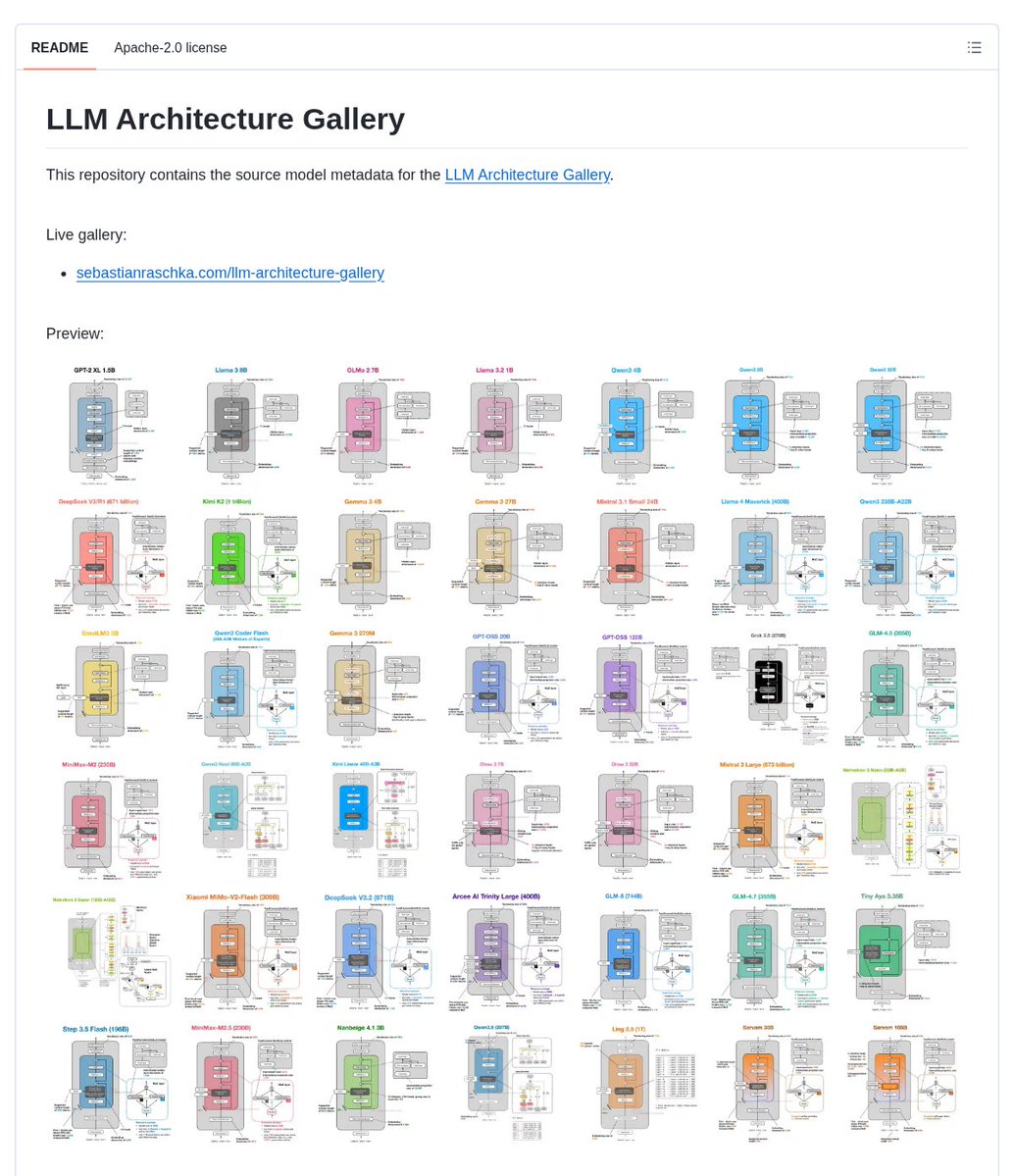
Need a lightweight public reference for LLM model architecture metadata without shipping an entire website implementation?
LLM Architecture Gallery is a repository containing source model metadata for the LLM Architecture Gallery.
It organizes per-model metadata in models.yml for gallery cards and publishes the repository as a lightweight public data export rather than the full website implementation.
Key features:
• Uses models.yml as the per-model metadata source for gallery cards.
• Includes image paths for each model entry.
• Records dates in the model metadata.
• Provides fact-sheet fields for model entries.
• Stores related links alongside each model's metadata.
Link in the reply 👇
We gave our AI agents for logistics an agentic search and memory retrieval graph so now they autonomously learn new skills and capabilities.
A major step toward a fully autonomous global supply chain where all the repetitive, error prone work is carried out by super intelligence AI agent swarms.
NO ONE IS RUNNING THIS - BIG MISTAKE
reverse prompting. you stop giving your agent orders and let it ask you questions instead.
ChatGPT 5.6, Fable and Grok 4.5 already know more about what's possible in your work than you've had time to find out. so let it lead.
open any of them, connect OpenClaw or Hermes, whatever agent you run. brain dump your work and your goals into it. messy is fine.
then paste this:
> "Based on what you know about me and my goals, what else do you need from me so you can move faster and take more of this off my hands?"
answer what it asks for. then paste this:
> "What can you start doing for me right now that gets us closer to those goals?"
that's the whole thing.
you'll walk out with more jobs to hand over than you'd have thought of on your own in a month.
you don't prompt. you hand it context and let it walk you somewhere you weren't looking.
save this prompts and read full article about AI agents revoluiton framework below.
if you still haven't run an agent in 2026, you're behind.
Don't waste 2 years learning to build LLMs like Claude & ChatGPT.
Andrew Ng, the godfather of AI, gave the complete playbook to become an AI agentic engineer in 2026.
• 00:00 - AI agent basics
• 12:12 - AI Agentic workflows & design patterns
• 53:27 - Practical tips for building AI agents
• 1:20:30 - self-improving AI agent loops
• 1:30:19 - multi-agent AI systems
Anthropic pays $750,000/year to engineers who understand the this exact knowledge of LLMs.
Bookmark this & give 2 hours today, no matter what. Then read the article below.
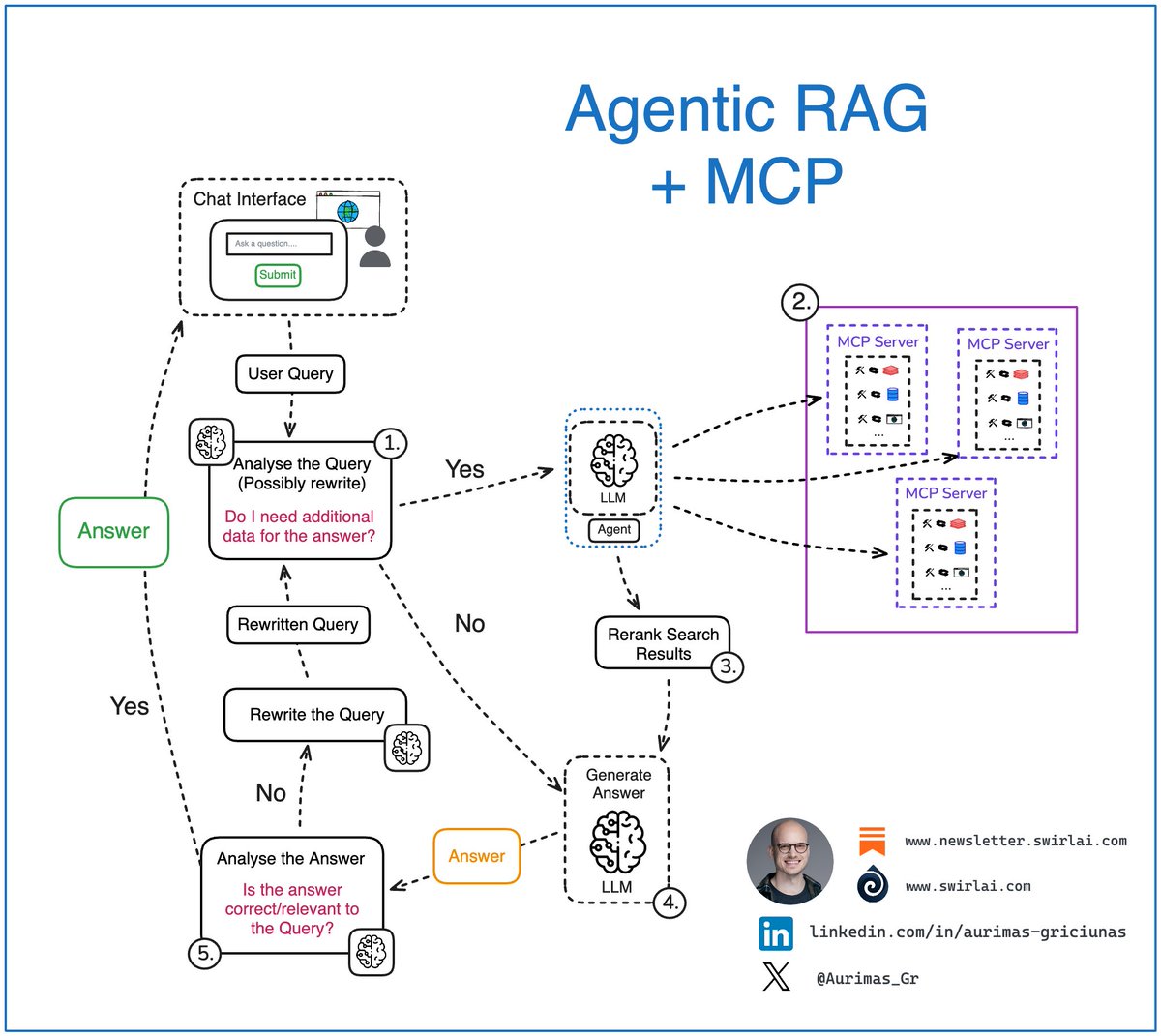
Integrating 𝗔𝗴𝗲𝗻𝘁𝗶𝗰 𝗥𝗔𝗚 Systems via 𝗠𝗖𝗣 👇
If you are building RAG systems and packing many data sources for retrieval, most likely there is some agency present at least at the data source selection for retrieval stage.
This is how MCP enriches the evolution of your Agentic RAG systems in such case (𝘱𝘰𝘪𝘯𝘵 2.):
𝟭. Analysis of the user query: we pass the original user query to a LLM based Agent for analysis. This is where:
➡️ The original query can be rewritten, sometimes multiple times to create either a single or multiple queries to be passed down the pipeline.
➡️ The agent decides if additional data sources are required to answer the query.
𝟮. If additional data is required, the Retrieval step is triggered. We could tap into variety of data types, few examples:
➡️ Real time user data.
➡️ Internal documents that a user might be interested in.
➡️ Data available on the web.
➡️ …
𝗧𝗵𝗶𝘀 𝗶𝘀 𝘄𝗵𝗲𝗿𝗲 𝗠𝗖𝗣 𝗰𝗼𝗺𝗲𝘀 𝗶𝗻:
✅ Each data domain can manage their own MCP Servers. Exposing specific rules of how the data should be used.
✅ Security and compliance can be ensured on the Servel level for each domain.
✅ New data domains can be easily added to the MCP server pool in a standardised way with no Agent rewrite needed enabling decoupled evolution of the system in terms of 𝗣𝗿𝗼𝗰𝗲𝗱𝘂𝗿𝗮𝗹, 𝗘𝗽𝗶𝘀𝗼𝗱𝗶𝗰 𝗮𝗻𝗱 𝗦𝗲𝗺𝗮𝗻𝘁𝗶𝗰 𝗠𝗲𝗺𝗼𝗿𝘆.
✅ Platform builders can expose their data in a standardised way to external consumers. Enabling easy access to data on the web.
✅ AI Engineers can continue to focus on the topology of the Agent.
𝟯. Retrieved data is consolidated and Reranked by a more powerful model compared to regular embedder. Data points are significantly narrowed down.
𝟰. If there is no need for additional data, we try to compose the answer (or multiple answers or a set of actions) straight via an LLM.
𝟱. The answer gets analyzed, summarized and evaluated for correctness and relevance:
➡️ If the Agent decides that the answer is good enough, it gets returned to the user.
➡️ If the Agent decides that the answer needs improvement, we try to rewrite the user query and repeat the generation loop.
Are you using MCP in your Agentic RAG systems? Let me know about your experience in the comment section 👇
MEMORY ENGINEERING IS THE MOST OVERLOOKED PART OF AGENTIC AI SYSTEMS
Most teams obsess over the context window
Almost no one designs the memory layer properly
Memory Engineering is what decides:
> What gets written
> Where it is stored
> How it is retrieved
> How it stays accurate over time
Without a clear write policy, systems store too much, trust everything equally, and never expire anything. Signal-to-noise collapses. Retrieval quality dies
A solid memory system needs four things:
1\ Write policy (what, when, in what form, with what confidence)
2\ Correct storage backends for different memory types
3\ Hierarchical retrieval (working memory first → semantic search → trust/recency filters)
4\ Active maintenance (TTL, confidence decay, deduplication, compression)
Context engineering decides what the model sees right now
Memory engineering decides what the system still knows next week
Bookmark this, then read the article below
ANTHROPIC ENGINEER JUST LANDED A HUGE INVESTMENT FOR A MEMORY SYSTEM THAT NEVER FORGETS
Most agents wake up blank every session, forgetting everything the moment the conversation ends.
He built a scoring layer instead, one that decides what actually matters past this session and what gets dropped.
Contradictions between old and new memory get flagged automatically, never silently overwritten the way most systems do.
Memory that never gets touched again quietly decays on its own, so nothing bloats the system with dead weight.
Nobody outside the deal knew what the scoring layer actually did before the check cleared.
See how the scoring layer actually decides what survives below👇