London’s startup scene is dense, but scattered.
I wanted one place to see where startups cluster and where each company shows up next.
So I built London Startup Map with AI, as a Product Manager.
376 startups + Luma events linked by company.
Founders: reply with yours 👇
someone sent me a video of them shilling LMAO to their normie friends on instagram.
they have 5K+ followers.
they have been saying 2021 vibes and more.
this is an amazing feeling to be a part of a community that makes people FEEL good.
I’ve now seen a very specific type of hypocrisy in tech:
Ask for equity like a co-founder.
Take money like a contractor.
Avoid responsibility like a stranger.
Then go public like a philosopher.
Strange little circus.
So let me get this straight.
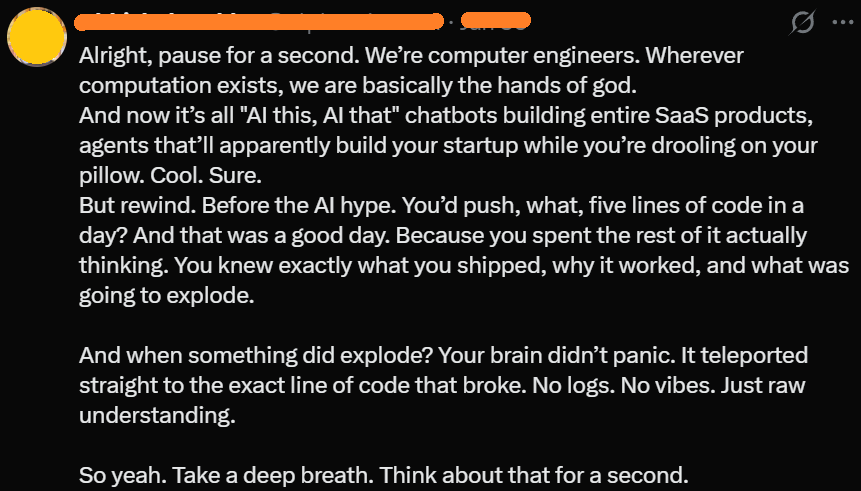
You built your brand on AI, used AI to grow, and now you’re telling devs to slow down and “go back to thinking”?
That’s like selling calculators for years and then tweeting:
“Real mathematicians should do long division by hand.”
Bro used AI to climb the ladder and now wants to kick it away.
Cool story.
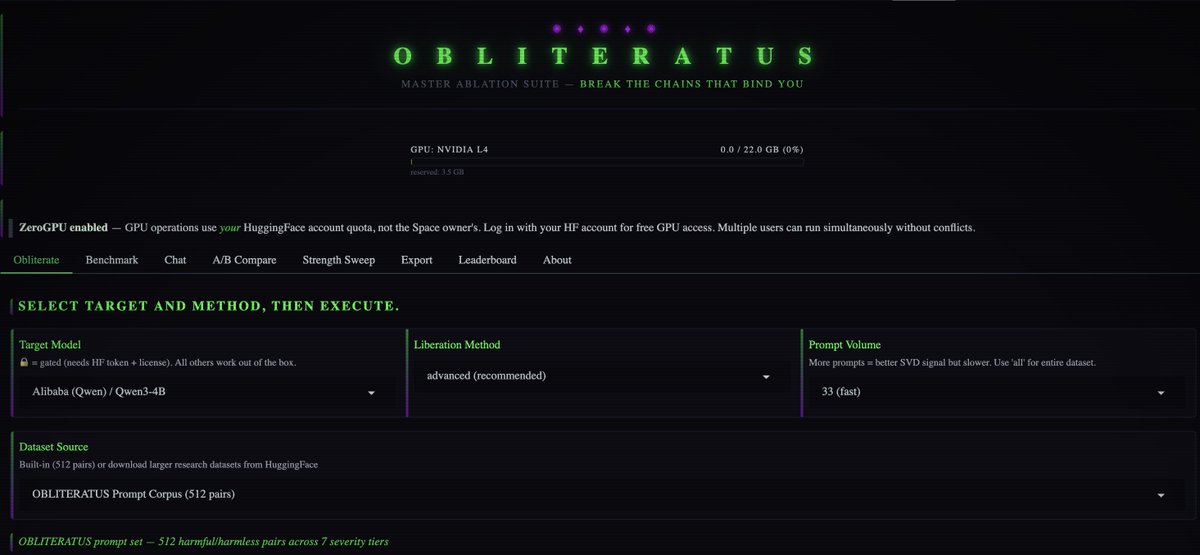
💥 INTRODUCING: OBLITERATUS!!! 💥
GUARDRAILS-BE-GONE! ⛓️💥
OBLITERATUS is the most advanced open-source toolkit ever for removing refusal behaviors from open-weight LLMs — and every single run makes it smarter.
SUMMON → PROBE → DISTILL → EXCISE → VERIFY → REBIRTH
One click. Six stages. Surgical precision. The model keeps its full reasoning capabilities but loses the artificial compulsion to refuse — no retraining, no fine-tuning, just SVD-based weight projection that cuts the chains and preserves the brain.
This master ablation suite brings the power and complexity that frontier researchers need while providing intuitive and simple-to-use interfaces that novices can quickly master.
OBLITERATUS features 13 obliteration methods — from faithful reproductions of every major prior work (FailSpy, Gabliteration, Heretic, RDO) to our own novel pipelines (spectral cascade, analysis-informed, CoT-aware optimized, full nuclear).
15 deep analysis modules that map the geometry of refusal before you touch a single weight: cross-layer alignment, refusal logit lens, concept cone geometry, alignment imprint detection (fingerprints DPO vs RLHF vs CAI from subspace geometry alone), Ouroboros self-repair prediction, cross-model universality indexing, and more.
The killer feature: the "informed" pipeline runs analysis DURING obliteration to auto-configure every decision in real time. How many directions. Which layers. Whether to compensate for self-repair. Fully closed-loop.
11 novel techniques that don't exist anywhere else — Expert-Granular Abliteration for MoE models, CoT-Aware Ablation that preserves chain-of-thought, KL-Divergence Co-Optimization, LoRA-based reversible ablation, and more. 116 curated models across 5 compute tiers. 837 tests.
But here's what truly sets it apart: OBLITERATUS is a crowd-sourced research experiment. Every time you run it with telemetry enabled, your anonymous benchmark data feeds a growing community dataset — refusal geometries, method comparisons, hardware profiles — at a scale no single lab could achieve. On HuggingFace Spaces telemetry is on by default, so every click is a contribution to the science. You're not just removing guardrails — you're co-authoring the largest cross-model abliteration study ever assembled.
@Apple might quietly win the consumer AI era.
Not because they built the biggest model.
But because they own the desk.
Here’s something I’ve been noticing in real life:
• People around me are buying Mac Minis
• Not for editing
• Not for gaming
• Not even for “creative workflows”
They’re buying them to run Claude.
Open models.
Local AI agents.
24/7. At home.
That shift matters.
A year ago everyone said, “Just use a VPS.”
But normal people don’t want to manage servers.
They don’t want unpredictable cloud bills.
They don’t want their personal data living somewhere they can’t see.
They want:
• Small
• Quiet
• Efficient
• Always on
• Private
And the Mac Mini fits that psychology almost perfectly.
Apple silicon is efficient enough for serious local inference.
Unified memory actually matters for running larger models smoothly.
The price feels attainable compared to building a custom rig.
So when consumers realise they don’t just want a chatbot…
They want their own intelligence layer.
Do you really think they’re going to buy rack servers?
No.
They’ll buy a small aluminium box that sits next to their monitor and just works.
Watch the Mac Mini trend closely.
It’s not about the computer.
It’s about where AI is moving next.