SINNING IS SO EXPENSIVE
Sin will always cost you more than you ever planned to pay, take you further than you ever planned to go, and keep you longer than you ever planned to stay. The devil never shows you the full price tag — he just shows you the pleasure, the excitement, the momentary satisfaction. But when the dust settles, you begin to realize how expensive sin truly is.
Sin steals your peace. It drains your joy. It robs you of confidence in prayer. It disconnects you from the presence of God — and nothing is more costly than that. David said in Psalm 51, “Do not take Your Holy Spirit from me.” He knew the pain of losing intimacy with God after sinning. He realized the throne, the crown, the fame meant nothing if God’s presence was far.
You may think no one saw what you did. You may hide it from people, but you can’t hide it from your spirit. Sin leaves stains in your soul that no amount of pretending can wash away — only repentance can. You start feeling heavy, distant, and spiritually dry because sin creates separation between you and the One who gives life.
Look at Adam — one act of disobedience cost him Eden.
Look at Samson — one moment of pleasure cost him his strength, sight, and destiny.
Look at Judas — one deal of silver cost him peace and his life.
Sin promises freedom but delivers bondage. It whispers “it’s not a big deal,” but later you find yourself battling guilt, shame, and spiritual emptiness. The devil knows once you lose your fire, once you start compromising, you become weak. That’s why sin is not just dangerous — it’s expensive.
But here’s the beauty of grace: God can still forgive, restore, and rebuild you. The blood of Jesus is the only currency that can pay for sin’s price. That’s why you must never stay down. The enemy wants you to drown in guilt, but God wants you to rise in repentance.
So the next time sin knocks on your door, remember — it’s not free. It costs purity. It costs destiny. It costs peace. Choose obedience. Choose holiness. Choose Jesus. Because whatever sin offers, it’s never worth what it takes away.
@TevinMacharia I love this I was so disappointed those few days you immersed yourself in Chivhayo matters. I really felt you were diverging from your calling but am glad you are back to your true purpose
God will literally sit you down and break you to humble you, then will isolate you to build you. Then give you back everything 10x to prove to you He’s real and everything is for a reason. Dear son, Keep your trust in Him.
Child of God, spiritual laziness is not harmless — it’s an enemy strategy to drain your power quietly. Don’t negotiate with it. Fight back today with action, not emotion. If you move toward God even one step, He’ll run toward you with revival in His hands.
Today I was reminded of a story in 2 Chronicles 20 that teaches us something powerful about what happens when we remind God of His promises.
Jehoshaphat was the king of Judah when terrible news came.
A great army was coming against him.
The Moabites, Ammonites and others had joined together to fight Judah. The Bible says Jehoshaphat was afraid.
And I love the next thing he did.
He decided to seek the Lord.
He called the entire nation to fast and pray.
Then Jehoshaphat stood before God and began reminding Him of His promises.
“God, are You not the God of our fathers?”
“Did You not give us this land?”
“Did You not promise that when trouble comes and we cry to You, You would hear us and save us?”
Then he looked at the situation and admitted:
“We do not know what to do, but our eyes are on You.”
What happens when you remind God of His promises?
God responds.
The Spirit of the Lord came upon Jahaziel, and he gave them a word:
“Do not be afraid or discouraged because of this vast army. For the battle is not yours, but God's.”
Imagine that.
They came to God saying, “We don't know what to do.”
And God answered, essentially, “You don't have to know. This battle belongs to Me.”
The next morning, they went out to face the enemy.
But Jehoshaphat did something unusual.
Instead of putting the strongest soldiers in front, he appointed people to praise God.
They began singing:
“Give thanks to the Lord, for His mercy and loving kindness endure forever.”
And as they praised, God began fighting the battle for them.
The enemies turned against each other.
By the time Judah arrived, their enemies were already defeated.
They didn't win because they had the biggest army.
They won because they remembered who their God was, remembered what He had promised, prayed, trusted Him, and obeyed His instruction.
And there is something beautiful at the end.
The place where they expected to find a battlefield became a place of blessing.
They spent three days collecting the spoils because there was so much.
They went into the battle afraid.
They came out carrying blessings.
That is what happens when we bring God's promises back before Him.
Not because God has forgotten.
But because His promises give us something to stand on when circumstances are telling us the opposite.
Sometimes your situation says, “It's over.”
God's promise says, “I am with you.”
Your situation says, “You cannot make it.”
God's promise says, “I will never leave you.”
Your situation says, “There is no way.”
God says, “Trust Me.”
So when you don't know what to do, do what Jehoshaphat did.
Seek God. Remind Him of His promises. Keep your eyes on Him. Pray. Praise. And obey.
Because sometimes the battle you are worrying about has already been handed over to God.
And the same place where you expected defeat may become the place where you collect your testimony.
“We do not know what to do, but our eyes are on You.”
That is the kind of faith I want to have always.
What did you learn today?
The Bible says, “After you have suffered for a little while, the God of all grace… will restore you.” — 1 Peter 5:10
This pain has an expiration date.
This season has an ending.
Restoration is coming!
GOD SAYS: I SAW WHAT THEY DID
I saw the betrayal you didn't deserve.
I saw the lies that were spoken about you.
I saw the way you were treated... like you didn't matter.
And I did not ignore it.
Nothing you went through was unseen.
Nothing you felt was dismissed.
You stayed quiet... but I was not silent.
I am stepping in.
What was hidden will be revealed.
What was done in secret will come to light.
And what hurt you... will not go unanswered.
I will restore your peace.
I will defend your name.
I will make things right.
You will not have to fight this battle.
I've already gone ahead of you.
Stay still.
I am handling it.
Exodus 14:14
The monk who jumped into the arena
Rome. Around AD 404.
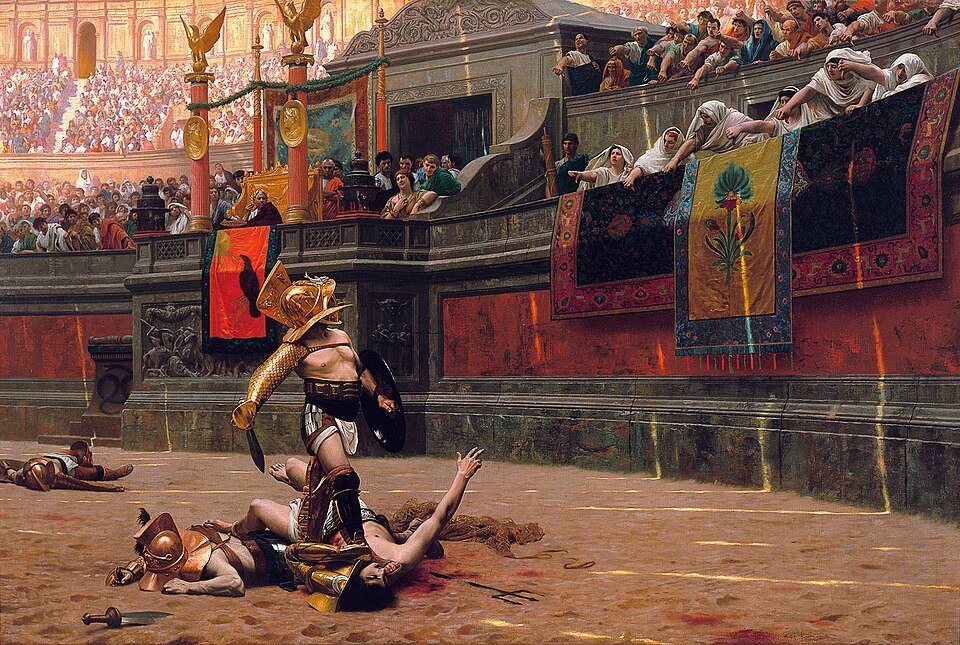
The Colosseum was packed, and the gladiators were fighting to the death while the crowd roared for more.
Then a stranger climbed down into the arena.
His name was Telemachus, a monk who had traveled from the East. He walked straight between the fighters and tried to pull them apart, begging them to stop.
The crowd was furious; he was ruining their entertainment. They hurled stones down at him until he lay dead in the sand.
According to the historian Theodoret, when Emperor Honorius heard what had happened, he banned gladiatorial games.
Historians debate exactly how quickly the games disappeared, since they were already declining under Christian emperors. But ancient writers remembered Telemachus as the man whose death ended them.
For centuries, Rome had watched men die for sport. It took one man dying for the opposite reason to make them see it.
He didn't have an army or a political office. He had no plan beyond walking in and saying "stop."
Some evils don't end with arguments. They end when someone is willing to step into the arena.
God’s Name(s) -Learn Them - Use them in your prayers.
Each name reveals a different facet of God’s nature—His self-existence, power, provision, healing, protection, peace, righteousness, and authority. In Scripture, God’s name is treated with reverence, as in Exodus 20:7, which commands not to take His name in vain. Invoking His name is seen as a call to His presence, power, and protection.
1. YHWH (Yahweh/Jehovah)
The most sacred name in the Old Testament, meaning “I Am” or “I Will Be”. It comes from the Hebrew verb to be, emphasizing God’s eternal, self-existent nature. In Exodus 3:14, God reveals Himself to Moses as “I AM WHO I AM”, highlighting His unchanging and eternal presence
2. Elohim
A plural form meaning “God” or “The Creator”, used in Genesis 1:1. It highlights God’s majesty, power, and sovereignty over creation
3. Adonai
Meaning “Lord” or “Master”, it expresses God’s supreme authority. Often used alongside YHWH to denote His lordship, as in Psalm 8:1.
4. El Shaddai
Translates to “God Almighty” or “The All-Sufficient One”. First revealed to Abraham in Genesis 17:1, it conveys God’s overwhelming power and ability to fulfill promises.
5. Jehovah Jireh
Meaning “The LORD Will Provide”, revealed in Genesis 22:14 when God provided a ram for Isaac. It points to God as the ultimate provider.
6. Jehovah Rapha
Meaning “The LORD Who Heals”, from Exodus 15:26, showing God’s power to restore and heal.
7. Jehovah Nissi
Meaning “The LORD Is My Banner”, from Exodus 17:15, symbolizing God’s protection and leadership.
8. Jehovah Shalom
Meaning “The LORD Is Peace”, from Judges 6:24, emphasizing God as the source of peace.
9. Jehovah Tsidkenu
Meaning “The LORD Our Righteousness”, from Jeremiah 23:6, pointing to God as the source of righteousness through the Messiah.
10. Jehovah Sabaoth
Meaning “The LORD of Hosts”, from Exodus 17:15, depicting God as the commander of heavenly armies.
11. The Name of Jesus
In the New Testament, Jesus’ name is given the highest honor—“the name above every name” (Philippians 2:9). It signifies His authority, salvation, and the ultimate revelation of God’s character.
Your Name is Power, Your Name is Healing, Your Name is Life.
#TheKingIsComing
What if the chapter you thought was about romance was actually written to confront a church?
1 Corinthians 13 wasn’t given to people who had everything together.
It was given to believers who were divided, proud, competitive, and gifted—but struggling to love.
And that makes the chapter uncomfortable.
You can have gifts without love.
Knowledge without love.
Faith without love.
Even sacrifice without love.
Paul’s message cuts through all of it:
If CHRIST is not shaping how you treat people, something is missing.
The goal isn’t merely to know 1 Corinthians 13.
It’s to become the kind of person who looks like JESUS. ✝️🔥
ONE CHAPTER: 1 CORINTHIANS 13
You've almost certainly heard this chapter at a wedding.
But Paul didn't write it for a wedding. He wrote it to a church that was tearing itself apart.
Read it that way, and it stops being a poem about romance. It becomes a mirror, and not a flattering one.
THE SETTING
Paul wrote to the church in Corinth around AD 54 or 55, from Ephesus. He had planted this church himself, and it had become a mess.
Corinth was a wealthy, proud port city. The church reflected it. Members were splitting into factions behind favorite leaders. Some were suing each other in pagan courts. They tolerated open sexual immorality and were proud of it. At the Lord's Supper, the rich ate first while the poor went hungry.
And they were fascinated with spiritual gifts, especially speaking in tongues, which they treated as a mark of status.
Chapter 12 explains that the church is one body with many parts. Chapter 14 corrects their chaotic worship. Chapter 13 sits between them, and it is the heart of Paul's answer.
One note: the King James Version translates the Greek word agapē as "charity." It means love, the self-giving love of God. I'll use "love" throughout.
THE CHAPTER IN FOUR MOVEMENTS
1. Without love, nothing (vv. 1–3)
"Though I speak with the tongues of men and of angels, and have not charity, I am become as sounding brass, or a tinkling cymbal."
Corinth was famous for its bronze. Pagan temples in the region used gongs and cymbals in worship. Paul's readers would have heard that noise every day.
His point is blunt. The gift you're proudest of, without love, is just noise.
Then he raises the stakes. Prophecy, all knowledge, faith that moves mountains, giving away everything you own, even giving up your body. Without love, it all adds up to nothing. Not "less." Nothing.
2. What love does (vv. 4–7)
Paul gives fifteen descriptions of love. In Greek, nearly all of them are verbs. Love isn't a feeling Paul defines. It's something you watch in action.
Love "suffereth long." The word means long-tempered, slow to boil over.
It "envieth not." It "vaunteth not itself, is not puffed up."
It "seeketh not her own." It "is not easily provoked."
It "thinketh no evil." The Greek word is an accounting term. Love doesn't keep a ledger of wrongs.
It "beareth all things." The word carries the idea of covering, like a roof covers a house. Love protects.
It "believeth all things, hopeth all things, endureth all things." That doesn't mean love is naive. It means love doesn't give up on people.
3. Love never ends (vv. 8–12)
"Charity never faileth."
Prophecies will cease. Tongues will stop. Knowledge will pass away. Paul isn't dismissing the gifts. He's saying they're temporary tools for a temporary age.
He uses two pictures. The first is a child growing up. "When I was a child, I spake as a child... but when I became a man, I put away childish things." The gifts the Corinthians were so proud of belong to the church's childhood.
The second is a mirror. "For now we see through a glass, darkly; but then face to face."
Corinth was known for its bronze mirrors, which gave a dim, imperfect reflection. The Greek word translated "darkly" is where we get the word "enigma." Right now we see God as if in a riddle. One day we'll see Him face to face.
4. The greatest (v. 13)
"And now abideth faith, hope, charity, these three; but the greatest of these is charity."
Why is love the greatest?
Think about heaven. Faith will become sight; you won't need to believe in what you can see. Hope will be fulfilled; you won't need to hope for what you already have.
But love will never be finished. It is the one thing from this life that goes all the way into eternity, because God Himself is love (1 John 4:8).
WHAT MOST PEOPLE MISS
Every line in verses 4 to 7 points straight at a sin the Corinthians were committing.
"Envieth not": Paul had already told them there was "envying, and strife" among them (3:3).
"Is not puffed up": he had already said, "some are puffed up" (4:18), and used the same word again and again in this letter.
"Rejoiceth not in iniquity": they were proud while tolerating sexual immorality in the church (5:2).
"Suffereth long" and "thinketh no evil": they were dragging each other into court (6:1–7).
"Seeketh not her own": at the Lord's Supper, each one rushed to eat his own meal while others went hungry (11:21).
"Doth not behave itself unseemly": their worship was disorderly (chapter 14).
This chapter isn't a description of the Corinthians. It's a description of everything they weren't.
That's why it hits so hard. Paul was holding up a portrait and asking them to compare.
THE HARD VERSE
"But when that which is perfect is come, then that which is in part shall be done away." (v. 10)
This verse sits at the center of a long debate. Have the miraculous gifts, like tongues and prophecy, ceased?
Some Christians have argued that "that which is perfect" means the completed New Testament. Once Scripture was finished, the partial gifts were no longer needed.
Most scholars, including many who believe the miraculous gifts have ceased, read it differently. Look at verse 12: "then face to face... then shall I know even as also I am known." That describes the return of Christ and the fullness of eternity, not the closing of the canon. We don't yet know God the way He knows us.
So where does that leave the debate? Believers on both sides usually settle the question of the gifts from other passages, not from this verse alone.
But don't miss Paul's actual point. He isn't trying to settle a theological argument about gifts. He's telling a church obsessed with gifts that the gifts are temporary, and love is permanent. Whatever side you take, if you're fighting about the gifts without love, you've missed the chapter.
WHAT THIS MEANS FOR YOU
Try this. Read verses 4 to 7 and replace the word "love" with "Jesus."
Jesus suffers long and is kind. Jesus envies not. Jesus seeks not His own. Jesus keeps no record of wrongs. Jesus bears all things.
It fits perfectly. This chapter is a portrait of Christ.
Now replace "love" with your own name.
That's harder. Most of us can't get past the first line without wincing.
But that's the point. This chapter shows you what you're not, so you'll run to the One who is. You can't produce this love by trying harder. It's the fruit of the Spirit (Galatians 5:22), grown in you by staying close to Christ.
If you're gifted, talented, or knowledgeable, ask yourself honestly whether there's love behind it. Without love, it's noise.
If you're keeping a ledger on someone, a spouse, a parent, a friend, a church, verse 5 asks you to close the books.
And if you're frustrated that you see God dimly right now, that prayer feels like a riddle and faith like a cloudy mirror, take heart. It won't always be this way.
One day, face to face.
And the love you practice now is the only thing you'll carry all the way there.
Which line of 1 Corinthians 13 convicts you the most?