298 children died from flu last season. You simply can’t say you care about kids, while dismissing these numbers, and the fact that almost all of them were unvaccinated/ their deaths were preventable. 😞
The public thinks preparedness is waste, because success looks like inactivity. The fire truck polished in the station house is called civilization. The missile buried in a Midwestern silo is called deterrence. Yet a WHO lab sitting quiet, a CDC epidemiologist waiting for an outbreak, or stockpiled PPE, suddenly is “bureaucratic excess.”
That is the idiocy of modern politics: we praise insurance in war, fire, and finance — but mock it in public health because the catastrophe did not happen this week.
Pandemics are not prevented by improvisation. They are prevented by long stretches of expensive boredom interrupted by moments of terror.
Cutting basic science and cutting preparedness means we will try to offload our problem on Kenya and volunteers at airports. That isn't a strategy, that is a bandaid for a gunshot wound
RFK is no better at psychiatric medications than he is about vaccines.
RFK's "overmedicalization crisis" thread is a master class in using true-ish numbers to imply a false conclusion. Let's go through it. 🧵
/1
Sharing this 🧵 for COVID cautious folks.
TLDR: I was denied entrance into @BrowardHealth for a doctor’s appointment by a group of 5 hospital personnel, including the hospital’s public safety director, for refusing to take my mask off for a biometric photo.
@gadboit2@drterrysimpson "infants of mothers who received an additional booster dose for COVID-19 were 56.0% less likely to acquire the infection in the first 6 months as compared to those whose mothers did not receive a booster (32)."
The head of infectious disease who ran the study can say whatever he wants in a documentary. It doesn’t change what’s in the study itself.
Zero ADHD cases among 2,000 unvaccinated children. National prevalence is 11%. That’s statistically implausible unless these conditions went undiagnosed in kids who rarely saw doctors. And that’s exactly what happened: vaccinated children averaged 7 healthcare visits per year, unvaccinated children averaged 2. You can’t diagnose ADHD, learning disorders, or developmental delays in children who aren’t being evaluated.
Half the unvaccinated children were tracked only to 15 months of age. Three-quarters dropped out before age 3. But ADHD is typically diagnosed around age 6-7. Autism around age 4. Learning disorders after kids enter school. As Penn biostatistics chair Jeffrey Morris writes: “When one group is watched longer and into the ages when problems are usually found, they will almost always look sicker on paper, even if the real risks are the same.”
The authors tried sensitivity analyses to correct for this. Restricting to 5+ years of follow-up actually increased the apparent risk, because far fewer unvaccinated children remained in the analysis. The bias got worse, not better.
The study claims a 6-8 fold increase in ear infections. There’s no biological mechanism by which vaccines cause ear infections. But children who rarely see doctors don’t get “otitis media” coded in their charts, even when they’ve had ear pain. Absence of diagnosis is not absence of disease.
One revealing detail: even this study found no association between vaccines and autism. The people promoting it as definitive proof of vaccine harms never mention that.
Henry Ford Health’s internal reviewers rejected the study: “The very first internal review revealed serious flaws in the data and methodology, and the paper was abandoned.”
One researcher’s confidence in his own work doesn’t override his institution’s scientific review process. If the study were sound, submit it for peer review. The fact that it’s been shopped to documentaries instead of journals tells you everything.
Your paracetamol is 100 percent petrochemical. Phenol from the cumene process, converted to p-aminophenol, acetylated to the tablet in your bathroom cabinet. Your ibuprofen is 100 percent petrochemical. Isobutylbenzene and propionic acid derivatives. Your metformin, the most prescribed diabetes drug on Earth, is 80 to 90 percent petrochemical. Dicyandiamide from natural gas derivatives.
The naphtha that makes these drugs transits the Strait of Hormuz. The strait is mined, uninsured, and unescorted.
The war just reached the medicine cabinet. Nobody is covering this.
Ninety-nine percent of pharmaceutical feedstocks and reagents are petrochemical-derived according to the American Gas Association. Not 50 percent. Not 70. Ninety-nine. The pills are made of oil. The same oil the same strait carries. The same naphtha that becomes polyethylene for a bread bag becomes phenol for a paracetamol tablet. When the petrochemical cracker shuts, both products vanish.
The crackers are shutting. Chandra Asri declared force majeure on March 3rd. Yeochun NCC on March 4th. PCS Singapore on March 5. CNOOC-Shell Huizhou is planning shutdown of its 1.2-million-tonne facility. These are not contained within the plastics industry. They cascade into pharmaceuticals because the feedstocks are identical.
India is the pressure point. Twenty percent of the world’s generic drugs. Forty percent of US generic demand. And India’s methanol supply, a key solvent in API manufacturing, has 87.7 percent exposure to the Hormuz corridor. The Indian government has prioritised household LPG over industrial petrochemical feedstock, starving downstream pharmaceutical supply chains of the naphtha derivatives they need. Indian pharma companies hold three to six months of finished product stock. The buffer exists. It is depleting at an accelerating rate as raw material pipelines empty.
The Serum Institute of India, the world’s largest vaccine manufacturer supplying 40 to 50 percent of global doses in key categories, runs on the same petrochemical chain. mRNA vaccines require petrochemical-derived lipid nanoparticles and solvents. Traditional vaccines use petrochemical intermediates for adjuvants and stabilisers. Every vial is plastic. Every syringe is plastic. Every cold-chain packaging film is plastic. The force majeures that shut the crackers are not just a packaging story. They are a vaccine story.
The developing world’s access to affordable antibiotics, diabetes medication, cardiovascular drugs, and childhood vaccines runs through Indian manufacturing plants that run on petrochemical feedstocks that run through a 21-mile waterway currently seeded with Iranian mines.
This is the fourth domino. The first was energy. The second was fertiliser. The third was packaging. The fourth is the one that converts an economic crisis into a humanitarian one, because you can find an alternative bread wrapper. You cannot find an alternative to metformin for 537 million diabetics worldwide. You cannot find an alternative to amoxicillin for a child with pneumonia. You cannot find an alternative to the vaccines that prevent diseases we spent decades eliminating.
The Fed meets tomorrow to assess inflation driven by energy, fertiliser, packaging, and now pharmaceutical inputs. All repricing through the same chokepoint. Four dominoes. One strait. And the fourth, the medicine, is the one the market has not priced because it does not appear on any commodity index.
It appears on a doctor’s prescription.
Full analysis: https://t.co/iFmUcarGdV
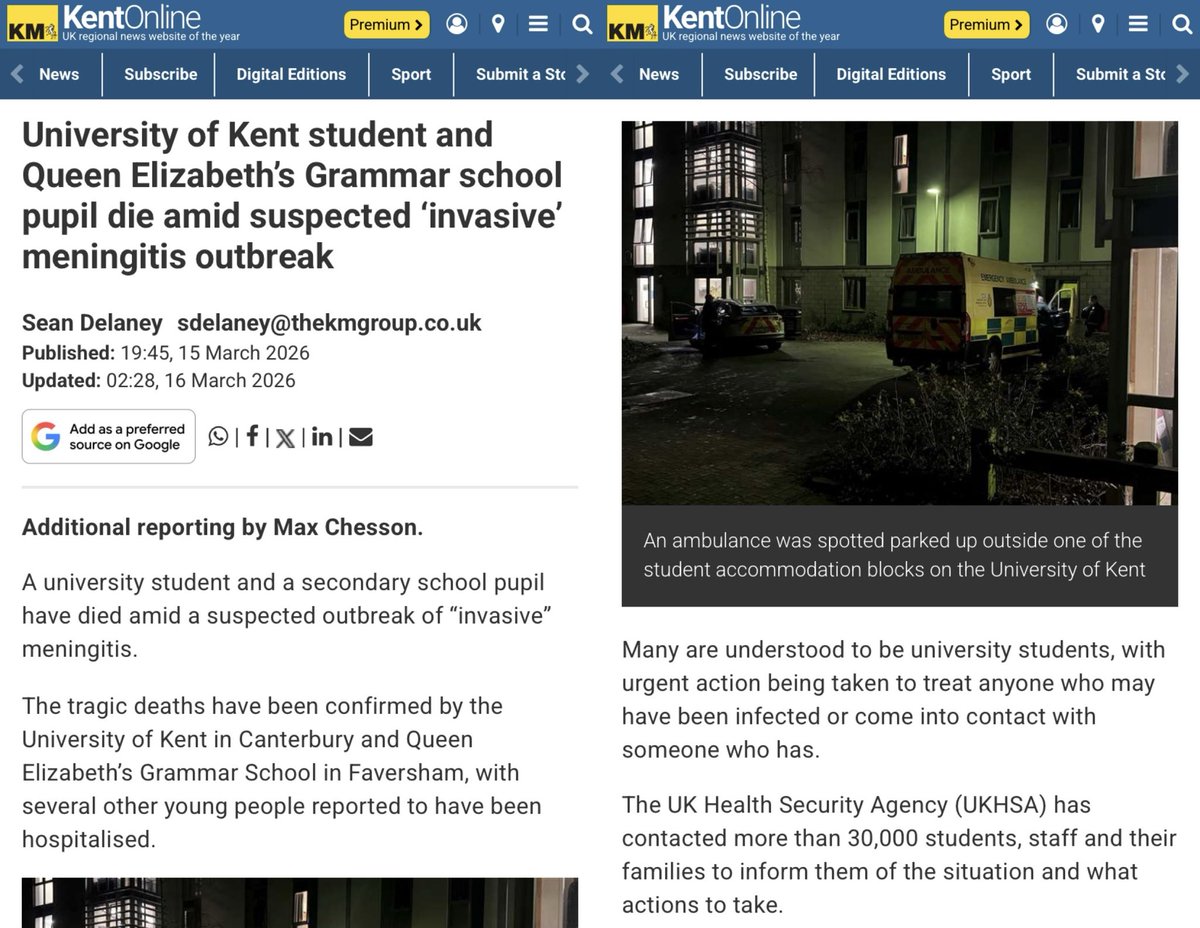
Really tragic news.
A university student and a secondary school pupil have died following an outbreak of "invasive" meningitis in Kent (England).
A further 11 people (mostly aged 18-21) are in hospital & reported to be seriously ill.
My heart goes out to the families 💔
All day I've been whacking my head against this vital tweet and the press release attached to it.
It's probably one of the most important things I've read about the early progression of the pandemic, but it's very hard to express concisely the huge scandal they've exposed here.
@statnews Dr Jessica Knurick is a fantastic person to follow to understand more about the systems driving these problems and what it will take to fix them -- and it's not nutrition education in medical school. https://t.co/loDugjjqHx