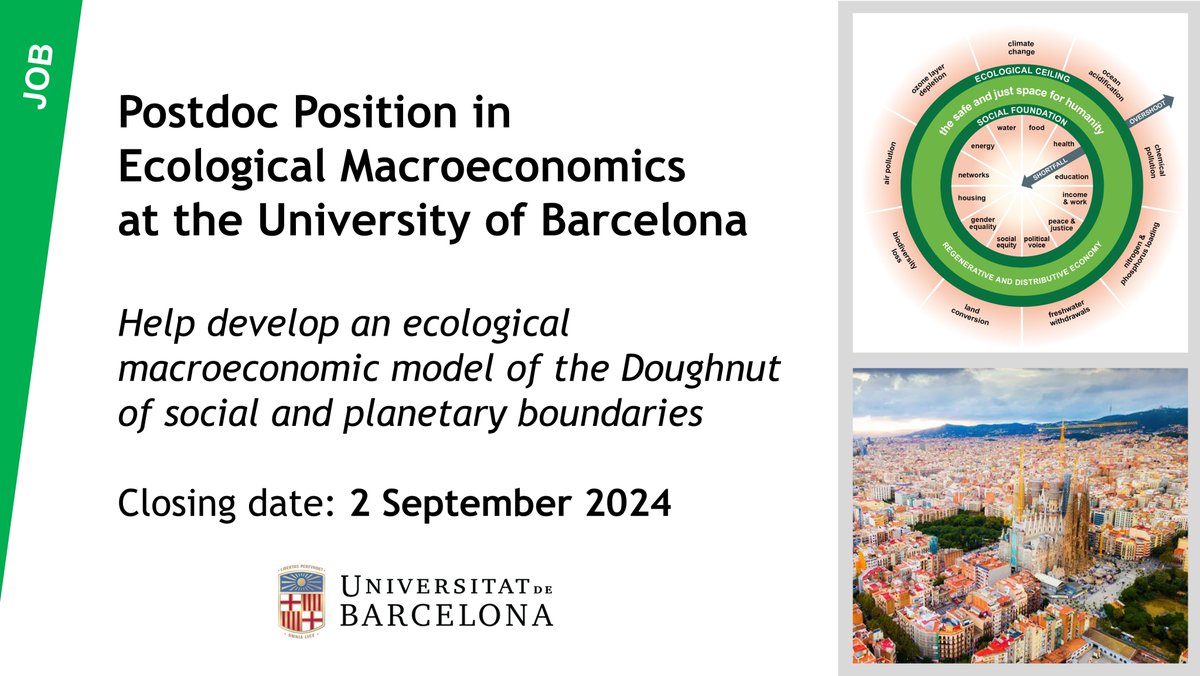
📢We're hiring again!
Join our fantastic team of post-growth researchers at the University of Barcelona!
We're looking for an outstanding researcher to help develop an exciting new model of the Doughnut of social and planetary boundaries.
Full details: https://t.co/PSGa8QPUlt
📢We're hiring again!
Join our fantastic team of post-growth researchers at the University of Barcelona!
We're looking for an outstanding researcher to help develop an exciting new model of the Doughnut of social and planetary boundaries.
Full details: https://t.co/PSGa8QPUlt
In summary:
• The US trade deficit = extreme consumption
• Reducing consumption could fix the problem without tariffs, while also reducing waste and climate change
• A post-growth economy could improve quality of life
What do you think? Could the US live better with less?
Less consumption = fewer imports = smaller trade deficit.
It also means:
• Less waste and resource depletion
• Lower CO2 emissions from production and shipping
• More resilience
We chase economic growth at all costs. But what if we prioritised human wellbeing instead?
To put things in perspective: The US trade deficit is 3-4% of GDP. So if Americans just consumed 1% less stuff per year, then by the end of Trump's term in office, the problem would be solved!
The US trade deficit is about $1 trillion per year—roughly 3-4% of GDP.
This means Americans buy $1T more in goods and services from abroad than they sell. Most of that is stuff: electronics, cars, fast fashion, etc.
What if Americans just... bought less?
Trump has started a trade war to try to reduce the US trade deficit. But there's a much simpler way to fix the deficit: 𝗰𝗼𝗻𝘀𝘂𝗺𝗲 𝗹𝗲𝘀𝘀.
Reducing consumption would eliminate the trade deficit, reduce environmental pressure, and improve quality of live. Let's dive in. 🧵
We've officially launched the MAPS project!!🚀
MAPS brings together 45 researchers from 10 institutions. Our aim is to develop new policies to improve human wellbeing within planetary boundaries, and test these with a state-of-the-art model
Check it out! https://t.co/TUlm4rzNN2
I’m chairing a special session on the impacts of AI at the @ISEEORG conference, June 24-27 in Oslo. The deadline is Jan 20, but only a 400-word abstract is required. So if you're working in this area, please submit an abstract :)
https://t.co/RHAIEYebeH
https://t.co/zvz2QaP29w
Great opportunity to work with the ESEE Board!
This is a part-time remote position, well suited to a PhD or MSc student in ecological economics.
Apply by Oct 7.
https://t.co/0GCFcyWbDQ
Join us as ESEE's new Website & Social Media Manager!
This is a great opportunity to get involved with the European Society for Ecological Economics, learn some new skills, and meet incredible researchers in the field.
Apply by Oct. 7.
https://t.co/FFL0sc6sGr
Great piece by @timparrique on Savin & van den Bergh's dodgy review of degrowth, which excludes my work:
"Not including [O'Neill et al.] in a literature review of the field would be like reviewing science fiction films without mentioning Star Wars." 😅
https://t.co/7HBpdtrIMw
Our team at @UniBarcelona is looking for a Postdoc in Ecological Macroeconomics for the project: Towards a Sustainable Well-being Economy: Integrated Policies and Transformative Indicators (To Be). Info: https://t.co/5jHsMqKQhE Apply by 2nd of September.
Join our team at the University of Barcelona!
We're looking for an outstanding researcher to help develop an exciting new model of the Doughnut of social and planetary boundaries.
Please circulate widely!
Full details: https://t.co/hHwK2Cm26w
Interested in research at the intersection of human wellbeing & enviro sustainability?
@UniBarcelona is seeking a #PostDoc to help develop a model to assess policy packages aimed at achieving a good life for all within planetary boundaries.
Apply by 2/9.
https://t.co/ozn0bz4z2y
Join our team at the University of Barcelona!
We're looking for an outstanding researcher in input-output analysis.
The position will work on quantifying/modelling the requirements of a good life for all people within planetary boundaries.
Full details: https://t.co/WjqLTkeyPZ
Would you like to help us map ecological economics research and education hubs? Have a look at the interactive map and provide your inputs: https://t.co/CmFZP9hZ7y