The paper provides detailed guidance on selecting suitable collections of auxiliary outcomes and combining TMO with existing spatial standard errors. STATA code for implementing TMO is available here:
https://t.co/g84TwBSFbY
https://t.co/V4fwHXgeXW
The Thresholding Multiple Outcomes method addresses spatial correlation in regressions by using information from additional outcomes to identify correlated locations, from @sdellavi, @guido_imbens, Woojin Kim, and @DRitzwoller https://t.co/lbCjyeiSYH
Applying TMO to nine recent papers, we find significant impacts on estimated standard errors, with a median increase of 37% compared to the published estimates.
(2) Determine a threshold from these estimates; pairs exceeding this threshold are modeled as correlated.
(3) Compute standard errors by accounting only for correlations above the threshold.
Our proposed method, Thresholding Multiple Outcomes (TMO), has three steps:
(1) Estimate pairwise correlations across locations using multiple outcomes.
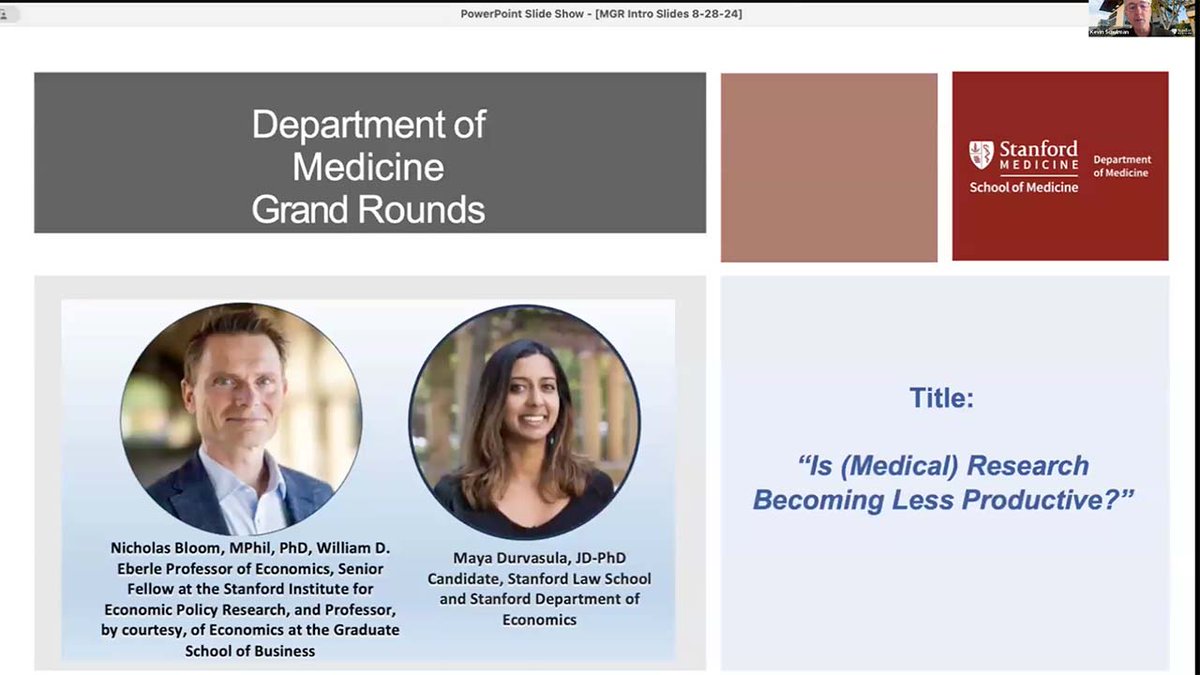
Catch up with the latest recording of #StanDOM's recent Medical Grand Rounds presentation, "Is (Medical) Research Becoming Less Productive?," with
@SIEPR's Nicholas Bloom, MPhil, PhD, & @StanfordEcon's @mayadurvasula . https://t.co/HTPm1lafwf
We were thrilled to welcome students & faculty from @SpelmanCollege@Spelman_Econ@Morehouse for the 2nd annual Stanford-Spelman-Sloan Summer Institute last week. Big thank you to @Stanford, @SloanFoundation, & @SIEPR for making this possible. Here’s our amazing visit. [1/ 15]


![StanfordEcon's tweet photo. We were thrilled to welcome students & faculty from @SpelmanCollege @Spelman_Econ @Morehouse for the 2nd annual Stanford-Spelman-Sloan Summer Institute last week. Big thank you to @Stanford, @SloanFoundation, & @SIEPR for making this possible. Here’s our amazing visit. [1/ 15] https://t.co/qWcGWphu7y](https://pbs.twimg.com/media/GVnbwy-bgAIKE4_.jpg)


