Becoming part of the @GenLayer community of builders, validators, and creators.
Looking forward to learning, connecting with other contributors, and finding ways to add value to the ecosystem.
Excited to see what we can build together. 🚀
Join me here https://t.co/9tknq43QmQ
A new kind of economy is forming, and I think Web3 should pay attention. 👀
@TalaxeumEco is building around a simple idea: value shouldn't stop at ownership.
People contribute through creativity, knowledge, collaboration and community. Yet that value often goes unrecognized.
Talaxeum's Participation Economy aims to connect those contributions with access, recognition and meaningful outcomes.
I'm exploring how the pieces fit together, and that's what makes this journey interesting to me.
Web3 isn't only about what you own. It's also about what you contribute. 🤝
CZ says $1M Bitcoin won't take 25 years.
Price isn't the main thing.
Bitcoin needs real utility: payments at massive scale and a role as a reserve for retirement pensions.
"All of those things will happen."
📍 When Shift Happens
Drove past a guy selling lemons today. Millions of cars stuck in traffic; nobody buys. Traffic is there. The message isn't.
Nobody needs your lemons. 🍋
Now imagine a big sign: "10 things you can do with a lemon" (lemonade, lemon pie, tea for a cold) 👉 full bag for $2.
Add a name, a logo, some branding, and he'd be a millionaire by now.
Sell the lemonade, not the lemons. 🍋
PBUG is on the case! Checking profiles, digging through contract addresses, and making sure nothing suspicious slips past. In crypto, curiosity is good, but doing your own research is even better.
$PBUG 7ERq23T83CExrHwag6FR4mdVWKSAP1jLgV3gBXsmpump
Applying but hasn’t been successful? Try this
Go to ChatGPT or Grok, type this prompt
“Act like a recruiter hiring for (include the job title and the job description), can you assess my resume & provide suggestions on how to improve it using the ATS standard?”
Paste your resume details after the prompt
Will you do it?
7/
But here's the bigger question.
What happens when AI systems stop relying on one model for everything?
A general-purpose model handles complex reasoning.
A smaller model handles rapid decisions.
Other models handle specialised tasks.
The result could be a system where each model does what it does best.
8/
This is one reason I'm watching what https://t.co/S5mowXJyqt is building.
Its work spans AI training, federated learning, model deployment and token-linked AI infrastructure.
The interesting part isn't simply putting AI and blockchain together.
It's figuring out how these systems can become useful, accessible and economically sustainable.
9/
Of course, there's still a lot to prove.
Can specialised models maintain accuracy in real-world conditions?
Will developers adopt them?
Can the economics work beyond early incentives?
And can decentralised AI infrastructure compete on reliability, cost and usability?
These are the questions worth following.
10/
The AI race isn't only about who builds the biggest model.
It's also about who figures out how to use models efficiently, solve specific problems and get them into real products.
FLock's THIS/THAT model is one approach worth examining.
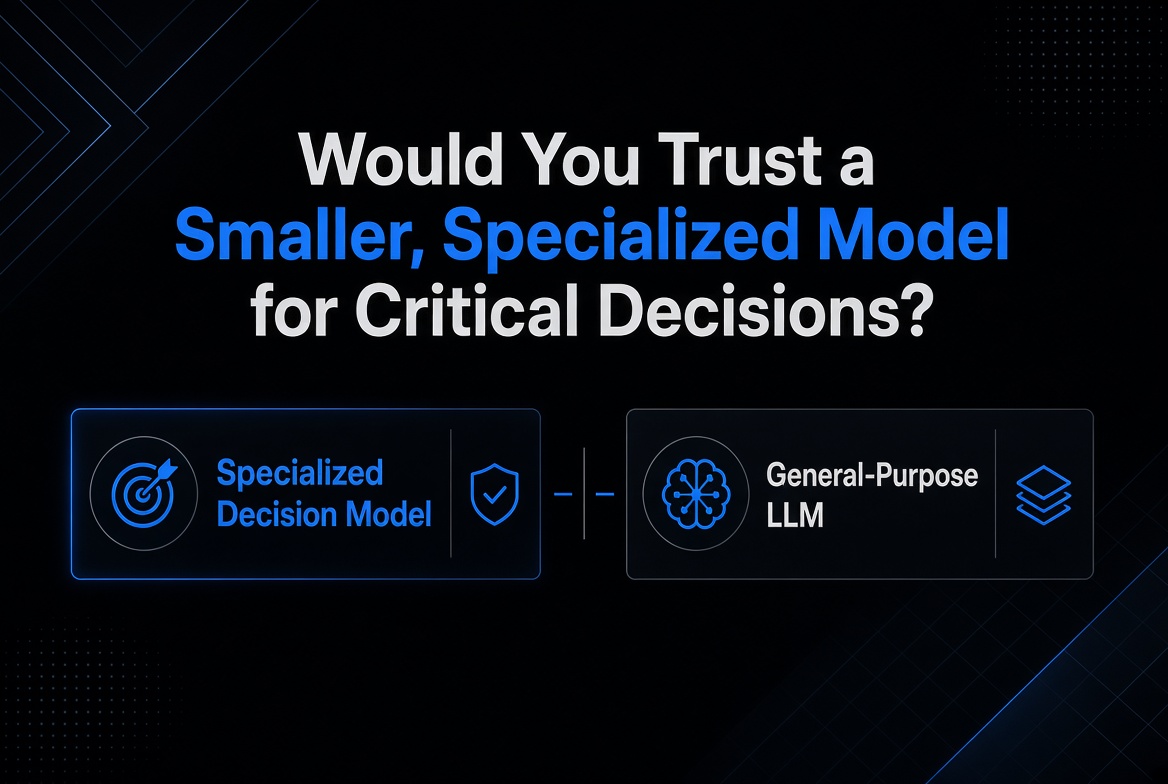
Would you trust a smaller, specialised AI model to make critical decisions in your workflow, or would you stick with a general-purpose LLM?
Sources:
[FLock's announcement] (https://t.co/Zoz5yahPbD) ·
[Model repository] (https://t.co/dMVnNTmZ2B)
6/
Why should other AI builders care?
Because every extra step in an automated workflow has a cost.
Latency matters. Inference costs matter. Reliability matters.
A specialised model could make certain systems faster and cheaper, provided it performs well on the actual tasks they're built for.