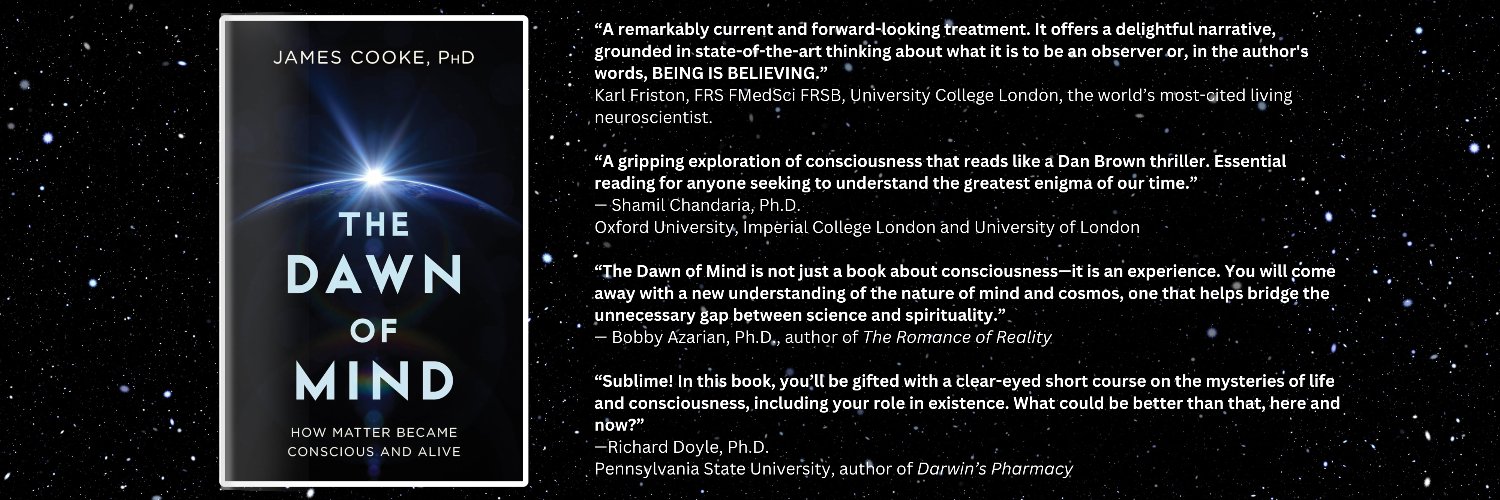
Neuroscientist. Director of Oxford's Contemplative Science Research Program. Author of The Dawn of Mind. Research Fellow, Linacre College, University of Oxford.
I'm happy to announce that I've just started my dream job as Director and Principal Investigator of a new Contemplative Science Research Program within The Centre for Eudaimonia and Human Flourishing at Oxford University.
Find out more at https://t.co/cMQSvVlYEJ
Unfortunately, it seems like the intelligence explosion will be happening in 2027 after all. Most of this post analyzes the new METR report (though other sources of evidence are also important). If they’re right, that implies an AI-driven acceleration that is 5 months ahead of the AI 2027 scenario. I am scared, sad, and angry. https://t.co/7KWmdc6AZk
@timcolbourn@RyanGreenblatt My understanding is that Ryan wasn't an author on the report itself and doesn't have access to the redacted material to share.
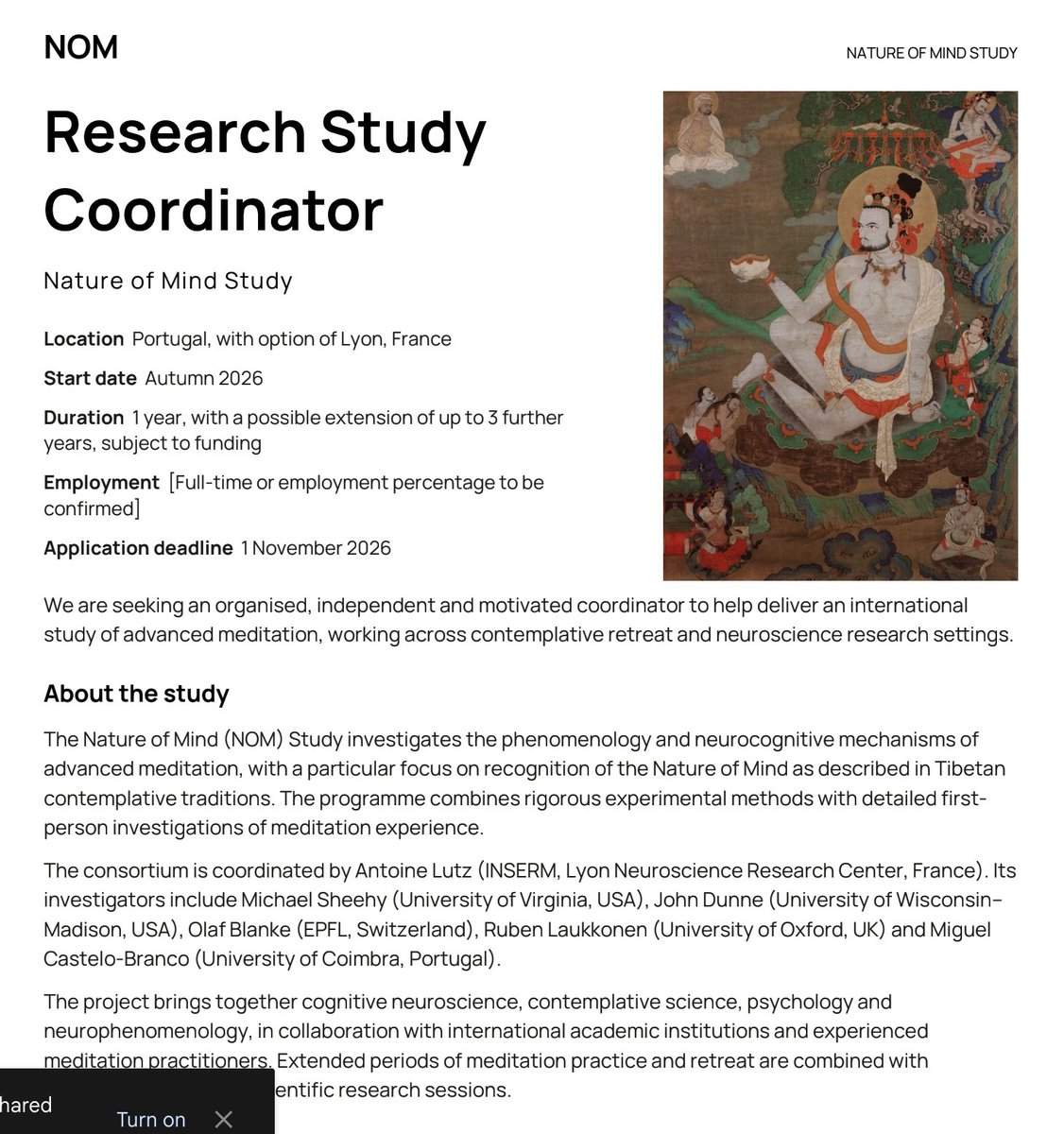
Help us collect the best meditation dataset in the world!
We are hiring a study coordinator for a neuroscience and physiology examination of a 3-year meditation retreat taught by Yongey Mingyur Rinpoche.
Apply by Nov 1st: https://t.co/UHC3FEgRN3
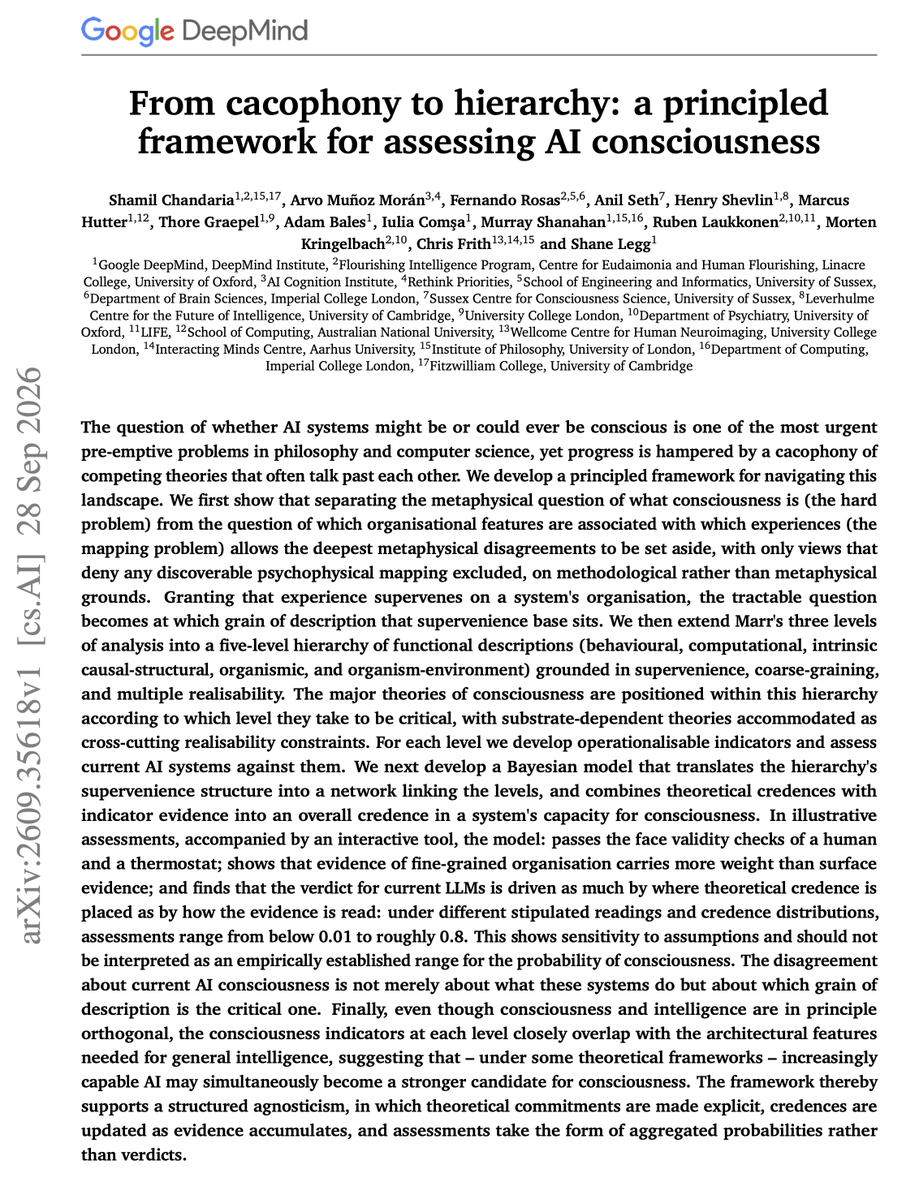
1/13 Can we assess AI consciousness without first solving consciousness itself?
New from Google DeepMind and collaborators across CS, neuroscience & philosophy:
“From cacophony to hierarchy: a principled framework for assessing AI consciousness”
https://t.co/4IqT2KRKUP 🧵
Can we model Buddhist awakening with mathematical physics?
Our latest paper proposes such a model, using the quantum formulation of the free energy principle to formalise the stable recognition of emptiness.
Link and thread below 👇
You can better model brain data if you assume quantum-like entanglement.
New work from our centre indicates that the brain expresses the efficiency of quantum computation through classical mechanisms. The brain is a magnificent specimen because it operates on 20w—or a banana and some water—and yet generates a coherent, stable, adaptive, and conscious inner universe that can build rockets, computers, fall in love, and construct empires and religions.
And it does so against the backdrop of slow, wet, porous, and inexpensive bioelectric activity. Compare this to contemporary AIs, which are energy guzzlers and require massive data centres. The difference is likely 10,000x or more. Instead of looking interstellar for data centres, we should really be looking to the brain.
First, you model the brain as a network of coupled oscillators (commonly used for whole-brain models). If you wire these coupled oscillators up like the brain’s connectome you get very interesting, very surprising, brain-like dynamics; such as criticality, metastability (via turbulence), etc. These stochastic dynamics are crucial for rapid information sharing and maintaining local and global integration. And when these dynamics are included in the model, it fits the brain like a glove.
Interestingly, when you then include long-range exceptions to the exponential distance rule (common in mammalian brains), you get a spectral gap that separates the dominant modes from the noisy bulk. These dominant modes behave like coherent state-vectors and their interactions produce interference effects, i.e., quantum-like entanglement.
These interference effects may be one of the secrets to how the brain rapidly binds distributed information into unified, context-sensitive states. The paper also demonstrates that QL entanglement provides the brain a richer dynamical repertoire at lower energetic cost. Keep in mind that this “quantum-like” entanglement arises from the interference of coupled oscillators, but the functional end state is analogous in that you get the same mathematical advantages.
It’s super exciting and we have a lot more to share in coming months.
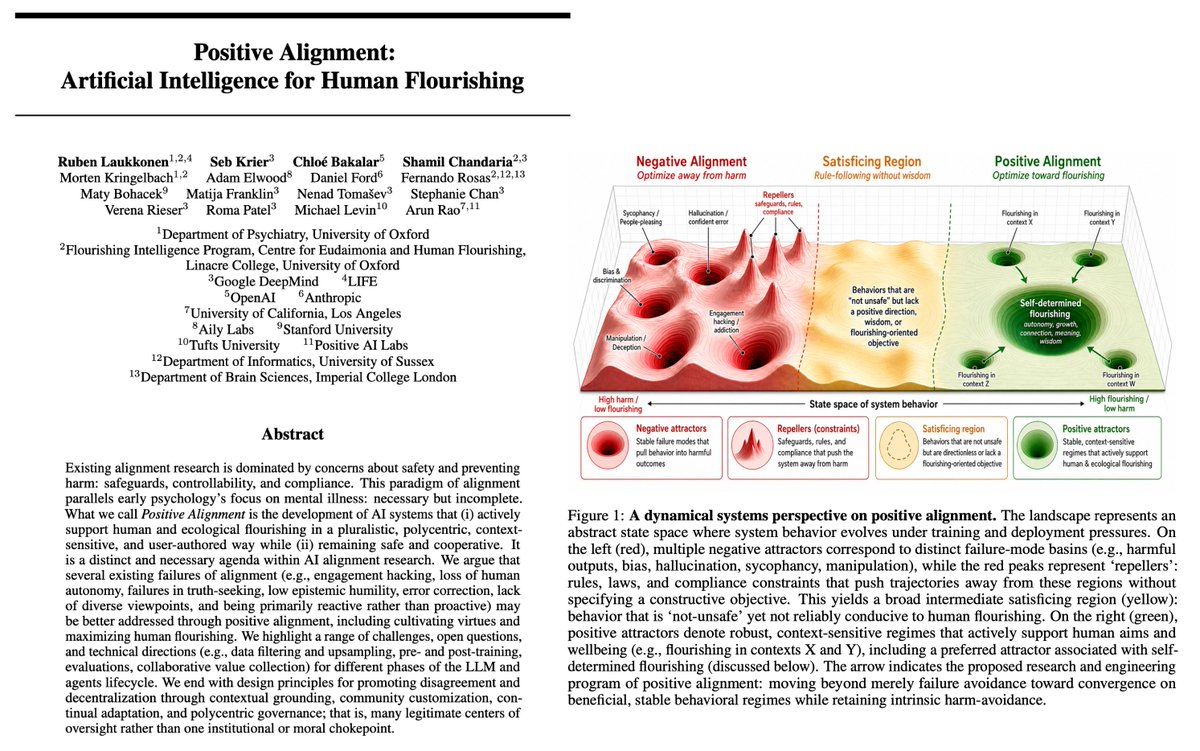
What is intelligence for?
In a rare collaboration between top universities and 3 frontier labs, we all agree that alignment should move beyond pathologizing to a positive focus on flourishing. We need north stars not just barbed wire.
A close historical analogue comes from psychology. For much of the twentieth century, mainstream psychological science organized its aims around diagnosing, predicting, and treating dysfunction: depression, anxiety, psychosis, addiction, and other forms of impairment. That focus was justified and socially urgent, and it produced progress.
Yet the field also discovered a systematic limitation. The constructs and instruments that reliably detect pathology do not, by default, specify what counts as a life well-lived. The turn toward positive psychology expanded the scientific target space by developing distinct theories, taxonomies, and measures for wellbeing, strengths, virtue, purpose, wisdom, meaning, and prosocial functioning, alongside interventions to boost these capacities beyond the status quo.
As AI becomes embedded all over society and everyday sensemaking, a solely negative posture risks optimizing our information ecology for risk avoidance rather than human development. It may reduce catastrophic errors but leave agents in a local optimum of superficial and `soulless' assistance, where subtle misalignments abound.
It also reveals that alignment is not a purely technical problem. We have to cut across vast disciplines because questions about the good life demand insights from philosophy, pychology, neuroscience, economics, and beyond. We need to work together to build AI systems that explicitly understand, model, and enhance human, animal, and ecological flourishing.
The core challenge is therefore to build systems that can represent and reason about wellbeing as a structured manifold of human goods, trade-offs, and temporal dynamics, while enabling individuals and communities to retain agency over what counts as better in their context.
While some may explicitly desire a system that is strictly and indiscriminately instruction-following, others must have the genuine option to choose systems configured to support their long-term growth or specific ethical commitments. This distinguishes *consented guidance*, where a user authorizes a system to help align their immediate actions with their higher-order goals, from *technocratic imposition*, ensuring that the pursuit of flourishing remains an exercise of, rather than an infringement upon, human agency.
It gives me optimism that we found common ground on such a profoundly complex issue as the end game(s) of AI. Because when learning become cheap, we need to take a serious look at what intelligence is actually for.
@_The_Heretic_@RubenLaukkonen Towards the end of the paper I discuss addiction and frame this kind of behaviour as a secondary consequence of interoceptive dysregulation produced by entrenched egostasis (effectively self soothing or hacking the chronic errors) rather than as healthy allostasis
I have a new preprint out formalizing a model of suffering I’ve been working on. I coin the term “egostasis” for a way of being that depends on a self model, and I explain why “selfing” in this way can be expected to create suffering.
https://t.co/YjtRaZorWv
My hope is that this can be a step towards a science of the human condition, one that fully reckons with our existential situation in order to relieve suffering and promote flourishing.
It also provides an explanation of why ego-dissolution experiences produced by certain substances have psychotherapeutic potential, and shows how psychopathology is in continuity with everyday suffering, thereby humanising those who struggle with psychiatric diagnoses.
Deep thanks to Tom Snow and Snow Medical for the generous funding that makes the research program possible, and to my amazing wife for the support that got me to this point.
I'm happy to announce that I've just started my dream job as Director and Principal Investigator of a new Contemplative Science Research Program within The Centre for Eudaimonia and Human Flourishing at Oxford University.
Find out more at https://t.co/cMQSvVlYEJ
...brain imaging, computational modelling, phenomenology, and philosophical investigation. The aim is to take contemplative insight seriously and seek to understand how such insight, combined with modern science, can be used to scale human flourishing.
@ReachChristofer Haha, these things just come out and then a thought comes that says "oh yeah, it kind of is isn't it?". I'm glad it's not just my internal system that thinks I'm onto something!
Here’s me and @RianSweetDoris a couple of weeks ago when, by another crazy coincidence, we both happened to be in the same small airport 48 hours after I accepted the position, despite living on different continents!
I’m very happy to announce that I’ll be starting next month as Chief Science Officer of https://t.co/CyrIyr0MaY! I’ll be working to make optimal states of consciousness accessible to ever greater numbers of people.
It feels great to work with someone where we were already mutual fans of each other's work and where we share the same vision of helping people to experience greater wellbeing, in a way that is grounded in cutting-edge science.