Statement to the Press by Dr Moses Paul, ADC Candidate for Chairman of Abuja Municipal Area Council (AMAC) Election Held on Saturday, February 21, 2026
Abuja, Federal Capital Territory
February 22, 2026
Gentlemen of the Press,
I have called you here to address the events of last Saturday, in which the Independent National Electoral Commission (INEC) once again took Nigerians for granted, showing a blatant disregard for their sensibilities.
I stand before you today not as a man diminished by the outcome of Saturday’s event, but as a man empowered by a political movement. This movement is not born of convenience but of conviction; it is carried not by power, but by people. It is written not in ink, but in sacrifice.
Over the past few months, from the streets of Karshi to the bustling markets of Wuse, from the crowded paths of Nyanya to the quiet resilience of Gui, Abuja residents have risen, standing up and expressing their beliefs. For this, I bow my head in gratitude.
Let it be known and recorded in history that what we witnessed in this election was not merely a contest for office; it was a declaration of dignity by a people who refuse to surrender their future.
I have reviewed the outcome as announced. While I firmly believe, based on our extensive engagement and the overwhelming spirit of our movement, that we earned the sacred mandate of the people, I strongly condemn the declared results, as they do not reflect the true will of the residents of Abuja.
Among those who voted, many have expressed deep disagreement with the announced outcome due to widespread irregularities. These include the restriction of movement through the imposition of a curfew; the intimidation and attacks on ADC party members by security agencies; massive vote buying across several wards; and voter suppression caused by the late arrival of election materials in key polling units, including Kabusa, among others.
There were also cases of alteration and mutilation of polling unit results, which tragically contributed to the death of Musa Abubakar at the Gwagwa polling unit while he was trying to protect his vote. I have since visited his family and have ensured that his children will be placed on scholarship, as a modest commitment to honour his courage and sacrifice. I am calling on the relevant authorities to thoroughly investigate the matter and ensure justice.
These actions undermine the integrity of the electoral process and the confidence of the people in our democracy.
Our movement was never built on the fragile foundation of titles; it was built on the enduring foundation of truth. And truth does not expire with an election.
To the young men and women who stood in the sun for hours, who walked distances they had never known, and who gave their time, strength, and voices: you are the authors of a new chapter.
To those who came from near and far, who sacrificed their resources and endured intimidation and doubt, your sacrifices have forever altered the moral landscape of AMAC.
To those who gave their life, blood, sweat, and unwavering courage: you have shown that the Nigerian spirit is alive and refuses to kneel.
You did not only stand for me; you stood for yourselves, for your children, for justice, for democracy and for the powerful belief that leadership must be earned, not imposed. For this, I will remain eternally grateful.
I extend my deepest appreciation to every voter who performed their sacred civic duty. Your courage has reaffirmed democracy as a living promise, not a forgotten idea.
I thank the leadership and members of the African Democratic Congress (ADC) for standing firmly on the side of principle. Your belief in a different kind of politics has not gone unnoticed, and history will honour your courage.
To every volunteer, supporter, elder, youth, and woman who carried this movement in their hearts: you have given me something far greater than victory; you have given me purpose...
I read all the messages, each one carefully, because words matter to me.
Every prayer, every birthday wish, every kind remark, every call, and every gesture of goodwill touched me deeply. While it may be impossible to respond to each message individually, please know that I have read them with gratitude and a heart full of appreciation.
To be remembered, prayed for, encouraged, and celebrated by so many wonderful people is a blessing that I do not take for granted.
I am humbled by your kindness and strengthened by your prayers.
Thank you for your love, your support, your confidence, and your continued belief in me.
I remain profoundly grateful with deep respect and appreciation, -DrMo
Today, as I mark another year of life, I do so not merely with gratitude for age, but with gratitude for purpose.
Birthdays are not just reminders that we have lived; they are reminders that we still have work to do. Every passing year should challenge us to ask ourselves: Have we made our nation better? Have we lifted others? Have we stood for truth when it was inconvenient? Have we remained faithful to our convictions?
To myself, I say: remain humble before God, steadfast in principle, and courageous in the face of adversity. Never allow comfort to silence your voice when justice demands that you speak. Never allow personal ambition to outweigh the collective good.
To others, especially the young people of Nigeria, I say: do not surrender your dreams to the failures of the present. Nations are transformed by ordinary people who refuse to accept that things must remain the way they are. Keep believing, keep building, keep serving.
Life is not measured by the years we accumulate but by the lives we touch, the values we defend, and the legacy we leave behind.
As I celebrate today, my prayer is simple: may God grant me greater wisdom to serve, greater strength to endure, and greater grace to remain a voice for justice, equity, and a better Nigeria.
The journey continues.
Happy Birthday to me. Happy Birthday to every dreamer, every patriot, and every believer in a New Nigeria.
-Dr. Moses Paul
22nd June, 2026
One thing has become increasingly clear, Mr. Peter Obi is no longer merely a politician seeking office. He has become a symbol of hope for millions of Nigerians who desire a different kind of leadership.
Whether in Lagos, Abuja, or other parts of the country, the crowds, the energy, and the genuine affection shown to him cannot be manufactured. They are not the product of state resources, political patronage, or ethnic mobilization. Rather, they are the result of years of consistency, simplicity, discipline, and a message that resonates deeply with ordinary Nigerians.
What continues to inspire many about Mr. Peter Obi is that he speaks less about power and more about purpose. He speaks about production rather than consumption, about investing in people rather than politics, and about building a nation where competence matters more than connections.
In every engagement, whether with business leaders, young professionals, market men and women, students, or community stakeholders, the same pattern emerges: people listen because they believe he understands their pain and shares their aspirations. His recent engagements in Lagos have once again reinforced his commitment to credible elections, national development, and a more productive Nigeria.
What many see in Mr. Peter Obi is not perfection. Rather, they see a leader who has consistently demonstrated prudence, accountability, and empathy in public service. They see a man whose personal lifestyle reflects many of the values he advocates publicly.
The excitement surrounding him is therefore not just about one man. It is about what he represents: the possibility that Nigeria can work, that leadership can be responsible, and that public office can once again become a platform for service rather than personal enrichment.
History often reminds us that great movements are built around ideas, not individuals. Mr. @PeterObi's greatest strength may not be Peter Obi himself, but the awakening of civic consciousness he has inspired among millions of Nigerians who now believe they have a stake in the future of their country.
Consistently unfolding events serve as yet another reminder that while political structures remain important, the most powerful force in any democracy is still the people.
As we celebrate Father's Day today, it is also fitting to acknowledge the fatherly role that true leadership plays in society, offering guidance, responsibility, sacrifice, and hope for future generations. Nigeria's yearning for better leadership is, at its core, a desire for a nation that cares for its people and secures a brighter future for its children.
Happy Father's Day to all fathers and father figures whose sacrifices, wisdom, and dedication continue to shape families, communities, and nations.
-DrMo
DECENCY AS A CIVIC VALUE
Decency is a civic value.
It is how we treat people, how we speak, how we dress, and how we behave when no one is watching.
A better society is built by decent citizens.
And character builds a nation.
#Decency#CivicValue#Nigeria#Integrity
As we celebrate Democracy Day, I urge our young people to aspire to be leaders, not merely politicians.
Politics is about seeking power, but leadership is about serving people. Politics may focus on positions, but leadership focuses on purpose, character, competence, and sacrifice.
Nigeria does not suffer from a lack of politicians; it suffers from a shortage of genuine leaders who are willing to put the people first. The future of our nation depends on young men and women who are prepared to lead with integrity, vision, courage, and compassion.
Do not wait for tomorrow. Start leading today, in your communities, schools, workplaces, and every sphere of influence. Let your actions inspire hope, promote unity, and create positive change.
The Nigeria of our dreams will not be built by those who seek titles, but by those who accept responsibility.
Happy Democracy Day, Nigeria. -DrMo
Justice must not only be done but must be manifestly and undoubtedly seen to be done. Any attempt to proceed to judgment without first addressing these weighty jurisdictional concerns would be deeply troubling and could cast a long shadow over the credibility of the entire process.
We therefore urge all relevant authorities to act swiftly, responsibly, and in accordance with the law to prevent what may become a serious miscarriage of justice and a dangerous precedent in the administration of electoral justice.
Signed
Dr. Paul Moses Ogidi
Petitioner, FCT/ACET/EP/01/2026
PRESS STATEMENT 9th June, 2026
URGENT DEMAND FOR THE IMMEDIATE SUSPENSION OF JUDGMENT IN PETITION NO. FCT/ACET/EP/01/2026: DR. PAUL MOSES OGIDI VS. INEC & 2 ORS
Our attention has been drawn to information indicating that the Area Council Election Petition Tribunal is set to deliver judgment in Petition No. FCT/ACET/EP/01/2026 between Dr. Paul Moses Ogidi and the Independent National Electoral Commission (INEC) & 2 Others.
While we remain committed to the rule of law and the independence of the judiciary, we consider it our duty to alert Nigerians and the international community to a fundamental jurisdictional defect that remains unresolved and which directly affects the competence of the Tribunal to validly proceed with, let alone determine, this Petition.
The crux of the matter is that the Tribunal, as presently constituted, is alleged to be in violation of the mandatory provisions of Section 135(3) of the Electoral Act, 2026, which requires the inclusion of a High Court Judge in the composition of the Area Council Election Petition Tribunal. This issue goes beyond mere technicality; it strikes at the very root of the Tribunal's jurisdiction and legitimacy.
Upon discovering this apparent defect, our legal team formally petitioned the Honourable Chief Judge of the Federal Capital Territory on 10th April 2026, requesting the immediate reconstitution of the Tribunal in compliance with the Electoral Act. Despite the seriousness of the concerns raised, no response was received and no corrective action was taken.
In view of the continued failure to address this fundamental issue, a further petition was submitted to the Chief Justice of Nigeria on 21st May 2026, seeking urgent intervention and drawing attention to the apparent constitutional and statutory irregularity in the composition of the Tribunal. To date, the concerns raised therein remain unresolved.
Furthermore, formal submissions and communications regarding this matter have been made to various national and international institutions, including the United Nations, the European Union, the Embassy of the United States of America, the British High Commission, and other stakeholders concerned with democratic governance, electoral integrity, and the rule of law.
It is trite law that jurisdiction is the foundation of every judicial proceeding. A court or tribunal that lacks jurisdiction cannot confer validity upon its proceedings by the mere passage of time. Consequently, any judgment delivered by a tribunal whose jurisdiction is under serious challenge may be rendered vulnerable to being declared a nullity.
The decision to proceed with judgment while petitions challenging the Tribunal's composition remain pending before the relevant judicial authorities would raise profound legal and constitutional concerns. It would also create the unfortunate impression that due process and statutory compliance have been subordinated to expediency.
Accordingly, we call in the strongest possible terms for:
1. The immediate suspension of the proposed judgment in Petition No. FCT/ACET/EP/01/2026.
2. The urgent intervention of the Chief Justice of Nigeria and other relevant judicial authorities to determine the issues raised in the petitions dated 10th April 2026 and 21st May 2026 before any judgment is delivered.
3. The immediate reconstitution of the Area Council Election Petition Tribunal in strict compliance with Section 135(3) of the Electoral Act, 2026.
4. The protection of the integrity of the electoral justice system by ensuring that all jurisdictional and constitutional questions are fully resolved before any final decision is rendered.
This is not merely about one election petition or one candidate. It is about preserving the sanctity of the law, protecting public confidence in the judiciary, and safeguarding the integrity of Nigeria's democratic process.
We have been reduced to a point where insecurity is no longer measured only by the number of people kidnapped or the number of children stolen from their homes and schools. We have now descended to an even darker level where images and videos of the rape and brutalization of our women are being circulated openly, as if human dignity no longer matters.
How did we get to a point where citizens wake up daily to stories of murder, kidnapping, banditry, rape, hunger, and despair, while those entrusted with the responsibility of protecting lives and property continue to offer explanations instead of solutions?
Today, mothers are afraid. Fathers are helpless. Children are traumatized. Communities are under siege. Yet we are told to remain patient.
When innocent women are violated and their humiliation becomes public spectacle, when children are abducted from their homes, when farmers cannot farm, when travellers cannot travel, and when ordinary citizens live in constant fear, then government must answer one fundamental question: Does government still exist?
What exactly is the primary purpose of government if not the protection of lives and property? And on a day like this, what do we go to our churches and mosques to pray about? More patience? More endurance? More strength to survive another week of horror? Prayer is important, but prayer was never meant to replace responsibility. Faith does not absolve leaders of their constitutional duty.
The blood, tears, and pain of innocent citizens are becoming too much to bear. The silence, the indifference, and the normalization of these atrocities are almost as dangerous as the crimes themselves.
Every life matters. Every woman deserves dignity. Every child deserves safety. Every Nigerian deserves to live without fear.
This nation is bleeding, and those in authority must stop acting as spectators while the country burns.
Happy Sunday!!!
-DrMo
When 1,954 students are abducted from schools in just 20 incidents, we are no longer discussing statistics; we are confronting a national tragedy. Behind every figure is a frightened child who should have been learning in a classroom, a mother who could not sleep, a father who could do nothing but pray, and communities left traumatized for life.
A nation that cannot guarantee the safety of its children in schools is a nation that is mortgaging its future. Education is meant to be a place of hope, not a hunting ground for criminals. Yet, year after year, Nigerians have watched schoolchildren become victims of a security crisis that should have united all levels of government in urgent action.
The greatest tragedy is that we are gradually becoming accustomed to these horrors. We react for a few days, offer condolences, make promises, and then move on until another set of innocent children are taken. This cycle of outrage without lasting solutions must end.
No parent should have to choose between educating their child and keeping that child alive. No child should have to associate the pursuit of knowledge with fear, trauma, and uncertainty. Schools must remain sanctuaries of learning, not crime scenes.
The recent abductions in Oyo State and similar incidents across the country remind us that insecurity is no longer a regional challenge; it is a national emergency. Every child kidnapped is a reminder that government exists first and foremost to protect lives and property. When children cannot learn in safety, every other conversation about development becomes secondary.
Nigeria's children deserve more than sympathy. They deserve security. They deserve functional intelligence gathering, effective policing, accountable leadership, and a government that treats every threat to their lives as an attack on the nation's future.
History will not judge us by the speeches we made after these tragedies. It will judge us by whether we created a Nigeria where children can walk into their classrooms with confidence and return home safely to their families. Until that happens, our work remains unfinished, and our conscience as a nation remains burdened.
A society that cannot protect its children cannot claim to be protecting its future. Every number on this graphic represents a child. A dream interrupted. A family shattered. A nation failing its most sacred responsibility.
-DrMo
This Southern Africa trip with Mr. Peter Obi, from Lagos to Johannesburg to Cape Town and back has been, for me, far beyond movement across cities and meetings across borders. It has been an opportunity for deep observation, learning, reflection, and a closer understanding of leadership, nation-building, and the burden of carrying the hopes of people across different spaces and circumstances.
Beginning in Cape Town, at the Spier dialogue on Africa’s growth and development, I watched Mr Peter Obi engage leaders from across the continent and beyond with remarkable humility and depth. Mr Peter Obi introduced me to the Mayor of Cape Town, political leaders, diplomats, academics, development experts, and participants who had come from different parts of Africa, Europe, and America. What stood out immediately was not merely recognition, but the genuine warmth, respect, and attentiveness with which people received him. Across ideological and political divides, there was a visible acknowledgment of his consistency, clarity, and moral standing.
For me, however, the most profound moments were often not on the podium, but in the quieter spaces, observing how Mr Peter Obi listens, the questions he asks, and the seriousness with which he approaches even the smallest conversations. Whether speaking to former Presidents, current ministers, political leaders, diaspora Nigerians, or ordinary citizens, his first instinct is always to ask questions, How are Nigerians faring? What are the challenges? How are our people treated? What opportunities exist? What lessons can Nigeria learn? What systems are working? What systems are failing?
There is something deeply instructive about seeing a leader genuinely curious, genuinely listening, and genuinely concerned. At the dialogue in Cape Town, when Mr Peter Obi delivered his key address on policies for growth in Africa, he spoke with clarity about the tragedy and paradox of a continent so blessed with natural and human resources still struggling under the weight of poor leadership, corruption, weak institutions, and misplaced priorities. But what struck me most was how seamlessly he connected the broader African conversation with the realities at home in Nigeria.
Mr Peter Obi spoke about leadership not as an abstract concept, but as a lived responsibility. He explained how the quality of governance within a nation ultimately reflects how its citizens are perceived and treated beyond its borders. That leadership at home shapes dignity abroad. That when governance fails, citizens often carry the burden internationally. Yet even while addressing difficult truths, he consistently defended the integrity, resilience, brilliance, and hard work of Nigerians everywhere. Mr Peter Obi raised hope while still confronting reality. He challenged systems without condemning people. He spoke honestly, but never hopelessly.
In Johannesburg and Cape Town, the interactions with Nigerian communities were deeply emotional and revealing. Many shared concerns, fears, frustrations, and experiences about migration, identity, economic hardship, and social tensions. Yet in those interactions, I also saw something else, the trust and emotional connection people have with Mr Peter Obi. Not merely politically, but personally. People spoke to him as someone who understands their pain and still believes in their future.
Watching Mr Peter Obi’s engagements with South African ministers and political leaders was equally enlightening. The discussions were thoughtful, respectful, and frank. There was no grandstanding, no unnecessary drama, just serious conversations around governance, migration, law, regional cooperation, and the future of Africa. Even in disagreement, there was mutual respect.
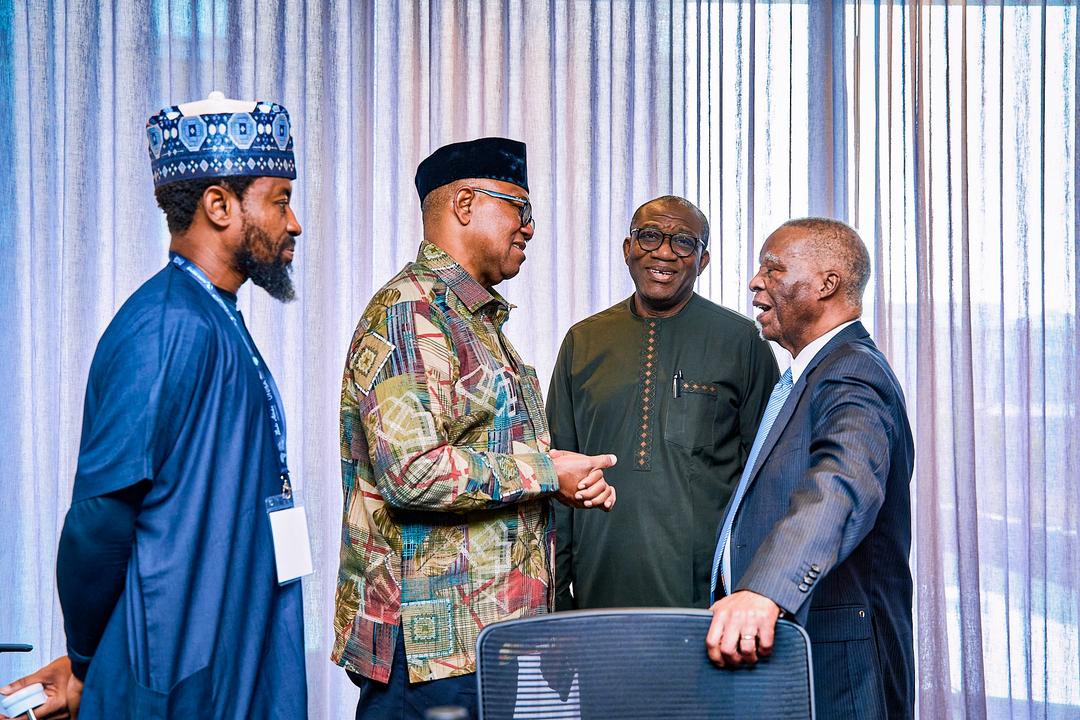
One particularly humbling moment for me was being present during his conversation with former President and elder statesman, Thabo Mbeki with Governor Kayode Fayemi . Listening to them reflect deeply on Africa, governance, peace, law, and continental progress was an experience difficult to fully capture in words. There was wisdom, historical perspective, and a shared belief that Africa must rise above division, poor governance, and narrow politics if it truly hopes to fulfill its promise.
What became increasingly clear throughout this trip was the extent of the respect Mr. Peter Obi commands both at home and abroad. It cuts across political affiliations, generations, professions, and even nationalities. There is a reverence many hold for him not because of power or office, but because of consistency, discipline, civility, and the perception and knowledge that he genuinely places people above self-interest.
What also struck me deeply is how even leaders who may differ politically or operate within parochial environments still often speak of him with unusual regard, almost as though they see in him a reflection of the kind of leadership Africa desperately needs, measured, competent, humane, accountable, and focused on development.
For me personally, this trip has reinforced that leadership is not noise. It is not aggression. It is not performance. Leadership is preparation, empathy, discipline, curiosity, courage, consistency, and the ability to carry people’s hopes without losing touch with their realities.
This journey has therefore become, for me, an ongoing classroom, one of observation, learning, growth, reflection, and deeper conviction about what Nigeria can and should become. It has shown me that despite the criticisms, the resistance, the misunderstandings, and the countless challenges, one must not give up on the nation or the continent.
We must continue to engage, learn, build, hold on to hope and above all, we must continue pressing on toward the vision of a more just, competent, peaceful, and prosperous Nigeria and Africa.
-DrMo
One particularly humbling moment for me was being present during his conversation with former President and elder statesman, Thabo Mbeki with Governor Kayode Fayemi . Listening to them reflect deeply on Africa, governance, peace, law, and continental progress was an experience difficult to fully capture in words. There was wisdom, historical perspective, and a shared belief that Africa must rise above division, poor governance, and narrow politics if it truly hopes to fulfill its promise.
What became increasingly clear throughout this trip was the extent of the respect Mr. Peter Obi commands both at home and abroad. It cuts across political affiliations, generations, professions, and even nationalities. There is a reverence many hold for him not because of power or office, but because of consistency, discipline, civility, and the perception and knowledge that he genuinely places people above self-interest.
What also struck me deeply is how even leaders who may differ politically or operate within parochial environments still often speak of him with unusual regard, almost as though they see in him a reflection of the kind of leadership Africa desperately needs, measured, competent, humane, accountable, and focused on development.
For me personally, this trip has reinforced that leadership is not noise. It is not aggression. It is not performance. Leadership is preparation, empathy, discipline, curiosity, courage, consistency, and the ability to carry people’s hopes without losing touch with their realities.
This journey has therefore become, for me, an ongoing classroom, one of observation, learning, growth, reflection, and deeper conviction about what Nigeria can and should become. It has shown me that despite the criticisms, the resistance, the misunderstandings, and the countless challenges, one must not give up on the nation or the continent.
We must continue to engage, learn, build, hold on to hope and above all, we must continue pressing on toward the vision of a more just, competent, peaceful, and prosperous Nigeria and Africa. -DrMo
We often think patriotism is about flags, anthems, or politics.
But one of the highest forms of patriotism is productivity.
A teacher teaching well.
A mechanic working honestly.
A farmer growing food.
A doctor saving lives.
#CivicValues#Patriotism#Productivity#Nigeria