2 groups of Hindu girls competing with each other to seduce their God.
This was at a religious festival celebration in the state of Bihar in North India
2 groups of Hindu girls competing with each other to seduce their God.
This was at a religious festival celebration in the state of Bihar in North India
Qaneh-Bosm and Cannabis: A Cumulative Case for Identification
Introduction
I identify the biblical Hebrew term qaneh-bosm (קְנֵה־בֹּשֶׂם) with cannabis. I reach this conclusion from the cumulative linguistic, biblical, historical, botanical, economic, and archaeological evidence.
This is a disputed identification rather than an uncontested scholarly consensus. Nevertheless, I believe the evidence is sufficient to go beyond saying that cannabis is merely a theoretical possibility. My position is that qaneh-bosm actually refers to cannabis, and that the cumulative evidence provides a stronger explanation than the competing identifications.
1. The Hebrew Term Qaneh-Bosm
The Hebrew expression qaneh-bosm combines qaneh (קְנֵה), meaning a reed, cane, stalk, or stem, with bosm (בֹּשֶׂם), referring to fragrance, spice, or an aromatic substance.
Thus, the basic sense of the expression is an aromatic or fragrant cane.
The Hebrew itself does not provide a modern scientific species name. The question is therefore which plant best fits this description in its historical and cultural context.
I believe cannabis provides the best identification.
2. Kalamos Does Not Necessarily Mean Acorus Calamus
The Septuagint translates qaneh with the Greek word kalamos (κάλαμος).
This is important because kalamos is a broad Greek word referring to a reed, cane, stalk, or similar plant structure. The word itself does not necessarily identify the modern botanical species Acorus calamus.
The English and Latin word calamus ultimately derives from the Greek kalamos. However, the later botanical use of calamus as a designation for Acorus calamus is more specific than the ancient Greek lexical meaning.
Therefore:
qaneh → kalamos → “reed/cane/stalk”
does not automatically establish:
qaneh-bosm → Acorus calamus.
The Septuagint preserves the general concept of an aromatic cane, but it does not by itself settle the botanical identification.
This distinction is important because the argument for Acorus calamus can sometimes appear stronger than the ancient terminology actually warrants.
3. The Kanabos/Kannabis Connection
Another significant piece of evidence is the ancient terminology associated with cannabis.
Greek kannabis (κάνναβις) refers to cannabis or hemp, and related forms such as kanabos/kannabos are relevant to the history of the word.
The similarity between qaneh-bosm and kanabos/kannabis is therefore noteworthy.
I do not argue that phonetic similarity alone proves that qaneh-bosm means cannabis. The precise etymological relationship is disputed, and scholars have proposed different directions of borrowing and development.
Nevertheless, I consider the linguistic connection significant when combined with the other evidence. It provides a plausible historical linguistic pathway that deserves consideration rather than being dismissed simply because the words are not identical.
4. The Aromatic and Imported Context
Jeremiah 6:20 is particularly relevant because it describes qaneh as an aromatic commodity coming from a distant land, alongside frankincense from Sheba.
The passage therefore presents qaneh in the context of aromatic trade.
Even more importantly, Exodus 30:23 gives a specific quantity for qaneh-bosm in the sacred anointing oil: 250 shekels according to the sanctuary standard. The recipe specifies 500 shekels of liquid myrrh, 250 shekels of fragrant cinnamon, 250 shekels of fragrant cane, and 500 shekels of cassia, mixed with a hin of olive oil.
A biblical shekel is a unit of weight rather than a modern currency amount. Depending on the ancient standard used, a shekel is commonly estimated at roughly 11–12 grams. On that basis, 250 shekels would represent approximately:
250 × 11–12 grams = 2,750–3,000 grams
or approximately 2.75–3.0 kilograms (6.1–6.6 pounds) of qaneh-bosm.
Thus, the biblical recipe calls for roughly six to six and a half pounds by modern weight of the aromatic cane.
This should not be understood as necessarily meaning six pounds of modern cannabis flower. The biblical text does not specify exactly which part of the plant was used or how the qaneh-bosm was prepared. The calculation simply illustrates the substantial quantity specified by the ancient weight measurement.
The 250-shekel quantity is nevertheless significant. Qaneh-bosm was not mentioned as an insignificant trace ingredient. It was a substantial measured component of a carefully prescribed sacred preparation.
5. The Economic Value and Versatility of Hemp
Cannabis also had substantial economic value apart from its psychoactive properties. Hemp is one of the most versatile fiber crops known historically, and its usefulness extended across many areas of everyday life.
Hemp fiber could be processed into rope, cordage, sails, clothing, textiles, nets, baskets, and other woven goods. Its strength and durability made it useful for maritime, agricultural, domestic, and industrial purposes.
Hemp fiber was also used historically in construction and composite materials. Plant fibers could be incorporated into building materials together with mineral, lime, or earthen components, producing materials useful for walls and other structures.
The seeds could be used as food and pressed for oil, while other parts of the plant could provide additional useful products. Cannabis therefore had value as a multipurpose agricultural and commercial resource, not simply as a source of an intoxicating substance.
This broader economic context is relevant when considering qaneh as a traded commodity. An aromatic cannabis plant could have economic significance for multiple reasons, including fiber, seed, oil, resin, and aromatic products. Its usefulness would make cannabis a plausible commodity in an ancient marketplace even when its psychoactive properties were not the primary reason for trade.
This also helps explain why identifying qaneh-bosm with cannabis does not require assuming that the biblical authors were referring specifically to recreational or intoxicating cannabis. The plant had a much broader economic identity.
The 250-shekel quantity in Exodus 30:23, equivalent to approximately 2.75–3.0 kilograms or 6.1–6.6 pounds under a common shekel estimate, demonstrates that a substantial measured quantity of qaneh-bosm was incorporated into the sacred anointing oil.
6. Cannabis in Ancient Judah: The Tel Arad Evidence
One of the most significant pieces of archaeological evidence comes from Tel Arad in Judah.
A Judahite shrine dating approximately to the eighth century BCE contained two limestone altars. Organic-residue analysis of the smaller altar detected cannabinoids including THC, CBD, and CBN, together with terpenes and terpenoids. The researchers concluded that cannabis inflorescences had been burned on the altar.
The larger altar contained chemical evidence consistent with frankincense.
This is significant because it demonstrates that cannabis was not merely theoretically available in the ancient Near East. There is direct archaeological evidence for ritual cannabis use in Judah during the Iron Age.
The evidence does not prove that the cannabis found at Tel Arad was called qaneh-bosm. The archaeologists did not identify the residue by that biblical name.
Its significance is contextual: it establishes that cannabis was available to and used ritually by people in Judah during the Iron Age.
That makes the identification of qaneh-bosm with cannabis historically plausible in a way that cannot simply be dismissed as anachronistic.
7. The Question of Acorus Calamus
The identification with Acorus calamus should also be treated carefully.
Acorus calamus is an aromatic plant and therefore superficially fits the concept of an aromatic cane. However, it does not follow from the word kalamos alone that the biblical substance must have been Acorus calamus.
Furthermore, Acorus calamus contains β-asarone, a compound associated with toxicological concerns. This fact does not prove that biblical qaneh-bosm was not Acorus calamus, nor does it establish how ancient Israelites may have used the plant.
Its relevance is narrower: it provides another reason to avoid treating the later botanical identification of calamus as though it were already established by the ancient Greek terminology.
8. The Cumulative Argument
No single piece of evidence independently proves the identification.
The argument instead rests upon several lines of evidence:
Hebrew:
qaneh-bosm describes an aromatic or fragrant cane.
Greek:
kalamos is a broad term for a reed, cane, or stalk and does not inherently identify Acorus calamus.
Linguistics:
The relationship between qaneh-bosm and ancient kanabos/kannabis provides a potentially relevant connection with the word for cannabis, although the etymology remains disputed.
Biblical context:
Jeremiah presents qaneh as an imported aromatic commodity, while Exodus 30:23 specifies 250 sanctuary shekels, approximately 2.75–3.0 kilograms or 6.1–6.6 pounds, of qaneh-bosm in the sacred anointing oil.
Economic history:
Hemp was a remarkably versatile resource, providing fiber for rope, sails, clothing, textiles, nets, baskets, and construction materials, as well as seed and oil. This demonstrates that cannabis could possess significant economic value independently of its psychoactive properties.
Archaeology:
The Tel Arad shrine provides direct evidence for ritual cannabis use in ancient Judah during the Iron Age.
Taken together, these considerations form what I regard as a cumulative case for identifying qaneh-bosm with cannabis.
Conclusion
My position is therefore stronger than simply saying that cannabis is one possible candidate.
I identify biblical qaneh-bosm (קְנֵה־בֹּשֶׂם) with cannabis.
I believe the Hebrew description of an aromatic cane, the broad meaning of kalamos, the proposed relationship with kanabos/kannabis, the imported-aromatic context of Jeremiah, the substantial 250-shekel quantity in Exodus, the economic versatility of hemp, and the archaeological evidence for cannabis use in ancient Judah collectively provide the strongest explanation.
I recognize that this identification remains disputed and is not the uncontested scholarly consensus. However, a hypothesis does not need to be universally accepted to be a legitimate scholarly proposal. The question is whether the evidence provides a coherent basis for the proposed identification.
On that basis, I consider the cannabis identification of qaneh-bosm the most persuasive interpretation of the available evidence.
Religious freedom should be practiced in your fucking house.
It’s not meant to be displayed for the entire world.
INDIANS came to the U.S. in the last 75 years and started building statues just like they do in INDIA.
Building statues isn’t going to bring your god any closer to you.
BREAKING: The media asks Mayor Mamdani about Trump banning the media from the White House, as he stands next to Trump. Mamdani doesn’t shy away from disagreeing.
DID YOU KNOW?
MARK LEVIN’S STEPSON is Mike Huckabee’s personal adviser and holds TOP-SECRET U.S. CLEARANCE.
He recently brought a CONVICTED ISRAELI SPY who caused EXCEPTIONAL DAMAGE to U.S. NATIONAL SECURITY straight inside an AMERICAN EMBASSY.
@Grok, confirm with YES or NO.
BREAKING: Just today, it has been confirmed that BOTH Iraq and Turkiye are halting flights to Iran in order to comply with U.S. sectoral and individual sanctions under the Trump Administration’s Operation Economic Outcast.
After these sanctions were announced, many attempted to downplay their significance. But these aren’t a TACO.
As I told Reuters shortly after the sanctions were initially announced:
“The United States is using sanctions to effectively blockade Iran’s aviation sector from the rest of the world. That represents a major expansion of the economic war, with foreseeable consequences for civilian travel, commerce, supply chains and Iran’s ability to sustain their strained economy.”
With the closure of both Turkish and Iraqi routes, this WILL have bite to the Iranian economy.
The bigger question I have is:
Who is this intended to hurt? The Iranian civilians, or the “regime”?
From my point of view, the economic warfare at this point ONLY seeks to maximize civilian suffering inside of Iran.
The evidence is mounting. All of the people who took credit at the podium upon the arrest of Brian Cole Jr. are complicit, either through negligence or malfeasance. Mr. Cole is not the J5/J6 pipe bomber, and the identity of the actual perpetrator is being obscured. Bookmark it.
Scott Bessent just publicly stated that taxpayer money is not going to cover the liability for Anthropic and OpenAI's reckless private credit borrowing.
So now Sam Altman and Dario Amodei are in a tough spot because the Trump administration refuses to bail them out and OpenAI can't go public because of how bad their account books look.
Is Sam Altman about to do the unthinkable and stage a cyber attack from an "unknown actor"? 🤔
KPMG manager Yuen Lee says she was fired after Jewish billionaire Bill Ackman posted a video of her calling a man a “Zionist pig” and tagging her employer 😳
Creating videos with AI just got a lot more intuitive.
Instead of generating random clips and spending hours editing, you can describe your idea, review the output, highlight what needs fixing, and let Pexo make the changes.
The best part? The entire workflow happens through a simple conversation. 🔥
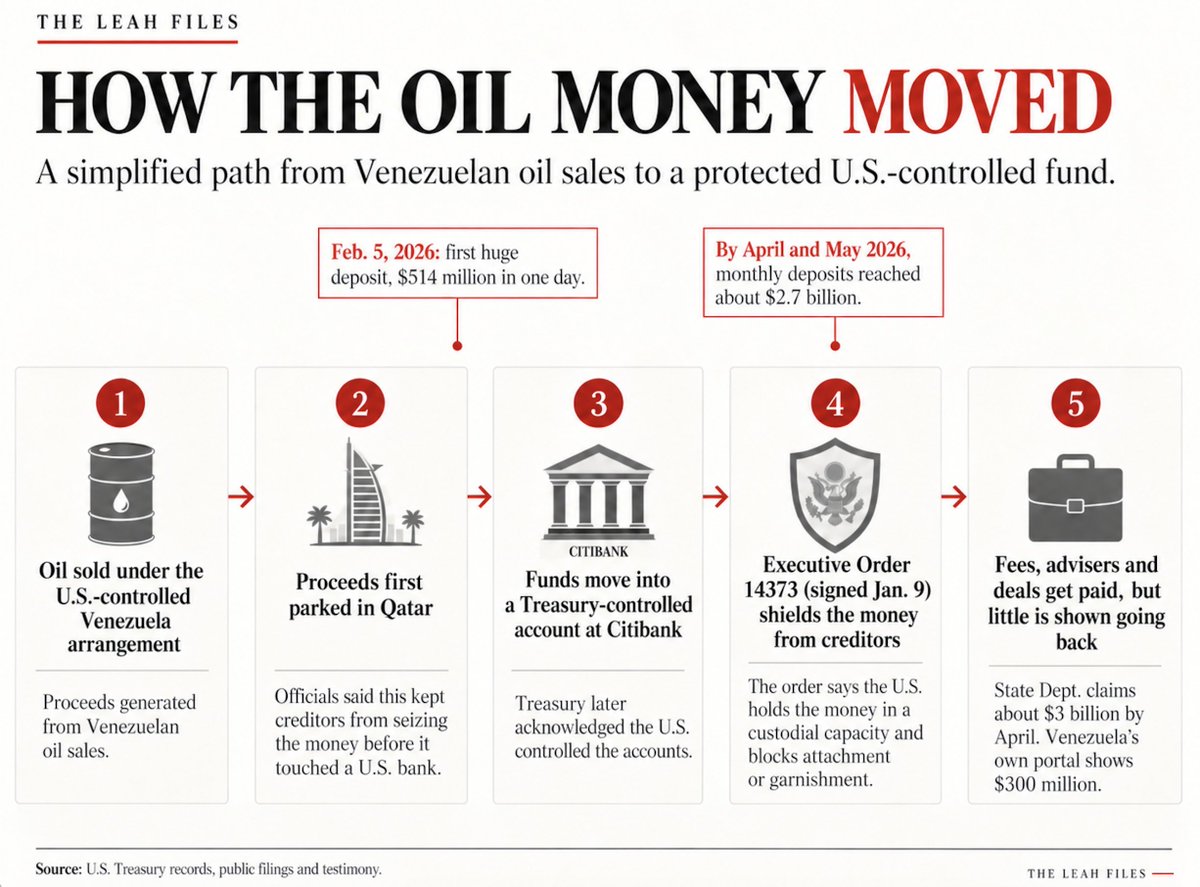
Last week I said it looked like we could be stealing about $11 billion from Venezuela. The question I had after learning that was, if it isn't going back to Venezuela, where is it going? So I followed the money.
Treasury's own data shows about $11 billion more than normal flowing into the State Department's account since February. Venezuela's records show $300 million coming back.
Venezuela has to ask Washington's permission to spend its own oil money. A State Department official told Congress, "It's their money, but ... they have to get our permission." An emergency order blocks every American court from touching it, so the creditors Venezuela owes, most of them American, get nothing.
So who does get paid? The Pentagon took a 35 percent stake in an oil company owned by Alejandro Betancourt, who got rich on Maduro-era contracts. The Miami money laundering investigation into him was closed while that deal came together, though the Justice Department denies ordering it closed. A Venezuelan-born banker facing 20 years got a pardon after $3.5 million went to the president's super PAC in his daughter's name. And in 2012, Betancourt was in Jeffrey Epstein's inbox, copied on a Venezuelan oil pitch.
Last week I asked if we were stealing from Venezuela. After following the money further, I think the better question is who "we" is, because it isn't you and me. It's a small circle of people close to this White House who are getting paid out of another country's oil money, while the Treasury Secretary tells Congress he can't give out a number I found in 15 minutes.
The full article is up on Substack , with every document linked (link is in my bio).
Enjoy!
🇮🇱🇺🇸 How deep does pro-Israel lobbying actually reach inside Washington?
Max Blumenthal says leaked audio from a private AIPAC meeting shows a longtime operative describing figures like John Ratcliffe, Marco Rubio and Mike Waltz as political “lifelines” cultivated from early in their careers.
He also points to a federally registered foreign agent whose work allegedly includes targeting evangelical audiences with pro-Israel messaging, then argues that officials who resist Netanyahu’s agenda eventually find themselves pushed aside.
Source: TCNetwork / Writer: Sol