@yuval_margalit_@GuyTros@FadiKhatib1311@GalunMeirav@RonenBasri [2/2] and models the displacement noise in inlier matches. Together with our two-step noise-aware training, our model achieves state-of-the-art results on both indoor and outdoor datasets while being faster than previous methods.
@yuval_margalit_@GuyTros@FadiKhatib1311@GalunMeirav@RonenBasri [1/2] TL;DR: We propose a simple network architecture based on Deep Sets for estimating the relative position and orientation of two cameras. Given a collection of point matches extracted from two images, our method identifies outlier point matches
Our exciting new paper applies spectral analysis to the neural tangent kernel to unravel the implicit bias of deep, over-parametrized *CNNs*, revealing advantages over fully-connected networks and underscoring the role of hierarchy. https://t.co/FcLch1sagX
Our video lectures from the course Multiple View Geometry for Computer Vision Applications at Weizmann Institute of Science are now available online. https://t.co/SfcSNAoxYe
@RonenBasri@GalunMeirav@AmnonGeifman@HodayaKoslowsky
Our architecture supports two setups: (1) single scene reconstruction and (2) learning from multiple scenes. Our experiments indicate that our method accurately recovers pose and structure, on par with state-of-the-art methods. Here are several examples: (cameras in red)
New paper: Deep Permutation Equivariant Structure from Motion.
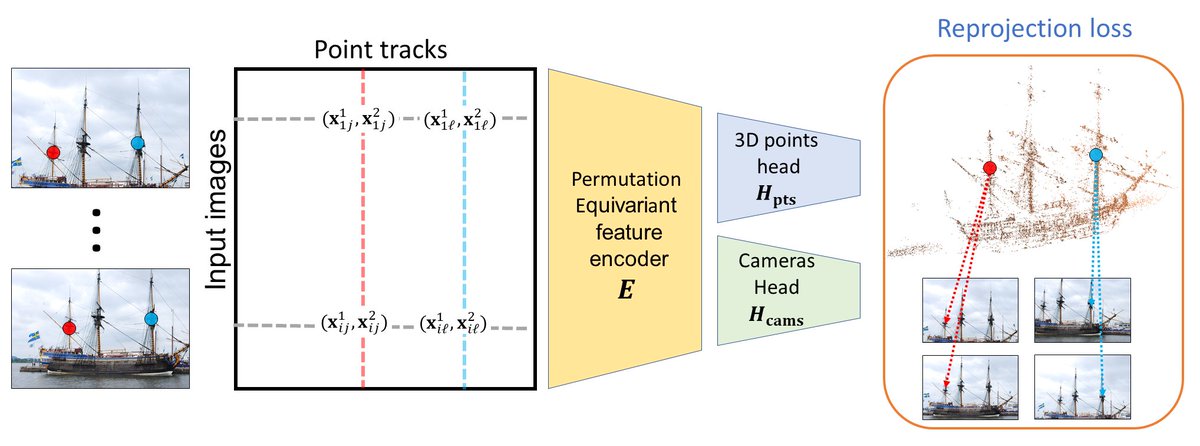
We propose an architecture that, given a set of point tracks in multiple images of a scene, recovers both the camera params and 3D structure by minimizing an unsupervised reprojection loss
https://t.co/Rh83NGcOx5
Our network architecture is designed to respect the structure of the problem: the sought output is equivariant to permutations of both cameras and scene points.