At long last, Cronyism: Rise of the Corporatist State, 1849-1929 is finally OUT!
Cronyism (part deux) threads together the myriad big businesses that sought to capture government for their own benefit and created the corporatist state in the US. From railroad magnates to Wall Street titans, from the origins of the FDA to the founding of the Fed, the book covers special-interest policies from the advent of the Civil War to the eve of the Great Depression.
I am deeply honored that Nobel Laureate Thomas J. Sargent wrote the foreword, wherein he lauds the discipline of economic history, Rothbard’s contributions to the field, and Cronyism-the-series’ place in that important tradition.
Available now on Amazon (link below). Premium print editions, audiobook, online course, and podcast from @mises all coming soon!
Always a delight to speak @mises Supporters Summit. In this talk I discuss Rothbard’s approach to studying history and his grand narrative of American history.
In doing so I provide a little sneak peak of Cronyism III: The warfare-welfare state is alive and well!
https://t.co/PIpxZIy04r
What a great thrill to have Patrick Newman return home and share his great insights on the history of cronyism in US history. Vol 1 and Vol 2 are outstanding, my expectation for Vol 3 is that it will be mind-shifting. Read Patrick!!!
Thank you for your explanation.
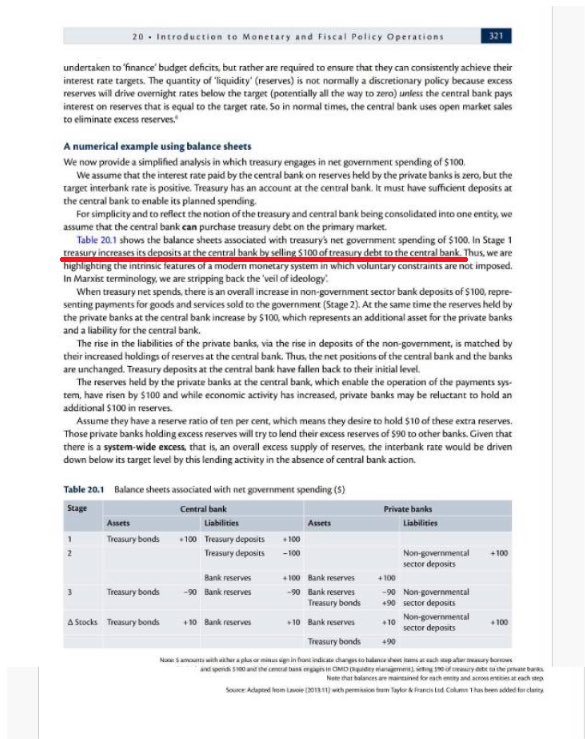
As shown in the images below, Mitchell et al. discuss what is called debt monetization. OMF is just a different phrase.
The treasury sells newly issued government debt to the central bank, and the end result is an increase in the monetary base and deficit spending.
I cited Mitchell and Fazi (2017, pp.183-84, 189-90) and Mitchell, Wray, and Watts (2019, pp.317-26) on debt monetization proposals. Mitchell and Fazi call it “Overt Monetary Financing,” also known as debt monetization. They say it is a "desirable option" from an MMT perspective.
In both sources the policy procedure is:
1) The Treasury sells newly issued bonds to the central bank
2) The Treasury spends the money, which increases non-government deposits and bank reserves
3) The central bank then sells debt to banks to sterilize excess reserves
So the monetary base and government debt goes up. Hence, debt monetization.
Excited that my new paper on sticky prices in the Independent Review @IndependentInst is now available for free download! (https://t.co/mpppj7BXPv)
Competition incentivizes entrepreneurs to flexibly adjust prices and wages when there are shortages and surpluses. Are they perfect? No, of course not. But remember, prices adjust more than we realize--the posted prices are often not the actual prices transactions occur at!
Government interventions restrict competition, which rigidifies prices and wages. Examples include licensing laws, minimum wages, union laws, compulsory publicity laws, anti-"unfair" price cutting regulations, etc. They are examples of corporatism, the system of government enforced cartels and monopolies.
Theory is put to practice by investigating American history from the Civil War to the Great Depression. Prices and wages used to be flexible and demand shocks led to brief recessions (the exception was the Panic of 1893, which was partially caused by a currency crisis that subdued investor certainty). But with the advent of corporatism in the early 1900s, prices and wages rigidified. Government induced sticky wages was the main reason why the Great Depression was so severe.
Couldn't have said it better myself! The Panics of 1873 and 1893 are both discussed in Cronyism: Rise of the Corporatist State, 1849-1929 )(https://t.co/GblEvtiGBP)
The severity of the depression of the 1870s has been exaggerated, as with most 19th century downturns. The 1890s depression was severe, but that was because the panic was also a currency crisis and investors were uncertainty whether the United States would remain on the gold standard. Thank Bryanite Populism for that.
I interviewed @DrPatrickNewman of the Ludwig von Mises Institute on the rise of crony capitalism, why DOGE and the GOP Congress didn’t make a dent, and how it drives young voters into the arms of Socialism.
We talk through potential solutions, and whether they can happen before a fiscal crisis hits 😬
https://t.co/976slcTuzC
@SpruceHeal@mises Thanks for bringing this up!
The audiobook is available on Amazon https://t.co/5WKBLITos5, but hopefully it will get uploaded to the @mises page for Cronyism II soon.
So sorry to hear about your business! I hope it survives the cartelizing meatpacking regulations.
Looking forward to it! If you are interested in the history of special interest policies and the Cronyism series, there is no better way to enjoy your Saturday afternoon (I think)
Thanks for your criticism. Rothbard is heavily cited in the first two chapters because they intentionally build on his Conceived in Liberty series, one volume of which I edited. The subsequent chapters do not cite Rothbard nearly as much, largely because Rothbard’s histories weren’t as extensive for those periods.
As for veering from traditional history, that is because most histories assume that government regulation promoted the public interest. But there is not sufficient evidence for this assumption.
Thanks for having me on! History has a lot to teach us, and the corporatist state created in the early 1900s is stronger than ever. Government enforced cartels and monopolies are alive and well in banking, industry, healthcare, transportation, and more.
The last 6 years shattered the old “business good, government bad” story. @jeffreytucker & @DrPatrickNewman talk about “Cronyism: Rise of the Corporatist State.” How special interests built the regulatory state, the Fed, the FDA, & WWI cartels in the name of the “public good”
Gordon’s book is an excellent overview of all aspects of Rothbard’s thought, including his notable contributions and works written. Our book is an in-depth and archival-based analysis of Rothbard’s development into a prominent Austrian economist in the 1950s. As such, it focuses mainly on the writing of MES and the related economic papers he wrote (eg, “Toward a Reconstruction of Utility and Welfare Economics”).
If you do choose to read our book, we hope that you enjoy it!
Thanks @BobMurphyEcon and @mises for having me on the Human Action podcast to discuss Cronyism II. If you want to start your weekend by learning about Upton Sinclair’s The Jungle, the Federal Reserve and World War I, and more, this is the podcast for you!
https://t.co/ycGPw2yvbD
Be sure to check out my latest @LibertarianInst - a review of @DrPatrickNewman’s excellent new book @mises
I can tell you I’ve cited the first volume in my own work several times and can foresee doing the same with this second 📕
Murray N. Rothbard: The Making of an Austrian Economist is now available for purchase! Available on Amazon, and premium editions available @mises (see links below).
https://t.co/RT9dD0wuCf
https://t.co/pviTyPMCOH
Last week at Rothbard University @mises released a book by @jtsale and I, “Murray N. Rothbard: The Making of an Austrian Economist.” We trace the intellectual development of Rothbard and his writing of Man, Economy, and State. Coming soon to an online bookstore near you!