In the ‘85 WJZ documentary Once Upon a Team the great John Steadman called Ray Berry, Lenny Moore, Johnny U, Art Donovan, Gino Marchetti, Jim Parker & Coach Weeb Ewbank. The Magnificent 7. All Hall of Famers. Hard to argue with that. Lenny is the only one left. Now 92!!
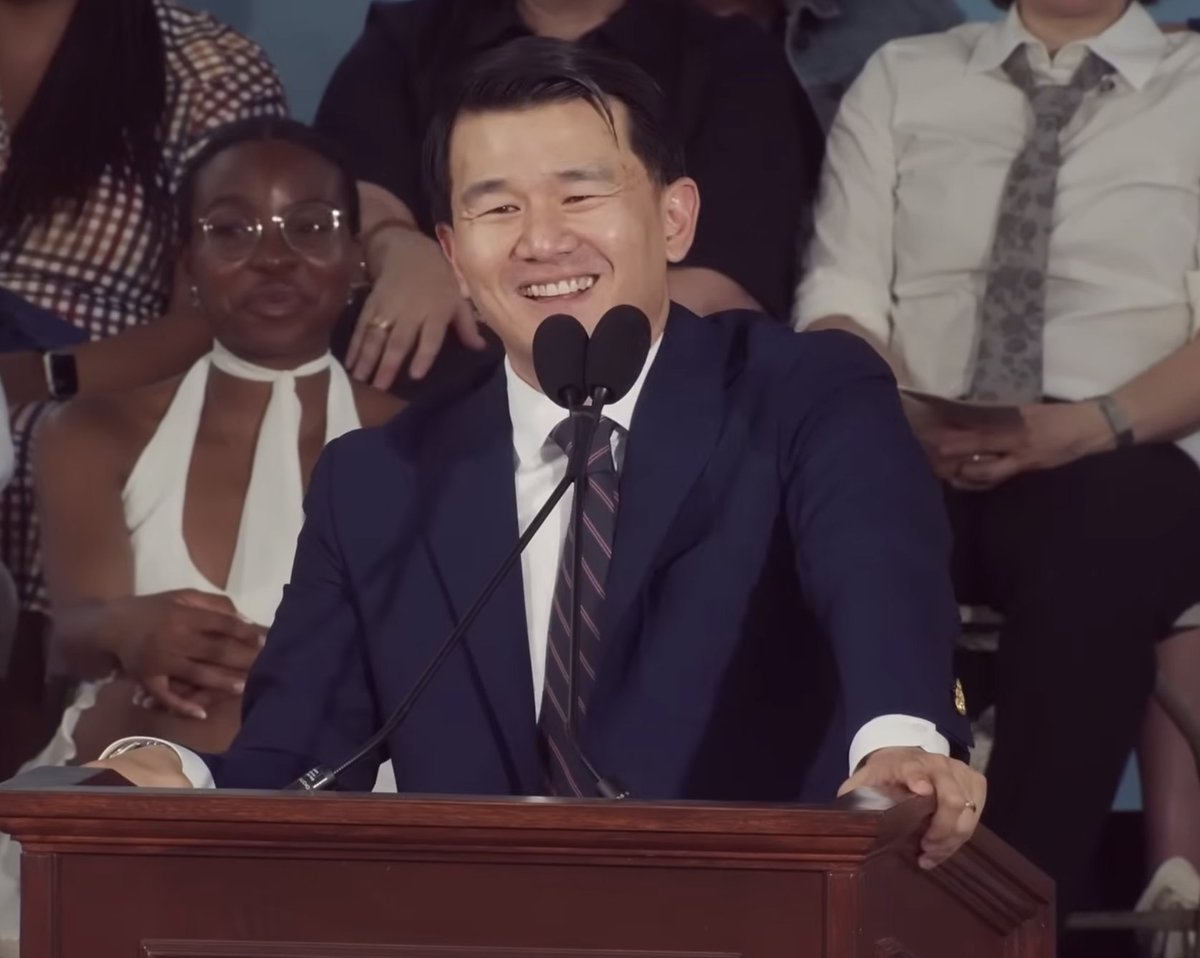
Ronny Chieng had one message for Harvard grads during his commencement speech: destroy AI.
"Look, a lot of other respected graduation speakers in colleges around America are talking about you guys needing to master AI for the future. I'm here to tell you the mission of your generation is to destroy AI...
"And I know, I know there's someone sitting out here right now who’s just like, 'Well, you know, what about the use of AI to pioneer breakthroughs in medicine and physics?' Well, first of all, shut up, nerd. I'm not talking about that. Obviously, if you're using it for that purpose, you're not the problem.
"I'm talking about the accumulation of cognitive debt due to excessive use of large language models according to a study by MIT published in 2025. That's right, MIT. MIT did that study. I guess you guys were too busy giving each other A's. Feel free to boo MIT, by the way, and AI, and yourselves, I guess.
"Look, this is actually good news, okay? This is why you guys shouldn't be scared of AI, because I think AI is just going to end up making mediocre people dumber. Have you heard how dumb people brag about how they use AI? They're always like, 'Hey, did you know that AI can now read my email, summarize it, and drop a response?' Yeah, you know who else can do that? Me. I can do that. You can't do that? How useless are you? You need artificial intelligence just to match me? I'm a dumb*ss who couldn't get into Harvard.
"From what I can see, getting an actual advantage from AI in the future will require a minimum escape velocity of intelligence that I'm assuming you guys from Harvard have. Everyone else who can't match that is just going to get dumber, and that's when you run up the score on them, assuming we still have a functioning society, of course.
"But to run up the score, you’re going to have to master your craft. And AI can be the fuel, but fuel is useless if you can't kindle the fire. For example, I recently used AI to use regression analysis to prove that a certain race of people are mathematically terrible at sports. I won't say which race, but thank you for not inviting Hasan Minhaj to Harvard. My point is, learning the fundamentals still matter. If I didn't know what a regression analysis was, and if I wasn't fundamentally racist, would I have been able to do any of that? No.
"Untalented people love bragging about using AI to help them draft their speeches and their scripts and their podcasts and their promo videos for UFC fights at the White House, which to be fair, even if they had filmed that for real, it would still have looked like AI. But what they're missing is this: the creating is the fun part. The best part of comedy writing is figuring out the puzzle pieces of a joke and getting the self-regard from having accomplished a difficult thing. Why would I want AI to take that away from me?
"You know what problem I want AI to solve? I want the problem of AI making everything look like sh*t. I want AI to solve that problem. How about that?
"Or how about, can AI take away the part of comedy writing where my TV pilot gets passed on and when I ask if I can pitch it to someone else, the network says, 'We don't want it, but we also don't want anyone else to have it. We just want you to be sad.' Can AI solve that?
"I recently tried to introduce my friend to Buddhism through a book called Buddhism Made Simple. It was literally a book about Buddhism made simple. And instead of reading it, he used AI to summarize it in 10 seconds. Believe it or not, he didn't reach enlightenment. It turns out speed running Buddhism is completely missing the point.
"And I know this platitude is almost worthy of AI, but the reason shortcuts to skip to the end aren't always good is because the journey isn't just how we acquire skills. The journey is the point of all this. It is! It turns out maybe the real Harvard was the friends we made along the way.
"Look, I know this won't apply to everyone's industry, but I'm just saying whatever your chosen profession is, please don't let AI rob you of the fun part of it.
"I think your generation's upcoming battle won't be humans against AI. That's at least two months away. It's going to be people with substance versus people with shallow knowledge. It’s going to be mastery versus faking it. It's going to be people with good taste versus tacky. I trust you will put in the work necessary to be on the right side of those battles."
With everything we are hearing right now about ticks this seems like good information to share.
“Here’s what I’ve learned after more ticks than I care to count.
First, whatever your uncle told you, forget it. No matches. No nail polish. No Vaseline. No soap on a cotton ball. All of those do the same terrible thing, they stress the tick out, and a stressed tick empties its gut back into the bite before letting go. Which, if you think about what that actually means for a second, is literally how Lyme and the rest get transmitted so you’re not speeding up its exit. You’re making it throw up into you.
Fine-tipped tweezers. Grip right where the mouthparts enter the skin, not the body, the head. Pull straight up, steady, no twisting, no jerking. It’ll feel like it’s resisting because it is, the mouthparts are barbed. Just keep the pressure on and it lets go in a few seconds. If a piece breaks off in the skin, leave it alone. Your body pushes splinters out. Digging around with a needle does more damage then the fragment ever would.
Clean it with alcohol or soap. Wash your hands.
Now here’s the part most people skip: don’t flush the tick.
Tape it to an index card. Clear packing tape right over the body, write the date and where on your body it was, and stick the card in a drawer. If you come down with anything weird in the next 30 days, rash, fever, joint pain, that flu-that-isn’t-flu feeling, that tick goes with you to the doctor. Some labs will test the tick itself, which is faster and often more reliable than waiting for antibodies to show up in your own blood. A dated tick taped to a card is one of the most useful things you can hand a doctor who’s trying to figure out what’s wrong with you.
The other thing worth saying out loud: if the tick was engorged when you pulled it, and you can’t swear it was off your body within 24 hours, call your doctor that same day. Don’t wait for a rash. Fewer than three out of four Lyme cases even produce the classic bullseye. A single preventive dose of doxycycline within 72 hours of a deer tick bite cuts the Lyme odds way down, and most docs in tick country will write that prescription without giving you a hard time, especially if you walk in with the tick taped to a card and a clear timeline.”
@Jimfrombaseball In 1965 or '66 I saw Whitey pitch against the Orioles. After a pitch, the batter asked the ump to check the ball. Before handing it to the ump, Elston Howard vigorously rubbed the ball into the dirt behind home plate, then nonchalantly handed it to the ump. Priceless!
Trump is now preparing for his third war in 5 months. Working families want their tax dollars for healthcare, schools, housing — not illegal wars that do nothing but pad Palantir's profits.
No war on Cuba. Lift the blockade.
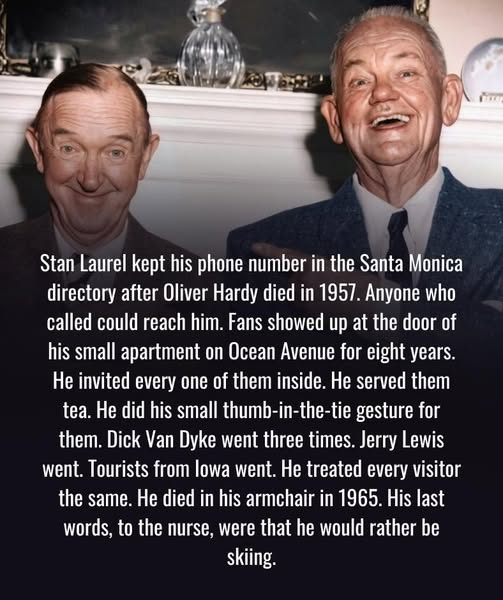
His phone number was in the book.
It was 1957. Oliver Hardy had died in August. Stan Laurel was sixty-seven years old. He was living in a small two-bedroom apartment at the Oceana on Ocean Avenue in Santa Monica. He had moved there after his last divorce because the rent was reasonable and it was within walking distance of the beach.
He had been Hardy's partner for thirty years. They had made over a hundred films together. They had been the most famous comedy duo in the world. They had not been wealthy — they had made most of their films for Hal Roach Studios on contracts that gave them almost nothing in residuals — and by the 1950s they had been living on personal appearance tours and what was left of their savings.
Hardy had a stroke in 1956. He had lost the ability to speak. Stan had visited him every week at his home in North Hollywood. He had sat by the bed and talked. Hardy could not answer. Stan had talked anyway.
Hardy died in August 1957. He weighed a hundred and forty pounds at the end. He had been three hundred at his peak.
Stan was too sick to attend the funeral.
He had been having his own health problems for years. A stroke of his own in 1955. Diabetes. He could no longer travel. The doctor had told him to stay in Santa Monica and rest.
He stayed.
He did not stop working. He could not. He had been writing comedy material for forty years, and he did not know how to do anything else, and the work was the thing that kept him from sitting in the apartment looking at the wall.
He wrote sketches for younger comedians. He answered fan mail. He kept his phone number listed in the Santa Monica directory under his own name. Anyone who wanted to call him could.
The fans started calling.
They started writing. They started showing up at the door. Word had gotten out, somehow, that the apartment number was easy to find. Tourists who had grown up watching the films would knock on the door of 849 Franklin Street, and Stan would open it.
He invited them in.
Every single one of them. For eight years.
He sat in his living room and talked to anyone who came. He served them tea. He showed them photographs from the films. He answered questions. He did his small thumb-in-the-tie gesture that he had done at the end of every film. He laughed at his own jokes and theirs.
He did not have an assistant. He did not have a secretary. He did not have security. He had his second wife, Ida, who made coffee and brought out cake. He did the rest himself.
He did this for hundreds of people.
Filmmakers who would later become famous — Dick Van Dyke, Jerry Lewis, Marcel Marceau, Peter Sellers, the writer Larry Harmon — came to the apartment because they had heard the door was open. So did tourists from Iowa. So did salesmen from Toronto. So did teenagers from Glendale who had ridden the bus across town. He gave them all the same hour.
Dick Van Dyke later said that Stan Laurel had taught him everything he had ever learned about comedy. He said he had gone to that apartment three times in five years. The first time, Stan had sat with him for four hours.
In 1961, Stan was given a special Academy Award for his contribution to comedy. He could not travel to the ceremony. Danny Kaye accepted on his behalf and read a short speech Stan had written. The speech ended with one line, which Stan had insisted on.
The line was: I wish my partner could share this with me. He was the funnier of the two of us.
Stan kept the Oscar on a bookshelf in the apartment. He showed it to fans when they asked. He let them hold it. He told them which year it was for. He never said it had been awarded to him alone. He always said it was for the two of them.
He died in February 1965. He was seventy-four. Heart attack. He had been resting in his armchair in the apartment. The nurse who was attending him in his last weeks had stepped into the kitchen. When she came back, he was gone.
His last words, spoken to the nurse minutes before, were about skiing. He had said he would rather be skiing. She had asked him if he liked to ski. He had said no, he had never skied in his life, but he would rather be doing that than what he was doing.
Then he laughed.
Then he died.
Dick Van Dyke gave the eulogy at the funeral. He said one line that became famous in comedy circles afterward. He said: a man like Stan Laurel doesn't really die. The thing he made is the thing that survives him.
The phone number in the Santa Monica directory was removed by Ida the week after the funeral. She kept the apartment for another two years. Fans still came to the door. She told them, kindly, that Stan was gone.
Some of them had not known.
She invited them in for tea anyway. She showed them the photographs. She told them stories. She did this for two years before she could bear to move out.
Some people, in the last act of their life, keep the door open to anyone who knocks, because they have nothing left to give but their time, and they discover, surprisingly, that their time is the only thing anyone had ever really wanted from them
"The Beatles came out, and there was life to what they were playing. Rock & roll seemed viable — it seemed less like prepackaged marketed pap, and more like there was some expansiveness to the music. I thought the Beatles' music had an incredible economy about it, and at the same time went just about anywhere you could want music to take you.
"We were thinking, 'These guys are awful good.' But also, 'they look like they're having an awful lot of fun.'
"So we became a rock & roll band. The Beatles were why we turned from a jug band into a rock ‘n’ roll band. What we saw them doing was impossibly attractive. I couldn’t think of anything else more worth doing."
--#BobWeir
"It was like the Beatles were saying, 'You can be young, you can be far-out and you can still make it.' They were making people happy. That happy thing — that’s the stuff that counts — was something we could all see right away.
"They're at least as responsible for us being here as anybody else is. They were real important to everybody. The Beatles took rock music into a new realm and raised it to an art form."
--#JerryGarcia
"I come from classical music, so my roots run back to Bach, Beethoven, Brahms, Debussy, Mahler, Chopin and Ives. It's a kind of larger scale of thinking. I personally think that with tunes — that is, songs with lyrics — you can hardly ever develop them. All it usually is, really, is a melody and lyrics and a chord change and you have to more or less be musically repetitive.
"But there are some people who do tunes very well. The Beatles managed to put a lot of development in their stuff. There's nobody yet who has equaled what they did with a tune."
--#PhilLesh
"'Strawberry Fields' . . . god, it was just beautiful. It made your heart beat a little faster. And the content, the lyric content, was so powerful. The arrangements were perfect. It couldn’t have been better. [And] ‘Fool On The Hill’ — I can remember the room, we were in New Jersey, me and Jerry, listening in a tiny room. And there was no heat. It was the middle of the winter, and so we were in gloves and coats, and you could see the breath. And there it was, ‘Fool On The Hill' . . . we just looked at each other and said, ‘Oh boy, this is great music'.
"The Beatles were really something to come to grips with. Because we really weren’t ready for a Beatles. They were big for The Grateful Dead and everybody who was listening to music in the '60s. When Beatles records came out, everybody went out and bought ‘em and went home, and listened to the Beatles. It was Beatles — Beatles, Beatles, Beatles."
--#MickeyHart
#GratefulDead #TheDead #Deadheads #JamBands #Improv #Psychedelia #HallOfFame #TheBeatles #Songwriting #Fun #Influence
@Kasuar5@rocknrollofall Absolutely, doesn't have to be a pretty voice. But the man can sing! Listen to his body of work. He is underrated and underappreciated.


![BeatlesPraise's tweet photo. "The Beatles came out, and there was life to what they were playing. Rock & roll seemed viable — it seemed less like prepackaged marketed pap, and more like there was some expansiveness to the music. I thought the Beatles' music had an incredible economy about it, and at the same time went just about anywhere you could want music to take you.
"We were thinking, 'These guys are awful good.' But also, 'they look like they're having an awful lot of fun.'
"So we became a rock & roll band. The Beatles were why we turned from a jug band into a rock ‘n’ roll band. What we saw them doing was impossibly attractive. I couldn’t think of anything else more worth doing."
--#BobWeir
"It was like the Beatles were saying, 'You can be young, you can be far-out and you can still make it.' They were making people happy. That happy thing — that’s the stuff that counts — was something we could all see right away.
"They're at least as responsible for us being here as anybody else is. They were real important to everybody. The Beatles took rock music into a new realm and raised it to an art form."
--#JerryGarcia
"I come from classical music, so my roots run back to Bach, Beethoven, Brahms, Debussy, Mahler, Chopin and Ives. It's a kind of larger scale of thinking. I personally think that with tunes — that is, songs with lyrics — you can hardly ever develop them. All it usually is, really, is a melody and lyrics and a chord change and you have to more or less be musically repetitive.
"But there are some people who do tunes very well. The Beatles managed to put a lot of development in their stuff. There's nobody yet who has equaled what they did with a tune."
--#PhilLesh
"'Strawberry Fields' . . . god, it was just beautiful. It made your heart beat a little faster. And the content, the lyric content, was so powerful. The arrangements were perfect. It couldn’t have been better. [And] ‘Fool On The Hill’ — I can remember the room, we were in New Jersey, me and Jerry, listening in a tiny room. And there was no heat. It was the middle of the winter, and so we were in gloves and coats, and you could see the breath. And there it was, ‘Fool On The Hill' . . . we just looked at each other and said, ‘Oh boy, this is great music'.
"The Beatles were really something to come to grips with. Because we really weren’t ready for a Beatles. They were big for The Grateful Dead and everybody who was listening to music in the '60s. When Beatles records came out, everybody went out and bought ‘em and went home, and listened to the Beatles. It was Beatles — Beatles, Beatles, Beatles."
--#MickeyHart
#GratefulDead #TheDead #Deadheads #JamBands #Improv #Psychedelia #HallOfFame #TheBeatles #Songwriting #Fun #Influence](https://pbs.twimg.com/media/HHvSDUzWIAMpdPd.jpg)






![BeatlesPraise's tweet photo. "The Beatles came out, and there was life to what they were playing. Rock & roll seemed viable — it seemed less like prepackaged marketed pap, and more like there was some expansiveness to the music. I thought the Beatles' music had an incredible economy about it, and at the same time went just about anywhere you could want music to take you.
"We were thinking, 'These guys are awful good.' But also, 'they look like they're having an awful lot of fun.'
"So we became a rock & roll band. The Beatles were why we turned from a jug band into a rock ‘n’ roll band. What we saw them doing was impossibly attractive. I couldn’t think of anything else more worth doing."
--#BobWeir
"It was like the Beatles were saying, 'You can be young, you can be far-out and you can still make it.' They were making people happy. That happy thing — that’s the stuff that counts — was something we could all see right away.
"They're at least as responsible for us being here as anybody else is. They were real important to everybody. The Beatles took rock music into a new realm and raised it to an art form."
--#JerryGarcia
"I come from classical music, so my roots run back to Bach, Beethoven, Brahms, Debussy, Mahler, Chopin and Ives. It's a kind of larger scale of thinking. I personally think that with tunes — that is, songs with lyrics — you can hardly ever develop them. All it usually is, really, is a melody and lyrics and a chord change and you have to more or less be musically repetitive.
"But there are some people who do tunes very well. The Beatles managed to put a lot of development in their stuff. There's nobody yet who has equaled what they did with a tune."
--#PhilLesh
"'Strawberry Fields' . . . god, it was just beautiful. It made your heart beat a little faster. And the content, the lyric content, was so powerful. The arrangements were perfect. It couldn’t have been better. [And] ‘Fool On The Hill’ — I can remember the room, we were in New Jersey, me and Jerry, listening in a tiny room. And there was no heat. It was the middle of the winter, and so we were in gloves and coats, and you could see the breath. And there it was, ‘Fool On The Hill' . . . we just looked at each other and said, ‘Oh boy, this is great music'.
"The Beatles were really something to come to grips with. Because we really weren’t ready for a Beatles. They were big for The Grateful Dead and everybody who was listening to music in the '60s. When Beatles records came out, everybody went out and bought ‘em and went home, and listened to the Beatles. It was Beatles — Beatles, Beatles, Beatles."
--#MickeyHart
#GratefulDead #TheDead #Deadheads #JamBands #Improv #Psychedelia #HallOfFame #TheBeatles #Songwriting #Fun #Influence](https://pbs.twimg.com/media/HHvSJ83WUAQle_n.jpg)


