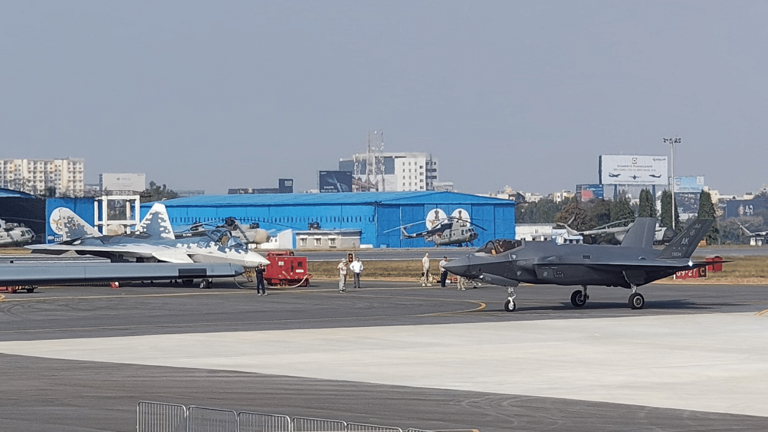
For the FIRST time ever, two global rivals—the United States and Russia—are bringing their most advanced 5th-generation stealth fighter jets together on Indian soil!
✈ F-35 Lightning II (#USA ) 🇺🇸
✈ Su-57 Felon (#Russia ) 🇷🇺
Aero India has become the ultimate stage where the world’s top aviation giants stand side by side, proving India’s role as a strategic global peace and a rising aerospace power.
Yet, despite such influence, India is still denied a permanent seat at the United Nations Security Council (#UNSC).
As a true Vishwaguru , India continues to shape the future of global defence, diplomacy and innovation—a leader that deserves its rightful place on the world stage! 🇮🇳
@SpokespersonMoD@DefenceMinIndia@DefenceU@IndiainUkraine@EUDefenceAgency@NATO@RusEmbIndia@mog_Russ@usnews@MedvedevRussiaE@AmericanAir@DefencePROkochi@UKDefJournal@GovtofPakistan@USIofIndia@dushy40098@OfficialCLAWSIN@aircenteraz
#RussianArmy #usarmy #IndianArmy #indianairforce #AeroIndia2025
Energy Tie-Up Tops India–Venezuela Agenda
Prime Minister Narendra Modi’s meeting with Venezuelan Acting President Delcy Rodríguez highlights India’s push to diversify its crude oil sources and strengthen long-term energy security.
India imports nearly 90% of its crude oil, making supply diversification a strategic priority. Venezuela has again become important for India, with India importing around 427,000 barrels per day of Venezuelan crude in May 2026, making it the second-largest buyer after the US.
The talks focused on upstream and downstream energy cooperation, long-term crude supply arrangements, and wider economic areas including critical minerals, mining, pharmaceuticals, trade and investment.
For India, this engagement is not just commercial it is strategic. As global oil routes face disruption and uncertainty, deeper energy ties with Venezuela can help New Delhi build a more resilient import basket, protect refinery needs, and strengthen strategic autonomy.
Key Data:
•India imports nearly 90% of its crude requirement.
•India bought around 427,000 barrels/day of Venezuelan crude in May 2026.
•Venezuela is among India’s major crude suppliers again.
•Cooperation may expand into critical minerals, mining and pharmaceuticals.
Energy security is now a core pillar of India’s foreign policy.
#IndiaVenezuela #EnergySecurity #PMModi #DelcyRodriguez #CrudeOil #StrategicAutonomy #EnergyDiplomacy #Geopolitics #CriticalMinerals #IndiaForeignPolicy @pawanagrawalceo
DRDO–IAF RudraM-II Test: India’s Indigenous Precision Strike Capability Gets Stronger
India has achieved another major milestone in indigenous missile development as DRDO and the Indian Air Force successfully flight-tested the RudraM-II air-to-surface missile from an airborne platform on 2 June 2026. The test was conducted under extreme release conditions, and the missile successfully struck its pre-designated target with pinpoint accuracy.
Key Data Points
* Missile: RudraM-II
* Type: Indigenous air-to-surface missile
* Launch platform: Su-30MKI fighter aircraft
* Test location: Integrated Test Range, Chandipur, Odisha
* Role: Precision strike / Suppression and Destruction of Enemy Air Defences
* Estimated range: Around 300 km
* Warhead: Around 200 kg
* Speed: Reported terminal speed of around Mach 5.5
* Developer: DRDO’s Research Centre Imarat, Hyderabad, with DRDL, HEMRL, ARDE and ITR support
* Industry ecosystem: HAL, RCMA, MSQAA, DcPPs and other Indian industry partners
The significance of RudraM-II lies in its ability to strengthen the IAF’s stand-off precision strike capability. In modern warfare, the first battle is often fought against enemy radar, command nodes and air-defence systems. A weapon like RudraM-II gives the IAF the ability to engage critical targets from safer distances, reducing aircraft exposure while improving mission effectiveness.
This successful test also highlights the growing maturity of India’s indigenous missile ecosystem. From design and propulsion to guidance, warhead integration, quality assurance and flight validation, RudraM-II reflects the combined strength of DRDO laboratories, the IAF, DPSUs and private industry partners.
RudraM-II is not just about range and accuracy it is about giving India the power to strike deeper, faster and smarter.
#DRDO #IndianAirForce #RudraMII #Su30MKI #IndianDefence #AatmanirbharBharat #MakeInIndia #MissileTechnology #PrecisionStrike #NationalSecurity #DefenceTechnology #IAF #SEAD #DEAD #DefenceInnovation @pawanagrawalceo
DFPDS-2026: India Moves Towards Faster, Smarter and More Decentralised Defence Procurement
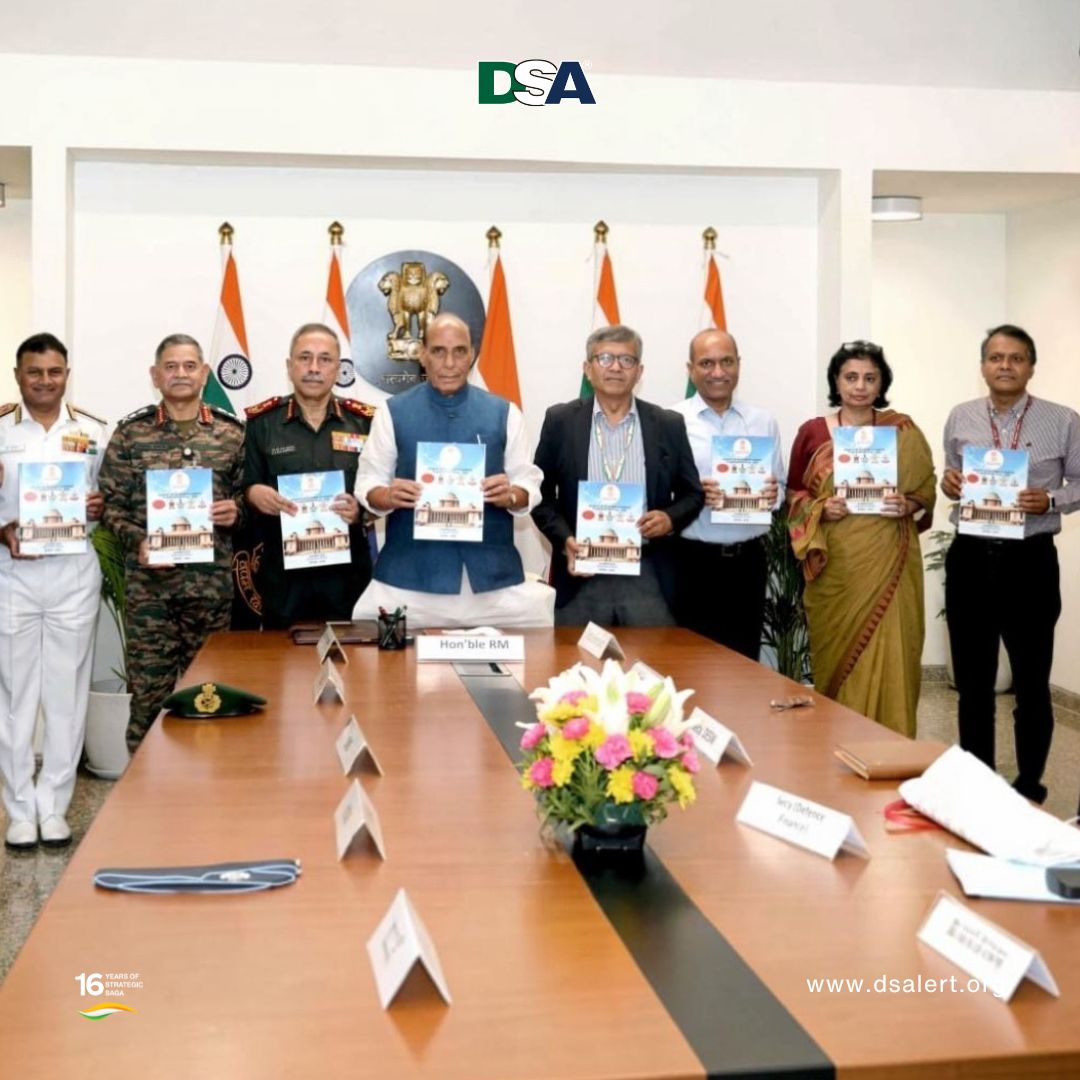
Defence Minister Rajnath Singh has launched the Delegation of Financial Powers to Defence Services 2026 (DFPDS-2026), a major reform aimed at strengthening India’s military readiness and procurement efficiency. With enhanced financial powers for revenue-related procurement worth over ₹1.25 lakh crore annually, the new framework gives greater authority to field commanders and service leadership to take faster decisions based on operational needs.
This reform matters because modern warfare does not wait for slow files and delayed approvals. From urgent operational requirements to infrastructure development, equipment sustainment, research and indigenisation, speed has become a strategic necessity.
Key takeaways from DFPDS-2026:
✅ Faster procurement decisions for the Armed Forces
✅ Increased powers for urgent operational requirements
✅ Stronger support for indigenous R&D
✅ Reduced dependence on foreign OEMs
✅ Greater participation of MSMEs, startups and private industry
✅ Doubled financial powers for works projects
✅ Higher delegation for Joint Service procurement through the Lead Service model
✅ More decentralised procurement of goods and services
The financial powers for indigenisation and R&D within the military ecosystem have also been doubled, giving a stronger push to Aatmanirbharta in defence. The message is clear: India’s defence reforms are now moving beyond acquisition of platforms. They are focused on building a faster, more flexible and self-reliant military system.
DFPDS-2026 is not just about financial delegation. It is about empowering commanders, strengthening readiness and accelerating India’s defence-industrial transformation.
#DFPDS2026 #RajnathSingh #IndianDefence #DefenceReforms #AatmanirbharBharat #DefenceProcurement #IndianArmedForces #MakeInIndia #MSME #Startups #MilitaryModernisation #NationalSecurity #DefenceIndustry @pawanagrawalceo
Russia–Taliban Military-Technical Pact: A New Strategic Shift in Afghanistan
Russia and the Taliban-led administration have signed a military-technical cooperation agreement, marking a significant development in Moscow’s evolving Afghanistan policy.
The agreement was signed on 27 May 2026 during the International Security Forum in Moscow, following a meeting between Russian Security Council Secretary Sergei Shoigu and Taliban Defence Minister Mohammad Yaqoob Mujahid. While the full text has not been publicly released, reports suggest that the pact focuses mainly on repairing Russian-made military equipment, logistical support, and creating a legal framework for future defence cooperation. Strategically, this is not merely a technical arrangement. For Moscow, the objective appears to be broader: strengthening influence in Afghanistan, securing its southern strategic perimeter, and building a buffer against ISIS-K threats that could destabilise Central Asia.
This agreement also follows Russia’s gradual normalisation of ties with the Taliban. In 2025, Russia suspended its terrorist designation of the Taliban and later became the first country to formally recognise the Taliban-led government in Afghanistan. For South Asia, the move carries wider implications. It may reduce Pakistan’s traditional strategic leverage in Afghanistan while opening space for new regional alignments involving Russia, Central Asia, Afghanistan and potentially India.
The key takeaway is clear: Afghanistan is once again becoming a central theatre in regional power politics not through occupation, but through security partnerships, counterterrorism calculations and strategic influence.
This is not yet a formal military alliance, but it is a clear signal that Moscow is deepening its security engagement with Kabul.
#Russia #Taliban #Afghanistan #Geopolitics #CentralAsia #ISISK #DefenceCooperation #RegionalSecurity #SouthAsia #India #StrategicAffairs #SecurityStudies #ForeignPolicy #DefenceAnalysis @pawanagrawalceo
China’s Nuclear Build-up: Why India Must Watch Closely
China’s rapid nuclear modernisation is no longer a distant strategic development. It is becoming one of the biggest security shifts in Asia. Recent satellite imagery reviewed by Reuters shows that China is building a vast network of 80+ launch pads, bunkers and communication nodes near its nuclear missile silo fields in Xinjiang and Gansu. Analysts believe these sites may support mobile missile launchers, air-defence systems, electronic warfare units and command-and-control infrastructure.
This is not just about more missiles. This is about survivability, second-strike capability and long-term deterrence dominance. China already has one of the fastest-growing nuclear arsenals in the world. SIPRI estimates China’s nuclear stockpile at around 600 warheads, while US assessments have earlier projected that China could move towards 1,000 operational nuclear warheads by 2030. For India, this development carries serious strategic meaning.
India faces a unique security challenge: a nuclear-armed China on one side and a nuclear-armed Pakistan on the other. Any expansion in China’s nuclear posture directly affects the regional balance, especially when combined with Beijing’s growing missile force, hypersonic systems, space surveillance, cyber capability and military pressure along the Line of Actual Control. India’s answer should not be panic. India’s answer should be preparedness.
New Delhi must continue strengthening its credible minimum deterrence, survivable second-strike capability, nuclear command-and-control, space-based intelligence, missile defence, cyber resilience and indigenous strategic technologies. The future of deterrence will not depend only on the number of warheads. It will depend on who can protect, detect, survive and respond with credibility. China’s desert silos and launch infrastructure are not just military construction projects. They are signals of a changing nuclear order in the Indo-Pacific.
For India, the message is clear: strategic patience must now be matched with strategic readiness.
#China #India #NuclearDeterrence #IndoPacific #NationalSecurity #IndiaChina #StrategicStability #DefenceStrategy #MissileDefence #Geopolitics #IndianDefence #SecurityStudies #StrategicAffairs #DefenceAnalysis #AtmanirbharBhara @pawanagrawalceo
🇮🇳🇷🇺 Su-57 for India: A Strategic Opportunity or a Capability Bridge?
Russia’s offer to jointly manufacture the Su-57 stealth fighter with India could become a major turning point in Indian air power.
For the Indian Air Force, this is not just about buying a fifth-generation aircraft. It is about closing the capability gap as China fields the J-20 and Pakistan explores next-generation platforms.
If structured smartly, Su-57 cooperation can give India:
✅ Near-term stealth capability before AMCA
✅ Make in India production ecosystem
✅ Technology exposure in stealth, sensors and avionics
✅ Stronger aerospace manufacturing base
✅ Strategic leverage in a changing Indo-Pacific
But the real test will be technology transfer, cost, timelines and whether this programme strengthens not slows India’s indigenous AMCA roadmap.
India does not need just another fighter deal. India needs a capability multiplier.
The Su-57 proposal should be judged by one question:
Will it help India become a producer of next-generation air power, not just an importer of it?
#Su57 #IndianAirForce #IndiaRussia #AMCA #StealthFighter #MakeInIndia #AatmanirbharBharat #DefenceTechnology #AirPower #Geopolitics #NationalSecurity #DefenceManufacturing #IndoPacific #MilitaryAviation @pawanagrawalceo
J&K on High Alert: Rajouri Operation Still Underway
The anti-terror operation in Jammu & Kashmir’s Rajouri district has entered its 10th day and is still continuing, as security forces carry out extensive search, surveillance and area-domination operations to track and neutralise terrorist threats.
Meanwhile, in the Uri sector, alert security personnel apprehended a suspected intruder from Pakistan-occupied Jammu & Kashmir (PoJK), highlighting the constant vigilance required along the Line of Control.
These developments once again show the operational readiness of India’s security forces in sensitive border areas. From Rajouri to Uri, the mission remains clear: prevent infiltration, protect civilians and maintain peace in Jammu & Kashmir.
Authorities are investigating the motive behind the intrusion, while counter-terror and border-security operations continue to ensure that any threat to national security is dealt with firmly.
India’s security forces remain watchful, determined and fully prepared.
#JammuKashmir #Rajouri #Uri #LoC #CounterTerrorism #IndianArmy #BorderSecurity #NationalSecurity #InternalSecurity #IndiaFirst @pawanagrawalceo
General N. S. Raja Subramani Takes Charge as India’s New CDS: A Renewed Push for Jointness, Aatmanirbharta and Military Transformation
General N. S. Raja Subramani, PVSM, AVSM, SM, VSM, assumed charge as India’s third Chief of Defence Staff and Secretary, Department of Military Affairs on 31 May 2026, succeeding General Anil Chauhan.
Commissioned into the 8th Battalion of the Garhwal Rifles on 14 December 1985, General Subramani brings nearly four decades of distinguished military service to India’s highest military leadership role. Over the years, he has held key command, staff and strategic appointments, including Vice Chief of the Army Staff, General Officer Commanding-in-Chief, Central Command and Military Adviser at the National Security Council Secretariat.
His appointment comes at a decisive moment in India’s defence transformation, as the nation moves towards deeper tri-service integration, jointness, theatre commands, indigenous modernisation and future-ready operational preparedness.
After assuming office, General Subramani underlined that his key priorities would include strengthening coordination among the Army, Navy and Air Force, accelerating organisational reforms and ensuring faster induction and integration of indigenous defence systems into the Armed Forces.
His leadership is expected to bring four major benefits to India’s defence sector:
1.Stronger coordination among the three services for more effective joint operations.
2.Faster military modernisation to meet emerging security challenges.
3.Greater emphasis on Aatmanirbharta through indigenous defence platforms and technologies.
4.Enhanced preparedness to protect India’s sovereignty and territorial integrity.
As India works towards building a more integrated, technology-driven and self-reliant military structure, General N. S. Raja Subramani’s tenure as CDS will be important in shaping the next phase of India’s defence transformation.
Team DSA extends its respectful congratulations to General N. S. Raja Subramani and wishes him continued success in his new responsibility.
#ChiefOfDefenceStaff #IndianArmedForces #IndianArmy #DefenceReforms #Jointness #AatmanirbharBharat #MilitaryTransformation #NationalSecurity #TriServiceIntegration #TeamDSA @pawanagrawalceo
India–EU Free Trade Deal Marks a Major Shift in Global Economic Dynamics
The India–European Union Free Trade Agreement marks an important step in the changing global economic order.
Concluded during the 16th India–EU Summit in New Delhi on 27 January 2026, the agreement strengthens India–EU cooperation in trade, investment, supply chains and strategic security.
At a time when global trade is facing tariff pressure, supply-chain disruption and rising geopolitical competition, Europe is increasingly looking towards India as a reliable economic partner.
The agreement is expected to boost trade, attract investment, create jobs, support manufacturing and position India as a rising global trade hub.
Key Highlights:
* Expands market access for Indian and European businesses
* Reduces trade barriers and simplifies procedures
* Opens new export opportunities
* Strengthens supply-chain diversification
* Deepens India–EU economic and security cooperation
This agreement reflects India’s growing importance in the European Union’s economic and strategic outlook. It is not just a trade deal, but a step towards stronger economic resilience and deeper India–EU partnership in a changing world order.
#IndiaEU #FreeTradeAgreement #GlobalTrade #IndianEconomy #EuropeanUnion #Geoeconomics #SupplyChains #MakeInIndia #StrategicPartnership #EconomicDiplomacy @pawanagrawalceo
Quad Foreign Ministers’ Meeting 2026: India Anchors the Indo-Pacific Agenda
The Quad Foreign Ministers’ Meeting, hosted by External Affairs Minister Dr S. Jaishankar, was held in New Delhi at Hyderabad House on 26 May 2026, bringing together Australia’s Foreign Minister Penny Wong, Japan’s Foreign Minister Toshimitsu Motegi, and U.S. Secretary of State Marco Rubio.
This meeting built on the previous Quad discussions held in Washington, D.C. on 1 July 2025, with the focus on advancing cooperation for a Free, Open, Inclusive and Rules-Based Indo-Pacific.
Key priorities included:
🔹 Maritime security and freedom of navigation
🔹 Critical minerals and resilient supply chains
🔹 Energy security and strategic fuel resilience
🔹 Indo-Pacific maritime surveillance cooperation
🔹 Regional connectivity, infrastructure and disaster response
A major outcome was the launch of a new Indo-Pacific energy security framework, aimed at protecting the uninterrupted flow of global commerce amid rising risks to energy supply chains. Reports also highlighted Quad cooperation on critical minerals and maritime domain awareness, including a proposed $20 million agreement to improve mineral flow among Quad partners.
For India, hosting the Quad in 2026 reinforces New Delhi’s position as a central pillar of Indo-Pacific stability. It also reflects India’s ability to engage major democracies while preserving its strategic autonomy. The message is clear: Quad is no longer just a dialogue platform; it is becoming a practical mechanism for security, supply-chain resilience and regional stability.
#Quad #IndiaDiplomacy #IndoPacific #StrategicAffairs #MaritimeSecurity #ForeignPolicy #Geopolitics #CriticalMinerals #EnergySecurity #NewDelhi @pawanagrawalceo
India–US Critical Minerals Pact: Strategic Supply-Chain Security
India and the US have signed a key framework to strengthen cooperation in the supply, mining and processing of critical minerals and rare earth elements.
Exchanged between EAM Dr S. Jaishankar and US Secretary of State Marco Rubio in New Delhi, the agreement aims to build resilient and diversified supply chains, support financing, and improve the management of critical mineral resources.
This is strategically important because critical minerals power semiconductors, EV batteries, clean energy systems, defence platforms, aerospace technologies and advanced electronics.
For India, the pact can strengthen domestic manufacturing, reduce supply-chain dependence, and support Atmanirbhar Bharat in high-technology sectors.
In today’s geopolitical environment, critical minerals are not just economic assets they are instruments of strategic power.
#IndiaUSRelations #CriticalMinerals #RareEarths #SupplyChainSecurity #Geopolitics #AtmanirbharBharat #DefenceManufacturing
India-Cyprus Defence Ties: Operation Sindoor Opens a New Export Window
Cyprus’ reported interest in Indian-made defence systems, including Nagastra and SkyStriker drones, is a strong signal that India’s combat-tested capabilities are now gaining international credibility.
After Operation Sindoor 2025, where India showcased precision strike and drone warfare capability, Cyprus is looking at Indian platforms to counter regional drone threats, especially from Turkey-backed systems.
During President Nikos Christodoulides’ India visit, both sides signed:
* Roadmap for Bilateral Defence Cooperation: 2026–2031
* MoU between CyDSIC and SIDM
* Technical Arrangement on Search & Rescue cooperation
The numbers matter. Cyprus is eligible for nearly €1.2 billion under EU defence funding instruments, creating a major opening for Indian defence exporters in the European market. For India, this partnership strengthens three goals: defence exports, India-EU security cooperation, and access to the Mediterranean defence ecosystem. From Atmanirbhar Bharat to combat-tested defence exports, India’s defence industry is entering a new strategic phase.
#IndiaCyprus #DefenceExports #OperationSindoor #AtmanirbharBharat #IndianDefenceIndustry #IndiaEU #Drones #StrategicPartnership #MaritimeSecurity @pawanagrawalceo
India at SOF Week 2026: Special Forces Diplomacy in Action
India’s participation in SOF Week 2026, held in Tampa, Florida from May 18–21, marks an important step in India’s expanding defence diplomacy. A high-level Indian Armed Forces delegation was led by Lt Gen Pushpendra Pal Singh, GOC-in-C Western Command and the seniormost serving Special Forces officer of the Indian Armed Forces. A major highlight was India’s first-ever participation in CAPEX, the biannual capability demonstration of SOF Week. The 2026 demonstration, titled “Battle in the Bay,” was conducted on May 20 at the Tampa waterfront and featured US Special Operations Forces with contingents from 10 partner nations in an integrated live-operational environment. For India, this was not just participation; it was strategic signalling.
It showcased Indian Special Forces’ growing proficiency in counter-terrorism, unconventional warfare, high-altitude combat and jungle warfare. More importantly, it reflected India’s intent to deepen interoperability, operational learning and defence cooperation with global partners while maintaining strategic autonomy. In an era of grey-zone conflict, terrorism, drones and hybrid warfare, Special Forces are becoming central to future military operations. India’s presence at SOF Week 2026 highlights its rising role as a credible security partner in the global special operations ecosystem.
#IndianArmedForces #SpecialForces #SOFWeek2026 #IndiaUSDefence #IndianArmy #WesternCommand #DefenceDiplomacy #CounterTerrorism #StrategicAffairs #GlobalSecurity
India has received its fourth Russian S-400 Triumf air defence squadron, reportedly being deployed in the Rajasthan sector to strengthen western air defence coverage. The system is expected to enhance protection across key military and strategic zones near the Pakistan front.
The S-400 is one of the world’s most advanced air defence systems, capable of:
* Detecting targets up to 600 km away
* Intercepting aerial threats at ranges of 40 km, 120 km, 250 km, and 400 km using different missile layers
* Tracking over 100 targets simultaneously
* Neutralising fighter aircraft, AWACS, drones, cruise missiles, and ballistic missiles
Strategically, the Rajasthan deployment improves India’s defence coverage against potential threats originating from Pakistan’s aerial and missile infrastructure, while also strengthening India’s broader western air defence grid. The system can potentially cover large portions of Pakistan’s airspace from Indian territory, creating a strong deterrence umbrella around sensitive military bases, logistics hubs, and critical infrastructure. With four S-400 squadrons now operational or under deployment and the fifth expected soon India is steadily building a multi-layered air defence shield for both western and northern theatres.
#India #Russia #S400 #IndianAirForce #AirDefence #StrategicAffairs #Defence #MilitaryTechnology #NationalSecurity #Geopolitics
The Siliguri Corridor: India’s Strategic Lifeline
On 19 May 2026, reports emerged that the West Bengal Government authorised the transfer of nearly 120 acres of land in the strategic Siliguri Corridor to the Central Government/BSF for security and infrastructure purposes. This is far bigger than a routine land decision. Known as the “Chicken’s Neck”, the Siliguri Corridor is the narrow stretch connecting mainland India to the Northeast while sitting close to China’s Chumbi Valley, Nepal, Bhutan, and Bangladesh.
In any future conflict or crisis, this corridor becomes critical for:
* Military mobilisation
* Logistics & supply chains
* Border surveillance
* Civilian connectivity
* Strategic deterrence
Post-Doklam, the strategic importance of Siliguri has grown significantly as India accelerates border infrastructure and Northeast connectivity projects. Sometimes geopolitics is shaped not through speeches, but through land, roads, and logistics. And Siliguri remains at the centre of that strategy.
#SiliguriCorridor #NationalSecurity #India #Geopolitics #StrategicAffairs #BorderSecurity #NorthEastIndia #Defence #China #Doklam
The 3rd India-Nordic Summit in Oslo marks another important step in India’s strategic engagement with the Nordic region, as Prime Minister Narendra Modi meets leaders of the five Nordic nations on May 18–19, 2026.
The summit focuses on maritime security, green technology, digital innovation, AI, semiconductors, and Arctic geopolitics areas increasingly shaping the future global order.
For India, the partnership offers major strategic benefits:
🔹 Access to advanced green & clean technologies
🔹 Cooperation in Arctic research and emerging trade routes
🔹 Stronger maritime and supply chain security
🔹 Investment and innovation partnerships with high-tech economies
🔹 Greater strategic influence in Europe and the Indo-Pacific
The summit reflects India’s evolving multi-alignment strategy building partnerships that support technological growth, sustainability, and strategic autonomy in a rapidly changing world.
#IndiaNordicSummit #NarendraModi #Geopolitics #Arctic #IndiaEuropeRelations #GreenTechnology #MaritimeSecurity #IndoPacific #ForeignPolicy #StrategicPartnership
The World Health Organization (WHO) has declared the Ebola outbreak in the Democratic Republic of the Congo (DRC) and Uganda a “Public Health Emergency of International Concern” (PHEIC).
As of 16 May 2026:
* 644 confirmed cases
* 513 suspected cases
* 131 suspected deaths
* Cross-border spread confirmed in Uganda
The Bundibugyo strain currently has no approved vaccine or specific treatment, raising serious concerns over regional and global health security. WHO has also warned that the actual scale of the outbreak may be far larger than currently detected?
The timing is strategically significant. The COVID-19 pandemic reshaped the global order during the presidency of Donald Trump, exposing vulnerabilities in supply chains, healthcare systems, and international coordination. Now, another dangerous outbreak is emerging again during the Trump era, reminding the world that biological crises can rapidly evolve into geopolitical and economic disruptions.
For India, this is not a distant African crisis alone. India’s large pharmaceutical sector, global medical outreach, diaspora connectivity, and expanding trade engagement with Africa make pandemic preparedness a strategic necessity. Future outbreaks can impact global mobility, energy markets, supply chains, and economic stability far beyond their point of origin.
This crisis reinforces an important reality: in the 21st century, health security is national security, and pandemic preparedness is now a core pillar of strategic governance.
#Ebola #WHO #GlobalHealth #HealthSecurity #DRC #Uganda #PandemicPreparedness #India #StrategicAffairs #BioSecurity #GlobalSecurity #PublicHealth #DonaldTrump
Defence Indigenisation Is No Longer Optional for India
For years, defence imports were viewed as capability acquisition. But modern geopolitics has exposed a deeper reality: Dependence during crisis becomes vulnerability. Wars, sanctions, supply-chain disruptions and geopolitical polarization have shown how quickly external military dependence can become a strategic liability. This is precisely why India’s defence indigenisation push has become far more than an economic initiative.
It is now a strategic imperative. From artillery systems and missile programs to naval platforms, drones, electronic warfare systems and defence electronics India is attempting to build long-term strategic self-reliance. The real objective is not isolation. India will continue global defence partnerships. The objective is survivability during prolonged geopolitical disruption. Because future wars may not only test military strength.
They may test:
* Manufacturing depth
* Technological independence
* Industrial endurance
* Supply-chain sustainability
A nation that cannot sustain its own military ecosystem during extended conflict risks strategic exhaustion. This is why “Atmanirbhar Bharat” in defence should not be misunderstood as a slogan. It reflects a recognition that national security in the 21st century begins inside factories, laboratories, shipyards and semiconductor ecosystems long before the battlefield.
#AtmanirbharBharat #Defence #India #MilitaryModernisation #IndianArmy #IndianNavy #NationalSecurity #StrategicAffairs #DefenceIndustry #Geopolitics
The Indian Ocean Is Becoming the Centre of Global Power Competition
Who controls critical sea lanes… controls strategic influence? That reality is reshaping global geopolitics in 2026. The Indian Ocean is no longer just a maritime space between continents. It has become the artery of global trade, energy movement and strategic competition. Oil tankers, undersea cables, rare earth supply chains, naval deployments and strategic chokepoints now intersect in one increasingly contested region. And India sits at the centre of this geography.
This is why India’s maritime strategy is expanding rapidly:
* Aircraft carrier operations
* Anti-submarine capabilities
* Long-range maritime surveillance
* Mission-based deployments
* Strategic island partnerships
* Indo-Pacific naval cooperation
The Indian Navy today is not only protecting waters. It is protecting India’s economic future. Recent disruptions in the Red Sea and concerns around the Strait of Hormuz proved one major lesson: A disruption at sea can trigger inflation, supply shocks and geopolitical instability thousands of kilometres away. Maritime security is now directly linked to national resilience. In the coming decade, power will not only be measured by armies and GDP.
It will also be measured by who can secure trade routes, energy flows and strategic maritime corridors. And the Indian Ocean may become the most decisive theatre of them all.
#IndianNavy #IndoPacific #MaritimeSecurity #India #Geopolitics #IndianOcean #StrategicAffairs #Defence #GlobalTrade #InternationalRelations