Now writing:
Book - Abolition in Practice (a history of abolitionist lawyering)
Article - Manifest Localism
Recent things:
Plantation Localism: https://t.co/2w1MlR3iJQ
Redemption Localism: https://t.co/UGVvRGXXJK
A Commons in the Master's House
https://t.co/tKA1oBKNgK
Popping in from exile to say:
Ben Levin and I have set up a place where we can, at irregular intervals, inflict our thoughts on you. My first thing there is an essay on founding moments, the 1850s, Thoreau, and the mess we're in.
https://t.co/NdMAJJ9smT
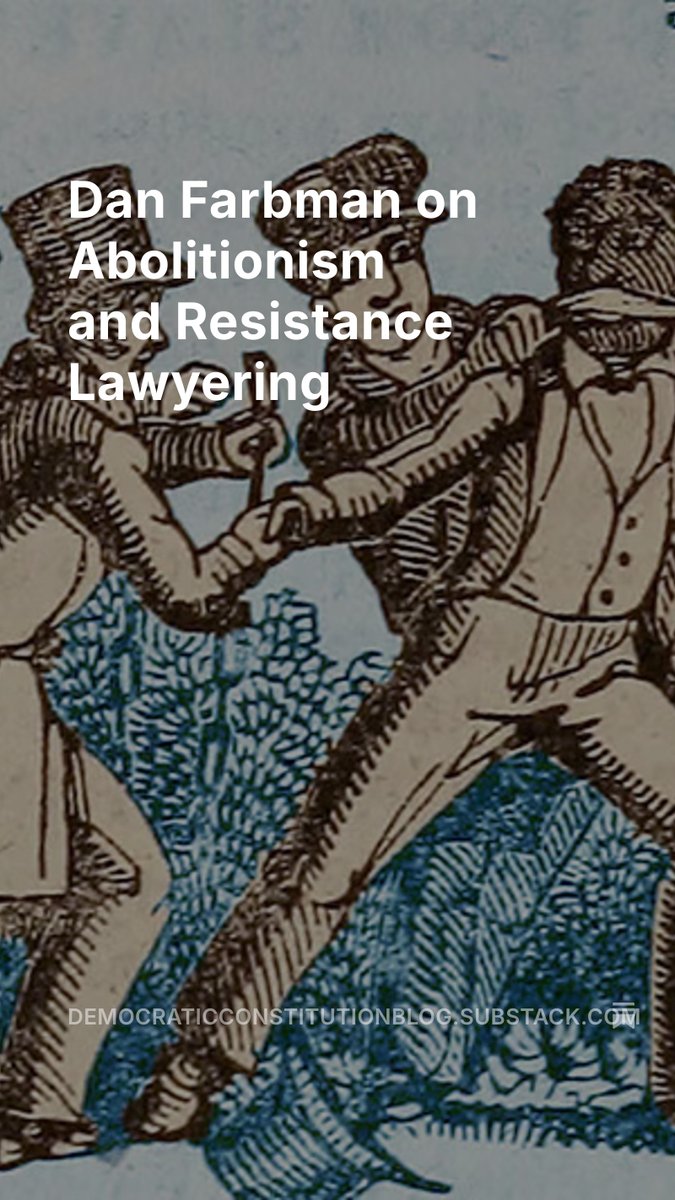
I spoke with @dsfarbman about parallels between current events and America in the 1850s, the abolitionist movement and resistance lawyering, working within “the master’s house,” and protests in Los Angeles on the latest @DemConBlog episode.
https://t.co/QctZ9e5nwm
Today, Dan Farbman looks back at the largely forgotten case of Horace Preston — a free black man arrested on false charges and enslaved in 1852 — to illustrate how lawyers can use legal proceedings to galvanize the public against unjust policies.
https://t.co/zJWFanpf1g
Reupping this: if there are any folks out there interested in doing non-profit, movement-rooted election protection work on or before election day, let me know in DMs or over email.
If any law professors or law students (or other law-related folks) on here are interested in doing some volunteer grassroots election protection work either before or on election day, let me know. Happy to share more information outside of the character limit.
Except non citizens pay taxes (often more than citizens). Obviously this whole issue is meant to stoke nativist anxiety since no mainstream dems are pushing non citizen suffrage at the state or national level. But the fact that it’s gross doesn’t make the analogy less stupid.
Grabbed some Tasty Ranch Dill pretzels for @DouglasEmhoff from Port City Pretzel in Portsmouth, New Hampshire—hopefully he doesn’t eat them all at once.
@neschulz @cps_buses Black Panther was also insanely late this morning. It does seem like a bus tracking app that works for kids and families is not too much to ask.
@RandyEBarnett We’ll leave it for longer forms. It’s just not plausible to imagine the shape of antislavery politics in the US without Garrison, et al. Chase’s own conversion to antislavery hinged on witnessing a proslavery riot against a garrisonian publisher in Cincinnati.
@RandyEBarnett Worse, Chase is a poor hero for this story. He was an opportunistic abolitionist who folks on the ground in Cincinnati held at arms length. The political salience of anti-slavery has a lot more to do with anti-constitutionalism than this account credits.
@RandyEBarnett I know you've read and written a lot about this, but this isn't an accurate account of the history here. Too much for twitter (and worse because I'm writing a book about this) but the move from Whigs to Republicans was shot through with Garrisonian influence.
Counterpoint: critique of the constitution goes back to 1787 and has generated some of the most important changes to our constitutional order. See Garrison, (early) Douglass, Wendell Phillips, DuBois, etc. Veneration is a bad way to tend a Republic. TLDR: read Aziz Rana’s book.
Alas, as the point about Redeemers adopting the logic of the EC demonstrates, this anti-Sims intuition has a pretty bleak and bigoted history in this country. (See, e.g. the 3/5 compromise)
Every year I ask my students to make their best arguments in favor of the senate and the EC. And every year it’s clear that those arguments run against democracy and in favor of some combination of: land should vote and rural votes should count more.
Matt's second point is such a good one.
If the electoral college is such a good idea, why didn't American states adopt it for their gubernatorial elections.*
* post-Reynolds v. Sims, the courts probably wouldn't let them, but before that?
These are theoretically defensible positions! We don’t all have to agree on one person one vote. But most students don’t feel comfortable abandoning Reynolds rhetorically—although some seem to feel as though it’s wrong to count every vote equally as a matter of intuition.