DSG STRATEGIC SERVICES
Open-Source Intelligence & Analysis
DSG tracks global security, conflict, geopolitics, cybersecurity, critical infrastructure, and emerging risks using publicly available information.
Follow for developing-event reporting, original analysis, maps and geospatial intelligence, and selected DSG intelligence products.
For the full real-time reporting feed:
Telegram: @DSGstrategicservices
We distinguish reported information from analytical judgment and update assessments as better evidence becomes available.
The intersection of risk and reality.
📝DSG ANALYSIS📝
————————————
🇪🇺🇷🇺🇮🇷HOAX BOMB THREATS SPREAD ACROSS EUROPE
11 NOV 26 | Updates our 04 NOV Eastern Flank Hybrid assessment
BLUF: A three-week wave of hoax bomb threats against European schools, airliners and newsrooms is most likely the work of one network rotating fake identities. Russia is the leading suspect. The Iranian, Russian and jihadist signatures on the emails look like deliberate misdirection.
──────
ANALYSIS
The wave began on 19 OCT with emails titled "Death Is Near" to schools in Northern Ireland, Scotland, Hungary, Serbia and Italy, posing as Saudi Arabia's education ministry. On 2 NOV about 270 Italian schools received Arabic emails signed by the IRGC, and a Wizz Air flight to Sofia diverted to Budapest. Eurocontrol counted 35 flights targeted on 3, 5 and 6 NOV, several escorted by fighter jets, including an Aer Lingus jet diverted to a French air base. On 6 NOV about eight newsrooms in Ireland, the UK and Bulgaria were threatened by a "Mikhail Andropov," who claimed the flight threats too. Today about 6,300 of Italy's 7,476 state schools got emails, 312 began evacuations, and roughly 1,300 schools in Scotland and Northern Ireland were targeted. All were hoaxes.
The signatures keep changing: a Saudi ministry, the IRGC, the Russian misogynist group Male State, and Andropov. The template does not. Italian reporting says today's email was word for word the IRGC email of 2 NOV with only the signature swapped. Male State's founder denies involvement, and a Montenegro school hoax in 2022 already used his name.
No government has named a culprit and no arrests have been announced. Spain called it "hybrid aggression and a form of psychological warfare," Ireland "a coordinated campaign of disruption," and Paris prosecutors are probing links to foreign powers. The FT reported on 7 NOV that some European officials see Russia as the most likely source. The Kremlin has called such accusations "stupid" and "baseless."
The precedents point the same way. Czech intelligence found a "clearly visible Russian trace" in 2024 school threats, sent by a Ukrainian man it says was paid from Russia. Lithuania's 2023 wave, which its intelligence service blamed on hostile states, demanded an end to support for Ukraine, and Russia's GRU has posed as ISIS hackers before.
Iran appears to be running its own campaign. On 9 NOV France attributed October's supermarket fridge sabotage to an IRGC-linked cyber unit, separate from the hoaxes.
The aims fit hybrid pressure. Each free email forces costly evacuations, diversions and fighter scrambles, tests how fast authorities respond and wears them down. Some Italian principals already declined to evacuate today. RUSI's Sidharth Kaushal says the aim, if Russian, is to make leaders "feel the costs of supporting Ukraine."
──────
ASSESSMENT
DSG assesses the hoaxes are the latest layer of the hybrid campaign against Europe we have tracked since 29 SEP. One network is likely behind most of the wave, and its IRGC, Male State and Andropov signatures are highly likely false flags. Russian direction or sponsorship, possibly through hired senders, is likely but unconfirmed. Iran as the main sender is unlikely, though its fridge sabotage shows a second campaign working the same ground, with no sign of coordination. Copycats may add noise.
The hoaxes matter less for the disruption than for what they build. Repeated false alarms slow responses and teach officials to doubt warnings, and rotating false identities make attribution harder. Those are the conditions for a real attack or a staged incident to land. More waves in the next 30 days are likely, and formal attribution soon is unlikely.
Indicators to Watch:
- Formal attribution or arrests
- Threats against rail, metro or cruise ships, as threatened on 6 NOV
- A real device hidden among hoaxes
📝DSG ANALYSIS📝
————————————
🇺🇸🇮🇷U.S. HOLDS OFF ON MAJOR IRAN STRIKES FOR NOW
10 NOV 26 | Updates our 07 NOV Iron Gate assessment
BLUF: The 9 to 11 NOV strike window is closing without a major U.S. attack. Trump has declared victory and chosen the economic squeeze, with Gulf backing, while a steady campaign against Iran's coastal air defenses keeps the strike option ready. The next realistic window is early December.
────��─
ANALYSIS
On 8 NOV Trump said "We won in Iran. It's just a matter of closing it out now," calling renewed fighting "highly unlikely" and tying any decision to "whether or not they sign a very strong agreement." After meeting Qatar's prime minister on 9 NOV, he said Qatar, Saudi Arabia, the UAE, Bahrain and Kuwait prefer the status quo of the blockade and Task Force Iron Gate, and that strikes now seem "quite unlikely."
The talks are stuck. Rubio called Iran's demands "overblown, ridiculous and really unrealistic." Araghchi says Iran's two-day proposal stands only if the war ends on all fronts. Trump says Iran is "talking very politely," while Rezaei calls the talks "imaginary" and says Hormuz stays shut until all seven of Iran's conditions are met. Each story serves its own side. Trump needs progress to justify waiting, and Tehran cannot be seen negotiating under blockade. On 10 NOV Qatar's prime minister told G7 foreign ministers in Paris that Doha had secured "at least two weeks" for diplomacy before any U.S. attack, while warning the two sides still disagree on key factors, according to diplomats cited by i24 and the Jerusalem Post. That window closes about when the additional carrier strike group and the MEU are due.
Meanwhile, U.S. jets hit Iranian air defenses around Qeshm and Bandar Abbas on 2, 6 and 8 NOV. Each round was called defensive, and officials say Iran fired on a U.S. aircraft before the first. The targets are now almost all SAM, radar and command sites on the Hormuz coast. Iran claims to have downed at least six MQM-170 Outlaws along the Hormuz coast since 29 OCT. The Outlaw is a target drone, well suited to switching on enemy radars so they can be found and struck, and CENTCOM has not denied the losses. Legally the strikes are self-defense. In practice they are suppressing Iran's air defenses.
Pressure from both directions continues. Netanyahu reportedly calls Trump daily urging renewed strikes, while Rep. Thomas Massie has filed impeachment articles against Hegseth for waging war without congressional authorization.
──────
ASSESSMENT
DSG's call for a major strike by this past weekend did not hold, and a major strike by 11 NOV is now unlikely. Washington has settled on the economic squeeze, the default our 4 NOV analysis named if Trump held off on strikes.
Shaping strikes on Iran's coastal air defenses are highly likely to continue. Qatar's reprieve runs out around 24 NOV, just ahead of the early-December moonless window. Renewed major strikes in that window are a realistic possibility if talks stay stuck.
Indicators to Watch:
- U.S. strikes beyond the coastal air defense belt
- Tanker or bomber surges into the region
- Iran discussed at Trump's APEC meeting with Xi and Putin
- The USS Theodore Roosevelt entering CENTCOM
📝DSG ANALYSIS📝
————————————
🇺🇸🇮🇷IRON GATE AND THE 9 NOV WINDOW
07 NOV 26 | Updates our 04 NOV Weekend Strike assessment
BLUF: The strike window on Iran has shifted to 9 to 11 NOV, while Washington moves to blockade Iran's land borders. Task Force Iron Gate shows the U.S. is planning for a long squeeze on Iran whether or not a strike occurs.
──────
ANALYSIS
Senior U.S. officials told Fox News 9 NOV, the new moon, is a favorable date to resume strikes, though CENTCOM has no order yet. Iraq's airspace restrictions for "military activity" run through 11 NOV, with Monday's window opening at midnight Eastern Sunday. U.S. jets hit Iranian air defenses on Qeshm twice this week in limited, defensive strikes. Iran has rejected direct talks in Doha and has not accepted Qatar's 48-hour plan, insisting its conditions be met first.
On 7 NOV CENTCOM commander Adm. Brad Cooper stood up Task Force Iron Gate, a staff of about 20 in Tampa that will work with other agencies to stop weapons, dual-use technology, sanctioned materials and revenue moving across Iran's land borders and the Caspian. Cooper said it builds on the naval blockade, which CENTCOM says has kept more than $25 billion in Iranian crude off the market in recent months.
The first visible move came the same day. Iraq's foreign minister said Washington formally asked Baghdad to close all but two crossings with Iran. Baghdad's border build-up this week was framed around militias and Kurdish groups. It now looks like interdiction too.
Iron Gate is a coordination cell, not a field force. Its tools are intelligence, sanctions and pressure on Iran's neighbors. That works where Washington has leverage. Iraq depends on dollar access, and Turkey and Azerbaijan are partners. It works poorly on the Caspian, where the U.S. has no presence and Iran's partner is Russia. Tehran has reportedly asked Moscow for S-400s, and the FT reports Russia agreed to supply 90 helicopter-mounted missile launchers.
──────
ASSESSMENT
DSG assesses a major U.S. or joint strike from 9 to 11 NOV is a roughly even chance, most likely Sunday night into Monday. If talks drag on, the next dark window is early December, after the USS Theodore Roosevelt arrives and before Congress turns over.
Iron Gate is highly likely to outlast any strike campaign. A standing interdiction staff makes little sense for a 72-hour war. It fits the outcome we laid out on 4 NOV, where Washington declares victory but keeps its economic grip on Iran. Expect Iraq to bear the most pressure, and expect the Caspian to become Iran's main resupply route, deepening its dependence on Russia.
Indicators to Watch:
- Iraq closing crossings, or resisting
- New Treasury sanctions on land or Caspian shippers
- Iran's formal answer to Qatar's plan
- Iranian or Israeli airspace closures
📝DSG ANALYSIS📝
———————
🇨🇳🇹🇼🇺🇸HOW CHINA TAKES TAIWAN WITHOUT A WAR
07 NOV 26
BLUF: DSG assesses Beijing's best path to Taiwan short of invasion is a quarantine run by its coast guard, not a declared blockade. The current unannounced deployment of more than 100 ships looks like a rehearsal of exactly that, timed while U.S. carriers and munitions are tied down by Iran. It has not yet crossed into an actual quarantine.
──────
ANALYSIS
A blockade is an act of war between states, and declaring one would imply Taiwan is a separate country. A quarantine framed as Chinese customs and law enforcement avoids that, keeps the navy in the background and forces Taipei or Washington to fire first. Taiwan imports about 97% of its energy and holds roughly 11 days of LNG.
Washington has handed Beijing its justification. The U.S. has blockaded Iran's ports since July, seized sanctioned tankers off Venezuela and choked Cuba's oil supply through sanctions and tariffs. Beijing condemned the Iran and Cuba measures at the UN in September and will cite them when its own ships start inspecting cargo.
The groundwork is already laid. Since June the coast guard has run "law enforcement" patrols east of Taiwan, radioing commercial ships for their origin and destination, and Taipei accused it of harassing shipping there at the start of November. From late October the Liaoning and Fujian put to sea, and on 3 NOV Taiwan's National Security Council reported more than 100 navy and coast guard vessels across the Western Pacific from three theater commands. Four task forces sit between Taiwan and Guam, positioned to keep U.S. forces out, while coast guard and navy ships form a closer ring around the island. That is the architecture of a quarantine.
Beijing has not named or announced it, and the silence looks deliberate. Each unannounced surge makes the next one look routine, so a real quarantine would draw less alarm when it starts. Egypt drilled along the Suez for months before crossing it in 1973.
Japan's forward-deployed carrier, the USS George Washington, has been in the Middle East since August, and the USS Theodore Roosevelt is crossing the South China Sea to replace it under Chinese surveillance. U.S. munitions and interceptors are being spent in the Gulf. What is missing is any act of enforcement. No ships have been boarded or turned away, no closure zones declared and no civilian ferries mobilized.
────
MOST LIKELY COURSE OF ACTION
Beijing keeps running large, unannounced deployments until they look routine, widens coast guard checks around Taiwan and its outlying islands, and leans on Taipei ahead of its late-November local elections. A limited quarantine of Kinmen or Pratas would be the natural test, cheap for Beijing and hard for Washington to answer.
────
MOST DANGEROUS COURSE OF ACTION
A major U.S. campaign against Iran pulls more naval and air power into CENTCOM, and Beijing converts the rehearsal into a real quarantine. The coast guard starts inspecting Taiwan-bound cargo under Chinese law while the navy holds the outer ring. Washington then has to choose between escorting convoys and firing first, or accepting inspections and conceding jurisdiction.
──────
ASSESSMENT
DSG assesses the current deployment is likely a rehearsal and pressure campaign rather than the opening of a quarantine, although it could shift quickly from rehearsal to real operation if Beijing judges the moment right. A quarantine of an outlying island within the next year is a realistic possibility. A full quarantine of Taiwan in the coming months is unlikely but rising, and most likely if the U.S. is drawn into a long fight with Iran. Invasion is highly unlikely in the near term.
Indicators to Watch:
- Coast guard boarding or inspection of Taiwan-bound ships
- Maritime Safety Administration closure zones east of Taiwan
- Civilian ferries mobilized
- Beijing publishing customs or inspection rules for Taiwan
- U.S. carrier gaps in the Western Pacific
📝DSG ANALYSIS📝
————————————
🇺🇸🇮🇷IRON GATE AND THE 9 NOV WINDOW
07 NOV 26 | Updates our 04 NOV Weekend Strike assessment
BLUF: The strike window on Iran has shifted to 9 to 11 NOV, while Washington moves to blockade Iran's land borders. Task Force Iron Gate shows the U.S. is planning for a long squeeze on Iran whether or not a strike occurs.
──────
ANALYSIS
Senior U.S. officials told Fox News 9 NOV, the new moon, is a favorable date to resume strikes, though CENTCOM has no order yet. Iraq's airspace restrictions for "military activity" run through 11 NOV, with Monday's window opening at midnight Eastern Sunday. U.S. jets hit Iranian air defenses on Qeshm twice this week in limited, defensive strikes. Iran has rejected direct talks in Doha and has not accepted Qatar's 48-hour plan, insisting its conditions be met first.
On 7 NOV CENTCOM commander Adm. Brad Cooper stood up Task Force Iron Gate, a staff of about 20 in Tampa that will work with other agencies to stop weapons, dual-use technology, sanctioned materials and revenue moving across Iran's land borders and the Caspian. Cooper said it builds on the naval blockade, which CENTCOM says has kept more than $25 billion in Iranian crude off the market in recent months.
The first visible move came the same day. Iraq's foreign minister said Washington formally asked Baghdad to close all but two crossings with Iran. Baghdad's border build-up this week was framed around militias and Kurdish groups. It now looks like interdiction too.
Iron Gate is a coordination cell, not a field force. Its tools are intelligence, sanctions and pressure on Iran's neighbors. That works where Washington has leverage. Iraq depends on dollar access, and Turkey and Azerbaijan are partners. It works poorly on the Caspian, where the U.S. has no presence and Iran's partner is Russia. Tehran has reportedly asked Moscow for S-400s, and the FT reports Russia agreed to supply 90 helicopter-mounted missile launchers.
──────
ASSESSMENT
DSG assesses a major U.S. or joint strike from 9 to 11 NOV is a roughly even chance, most likely Sunday night into Monday. If talks drag on, the next dark window is early December, after the USS Theodore Roosevelt arrives and before Congress turns over.
Iron Gate is highly likely to outlast any strike campaign. A standing interdiction staff makes little sense for a 72-hour war. It fits the outcome we laid out on 4 NOV, where Washington declares victory but keeps its economic grip on Iran. Expect Iraq to bear the most pressure, and expect the Caspian to become Iran's main resupply route, deepening its dependence on Russia.
Indicators to Watch:
- Iraq closing crossings, or resisting
- New Treasury sanctions on land or Caspian shippers
- Iran's formal answer to Qatar's plan
- Iranian or Israeli airspace closures
📝🚨DSG WATCH🚨📝
————————————
🇺🇸🇮🇱🇮🇷RENEWED STRIKES ON IRAN LIKELY THIS WEEKEND
04 NOV 26 | Updates our 22 OCT November Window assessment
DSG assesses renewed U.S. or joint U.S.-Israeli strikes on Iran are likely by Sunday, most probably Friday or Saturday night U.S. time while markets are closed. At the very least, another round of intense strikes before the new Congress is seated in January is highly likely as long as conditions don't change and a deal isn't reached.
Preparations appear complete, or will be by the time the strike window opens on Friday. At this point it is mainly defensive preparations taking place in the Gulf states, Israel and Cyprus. Most strike capability never left the theater, so final warning signs may come only hours out. Trump says there is "no rush," but he said much the same before the June 2025 and February 2026 strikes.
Further mediation, a deal or ceasefire, even a temporary one, is the main brake on the current strike period. If this weekend passes quietly, the moonless window still runs to 13 NOV, keeping conditions favorable for another week.
Watch for a surge in airborne tankers, Iranian or Israeli airspace closures, increased ISR activity, and Home Front Command restrictions.
──────
Open-Source Intelligence & Analysis
Telegram: @DSGstrategicservices
X: @DSGStratServ
📝🚨DSG WATCH🚨📝
————————————
🇮🇶🇺🇸🇮🇷IRAQ RESTRICTS AIRSPACE FOR "MILITARY ACTIVITY" 7–11 NOV
05 NOV 26 | Updates our 04 NOV Weekend Strike assessment
Iraq issued NOTAM A0471/26 tonight citing "military activity." From 7 to 11 NOV, daily 0500–1100 UTC, all overflights and traffic into Baghdad, Erbil, Sulaymaniyah and Kirkuk must follow fixed corridors. That is midnight to 6 a.m. Eastern and mid-morning in Tehran. The first window opens Friday night U.S. time, and the 28 FEB opening strikes hit Tehran in that same daylight slot.
The notice restricts routes rather than closing Iraqi airspace, and Iraq has issued similar notices for its own operations. It comes a day after Axios reported U.S. preparations are in their "final stages." DSG's call that strikes are likely by Sunday stands.
Watch for matching notices from Jordan, Kuwait, Israel, Saudi Arabia or Iran.
📝DSG ANALYSIS📝
————————————
🇺🇸🇮🇷🇮🇱HOW THE IRAN WAR ENDS
04 NOV 26
BLUF: DSG assesses the most likely end to the Iran war is a large U.S. strike wave, a declared victory and a phased deal that quietly gives Tehran much of what it wants. The most dangerous path is Iran refusing to play along and widening the war to the Gulf, as well as to Israel if it joins the strike. Neither path brings regime change or much of a true victory for the United States.
──────
ANALYSIS
Washington has never settled on why it is fighting. Regime change, unconditional surrender, the nuclear program, missile stockpiles and Hormuz have all been named as goals since 28 FEB. On 5 MAY Rubio declared Operation Epic Fury "concluded" with Iran's enrichment capability and stockpile still intact. That flexibility makes it easy to call the next strike the last one.
The pressure to exit is real. Democrats took both chambers in a midterm fought partly over the war and can restrict war powers from January. The administration is split three ways. Ratcliffe, Rubio and Bessent favor economic pressure, keeping the blockade and sanctions in place under "no war, no deal." Hegseth sides with Netanyahu on renewed strikes. Vance and Witkoff want a settlement. Strikes alone will not remove the regime, and most Americans will not accept ground troops.
──────
MOST LIKELY COURSE OF ACTION:
An intense strike wave, likely including Pickaxe Mountain, followed by a declaration that the goals are met. Iran answers with a calibrated, telegraphed strike, as it did at Al Udeid in June 2025, and claims its own victory. A Qatar-brokered deal follows in phases: oil-sale waivers and unfrozen funds, then Hormuz reopening, with nuclear issues pushed to a second phase that may never come. Waivers can be revoked, so Washington keeps its economic leverage.
The face-saver is a drawdown already under way. Iranian strikes left Fifth Fleet headquarters in Bahrain unusable, and the Navy is weighing whether to rebuild. Moving forces out of missile range meets Iran's demand for a U.S. withdrawal at little cost and can be sold at home as a stronger posture.
──────
MOST DANGEROUS COURSE OF ACTION:
Iran reads U.S. fatigue as weakness and doubles down, with heavy strikes on Gulf energy and desalination, a full closure of Hormuz, Houthi fire on Saudi Arabia and the Red Sea, Iraqi militia attacks, and large salvos on Israel if it joins the strike. Tehran's aim would be to restore its deterrence and regional standing and rally nationalists behind the regime.
That would flip the Gulf's position. Mediating states would become targets. A coalition led by the UAE, which has claimed Abu Musa and the Tunbs since Iran seized them in 1971, could take one or more of those islands with U.S. air and ISR support and no U.S. ground troops. The islands would not give control of the strait, since Iran's grip rests on its mainland coast, and holding them under fire would be costly. Their value is as a bargaining chip, traded back for reopening Hormuz on international terms.
──────
ASSESSMENT
Regime change is highly unlikely. The hinge is Tehran's response to the strike. A token strike and a victory claim point to a deal within weeks. Large-scale retaliation on the Gulf beyond U.S. targets points to a longer war. If Trump holds off, the default is the economic camp's slower squeeze, with a tighter blockade and more sanctions while Hormuz stays restricted into 2027.
Washington will most likely keep defending Israel and may base forces there, but is unlikely to join new Israeli offensives after this round. A full end to dedicated U.S. military support is unlikely but possible, and would leave Israel most eager to pull the U.S. back in.
Even the likely outcome is costly. Iran keeps de facto leverage over Hormuz and learns that nuclear latency pays, Gulf states hedge toward China, and Russia gains from U.S. attention and interceptors spent here instead of in Europe.
📝🚨DSG WATCH🚨📝
————————————
🇺🇸🇮🇱🇮🇷RENEWED STRIKES ON IRAN LIKELY THIS WEEKEND
04 NOV 26 | Updates our 22 OCT November Window assessment
DSG assesses renewed U.S. or joint U.S.-Israeli strikes on Iran are likely by Sunday, most probably Friday or Saturday night U.S. time while markets are closed. At the very least, another round of intense strikes before the new Congress is seated in January is highly likely as long as conditions don't change and a deal isn't reached.
Preparations appear complete, or will be by the time the strike window opens on Friday. At this point it is mainly defensive preparations taking place in the Gulf states, Israel and Cyprus. Most strike capability never left the theater, so final warning signs may come only hours out. Trump says there is "no rush," but he said much the same before the June 2025 and February 2026 strikes.
Further mediation, a deal or ceasefire, even a temporary one, is the main brake on the current strike period. If this weekend passes quietly, the moonless window still runs to 13 NOV, keeping conditions favorable for another week.
Watch for a surge in airborne tankers, Iranian or Israeli airspace closures, increased ISR activity, and Home Front Command restrictions.
──────
Open-Source Intelligence & Analysis
Telegram: @DSGstrategicservices
X: @DSGStratServ
📝🚨DSG WATCH🚨📝
————————————
🇵🇱🇱🇻🇷🇺HYBRID ACTIVITY ESCALATES ON NATO'S EASTERN FLANK
04 NOV 26 | Updates our 02 NOV Kaliningrad assessment
Shortly after midnight on 3 NOV, Polish border guards reported "disturbing movement" by people with flashlights near Sępopol on the Kaliningrad border. No one crossed, and the group withdrew into Russia. Tusk said Poland "managed to prevent a provocation," while admitting that can't be fully confirmed, and said intelligence points to incidents "in the first half of November, including armed people entering Polish territory."
On 4 NOV Poland's special services coordinator, Tomasz Siemoniak, went further. He warned that "something very massive could happen on both sides of the border," staged so that Ukrainians are blamed, and said the warnings also cover the Baltic states.
Latvia had two drone alerts in three days. The army assesses the 1 NOV drone as most likely a Russian Geran. The 3 NOV drone looked like a Ukrainian one, but its origin is unconfirmed.
ItaMilRadar data showed heavy GPS jamming on 3 NOV along nearly the entire eastern flank, from Kaliningrad to Bulgaria's Black Sea coast. No authority has confirmed the scale. A second wave of cyberattacks on supermarket freezers has now hit about 10 European countries. Pro-Russian groups NoName057(16) and Z-Pentest claimed it, then deleted the claim, and no government has attributed it.
On 2 NOV DSG assessed an armed-group crossing into Poland as a realistic possibility, and that call stands. Siemoniak's warning matches the false-flag scenario Danish intelligence described in September. A staged incident blamed on Ukraine, on either side of the border or in the Baltics, is now a realistic possibility before mid-November. Hybrid incidents are highly likely to continue through the month. An incursion by unmarked Russian troops remains unlikely.
Indicators to Watch:
- An incident in or near Kaliningrad quickly blamed on Ukraine
- Results of Latvia's drone debris search
- 11 NOV, Polish Independence Day
- The U.S. decision on troop levels in Europe
──────
Open-Source Intelligence & Analysis
Telegram: @DSGstrategicservices
X: @DSGStratServ
📝🚨DSG WATCH🚨📝
————————————
��🇱🇷🇺POLAND REINFORCES KALININGRAD BORDER AFTER SABOTAGE WARNING
02 NOV 26 | Updates our 29 SEP NATO Test assessment
Poland has sent police, counterterrorism units, soldiers and border guards to its border with Kaliningrad. Per RMF, Polish military intelligence and allied services warned last week of sabotage “in the coming days,” including armed groups crossing from Kaliningrad. National Police Chief Boroń confirmed the operation and called it preventive. No incident has been reported.
The warning comes a month after armed, masked men raided Latvia’s border from Belarus, and after Russia threatened nuclear use if NATO tries to “isolate” Kaliningrad. Overnight, a second wave of cyberattacks overheated supermarket freezers in Belgium, Luxembourg, Sweden, Ireland and Estonia, after hundreds of French stores were hit in October. No one has claimed them. The UK, France and others are also pushing households to keep emergency supplies on hand.
On 29 SEP DSG called hybrid attacks highly likely and “built to be arguable,” and on 12 OCT the Latvian raid bore that out. An armed-group crossing into Poland is now a realistic possibility. An incursion by unmarked Russian troops is still unlikely, but the Pentagon’s options on U.S. troops in Europe are due 6 NOV, the same week a U.S. campaign against Iran could begin.
Indicators to Watch:
- An armed crossing or sabotage in Warmia-Masuria or Podlaskie
- Claims from new or unknown groups
- A third wave of cyberattacks on infrastructure
- The U.S. decision on troop levels in Europe
──────
Open-Source Intelligence & Analysis
Telegram: @DSGstrategicservices
X: @DSGStratServ
📝DSG ANALYSIS📝
————————————
🇰🇵🇰🇷NORTH KOREA DRAWS THE LINE
27 OCT 26
BLUF: North Korea is using artillery and threats to force Seoul to accept the border it is building along the DMZ. Pyongyang is not looking for a fight, but it has prepared for one, or at least believes it is ready, and has already filed its justification at the UN. A South Korean warning shot at the line is now the most likely trigger for a limited exchange.
──────
ANALYSIS
On 26 OCT a Reuters witness at the Aegibong observatory in Gimpo saw three North Korean armored vehicles on the Kaepung coast with their guns pointed south, while 20 to 30 soldiers built fencing nearby. Yonhap said they appear to be 122mm self-propelled howitzers and called it a rare public display. Guns parked in clear view of a South Korean observatory are of little use in a real fight. North Korea’s front-line artillery sits in hardened hillside sites. These were placed to be photographed. South Korea’s Joint Chiefs said on 27 OCT the North is “deploying and exposing its older artillery pieces.” It’s military swaggering in its most basic form.
The display is the latest step in a campaign that has picked up sharply this year. North Korea has been fencing, mining and cutting roads along the demarcation line since 2024, after Kim Jong Un declared the Koreas “two hostile states.” About 5,000 workers were on the job in the first half of 2026, up from about 1,000 a year earlier, and Kim has ordered it finished by year’s end. South Korean troops fire warning shots when North Korean soldiers cross the line. Seoul counted 17 crossings in all of 2025. August 2026 had more than 20 and September about 30, mostly work crews in sectors where the original line markers are long gone.
The tone changed after 21 SEP, when a mine blast wounded three South Korean soldiers and the UN Command found a North Korean mine south of the line. Kim Yo Jong denied it and said “an enemy is still an enemy.” On 21 OCT she said “tactical hunting teams” had moved into new positions and loudspeakers would run along the whole border this month. If South Korean warning shots harm North Korean troops or territory, she said, border units will “mercilessly eliminate” those responsible. On 25 OCT Pyongyang told the UN Security Council the mine incident was fabricated and that violations of its sovereignty could bring “self-defence measures.”
Seoul under Lee Jae Myung has proposed talks to agree on where the line actually runs. Pyongyang has not responded.
──────
ASSESSMENT
DSG assesses North Korea’s aim is to make Seoul stop challenging the work crews and accept the new border as Pyongyang draws it. If the warning shots stop, North Korea gets its border without firing. A deliberate push toward full-scale war is highly unlikely, and North Korea is unlikely to start a limited clash on purpose.
It has still set a public tripwire and laid out its self-defence case in advance, the same sequence it followed before shelling Yeonpyeong in 2010. With dozens of crossings a month and warning shots on each, Pyongyang gets to decide what counts as harm. If an incident hands it that claim, return fire is likely, most plausibly brief and local against a guard post or loudspeaker site rather than from the guns on display. A limited exchange before border work pauses for winter remains unlikely, but the risk is the highest it has been since the fortification began.
Indicators to Watch:
- North Korean loudspeakers broadcasting
- A North Korean claim that South Korean fire hit its troops or territory
- More artillery or armor moved into the open near the line
- A KCNA “self-defence” statement tied to a specific incident
- Any change to Seoul’s warning-shot rules
──────
Open-Source Intelligence & Analysis
Telegram: @DSGstrategicservices
X: @DSGStratServ
📝🚨DSG WATCH🚨📝
————————————
🇮🇷🇮🇱🇷🇺🇮🇶THIRD PARTIES BRACE FOR STRIKES
23 OCT 26 | Updates our 22 OCT assessment
A Russian VIP Tu-134 left Tehran today. Iranian sources claim it carried Russian staff from Bushehr. Rosatom has not confirmed. Russia pulled Bushehr staff the day the war began on 28 FEB. A source in Iraq's ruling bloc told Kurdish outlet Channel8 that Baghdad was warned of a strike on Iran "in the coming days." Both are single-source, and the warning may cover just an Israeli strike, not a U.S. or joint strike.
Netanyahu says, "We have information indicating that Iran wants to attack us before the election," although IDF officials say there is no specific sign of an imminent attack. In the meantime, Iran kept up missile drills and other military preparations for renewed conflict.
On 22 OCT DSG said conflict before November most likely starts with Iran firing first. A claimed Iranian threat works too, letting Israel strike first whether or not the threat is real. Joint action after 3 NOV remains likely. A strike before then is still possible, but less likely.
──────
Open-Source Intelligence & Analysis
Telegram: @DSGstrategicservices
X: @DSGStratServ
📝DSG ANALYSIS📝
————————————
🇮🇱🇮🇷🇺🇸THE NOVEMBER WINDOW HOLDS
22 OCT 26 | Updates our 21 OCT assessments
BLUF: DSG walks back last night's call that an Israeli strike on Iran before 27 OCT was highly likely. New reporting further solidifies a joint U.S.-Israeli campaign after the 3 NOV midterms, the window DSG has consistently assessed since 14 OCT. Before then, renewed conflict is likely only if Iran strikes first, either preemptively or because Israel succeeds in baiting them.
──────
ANALYSIS
The New York Times reports the U.S. and Israel have drawn up plans for a short, intensive campaign after the midterms, possibly a 72-hour bombing run on energy, nuclear and missile targets.
That changes how yesterday’s evidence reads. The drawdown of U.S. troops and diplomats and the aircraft moved out of Al Udeid fit a force getting into position for November just as well as a strike this week. Monday's attack-formation flight over Iraq now looks like one of the stepped-up joint exercises the Times describes, which is what DSG called it on 19 OCT. The Times also reports both militaries came close to striking in early October before Trump postponed at the last minute.
Trump said Tuesday night that "we're not negotiating" and that something "will happen fairly soon," adding that "most people seem to think it's after the election."
──────
ASSESSMENT
Joint U.S.-Israeli action after 3 NOV is likely, most plausibly once U.S. forces are fully in place in early November. That is the call DSG made on 14 OCT, and the additional reporting now supports it further.
Last night DSG weighted the drawdown as a sign of an Israeli strike within days. However, it now reads better as preparation for November. A unilateral Israeli offensive before the 27 OCT election is unlikely. It would cut against Trump, and launching a war days before a vote is a hard sell for Netanyahu.
The exception is Iran firing first. A preemptive Iranian strike, or Iranian fire drawn out by Israeli provocation, would give Israel a response Washington could not block and could pull the U.S. in before the midterms. That is the main path to renewed conflict before November.
──────
Open-Source Intelligence & Analysis
Telegram: @DSGstrategicservices
X: @DSGStratServ
📝DSG ANALYSIS📝
———���————————
🇮🇱🇮🇷🇺🇸 ISRAELI STRIKE ON IRAN HIGHLY LIKELY
21 OCT 26 | Updates our earlier 21 OCT assessment
BLUF: An Israeli strike on Iran before the 27 OCT election is now highly likely, possibly within 72 hours. The U.S. is moving people and aircraft out of Iran's reach, which points to Washington expecting escalation. Trump still wants no new war before 3 NOV, and that is shaping the U.S. role, not whether Israel moves.
──────
ANALYSIS
This morning DSG called an Israeli strike before the election a realistic possibility. Three things changed by evening.
First, the drawdown. NBC reports U.S. troops and diplomats are leaving posts across the region as Trump weighs new action against Iran. State says its ordered departure covers Saudi Arabia only, because of the Houthis. Both can be true. State speaks for its own staff. Troops and military entities answer to the Pentagon.
Second, Al Udeid. U.S. aircraft are being moved out of the base in Qatar. The last time tankers cleared Al Udeid, on 27 FEB, the U.S.-Israeli strikes began the next day.
Third, the Hegseth visit. He met Netanyahu on Monday. Axios reports the two sides discussed resuming large-scale operations, and the FT says Israel handed him an updated target bank. The same night, dozens of Israeli jets flew an attack formation to Iran's border and turned back. U.S. sources told Channel 12 they suspect Israel wanted Iran to fire first.
A leave freeze for IDF units starts tomorrow, with more troops sent to the West Bank and other fronts.
Iran has not taken the bait. Its fighters patrolled the border during Monday's flight but held fire. Officials warn of "all-out war" if attacked, while the foreign minister keeps talks and a Hormuz reopening on the table.
──────
ASSESSMENT
DSG assesses an Israeli strike on Iran before 27 OCT as highly likely, most plausibly on the weekend when the markets are closed. The U.S. drawdown is the deciding factor. Washington does not clear bases and aircraft on a hunch, and the 27 FEB precedent gave one day's warning.
The likeliest sequence is an Israeli strike, alone or after Iran is provoked into firing first, followed by Iranian retaliation on Israel and possibly on U.S. bases. That risk is why U.S. assets are moving. A U.S. role in the opening strike is unlikely before 3 NOV, given Trump's pledge and the midterms. U.S. air defense of Israel and its own bases is likely once Iran responds.
Joint U.S.-Israeli action after 3 NOV, our call since 14 OCT, still stands. The window has opened early for Israel, not for the U.S.
Indicators to Watch:
1. Airspace closures
2. Israeli Home Front Command restrictions, opening of shelters
3. Further deployment of Israeli air defense systems
──────
Open-Source Intelligence & Analysis
Telegram: @DSGstrategicservices
X: @DSGStratServ
📝DSG ANALYSIS📝
————————————
🇮🇱🇮🇷🇺🇸 ISRAELI STRIKE ON IRAN HIGHLY LIKELY
21 OCT 26 | Updates our earlier 21 OCT assessment
BLUF: An Israeli strike on Iran before the 27 OCT election is now highly likely, possibly within 72 hours. The U.S. is moving people and aircraft out of Iran's reach, which points to Washington expecting escalation. Trump still wants no new war before 3 NOV, and that is shaping the U.S. role, not whether Israel moves.
──────
ANALYSIS
This morning DSG called an Israeli strike before the election a realistic possibility. Three things changed by evening.
First, the drawdown. NBC reports U.S. troops and diplomats are leaving posts across the region as Trump weighs new action against Iran. State says its ordered departure covers Saudi Arabia only, because of the Houthis. Both can be true. State speaks for its own staff. Troops and military entities answer to the Pentagon.
Second, Al Udeid. U.S. aircraft are being moved out of the base in Qatar. The last time tankers cleared Al Udeid, on 27 FEB, the U.S.-Israeli strikes began the next day.
Third, the Hegseth visit. He met Netanyahu on Monday. Axios reports the two sides discussed resuming large-scale operations, and the FT says Israel handed him an updated target bank. The same night, dozens of Israeli jets flew an attack formation to Iran's border and turned back. U.S. sources told Channel 12 they suspect Israel wanted Iran to fire first.
A leave freeze for IDF units starts tomorrow, with more troops sent to the West Bank and other fronts.
Iran has not taken the bait. Its fighters patrolled the border during Monday's flight but held fire. Officials warn of "all-out war" if attacked, while the foreign minister keeps talks and a Hormuz reopening on the table.
──────
ASSESSMENT
DSG assesses an Israeli strike on Iran before 27 OCT as highly likely, most plausibly on the weekend when the markets are closed. The U.S. drawdown is the deciding factor. Washington does not clear bases and aircraft on a hunch, and the 27 FEB precedent gave one day's warning.
The likeliest sequence is an Israeli strike, alone or after Iran is provoked into firing first, followed by Iranian retaliation on Israel and possibly on U.S. bases. That risk is why U.S. assets are moving. A U.S. role in the opening strike is unlikely before 3 NOV, given Trump's pledge and the midterms. U.S. air defense of Israel and its own bases is likely once Iran responds.
Joint U.S.-Israeli action after 3 NOV, our call since 14 OCT, still stands. The window has opened early for Israel, not for the U.S.
Indicators to Watch:
1. Airspace closures
2. Israeli Home Front Command restrictions, opening of shelters
3. Further deployment of Israeli air defense systems
──────
Open-Source Intelligence & Analysis
Telegram: @DSGstrategicservices
X: @DSGStratServ
📝🚨DSG WATCH🚨📝
————————————
🇺🇸🇮🇷🇮🇱U.S. PREPARES FOR RENEWED MIDDLE EAST CONFRONTATION
21 OCT 26
NBC News reports U.S. troops and diplomats are leaving Middle East posts as Trump weighs new military action against Iran. State says its ordered departure covers Saudi Arabia only. Both can be true. State spoke for its own staff, and troops answer to the Pentagon. Washington may be saying it isn't evacuating while it does.
This is the indicator DSG named on 15 OCT. It follows Hegseth's visit to Israel, where the two sides discussed resuming large-scale operations (Axios) and Israel handed him an updated target bank (FT). Monday's Israeli attack-formation flight to Iran's border and tomorrow's IDF leave freeze fit the pattern.
DSG now assesses a strike on Iran before Israel's 27 OCT election as likely, either Israeli alone or joint with the U.S. Trump's pledge against U.S. strikes before 3 NOV is the main brake on a joint one.
──────
Open-Source Intelligence & Analysis
Telegram: @DSGstrategicservices
X: @DSGStratServ
📝DSG ANALYSIS📝
————————————
🇮🇱🇮🇷🇺🇸ISRAEL LEADS, IRAN REACTS
21 OCT 26 | Updates our 15 OCT and 19 OCT assessments
BLUF: The Iranian alerts and dispersals of the past two weeks now read as reactions to Israeli preparations, not preparations for an Iranian first strike. Israel is the more likely first mover before 27 OCT, and its likeliest path is drawing Iranian fire rather than striking outright, since Trump has already blocked one Israeli strike.
──────
ANALYSIS
The activity DSG flagged on 19 OCT was real. Dozens of Israeli fighters in "full attack formation," with tankers, flew over Syria and Iraq overnight, came close to Iran's border and turned back (Channel 12). Israel told Washington in advance and called it a deterrence drill. U.S. sources suspect it was meant to provoke Iranian fire and give Israel a pretext for a large strike. It came the day Hegseth was in Israel.
The Financial Times reports Israel had a strike campaign ready for 10 OCT against energy, nuclear and "regime targets," cancelled over Trump's opposition, and that Israeli officials then handed Hegseth an "updated target bank" that includes civilian infrastructure not previously hit. At least one report disputes the 10 OCT plan.
Set against that, Iran's moves follow Israel's. Missile tests began 11 OCT, a day after the reported strike date. By 15 OCT Iranian officials reportedly told diplomats they were "100% certain" a strike was coming, and on 19 OCT Iran scrambled fighters along its border as the Israeli formation approached. The rhetoric has hardened too. The IRGC says Iran will "respond and go on the offensive," and Katz says Iran "will burn" if it attacks. Netanyahu, who told Army Radio on 14 OCT that "this is not the right time," now says the only way to remove the threat is "toppling the regime."
Washington remains the brake. Trump's pledge not to attack before 3 NOV holds, Rubio welcomes Qatari and Pakistani mediation, and Tehran says talks and Hormuz depend on U.S. acceptance of its terms.
─���────
ASSESSMENT
DSG revises its 15 OCT judgment. We called Iran the less predictable actor and an Iranian preemptive strike a realistic possibility. The sequence now points the other way, and a deliberate Iranian first strike is unlikely. Iran is reacting to what it sees coming. An Israeli strike before 27 OCT is a realistic possibility, but Trump has already stopped one and Israel needs his support for whatever follows. The likelier path is the one the 19 OCT flight suggests, pressure close enough to Iran's borders that Tehran fires first and hands Israel a strike Washington cannot block. That is the miscalculation risk DSG flagged on 19 OCT, now looking deliberate. A U.S. strike before 3 NOV remains highly unlikely, and joint U.S.-Israeli action after the vote remains likely.
──────
Open-Source Intelligence & Analysis
Telegram: @DSGstrategicservices
X: @DSGStratServ
📝🚨DSG WATCH🚨📝
————————————
🇮🇱🇮🇷🇮🇶🇯🇴Strike and Defense Dry-Runs Taking Place
19 OCT 26
Open-source reporting states that fighter activity is reported over northwestern Jordan heading east and over southern Iraq, the corridor used in past strikes on Iran. Iranian fighters are patrolling the southern Iran-Iraq border, and Iranian outlets claim a "Code 100" top-readiness order. None of this is confirmed by the IDF or CENTCOM, and Iranian airspace remains open.
DSG assesses this is most likely a rehearsal rather than a strike, consistent with our 14 OCT call that Washington and Jerusalem are preparing to act after 3 NOV, however a miscalculation from either side can easily renew the conflict prior to anticipated. Iran's patrols let it study the same route, so both sides are rehearsing in the same sky.
Indicators to Watch:
1. Airspace closures in Gulf States, Iran, or Israel
2. Israeli Home Front Command restrictions and deployment
3. U.S. tankers or AWACS supporting the package
4. Explosions reported inside Iran
──────
Open-Source Intelligence & Analysis
Telegram: @DSGstrategicservices
X: @DSGStratServ
📝DSG ANALYSIS📝
————————————
🇮🇷🇮🇱🇺🇸BEFORE THE WINDOW
15 OCT 26 | Updates our 14 OCT November Window assessment
BLUF: On 14 OCT DSG assessed that the U.S. and Israel would likely move against Iran after 3 NOV. Both still prefer that window, but Tehran now appears to expect it, and that expectation could pull the fight forward. Before the elections in both the U.S. and Israel, the likeliest path to renewed conflict runs through Iran or Israel moving first, not the U.S.
──────
ANALYSIS
Western intelligence has detected "extreme" military movements inside Iran, and Israel believes Tehran may be preparing a preemptive attack (Channel 12). Iran has test-fired missiles at several sites over the past week, unconfirmed reports say the IRGC ordered evacuations of several bases, and footage claims armor is moving near the Iraqi border. Iranian officials reportedly told regional diplomats they are "100% certain" a strike is coming. On 8 OCT Iran's army spokesman said Iran would act preemptively "if necessary" and cited its July missile strike on a U.S. base in Jordan as precedent. Israeli and U.S. officials say the activity is not yet a "ticking bomb."
Netanyahu told Army Radio on 14 OCT that "this is not the right time" for a preemptive strike, and Maariv reports Jerusalem told Washington it prefers action after the 27 OCT vote. Likud fears missile casualties before election day, and postponing the vote takes 80 MKs. Yet Netanyahu says Israel can "act independently," an adviser says Israel is "very close" to creating conditions for regime change, he convened a security meeting on Iran tonight, and Ynet reports the state of emergency may run through 3 NOV. Israel struck first in June 2025 while talks were still scheduled.
Trump's pledge not to attack Iran before 3 NOV holds, but strike plans now include the GBU-43 "MOAB" (CBS), and a source cited by CNN pointed to acting before forces rotate out of CENTCOM. Trump says the war will end "one way or the other." In Hormuz, IRGC fire sank the container ship GFS Pride and at least 10 ships have been hit around the strait since Sunday. The Houthis have attacked Riyadh's airport 20 times this month, and a Saudi deputy minister says Iran is encouraging them.
──────
ASSESSMENT
Washington and Jerusalem still prefer to act after their elections, and DSG's call that joint U.S.-Israeli action is likely after 3 NOV stands. The risk before then has risen. A unilateral Israeli strike before 27 OCT is possible but cuts against Netanyahu's stated position and Likud's electoral interest. A U.S. strike before 3 NOV remains highly unlikely unless American deaths, intelligence of an imminent Iranian preemptive attack or escalating Hormuz attacks force the decision. Iran is the less predictable actor. If Tehran is convinced it will be hit in November, the military case for striking first, before its launchers are hit, may outweigh the domestic political gift it would hand Trump and Netanyahu. DSG assesses an Iranian preemptive strike as a realistic possibility, not the most likely outcome. Dispersal and base evacuations fit both bracing for a strike and preparing one, so they cannot settle the question. Any first move by Iran or Israel would draw U.S. forces in before 3 NOV. The clearest warning would be Iranian airspace closures alongside Israeli Home Front Command restrictions, which would put an exchange hours away whichever side moves first. U.S. ordered departures from regional embassies would show Washington expects one, as they did two days before Israel struck in June 2025.
──────
Open-Source Intelligence & Analysis
Telegram: @DSGstrategicservices
X: @DSGStratServ
📝DSG ANALYSIS📝
————————————
🇸🇦🇾🇪🇺🇸🇮🇷THE NOVEMBER WINDOW
14 OCT 26
BLUF: Trump has pushed any strike on Iran past the 3 NOV midterms, and Tehran and the Houthis are using the window. Saudi Arabia is absorbing strikes on its airports and Aramco's Dhahran complex with no deterrent and no ground response. After the vote, the U.S. is likely to return to war with Iran and fight the Houthis as part of it.
──────
ANALYSIS
Houthi missiles have hit Riyadh's main airport repeatedly since 6 OCT. The 10 OCT terminal strike killed at least 13, including an American, and wounded 300+, the kingdom's deadliest attack in over a decade. Interceptor stocks are drained, and Riyadh is probing why its defenses are failing. On 13 OCT the coalition struck a Sanaa fuel depot it says stored Houthi missiles, and within hours an attack set fire to an Aramco office building in Dhahran, a target the Houthis had named in advance.
Saudi Arabia, Pakistan and Turkey invoked their Mecca defence pact on 5 OCT, pledging "collective deterrence" and rapid deployment. The worst strikes followed within days. Pakistan calls its role supporting and says its troops will not enter Yemen. Turkey calls it "a defensive agreement," and its parliament has not ratified it. Pakistan also mediates between Washington and Tehran, which has warned it against intervening. Pakistani jets add some defense, but the pact deterred no one.
Saudi Arabia is fighting through proxies rather than its own ground forces. The coalition says 100 jets are backing Operation Dawn of Yemen, the 5 OCT drive to retake Sanaa. Yemeni units fight on the ground, including the Saudi-backed Nation's Shield and UAE-aligned Giants Brigades, which the government says retook Mokha and Dhubab, unconfirmed. Analysts tie Riyadh's absence to the 2015-2022 quagmire and reluctance to act without U.S. backing. MBS pressed Trump for strikes in September, and he held off twice while the Houthis spared non-Saudi shipping (NYT, Axios).
On Iran, Trump posted on 8 OCT that "we will not be attacking Iran at any time prior to the Midterm Elections," as the Pentagon told CENTCOM to finish preparations to resume major combat (Axios). A third carrier group and a Marine amphibious group are due by late November. DSG assesses this as a rotation, but the overlap before handover would briefly put three carriers in theater, a window that could be used. On 13 OCT he told a rally "Wait till you see what we do to Iran." Tehran is taking him seriously. It is test-firing missiles and air defenses (ISW) and fortifying Pickaxe Mountain and Natanz, and has warned Arab mediators it may hit Saudi oil if war resumes (WSJ). Iranian officials told Reuters new attacks on Hormuz shipping aim to keep oil high before the vote. Talks are stuck on enrichment. On the Houthis Trump has set no date, saying "We may" join, and suggesting Iran is behind their attacks. The Houthis threaten U.S. interests if Washington joins.
──────
ASSESSMENT
Until U.S. air power joins, Saudi ground forces are highly likely to stay out of Yemen. U.S. strikes on Iran before 3 NOV are highly unlikely on Trump's own pledge, though his Iran statements have not always held. U.S. strikes on the Houthis before then are less likely than not, because the oil logic holding Iran until after the vote applies to Yemen too. More U.S. deaths or attacks on U.S. forces or non-Saudi shipping would change that. Until then, Iran and the Houthis are likely to keep up attacks on shipping and Saudi energy. After 3 NOV, renewed U.S. major combat against Iran becomes likely, with moderate confidence, most plausibly during the carrier overlap, unless Tehran concedes on enrichment. Houthi attacks on U.S. and Western shipping and U.S. strikes in Yemen would likely follow, folding Yemen into the Iran campaign. That lifts the constraint analysts cite, making a Saudi ground offensive under U.S. air cover a realistic possibility. Pakistan and Turkey are highly likely to stay in support roles
Agreed, and the timing is deliberate. Trump ruled out Iran strikes before 3 NOV, so Tehran is pressing through the Houthis and Hormuz while the window is open. Iranian officials told Reuters the goal is to keep oil high before the vote, and Iran has warned Arab mediators that Saudi oil may be on its list if the war resumes. Watch late November, when a third U.S. carrier overlaps the one it relieves. If the war restarts then, this goes regional.
📝DSG ANALYSIS📝
————————————
🇸🇦🇾🇪🇺🇸🇮🇷THE NOVEMBER WINDOW
14 OCT 26
BLUF: Trump has pushed any strike on Iran past the 3 NOV midterms, and Tehran and the Houthis are using the window. Saudi Arabia is absorbing strikes on its airports and Aramco's Dhahran complex with no deterrent and no ground response. After the vote, the U.S. is likely to return to war with Iran and fight the Houthis as part of it.
──────
ANALYSIS
Houthi missiles have hit Riyadh's main airport repeatedly since 6 OCT. The 10 OCT terminal strike killed at least 13, including an American, and wounded 300+, the kingdom's deadliest attack in over a decade. Interceptor stocks are drained, and Riyadh is probing why its defenses are failing. On 13 OCT the coalition struck a Sanaa fuel depot it says stored Houthi missiles, and within hours an attack set fire to an Aramco office building in Dhahran, a target the Houthis had named in advance.
Saudi Arabia, Pakistan and Turkey invoked their Mecca defence pact on 5 OCT, pledging "collective deterrence" and rapid deployment. The worst strikes followed within days. Pakistan calls its role supporting and says its troops will not enter Yemen. Turkey calls it "a defensive agreement," and its parliament has not ratified it. Pakistan also mediates between Washington and Tehran, which has warned it against intervening. Pakistani jets add some defense, but the pact deterred no one.
Saudi Arabia is fighting through proxies rather than its own ground forces. The coalition says 100 jets are backing Operation Dawn of Yemen, the 5 OCT drive to retake Sanaa. Yemeni units fight on the ground, including the Saudi-backed Nation's Shield and UAE-aligned Giants Brigades, which the government says retook Mokha and Dhubab, unconfirmed. Analysts tie Riyadh's absence to the 2015-2022 quagmire and reluctance to act without U.S. backing. MBS pressed Trump for strikes in September, and he held off twice while the Houthis spared non-Saudi shipping (NYT, Axios).
On Iran, Trump posted on 8 OCT that "we will not be attacking Iran at any time prior to the Midterm Elections," as the Pentagon told CENTCOM to finish preparations to resume major combat (Axios). A third carrier group and a Marine amphibious group are due by late November. DSG assesses this as a rotation, but the overlap before handover would briefly put three carriers in theater, a window that could be used. On 13 OCT he told a rally "Wait till you see what we do to Iran." Tehran is taking him seriously. It is test-firing missiles and air defenses (ISW) and fortifying Pickaxe Mountain and Natanz, and has warned Arab mediators it may hit Saudi oil if war resumes (WSJ). Iranian officials told Reuters new attacks on Hormuz shipping aim to keep oil high before the vote. Talks are stuck on enrichment. On the Houthis Trump has set no date, saying "We may" join, and suggesting Iran is behind their attacks. The Houthis threaten U.S. interests if Washington joins.
──────
ASSESSMENT
Until U.S. air power joins, Saudi ground forces are highly likely to stay out of Yemen. U.S. strikes on Iran before 3 NOV are highly unlikely on Trump's own pledge, though his Iran statements have not always held. U.S. strikes on the Houthis before then are less likely than not, because the oil logic holding Iran until after the vote applies to Yemen too. More U.S. deaths or attacks on U.S. forces or non-Saudi shipping would change that. Until then, Iran and the Houthis are likely to keep up attacks on shipping and Saudi energy. After 3 NOV, renewed U.S. major combat against Iran becomes likely, with moderate confidence, most plausibly during the carrier overlap, unless Tehran concedes on enrichment. Houthi attacks on U.S. and Western shipping and U.S. strikes in Yemen would likely follow, folding Yemen into the Iran campaign. That lifts the constraint analysts cite, making a Saudi ground offensive under U.S. air cover a realistic possibility. Pakistan and Turkey are highly likely to stay in support roles
📝DSG WATCH📝
————————————
🇱🇻🇧🇾🇷🇺EYES ON THE EASTERN FLANK
12 OCT 26
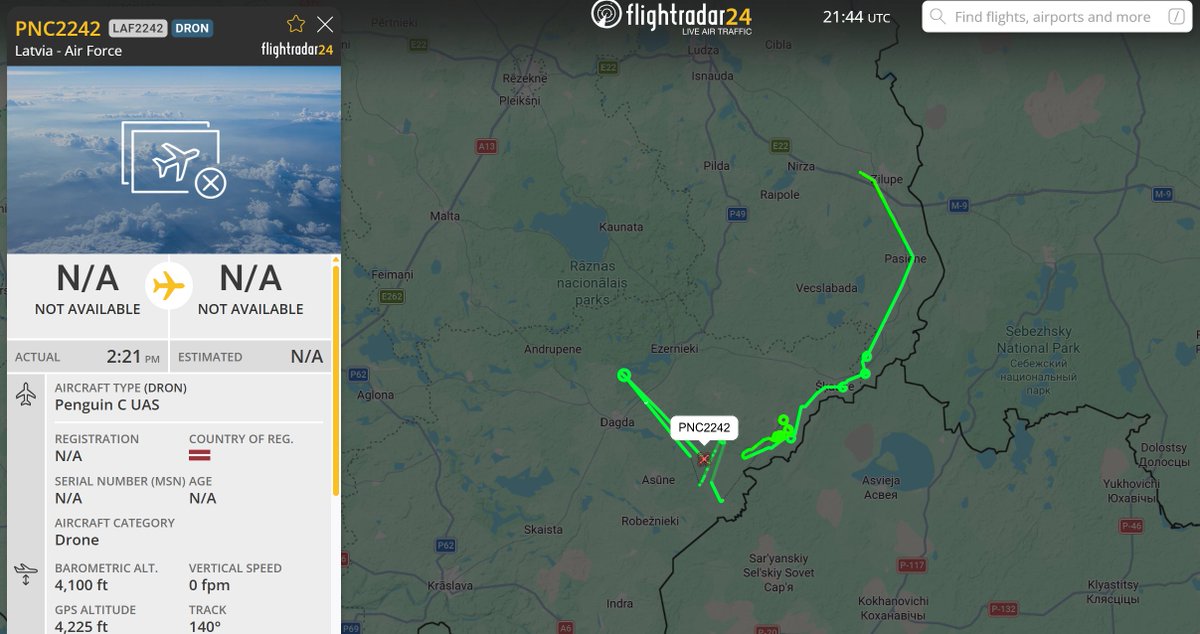
A Latvian military Penguin C drone is flying night surveillance along Latgale's borders with Russia and Belarus, per flight tracking. It fits a wider rise in allied ISR. DSG has logged Lithuanian Border Guard night searches near Belarus, maritime drones over the Baltic and SIGINT flights toward Kola.
The flight comes a week after 5-6 OCT, when armed, masked escorts threatened Latvian soldiers on the Belarus border, and hours later masked men crossed in, stole surveillance cameras and withdrew. A group calling itself "Black Russians" claimed it.
On 29 SEP DSG assessed hybrid attacks as highly likely to continue and "built to be arguable." Increased ISR improves attribution and early warning. Units without insignia have not appeared, and our call that they are unlikely before 6 NOV stands.
──────
Open-Source Intelligence & Analysis
Telegram: @DSGstrategicservices
X: @DSGStratServ