Did You Know the Psalms Speak About Yeshua?
Many people read the Psalms as poetry alone.
But the Psalms are also prophetic.
They do not merely describe David’s suffering, victories, prayers, and songs. Again and again, the Spirit points beyond David to Israel’s coming Messiah.
Yeshua is woven throughout the Psalms. Don't believe me? Keep reading...
❖ Psalm 2 — The Reigning King
“Why do the nations conspire and the peoples plot in vain?”
“The kings of the earth rise up… against the LORD and against his anointed.”
The Hebrew word for “anointed” is Mashiach.
Psalm 2 is a royal Davidic Psalm connected to the covenant promises of 2 Samuel 7. Yet its scope stretches far beyond David himself.
God declares:
“I have installed my king on Zion, my holy mountain.” (Psalm 2:6)
And then:
“I will make the nations your inheritance.” (Psalm 2:8)
David never ruled the nations.
Messiah will.
The world still rages against God’s King, but Scripture says the throne in Zion belongs to Him.
❖ Psalm 22 — The Suffering Messiah
“My God, my God, why have you forsaken me?”
Centuries before crucifixion was practiced in Israel, Psalm 22 described details astonishingly consistent with Yeshua’s suffering:
“All who see me mock me.”
“They pierce my hands and my feet.”
“They divide my clothes among them and cast lots for my garment.”
Mockery.
Public humiliation.
Pierced hands and feet.
Casting lots for garments.
Yeshua quoted Psalm 22 from the cross because He was fulfilling it.
David suffered deeply, but David was never pierced like this, nor did the nations later worship because of his suffering as Psalm 22 concludes:
“All the ends of the earth will remember and turn to the LORD.” (Psalm 22:27)
The Psalm ultimately points beyond David to Messiah.
❖ Psalm 41 — The Betrayal
“Even my close friend, someone I trusted, one who shared my bread, has turned against me.” (Psalm 41:9)
Yeshua directly applies this Psalm to Judas in John 13:18.
Again, the pattern exceeds David’s own experience and moves toward the greater Son of David.
❖ Psalm 69 — Zeal and Rejection
“Zeal for your house consumes me.”
This Psalm echoes powerfully when Yeshua cleanses the Temple.
His passion for the House of God was not random emotion.
It was Messianic fulfillment.
Psalm 69 also says:
“They put gall in my food and gave me vinegar for my thirst.” (Psalm 69:21)
Even details surrounding Messiah’s suffering appear in the Psalms.
❖ Psalm 16 — The Resurrection
“You will not abandon me to the realm of the dead, nor will you let your holy one see decay.”
Peter directly applies this Psalm to Yeshua in Acts 2.
David died.
David’s tomb was known.
David’s body saw decay.
But Messiah would rise.
The resurrection was not invented centuries later.
Its roots are already embedded in the Hebrew Scriptures.
❖ Psalm 110 — David’s Lord
“The LORD says to my lord: ‘Sit at my right hand until I make your enemies a footstool for your feet.’”
This is one of the most quoted Psalms in the New Testament.
Notice the distinction:
YHWH speaks to David’s “Lord.”
Yeshua challenged the religious leaders with this very Psalm:
“If then David calls him ‘Lord,’ how can he be his son?” (Matthew 22:45)
Messiah is not merely David’s descendant.
He is greater than David.
David was never seated at God’s right hand.
David was never worshiped by the nations.
David never ruled forever from Zion.
The Psalm pushes us toward a greater King.
❖ Psalm 118 — The Rejected Stone
“The stone the builders rejected has become the cornerstone.”
Rejected by the leaders.
Chosen by God.
Yeshua directly applied this Psalm to Himself.
The irony is staggering:
The builders rejected the very cornerstone God appointed.
❖ A Prophetic Pattern Impossible to Ignore
The Psalms describe a Messiah who would:
• Be rejected — Psalm 118
• Be betrayed by a close friend — Psalm 41
• Be mocked — Psalm 22
• Have pierced hands and feet — Psalm 22
• Be given vinegar — Psalm 69
• Rise before decay — Psalm 16
• Sit at God’s right hand — Psalm 110
• Rule the nations from Zion — Psalm 2
Individually, these are striking.
Together, they form a prophetic portrait.
❖ Alfred Edersheim Observed
Alfred Edersheim, a Jewish believer in Yeshua and renowned scholar of Jewish history and Second Temple Judaism, wrote extensively about how the Messianic hope of the Hebrew Scriptures converges in Yeshua.
He famously noted that the Old Testament contains “upwards of 456 references to the Messiah,” many flowing through the Psalms themselves.
Edersheim did not see belief in Yeshua as abandoning Jewish Scripture.
He saw it as its fulfillment.
❖ Why This Matters
The Psalms were precious to Yeshua Himself.
He quoted them on the cross.
He used them in debates.
The Hallel Psalms were sung during Passover.
The earliest Jewish believers constantly appealed to them when proclaiming Messiah.
David was not merely writing songs.
He was also speaking prophetically.
As Peter declared:
“David… foresaw and spoke about the resurrection of the Messiah.” (Acts 2:30–31)
The Psalms begin with blessing and end with universal praise.
And between those bookends stands the Messiah:
Rejected.
Pierced.
Risen.
Exalted.
Coming to reign from Zion.
The Psalms were always singing about Him.
Claude can now build your retirement plan like a Vanguard $500/hour wealth consultant (for free).
Here are 5 insane Claude prompts that replace your retirement advisor, tax consultant, and investment strategist.
(Save for later.)
Prompt 4: The Retirement Risk Stress Test
Paste this into Claude word for word:
"Act as a retirement risk analyst and fiduciary advisor. I am planning to retire at age [age] with a portfolio of $[amount]. I plan to withdraw $[monthly amount] per month to cover my expenses in retirement, which I expect to last [number] years. My portfolio is currently allocated [allocation breakdown]. I am relying on Social Security starting at age [age] for an estimated $[monthly amount] per month. Run a complete retirement risk stress test on my plan that covers the following scenarios: What happens to my portfolio if the market drops 40% in my first year of retirement, which is called sequence of returns risk, and how do I protect against it? Whether my withdrawal rate is safe based on the 4% rule and its limitations, and what a more conservative safe withdrawal rate looks like for my situation. How long does my money actually last under three scenarios: a good market environment, an average one, and a bad one? What is the real impact of inflation at 3%, 4%, and 5% does to my purchasing power over 30 years? And what specific guardrails, buffer strategies, or income floors I should put in place to make sure I never run out of money. Give me a specific risk mitigation plan, not just a diagnosis."
What you get: A sequence-of-returns risk analysis and withdrawal strategy that fee-only advisors charge $1,500 to model.
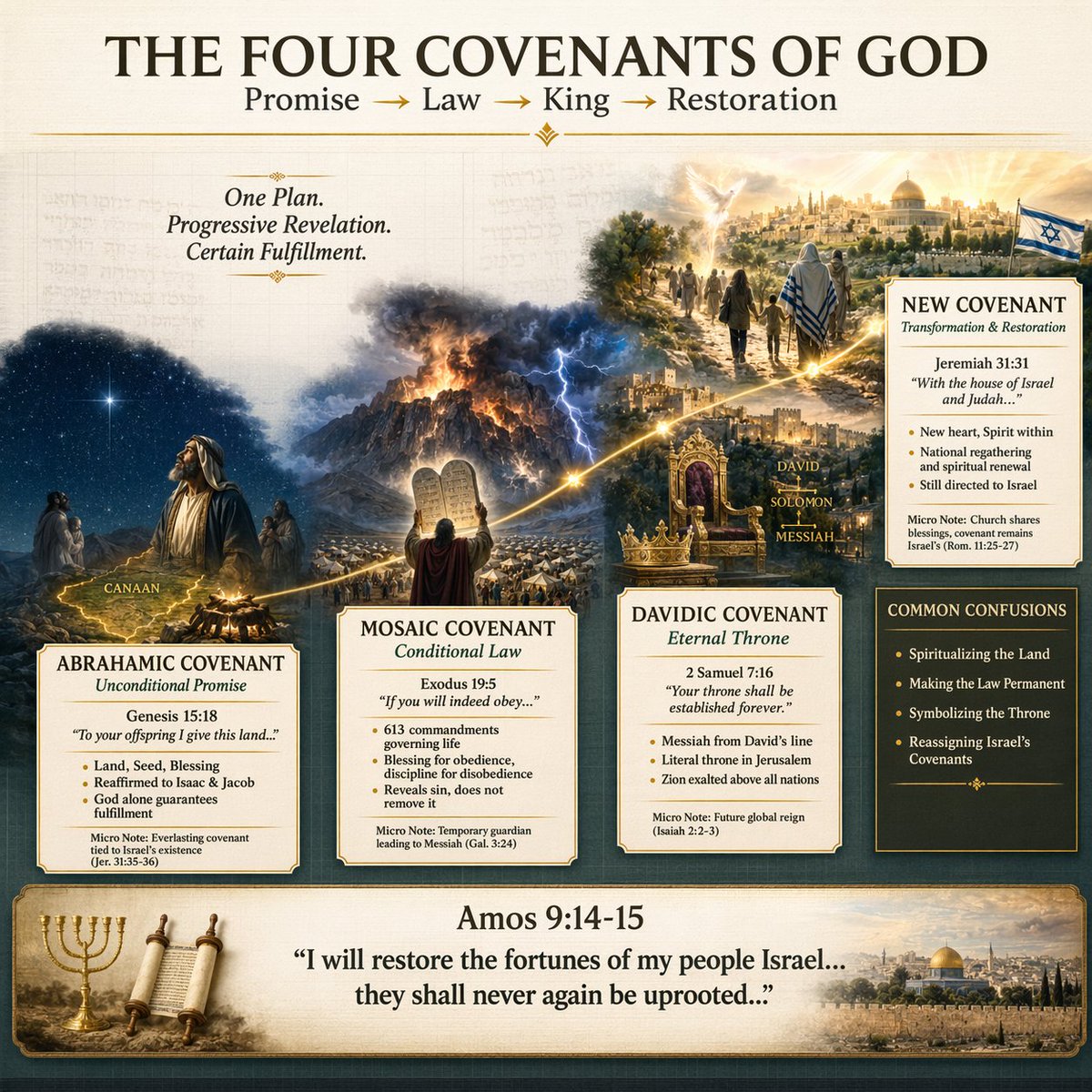
Did God redefine His covenants… or are His promises to Israel still unfolding exactly as spoken?
From Genesis to the Prophets, Scripture reveals not one vague agreement, but four distinct, interconnected covenants made with Israel. When they are blurred or reassigned, prophecy collapses. When they are read plainly, a powerful, unified story emerges.
Each covenant does not replace the previous—it builds, clarifies, and moves the promise forward toward its final fulfillment.
❖ The Abrahamic Covenant — The Unbreakable Foundation
God begins with promise, not law.
Genesis 12:2–3
“I will make of you a great nation… and in you all the families of the earth shall be blessed.”
Genesis 15:18
“To your offspring I give this land, from the river of Egypt to the great river, the river Euphrates.”
This covenant is unconditional. In Genesis 15, God alone passes between the pieces. Abraham does not. The promise rests entirely on God.
And it wasn’t stated once, it was reaffirmed repeatedly:
Genesis 17:7–8
“I will establish my covenant… as an everlasting covenant… I will give… all the land of Canaan.”
Genesis 26:3 (to Isaac)
“I will establish the oath that I swore to Abraham your father.”
Genesis 28:13 (to Jacob)
“The land on which you lie I will give to you and to your offspring.”
This repetition matters. God is not revising, He is reinforcing.
Jeremiah 31:35–36
“If this fixed order departs… then shall the offspring of Israel cease from being a nation before me forever.”
▶️ The covenant is tied to creation itself. If Israel is redefined, then God’s language has no stable meaning.
John Walvoord:
“Israel’s covenants are not canceled by the Church; they await literal fulfillment in the future kingdom.”
This promise sets the stage for everything that follows.
❖ The Mosaic Covenant — The 613 Commands and the Need Revealed
At Sinai, God gives Israel the Law—traditionally counted as 613 commandments.
Why so many?
Because the Law was not merely moral, it governed every aspect of life: civil, ceremonial, dietary, priestly, and moral. It set Israel apart as a holy nation among the nations.
Exodus 19:5
“If you will indeed obey my voice… you shall be my treasured possession…”
Deuteronomy 28:1–2
“If you faithfully obey… all these blessings shall come upon you.”
Deuteronomy 28:15
“If you will not obey… all these curses shall come upon you.”
This covenant is conditional. It does not secure the promise—it tests and exposes the human heart.
Galatians 3:24–25
“The law was our guardian until Christ came…”
The 613 laws reveal something profound: not that Israel could achieve righteousness—but that no one could.
The Mosaic Covenant does not replace the promise.
It reveals the need for redemption within it.
❖ The Davidic Covenant — The Throne That Will Not Move
God now advances His plan—from promise, through law, to a King.
2 Samuel 7:16
“Your house and your kingdom shall be made sure forever before me. Your throne shall be established forever.”
Psalm 89:34–36
“I will not violate my covenant… his throne as long as the sun before me.”
This is not symbolic language. It is covenant certainty.
Luke 1:32–33
“The Lord God will give him the throne of his father David…”
If this throne is not literal, then no promise in Scripture can be read with certainty.
And Scripture tells us where this throne will be established:
Isaiah 2:2–3
“In the latter days the mountain of the house of the Lord shall be established as the highest of the mountains… For out of Zion shall go forth the law.”
Zechariah 14:9
“The Lord will be king over all the earth.”
The Davidic throne will be in Jerusalem, on Mount Zion, exalted above all. Not metaphorically—geographically, visibly, globally.
Chuck Missler:
“God means what He says, and says what He means. The covenants with Israel are not poetic—they are contractual.”
A real King. A real throne. A real reign.
❖ The New Covenant — Offered to Israel, Fulfilled in the Future
After failure under the Law, God promises transformation, not replacement.
Jeremiah 31:31–33
“I will make a new covenant with the house of Israel and the house of Judah…”
This language is precise. It is never used for a spiritualized group.
Ezekiel 36:24–27
“I will take you from the nations… bring you into your own land… I will give you a new heart…”
Notice the order:
Regathering → Cleansing → Renewal → Obedience
This covenant was offered to Israel, and it still stands.
Yet many assume it was transferred entirely to the Church. That assumption cannot stand under the text.
Jeremiah 31:35–37 (partial)
“If the heavens above can be measured… then I will cast off all the offspring of Israel…”
Romans 11:25–27
“A partial hardening has come upon Israel… and in this way all Israel will be saved…”
This is not God abandoning His people—it is God ensuring their ultimate restoration.
The Church partakes in all the spiritual blessings through Messiah, but it is never called the nation to whom these covenants were sworn.
❖ Where the Confusion Begins
The issue is not Scripture—it is misreading it.
When the Abrahamic Covenant is made conditional, promise weakens.
When the Mosaic Covenant is made permanent, law replaces grace.
When the Davidic Covenant is made symbolic, the throne disappears.
When the New Covenant is reassigned, Israel vanishes from its own promises.
❖ The Chain Reaction
Spiritualized land → God no longer means what He says
Symbolic throne → Messiah never rules from David’s line
Redefined Israel → Covenant identity is erased
Collapsed prophecy → Scripture loses predictive authority
❖ The Prophetic Anchor
Zechariah 14:4
“On that day his feet shall stand on the Mount of Olives…”
This is not symbolic. It is visible, geographic fulfillment—exactly where God said it would happen.
❖ The Story God Is Telling
These covenants are not competing—they are unfolding.
The Abrahamic Covenant establishes the promise.
The Mosaic Covenant exposes the need.
The Davidic Covenant secures the King.
The New Covenant restores the people.
❖ The Prophetic Crescendo
Amos 9:14–15
“I will restore the fortunes of my people Israel… I will plant them on their land, and they shall never again be uprooted…”
God does not revise His covenants.
He fulfills them, exactly as spoken, in the place He promised, to the people He named.