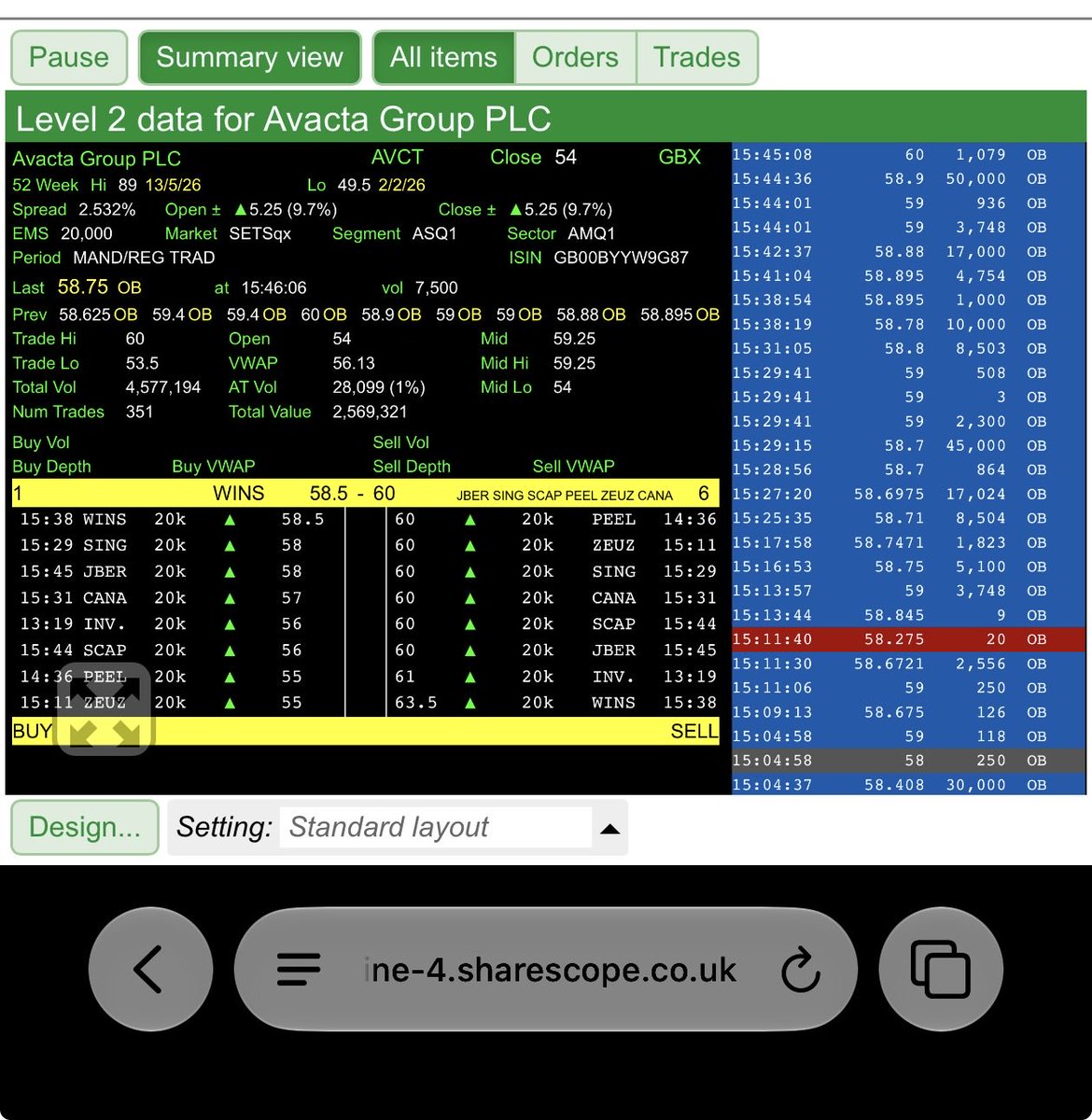
8p below a 68p placing which saw directors buy £660k of stock just 5 weeks ago.
Why?
Because those directors had seen the same AVA6103 biopsies as Ruiaridh.
Genuine madness #AVCT ever dipped below it, given what is known.
Delighted to bring a fresh look at #AVCT ESMO presentations from our TMED team. Our pre|CISION platform data inform HOW the durable release occurs. This is a masterclass in the feedback loop of information in biotech. An observation in Ph 1 explained in preclinical models.
If you told me last year #AVCT would sell off on confirmation (via RNS) AVA6207 was replicating pre-clinical performance in human but then rally on a smile I’d say you’re mad.
Yet here we are. Nothing has changed over the past two weeks. The CEO is executing her strategy. AVA6103 is working. 7.5 months into clinic.
It’s quite clear the team is seeing bazooka levels of Exatecan in the tumour biopsies received to date.
It’s clear the safety which enables this is impeccable.
What’s isn’t really discussed is the high level of consistency in these data sets. That matters for the platform.
Coughlin often says pharma tells her “show me you can do it twice”.
I suspect she can do it thrice in AVA6207.
She’s that damn good.
In this Episode of the R&D Spotlight Series, the team discuss the key findings from our ESMO data. One important finding is that tumors recruit fibroblasts during treatment, leading to an increased ability to release the payload.
https://t.co/DLG6qEo9Ww #AVCT
#AVCT releases the warheads which will make up AVA6207 next week.
The foundation of AVA6207 is AVA6103. Now proven in human.
Ownership of the ATR inhibitor, which will sit alongside Exatecan in AVA6207, will be highly informative.
Who owns the green payload AVCT seeks to use?
#AVCT
Cohort 1: two patients between 5.5-7.5 months of disease stabilisation (or better) as of today
Indications: pancreatic; gastric
That’s x5 scans for any C1 patient still on drug in the Q3W arm at this stage.
1.5mg
Cohort 2: five patients between 4-6 months of disease stabilisation (or better) as of today
Indications: pancreatic; CRC; cervical
That’s x4 scans for any C2 patient still on drug in the Q3W arm at this stage.
3mg
Cohort 3: seven patients between 2.5-4.5 months of disease stabilisation (or better) as of today
Indications: pancreatic; CRC; breast
That’s x3 scans for any C3 patient still on drug in the Q3W arm at this stage.
4.5mg
So multiple patients with advanced (stage 4) disease remain on *low-dose* AVA6103 for several months without progression in *very aggressive histologies* such as pancreatic cancer.
This is consistent with the intended reservoir/controlled-release mechanism and with the clean safety profile reported it has allowed continued dose escalation.
By my count a maximum of ~50 scans across the population to date. Excluding C4 which has completed enrolment.
In reality it will be fewer (drop outs and Q2W less frequent than Q3W) so call it ~30 scans across C1-3.
Then you’ve the backfill. Which also require mandatory biopsies.
At 7.5 months into trial they know exactly how this drug is behaving.
#AVCT has cracked it.
The IC90 of Exatecan is key. But so is the mechanism of action.
Top1 (Exatecan) drugs mainly create single-strand cuts during DNA copying, while Top2 (dox) drugs create double-strand breaks that are more immediately disruptive.
So whilst dox is more immediately disruptive, Exatecan is far more lethal (but takes the ‘death by many cuts’ approach to killing the cancer). This feels counterintuitive.
At some point in the dose escalation this ‘bites’ and a blockbuster drug begins to take shape.
Then we can start thinking about Seagen as our North Star. Sounds outlandish doesn’t it.
It’s not and they have the ambition. I can promise you that.
@RAH00084 Only 2-4 months until the wider market starts to perceive that #AVCT's AVA6103 could genuinely become a $20bn, $30bn, >$40bn per annum drug.
The best selling oncology drug in history.
That is, until the data for AVA6207 begin to emerge...!
#AVCT
Cohort 1
Began end of March
On 10 September, two patients remained on drug. That’s 5.5 months of disease stabilisation across stage 4 pancreatic cancer patients. Achieved with a 1.5mg dose of AVA6103.
I.e. their tumours are not seeing progression.
Cohort 2
Began ~mid May
On 10 September, five patients remained on drug. That’s ~4 months of disease stabilisation across stage 4 pancreatic/CRC/cervical cancer patients. Achieved with a 3mg dose of AVA6103.
I.e. their tumours are not seeing progression
Cohort 3
Began ~early July
On 10 September, (all) seven patients remained on drug. That’s ~2.5 months of disease stabilisation across stage 4 pancreatic/CRC/breast patients. Achieved with a 4.5mg dose of AVA6103
I.e. their tumours are not seeing progression
Cohort 4
Began began ~mid August
Dosing 6.8mg. Just below the Enhertu equivalent. Cohort 4 has completed enrolment as of 23 October.
Enrollment is ongoing in both arms of the study. 8 months into trial end of November.
It is quite clear AVA6103 is working. In human.
Funded well into May 2027. That’s ~7 months of funding after a 68p fundraise which saw the directors take £660k.
Cohort 5 (current cohort) projected to match the absolute dose of Enhertu.
Q2W scanned every 8 weeks.
Q3W scanned every 6 weeks.
Couple of biopsies up their sleeves. They know exactly what this drug is doing 7.5 months into trial.
The amount of ‘ hot takes’ I’ve read which are concerned about “funding into May when AVA6103 efficacy is not due to H1 2027” demonstrates enormous naivety.
For two reasons:
(1) the trial is flying, you’ll see efficacy early H1 2027 at this rate;
(2) the efficacy data (as a package) for AVA6103 is actually irrelevant for the assets AVCT is seeking to deal on: a 3rd party warhead; AVA6000; AVA6207.
Yes, the AVA6103 data supports the negotiations but they are not dealing on AVA6103.
Proving AVA6103 is working (to the extent the tech can transfer to a third party warhead) was done when they RNS’ed preCISION was proven.
Partners will receive this data under NDA on a constant basis.
Far more important are the commercials of those deals, which improve as the AVA6103 data grows.
That is to say the 6103 data *supports* the value discussion, rather than being the arbiter of any deal(s).
Crazy thought I know, but they have a strategy.
X3 separate deal avenues to deal on before May 2027.
Lots of noise. Little logic.
Regardless of whether it was a determined seller or a short that has dragged #AVCT down in recent weeks, I think these numerous big prints at 55/56p mark the bottom of this mad selloff.
I'm sure very many are watching closely (like me!) for any further big prints today, and are beginning to scale (more) in for a strong recovery from the current 9-month low share price.
We had a £12m cash injection at a (then) discounted 68p less than 4 weeks ago. Cash runway extends to May next year, and gross debt is now a negligible <£10m.
We're highly likely to see some form of partnership for the first Gen3 asset, AVA6207, before Christmas (given the ATRi reveal in 14 days' time); as well as another form of partnership for AVA6000 - in my view again before Christmas - to fund it through the pivotal Phase 2 trial.
Do they partner 6103 this early on? I would hope not, unless it's for a very narrow scope (a single indication in a single region) and for a monster upfront cash sum ($100m+).
Despite what the SP currently portrays, Avacta continues to make gargantuan strides. But we continue to suffer from a surreal blend of PTSD (caused by dramatic volatility over the past six years), and a case of a too-good-to-be-true story. And, of course, overleveraged players getting spanked every few months by the aforementioned volatility!
Ignore the noise and volatility, and appreciate that Avacta is doing remarkanble work in the battle against cancer.
A multi-billion-$ for shareholders is, in my eyes, more likely than ever before.
Avacta will present AVA6207, its Next-Generation pre|CISION® dual payload peptide-drug conjugate, in a poster at the 38th EORTC-NCI-AACR Symposium on Molecular Targets and Cancer Therapeutics, taking place in Barcelona, Spain, from November 18-20. https://t.co/9dVUvSOJLO #AVCT
Great discussion today at the @LongwoodLeaders forum in Boston on prioritizing the pipeline. Delighted to discuss the #AVCT pipeline & how we make hard decisions: sure bets v. Moonshots and those between. Big pharma and biotech have similar priority: patient impact
#LetsDoThis
Our CEO Christina Coughlin participating in the Prioritizing the Pipeline panel with @LongwoodLeaders in Boston today, discussing how we assess our platform opportunities to deliver high patient impact. #AVCT https://t.co/eP1XCtWUfn
CEO Christina Coughlin and CFO Brian Hahn will be at @Jefferies Healthcare Conference, Nov 16-19 in London. Curious how pre|CISION® keeps potent payloads silent in the bloodstream and active in the tumor? Book a 1:1 via the partnering system. https://t.co/PoHwBYBgkM #AVCT
#AVCT’s AVA6103 works.
“Mechanistically, the sustained release mechanism is playing out as we expect.”
“Findings increase confidence that the nonclinical-to-clinical translation is performing as intended - exactly as we anticipated.”
#AVCT’s pipeline of clinical & pre-clinical assets are receiving so much attention that @avacta’s ability to partner preCISION to another company’s warhead is receiving none.
Said deal is becoming far more likely given the recent platform-validating findings from AVA6000 & 6103.
#AVCT has said AVA6000 will not progress without a partner.
The pivotal trial will use PFS as the primary endpoint.
That PFS (though ongoing) is now known.
I therefore expect a partner to advance AVA6000 in SGC.
The fact they’ve waited for the PFS to be known (plus the very important point on recruitment) is obviously a conscious decision.
There no more data to collect, the P1 has closed recruitment. So there’s nothing left to do, but deal.
Some will agree with the 6000 strategy, some won’t.
Some would like to see 6103 partnered early, some won’t.
Some would like to see 6207 partnered post warhead reveal, some won’t.
Acutely aware Avacta will sit on 6103 scans (and biopsies) right now which are informing their entire strategy.
Delighted to see them to commit to Q4 6103 data via RNS (when Interims has suggested may slip into Q1) so clearly have another few “up their sleeves”.
Interesting few weeks incoming.
It is remarkable (though perhaps unsurprising) how little attention this is generating.
#AVCT sits on data which suggests the persistent release of payload is due to the recruitment of FAP+ fibroblasts to the tumour.
I.e. Imaging scans (FAPI-PET machine) that ‘light up’ FAP and blood measurements of how the drug is broken down show that FAP does NOT disappear as the tumour is killed.
Note: this FAPI-PET data is in Gen1 tech (AVA6000) where there is no capping group and linker designed to extend the release of the drug…
When they look at preclinical studies from AVA6103 (designed to extend release) this data also suggests the treatment itself is recruiting more FAP-positive fibroblasts into the tumour.
That means the “activating” enzyme (FAP) stays available, so the drug can keep releasing its payload for many cycles in BOTH generations of technology.
So does Gen1 have its very own ‘extended release’ mechanism?
Hola! Greetings from Madrid 🇪🇸
Delighted to present updates in the AVA6000 program w/ efficacy in SGC. Platform data support our clinical observations with persistent FAP expression even in deep tumor response, with prolonge FAP activity and payload release. #AVCT#LetsDoThis
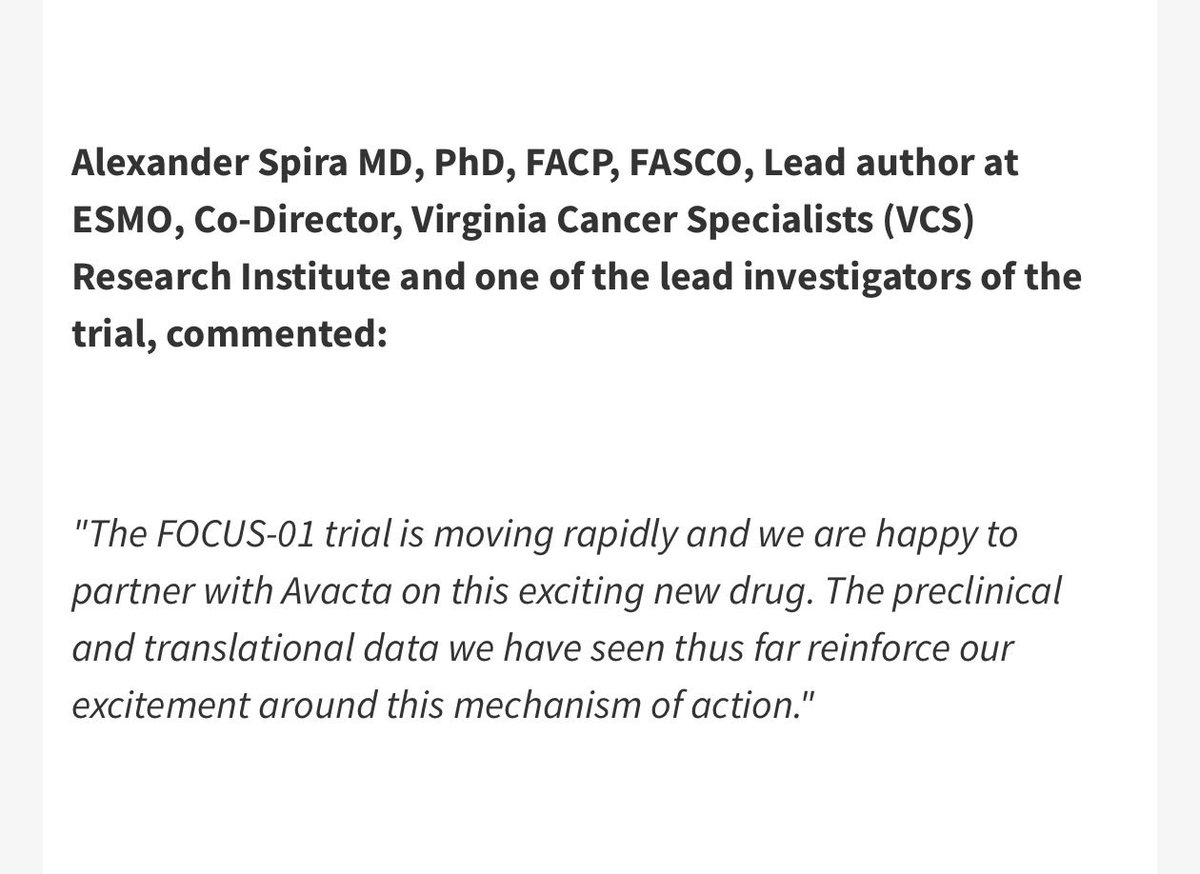
New at #ESMO26: faridoxorubicin (AVA6000) data in salivary gland cancers show a median PFS of 11.4 months, with FAPI-PET imaging showing FAP persists as tumors respond. Poster 1549P, 12:00-12:45 PM CET.
https://t.co/lhnwd6E0Ol
#preCISION#AVCT