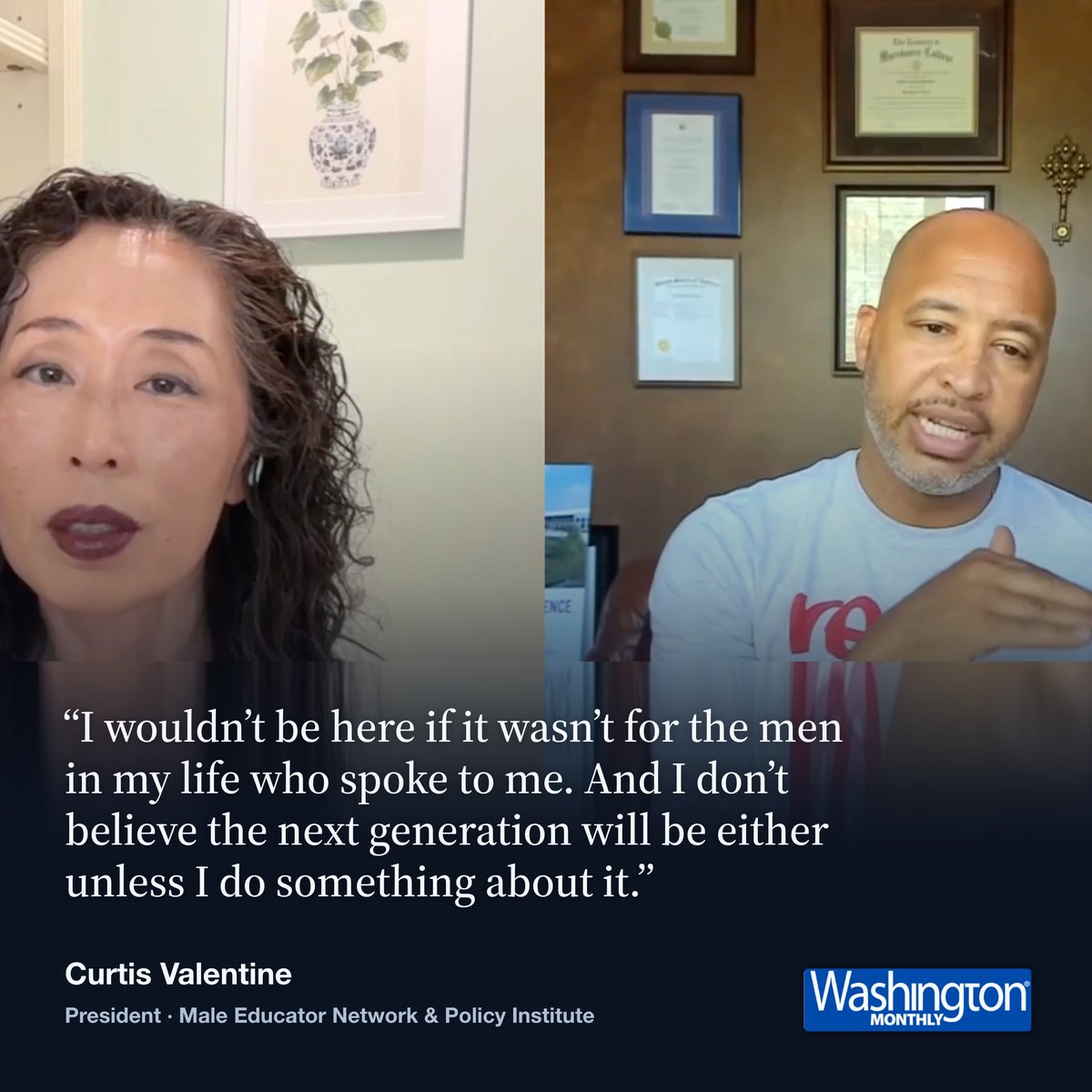
"I wouldn’t be here if it wasn't for the men in my life who spoke to me. And I don’t believe the next generation will be either unless I do something about it." - @curtiseveryday
Representation shapes futures. MEN President Curtis Valentine sat down with @Anne_S_Kim at The Washington Monthly to discuss the core inspiration behind our work.
Listen on Spotify, Apple Podcasts, or wherever you get your podcasts. Link in thread:
@RealMenTeach2@aibm_org@monthly
@C_Hendrick The lack of explicit writing instruction is big proof of teacher's limited understanding of literacy/language comp, but also reflective of the poor curriculum options.
Aside from the growth in instruction, this was the highlight of the year.
This student was expelled last year and came back to us for 8th grade. He was put in my class 4-5 months into the semester. I poured into him all year, helped him stay out of trouble, helped self regulate, etc.
Honing in on the Science of Learning, consistent routines/procedures, and warm demander pedagogy worked in my favor.
He hugged me on the last day of school yesterday, just bawling.💙
“We are admitting a cohort that cannot read at a college level and are pretending otherwise.”
Another college professor adds to the chorus of concern about student capacity.
In @chronicle:
“Six weeks into the term, I assigned my rhetoric and writing students a 20-page article. It was the same length I had assigned for five years and the same length I had read without complaint as an undergraduate a decade ago. Not one student finished it.
When I asked why, a student answered honestly: It was too long, and she kept losing track of what the paper was about. This was not a remedial class: These were students who had cleared the admissions process and written essays good enough to get them here. Yet a routine academic reading assignment had defeated them.
Every generation of professors has complained that their students cannot read. The lament is usually overblown, but data have caught up to anecdote, and what I am seeing in my classroom is no longer a hunch. There is a measurable, generational collapse in sustained reading and writing, and the academy is responding to it with improvisation and exhaustion rather than the structural overhaul it requires.
In February 2024, Adam Kotsko, who teaches in the Shimer Great Books School at North Central College, wrote in Slate that students who once handled 30 pages of reading per class meeting now seem “intimidated by anything over 10 pages and seem to walk away from readings of as little as 20 pages with no real understanding.” Crucially, he added that this is “not a matter of laziness on the part of the students” but of underlying skills they were never given a chance to build.
The Chronicle of Higher Education’s 2024 investigation found the same pattern across institutions as different as the Stevens Institute of Technology and Wellesley College, where the average SAT exceeds 1400. Nicholaus Gutierrez, an assistant professor at Wellesley, told The Chronicle that the baseline for what students consider a reasonable amount of work has dropped so noticeably that he has cut his readings accordingly; a 750-word essay now strikes many students as long. At Stevens, the science and technology studies associate professor Theresa MacPhail described following the mantra of “meet your students where they are” for so long that she has begun to feel “like a cruise director organizing games of shuffleboard.”
Worse, the national data tell the same story in colder language. On the 2011 National Assessment of Educational Progress (NAEP) writing assessment, which is the most recent comprehensive writing benchmark, only 24 percent of 12th graders reached the Proficient level, and just 3 percent reached Advanced; another 21 percent scored below Basic. The reading side of the ledger is worse, and getting worse fast: The 2024 NAEP results released in September 2025 show 12th-grade reading scores at the lowest level recorded since the assessment began in 1992. Thirty-two percent of 12th graders now score below NAEP Basic in reading, meaning that, in the assessment’s own language, they likely “cannot draw general conclusions based on concepts presented explicitly in a text.” And yet more than half of these same seniors reported being accepted to a four-year college. That last sentence is the whole problem in one line: We are admitting a cohort that cannot read at a college level and are pretending otherwise.”
Procedures and routines are the lifeblood of a classroom. They establish the standards for how we learn and why we learn the way we do. More often than not, they are the difference between an average teacher and a great one. Of all the variables that influence teacher effectiveness, this is one area that I believe does not receive the attention and focus it deserves.
We tend to focus on getting so many other things right in a classroom, but I would argue that nothing is more important than establishing strong procedures and routines from the very first day of school and maintaining a high standard of excellence throughout the entire year. If we have a procedure or routine for doing something, students should know what to do, why we do it, and how we do it. Most importantly, we should do it that way every time, without exceptions. Consistency is what turns routines into habits and habits into a productive learning environment.
A sincere thank you to The Knowledge Exchange @StamStam193 for the opportunity to collaborate on this post and share some of the sources that have had the greatest impact on my thinking and practice.
@Doug_Lemov@MrFerguson85 I would assert this goes hand in hand with the flaw of mastery based grading that essentially lets students turn in work whenever they want. Lack of deadlines create youth that lack urgency, timeliness, and discipline.
@pensandpoison We have a whole chapter in our book on “recentering” the book. It’s an explicit response to this statement- arguably the stupidest thing ever written by a professional organization in the education sector.
A few updates:
•I cleared my credential🎉
•I applied to present on Explicit Direct Instruction at the @CenterBlackEd Convening in November.
•Scores are coming in, but more importantly, learning happened this year.
The National Council of Teacher Quality will share updated ratings for colleges on June 9th showing how well they prepare teachers to teach reading. Every newspaper, church, boys/girls club, school system, and civil rights group should be on high alert.
@NCTQ@HeatherPeske
The soft bigotry of low expectations, presented as empathy, compassion, and tolerance, is a 1st order threat to our children’s education - trapping them in illiteracy and lifelong dependency.
There are seven key themes Colleen Driggs, Erica Woolway and I write about in our new book, The Teach Like a Champion Guide to the Science of Reading:
1) The fracturing of student attention (and how to implement attention-reinforcing low tech; high text classrooms).
2) The importance of fluency to comprehension, the hidden epidemic of dysfleuncy, especially in older grades (and what to do about it).
3) The importance of background knowledge to understanding in reading (and how to design lessons to be more knowledge rich).
4) The centrality of vocabulary to a knowledge rich classroom (and how to teach vocabulary more effectively).
5) The synergy between intentional writing activities and better reading (and how to understand different types and purposes of writing, especially short, mid-stream writing).
6) The necessity of reading whole books, great ones, together as a class (and why the science clearly supports this).
7) The importance of close reading (and how putting complex passages in a cognitively privileged environment can help students learn to read “above their comfort zone”).
Many of these topics are on the top of people’s minds right now and if that includes you, the book will help you think about how to teach and design lesson materials accordingly. It’s full of videos of real classrooms and samples from our own curriculum.
https://t.co/Ni34fSnaTA
The Woodson Center Mourns the Passing of Founder and President Robert L. Woodson, Sr. - A visionary leader whose life's work transformed communities from the inside out.
Read the full statement here: https://t.co/qkCExpOiJh