$Dusk @DuskFoundation community rules, thank you to the awesome community for all the cool GIFs and artwork!
@cyborgjox @JeroenCooiman @wassiemoto and all the other meme makers
Very interesting discussion between @JanvanEck3 and @RaoulGMI about issuance on-chain and ETFs.
Jan correctly asks "Who is going to provide the liquidity?". This is one of the main problems with tokenization of #RWAs and tokenization services, nobody really seems to care about these services in isolation, and they do not provide the benefit of a full on-chain lifecycle.
Another great example of this being the case is how little adoption Bitfinex Securities has received in jurisdictions like Kazakhstan. Jan correctly remarks that the EU is a much more interesting place for issuance, given the regulatory space is clear and there's a lot of liquidity in the EU markets.
On-chain native issuance of assets, and a direct link to the ETF, is what will provide the liquidity Jan is talking about. This is where $DUSK @DuskFoundation as an open, public and permissionless platform makes the difference versus permissioned and private solutions.
Our focus on EU regulations like MiCA, MiFID II and GDPR give us a head start versus competitors that leave the details up to the issuers. We provide programmable building blocks that do comply with regulations, directly on the dApp layer.
Not to mention our strategic partnership with @npex, which could in fact be a party that issues assets natively on Dusk, just to be provided as assets to be put in ETF buckets. DIRECTLY, ON-CHAIN, THE WHOLE LIFE-CYCLE OF THE SECURITY.
Dismissing us as standard tech is pretty weak. $Dusk @DuskFoundation is one of the innovators in this space. We published the widely used Poseidon paper, plus provided a widely used Rust implementation.
We created the Rust reference implementation of Plonk and contributed to the Plookup (Plonk + Lookups) paper and implementation.
The fact that you dismiss our solution so easily shows the contrast between someone who takes a technologists view and a more pragmatic one where we look at the business case and requirements of institutions.
The "We can solve your problem with our technology under my convenient assumptions" does not work. We designed a L1 that is public, permissionless but allows for dApps that are MiCA/GDPR/MiFID II compliant.
We're not looking to wrap securities and provide a weak version of it to consumers, with all the risks that come from it. We're working to become the settlement and clearing layer for the financial world. This is what the network is designed for.
A subnet will not do this. A subnet wont be a shared data ledger where RegDeFi and DeFi live together, where people will retain full control over their assets, settlement is near-instant, validators are neutral arbitrars and security is solely derived from the main chain.
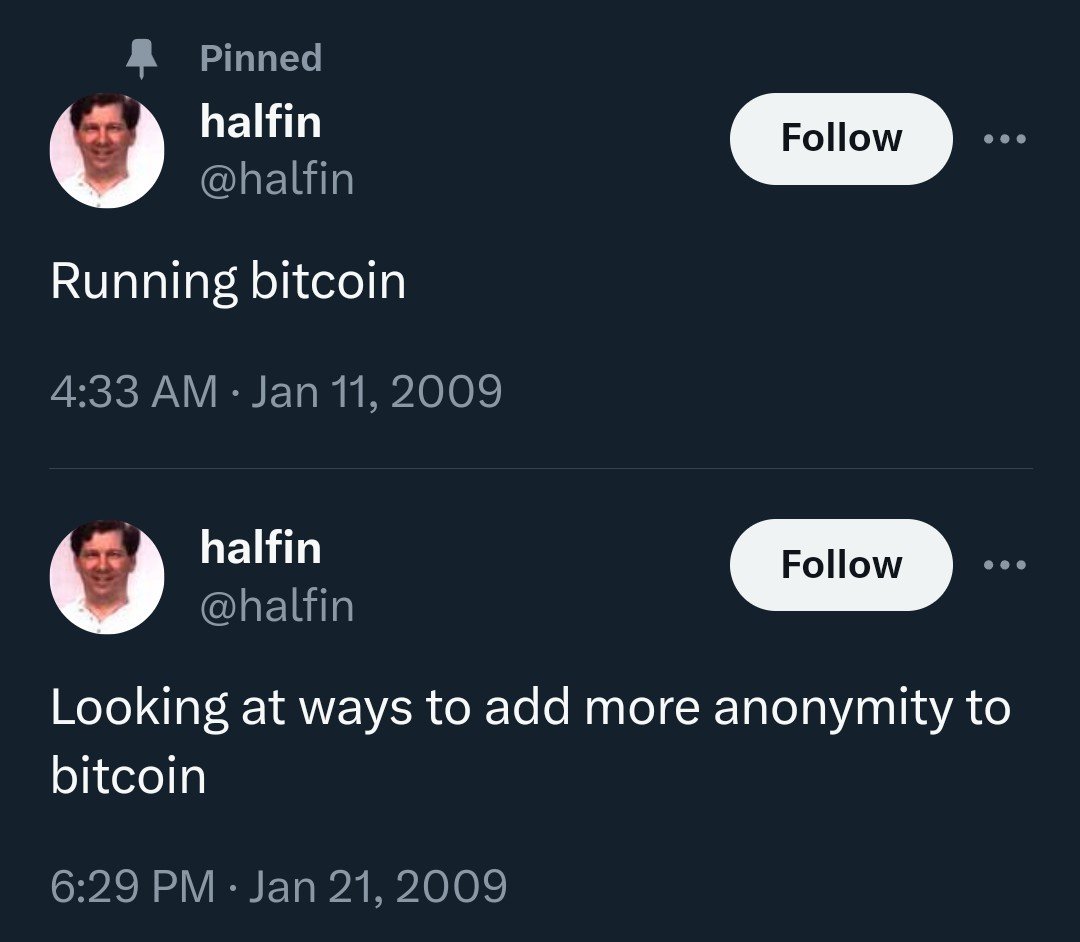
$Dusk improves upon the concept of $BTC by realising privacy. Hal realised it within 2 weeks that pseudo anonymity is not good enough to protect people.
On Dusk, noone can see your holdings or monitor your transactions. Real financial freedom.
$dusk provides the solution that institutions like @BlackRock needs.
Institutions will make a queue just to use the network. not only #tokenization but #OnchainIssuance is the future and @DuskFoundation will be the backbone of it.
Fink talks about tokenization, but the real benefit when combining DLTs and securities comes from the native issuance of assets on-chain and managing the full life cycle on it. From issuance, to settlement, to clearing, to trading, to voting.
TradFi might be reluctant to use decentralized blockchains, but this primarily stems from regulatory uncertainty, something the EU is slowly solving with regulations like MiCA and DLTR. I highly doubt they care that much about infrastructure, given there's numerous institutions that already outsource infrastructure to third parties on multiple levels. For them it's all about compliance and risk-management.
RegDeFi and DeFi can live together on a singular chain, case in point being @DuskFoundation $DUSK. We've designed a public, permissionless L1 that is designed with compliance in mind.
Anyone can join the network and build dApps on top of it that are privacy-preserving. Privacy and Compliance? Yes. These are not a false dilemma, these are both a requirement if you want to run compliant dApps on a public chain. Privacy is necessary to prevent front-running and business secrets from leaking, as well as complying with GDPR.
At the same time, through our Confidential Securities Contract (XSC) standard, the life cycle and rules of MiFID are implemented. Voting, access lists, explicit acceptance, auditor views are all implemented.
Through our Self-Sovereign Identity (SSI) protocol Citadel, it's possible for issuers to prove identity properties of their users without revealing any personal information on-chain.
The benefits of doing securities life cycles on-chain are massive in terms of liquidity, outsourcing infrastructure and interoperability versus private chains.
I'll ignore the goalpost shifting here for a second and just stick to the main point you're making here.
It is not a "standard" approach to native issuance. Even the German eWpG law you're referring to has restrictions on bond issuance as a native asset.
If you want to do actions beyond using it as a lookup table, which is gimmicky at best, you will still have to register with a CSD, which makes the whole exercise useless.
There's one law that matters now when it comes to native issuance of securities on DLTs and that is the DLTR. In DLTR, the TSS option is the golden ticket.
For a system to be public, permissionless, privacy preserving and compliant but with shared liquidity, data and composability at the same time you need the mix of ingredients we have, which is:
- Baked in KYC/SSI on the dApp layer through our Citadel protocol
- Near-instant finality
- Privacy (GDPR compliance, no value extraction from frontrunning in trades)
We have ZKPs as a first-class citizen in the VM.
It's a network where DeFi and RegDefi can freely live next to each other.
So, it seems like Citadel is popular!
The Citadel SDK is #Dusk's privacy-preserving licensing tool, that allows access to goods and services without revealing private or personal data.
With Citadel, you no longer have to share your personal information, rather you use your "pass" which proves you are able to access goods/services.
It's the difference between sharing your DOB vs proving that you are 18+ to buy alcohol.
It's the difference between sharing your income vs showing you earn over a given amount to qualify.
It's a game-changer, for institutions, users, and blockchain developers (KYC is coming for DEXs too).
Read more about it (and see a demo) here: https://t.co/8yFkos4LBB
$DUSK #ZKP #RWA
TradFi exchanges are as fragmented as can be. Interoperability barely exists. CEXs have the big benefit of being connected to a shared ledger, with established APIs and standards.
The day TradFi has access to a blockchain that is public and permissionless, but can also provide privacy-preserving and compliant dApps, is the day that we'll see DeFi and RegDeFi come together on a single network.
It is the day we'll see the Binance of securities exchanges come to life. When CSDs and clearing houses become obsolete, and T+0 settlement truly becomes a reality for regulated assets. $DUSK #RWA #Privacy #ZKP @DuskFoundation
What's coming up at Dusk?
There's a lot to look forward to!
ITN, our incentivized #testnet for staking and running nodes with $DUSK, is on the agenda for this month as we continue our progress towards #mainnet💪
The last time we ran ITN it was a huge success with thousands of nodes 🎉
TradFi exchange infrastructures are a mess when it comes to interoperability. CEXs have the benefit of connecting to blockchains with established APIs and standards.
The day we see a blockchain become a Financial Market Infrastructure (FMI), and a Bitfinex for securities attached to a public permissionless chain ,is going to be a glorious day.
Native issuance of ETFs, stocks, bonds (not the wrapped forms), eliminating the need for CSDs and clearing houses, with true T+0 settlement.
$dusk #rwa cough cough..
While you focus on vapor projects jumping into #rwa narrative,, $dusk has been building for 5 years and ready to deliver mainet in few months
Why? $Dusk is a privacy-preserving chain. The data is public, but encrypted.
On-chain assets issued through our Confidential Securities Contract (XSC) standard are MiFID compliant. The rules are coded in the smart contract.
Positions and trades are not visible to other participants, except for auditors.
Not everyone can just trade a security. KYC is required for that. Nobody wants to leak their on-chain identity and have a direct link between a pseudonymous address and their personal data. That's why we don't use an account model, but rely on UTXO in the basis and a hybrid model on XSC called Zedger.
On-chain identities can be represented as licenses issued from our Self-Sovereign Identity (SSI) protocol called Citadel, with which you can create Digital Identities (DIDs).
With these you can prove that you're not from a sanctioned country and eligible to trade the given assets, without revealing any personal information on-chain.
Native issuance of securities/RWAs, compliance AND privacy on-chain on a public permissionless blockchain are not a pipe dream, it's about to be released this year. It's called @DuskFoundation. 😉