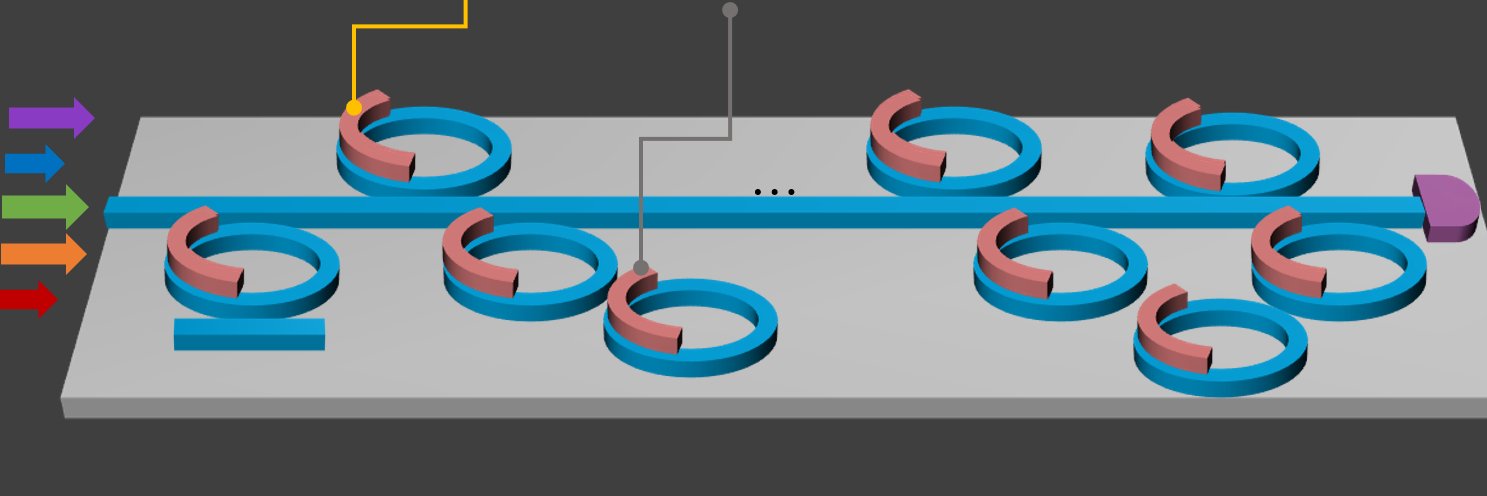
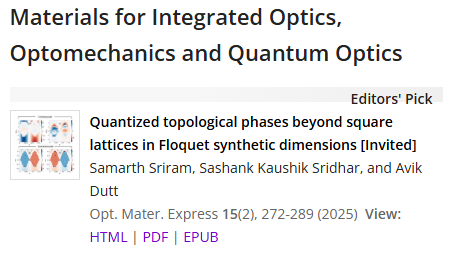
Here we show how synthetic dimensions can be extended to non-square lattice geometries, including hexagonal and Haldane-like lattices, which have been a cornerstone for hosting exotic phases of light and matter, e.g. anomalous quantum Hall effects.
Our recent paper by @smrthsrrm and Sashank @twomodesqueezed was highlighted as an Editor's Pick by Optical Materials Express -- a part of the special issue on "Floquet engineered materials and systems"!
https://t.co/CKQYdla3Y8
@OpticaPubsGroup@UMDResearch@ClarkSchool@umdme
Pleased to share our paper in the @ACSPhotonics special issue “Rising Stars in Photonics” by Nate @Nateblah0!
https://t.co/gTD9RfWo5E
In short, we see ~100X improvement in accuracy for nm-scale perturbations in multimode silicon nanophotonics!
@umdme@UMD_IPST@UMDResearch@UMDBioChemPhys@NSF!
@AlbanSauret@UofMaryland@umdme@ClarkSchool Welcome to UMD, Alban! Excited to have you as a colleague in the department, and looking forward to your continued excellent work.
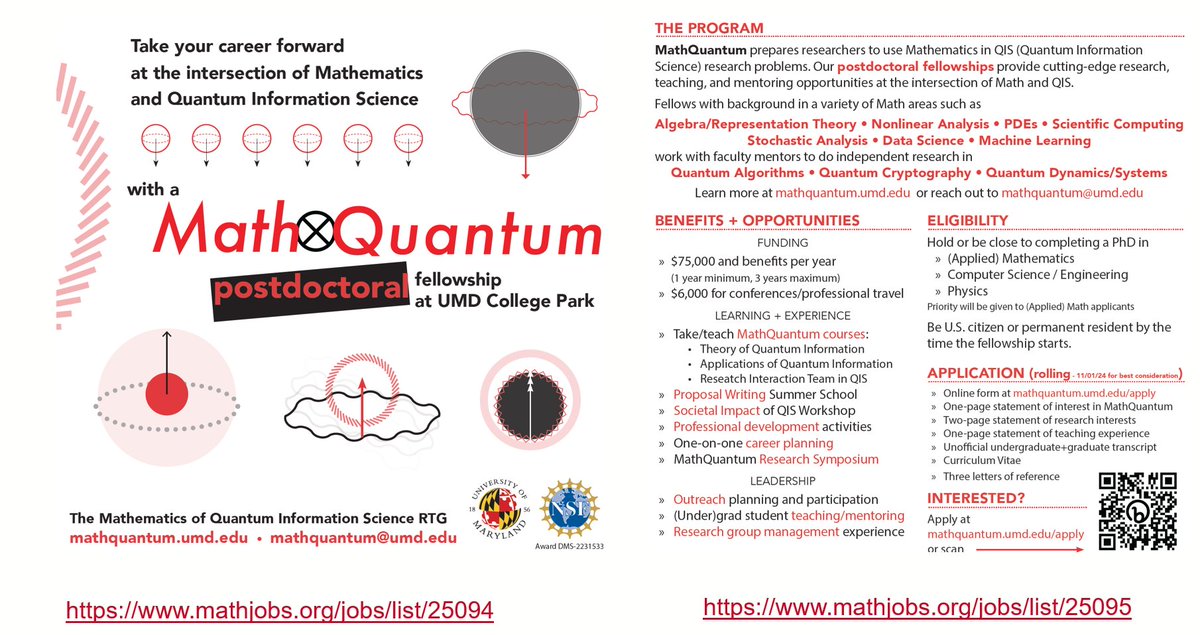
Reposting as the best consideration date (Nov 1) approaches: our group at @UofMaryland has an opening for a postdoctoral fellow at the intersection of #Math and #Quantum Information Science. Please help spread the word!
https://t.co/TjY0xPpCVG
https://t.co/0zCtmqwIdv
Feynman is right. The goal of physics isn't to find theories that are philosophically or psychologically pleasing to humans. The goal is to find theories that describe nature as accurately as possible
Our FloQuET lab has been awarded the @NSF CAREER. Stay tuned for exciting results on #nanophotonic synthetic dimensions for #quantum simulation & sensing by students supported on this grant! Popular summary: https://t.co/b5POkFba5n
Technical details: https://t.co/mugakqEDr5
Stroboscopic generation of topological phases with high school student dances! funded by @NSF. A discussion in Physics World
https://t.co/wnuS3E0F4i
Led by Matt Du. Finally out
@AnilZenginoglu@VergaraLautaro @the_happyproton I agree. I'm in disagreement with the usual definition of quantum being things on the microscopic scale. The size of a *single* photon can be macroscopic, e.g. a photon in a collimated cm-wide Gaussian beam. Pauli's exclusion pushes it to neutron-star scales like you mentioned.
"We discuss [...approaches towards...] realizing the major goals of integrated nonlinear photonics such as broadband frequency conversion, frequency-comb generation, quantum light sources and nonlinear optical quantum logic gates."
Our review on Nonlinear and Quantum Photonics based on high-confinement platforms is out in @NatRevMater, with @mohanty_aseema@gaetalab@Michallipson. Hope this is useful both to early-career scientists and experienced researchers! Thanks @Giulia_Pacc
https://t.co/9Yujr5xYxi
Thanks to the broadband emission bandwidth, we perform a proof of concept of a trusted-node-free, fully connected network between 5 users. Here is the link to the paper:
https://t.co/fmNzBFDN1U
Abstracts for @SPIEtweets@PhotonicsWest and #QuantumWest due tmr, July 17! Please consider submitting your latest work, especially to Laser Resonators, Microresonators, and Beam Control section, Chairs include @ProfArmani:
https://t.co/mHIvDEjUE2