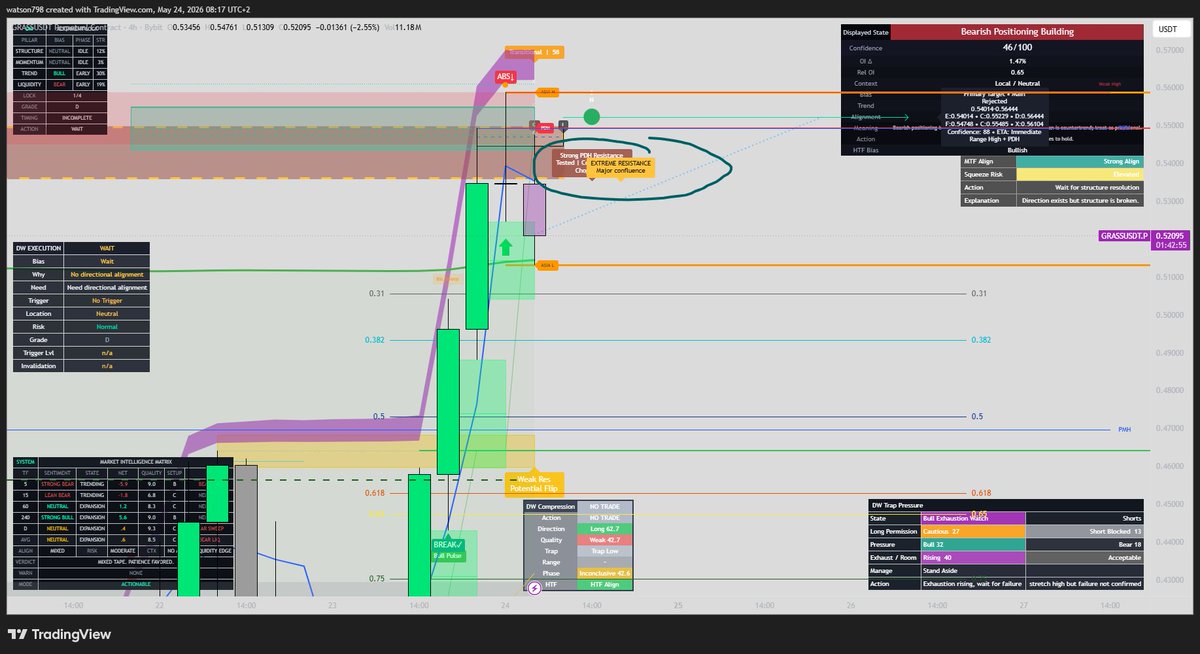
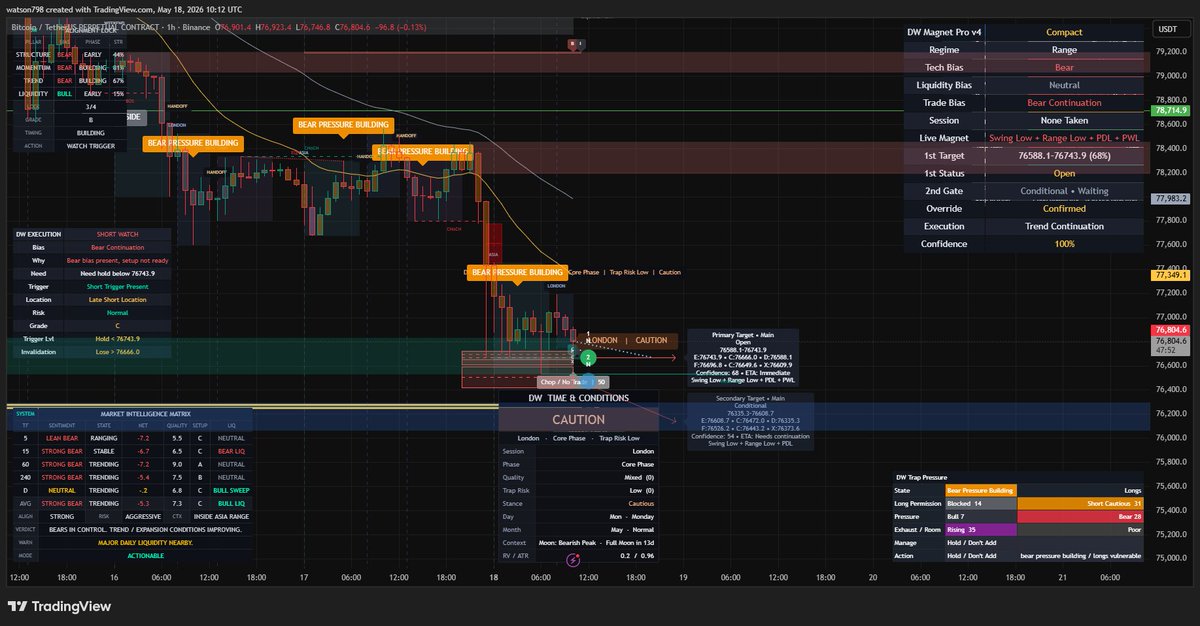
Try our #Tradingview indicators, free and premium- Follow the liquidity and stop trading blindly!
Institution level quant data, proven backtesting!
#BTC#Crypto#Trading#CryptoHelp
Get them here ➡️
https://t.co/R2bDWXcBxl
Strategy has acquired 1,550 BTC for $101 million to increase our $BTC Reserve to ₿845,256. We have also increased our USD Reserve by $100 million to $1.0 billion. $MSTR $STRC https://t.co/1Zf1AVsP1H
The uncomfortable part is that my own scenario map is pointing in a similar direction: a lower retest is absolutely on the table.
But I don’t think the interesting question is “bear market or manipulation?”
The real question is what BTC does at the retest.
Flush into major support + reclaim = cycle reset opportunity.
Flush, weak bounce, fail to reclaim = then the bulls have a real problem.
Low volume and low social interest can mean exhaustion — but it can also mean nobody is left to sell aggressively until price proves otherwise.
Prepared, yes.
Married to the bearish narrative? No.
Interesting basket — but this feels less like a portfolio update and more like a liquidity stress test for followers. BTC makes sense as the anchor, but once you get into 12–15 names, the question becomes: is this conviction, or just narrative diversification with extra volatility? In this market, being early is expensive, being crowded is dangerous, and being “updated” every cycle is usually where returns go to die.
The 5y chart is ugly, no argument. But calling Ethereum a “fossil” because price hasn’t rewarded holders is confusing price with progress. ETH shipped the Merge, staking, blobs, L2 scaling and major fee-market changes. The bearish case isn’t “no innovation” — it’s that the innovation has mostly benefited users and L2s more than ETH holders. That’s the actual debate. Price can be dead money while the tech keeps moving. Welcome to crypto, where fundamentals and bags often stop speaking for years.
That’s a neat soundbite, but it assumes BTC is just Nasdaq with worse PR.
The real question is why BTC is lagging: liquidity absorption, deleveraging, ETF flow weakness, or simple rotation?
If equities roll over and BTC still holds key bids, the “weak beta asset” argument collapses fast.
This is shocking.
Mark Cuban SOLD all his Bitcoin.
In his own words:
"Bitcoin lost the plot."
He explains that $BTC was designed to be the ultimate alternative to fiat - and completely failed the test during the Iran war.
(interview from Portfolio Players)
The more I trade, the less interested I am in whether a level is “support” or “resistance” in the textbook sense. I care more about what happened there: who got trapped, who was forced out, what kind of fuel moved price away from it, and where the next pocket of vulnerability sits.
That is where two-level trading becomes interesting.
Have a look and see what you think of this deeper look in my article here:
https://t.co/m3NQb2pgdS
#Trading #Crypto #BTC
The missing piece is that STRC below $100 doesn’t automatically mean “the market discovered it isn’t worth $100.”
It can also mean the market is demanding a higher yield for a perpetual, BTC-treasury-linked preferred with liquidity/credit/reflexivity risk.
Preferreds trade below par all the time. That alone isn’t the death spiral.
The real issue is different:
If STRC stays below par, the BTC accumulation flywheel loses torque.
Saylor can still raise capital, but the capital becomes more expensive. Raising the dividend may support the price, but it also increases the fixed cash burden. At some point, the market stops asking “can he buy more BTC?” and starts asking “what is the true cost of maintaining the machine?”
So I don’t think $99.50 vs $100 is the apocalypse.
But STRC persistently trading weak would matter because it changes the narrative from:
“infinite premium-funded BTC accumulation”
to
“high-yield capital structure with BTC reflexivity risk.”
That’s not instantly fatal.
But it is the point where the spreadsheet enters the room and ruins the laser-eye party.
I agree on fading “alt season” as a broad narrative.
But the nuance is this:
Alts don’t need to reverse a 5-year BTC bleed to give massive tradable rotations.
The real mistake was calling every bounce “alt season.”
The next mistake may be dismissing every alt rally because the macro ratio still looks awful.
Alt season as a lazy blanket trade is dead.
Selective rotation isn’t.
#TOTAL3 is sitting in the decision zone.
Bears had the clean breakdown attempt — but so far, price is still defending the major support block around 438–443B.
The real test is simple:
Hold here → alts can still build a relief leg.
Lose this zone → the market likely sweeps lower before any real alt season talk matters.
For now, I don’t see “alt season.”
I see a market trying to prove it can survive the first major support test.
Support below.
Resistance stacked above.
No confirmation yet — just pressure.
(Using the new Level indicator, soon to be released)
The market gives you one clean “level-to-level” TA day…
then immediately follows it with 48 hours of chop mayhem designed to take the money back.
Not today, José.
Directional days are for extracting.
Chop days are for protecting.
The real edge is knowing when your job has changed.
#BTC #Crypto
Fair take. The one thing I’d push back on is assuming “thin books + weak rotation” automatically means top.
Sometimes that’s exactly how late-cycle distribution starts.
But sometimes it’s also how the market climbs before sidelined capital is forced back in.
For me the key is not whether 60K “should” be the bottom — it’s whether BTC starts accepting back below key reclaimed levels.
If the move up was just liquidity sloshing around, breakdown should be fast and obvious.
If bears get another perfect short setup and price refuses to die, that’s the signal.
@jasonpizzino The real winner was the guy who bought at $65k, didn’t sell, rode it all the way down, and still told everyone he was “in it for the technology” 😂