ran an audit on a project's site last week and got genuinely annoyed at what we saw.
"connect wallet." everywhere. on every button. on every page.
not because its wrong. because its the same button on literally every web3 project that exists.
we have looked at hundreds of these sites by now and "connect wallet" shows up on almost all of them. so does "deposit now." so does "enter amount."
nobody clicks a button because they want to connect a wallet.
they click because they want what happens after.
yield. ownership. access. a position that grows. something real that wasnt there before.
and almost every project in this space is asking for the action instead of promising the outcome.
we changed three buttons on that audit.
> "connect wallet" became "start earning."
> "deposit now" became "claim your position."
> "enter amount" became "see your projected yield."
same flow. same product. same five seconds of effort from the user.
the only thing that changed was what the button told them they were about to get.
this is such a small thing and it gets ignored by almost everyone building in this space. which honestly works in our favor because it means the projects that fix it stand out without trying very hard.
at zingy labs this is the kind of detail we actually look at. not the big strategy deck stuff. the button. the one line. the thing that decides if someone clicks or scrolls past.
name what they get. not what they do.
its the easiest unfair advantage sitting on every web3 site right now and almost nobody is using it.
2009: send money without a bank.
2020: run financial markets without institutions.
2023: physical infrastructure onchain.
2024: AI agents earning and spending autonomously.
2026: robots working, climbing mountains, getting funded onchain.
each step brought the real world closer to the chain.
the robotics chapter just got a lot more interesting. 🧵👇
(1/10)
when @pantheonvaults launched we wrote about it as a new asset class.
a month later there are 7 creator index tokens live and the range of creators tells a more interesting story than any single number does.
here is what is actually live right now.
$BLKSHP by @taniatare
professional golfer, instagram creator, crypto advocate. her index is built around the partnerships, luxury events, and community surrounding her brand. highest market cap on the platform right now.
$FADED — DontFadeCrypto
the wildest stat on the platform. 91,204% APR. $4.57M reward pool. 50% of supply locked for 24 months in vault rewards. creator allocation locked with a 6 month cliff before anything moves.
$WYFNDR by @SpikeCollects / @WayfindersGG
first creator community index where creators and communities grow through shared rewards. 1,816% APR. $277K reward pool. 7% circulating at launch with 30% going to vault rewards over 24 months.
$GSTAR by @mizzysworld
the original. agentic culture, AI agents, gaming, experimental onchain communities. 138 token holders. $323K reward pool. the one that proved the model works.
$BWIL by @bigwil
has @RatehopperAI, the first agentic self-repaying loan protocol, as one of five teams in his index. 64 vault holders. 341% APR.
$DGC by @DadsGoneCrypto
making crypto simple for people with jobs and families. 996% APR. $144K reward pool. 30 vault holders.
$PATCHA by @0xPatchara
cinematic storyteller working at the crossroads of AI, DeFi, and gaming. 843% APR. $231K reward pool.
the structure behind all of them
creator allocation is 50% of supply. locked for 6 months minimum before anything moves. vault rewards make up 21% to 50% of supply, paid out over 24 months. only 1% to 8% circulates at launch.
creators cannot dump on their community without destroying the value of the 50% they are still waiting on.
the incentive to keep building is written into the contract.
for users, there is a points program running with 104 days left. trade, stake, hold, or refer to earn points that convert to token rewards. 444 people already on the leaderboard.
Pumpfun metrics for the week ending june 26. no spin, just the numbers.
what the data says this week
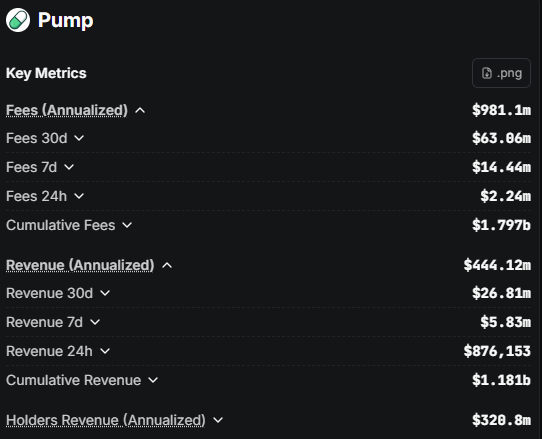
> fees generated (7 days): $14.57M
> protocol revenue (7 days): $5.85M
> fees in the last 24 hours: $2.24M
> TVL sitting at: $211.11M
> cumulative fees since launch: $1.797B
the context behind those numbers
> daily revenue peaked at around $4.8M in january. its now averaging $800K to $2M depending on the day. thats a 60 to 80% drop from the january high.
> the token graduation rate tells the same story. earlier this year tokens were graduating to Raydium at roughly 1%. that number is now sitting at 0.26%.
> for every 400 tokens launched this week, roughly one made it to a major DEX.
what changed in may that matters
> USDC-paired launches went live on may 21. creators can now launch tokens paired with $SOL or $USDC instead of SOL only. broader participation, less dependence on SOL price as the entry point.
> the buyback structure also shifted. after burning ~$370M in $PUMP tokens (36% of circulating supply) earlier this year, the protocol locked 50% of revenue into ongoing programmatic buybacks. at current revenue levels that is roughly $400K to $1M per day going back into PUMP.
the GO feature and this weeks controversy
> @Pumpfun launched GO in early june. a bounty marketplace where users escrow crypto and others complete tasks to earn it.
> $370K+ paid out since launch.
> on june 21 New York Governor Kathy Hochul called the platform a "dystopian model" after reports surfaced of bounties for dangerous stunts and humiliating tasks. june 22 brought wider backlash across media.
> no proactive moderation is in place. the team has not publicly responded as of june 26.
the bigger picture
> $PUMP token is down 86.8% from its ATH of $0.008819. trading at $0.001162 today.
> the platform still generates more cumulative revenue than almost any application in crypto history at $1.776B lifetime. the question is whether the weekly run rate can recover without a new memecoin cycle pulling volume back.
> the graduation rate is the number to watch. when it climbs back above 1% the revenue picture changes fast.
until then the data is what it is.
hot take: nobody cares how good your web3 product is if you launch it without the complete package.
most web3 projects launch with one thing.
the product.
and then wonder why uptake is slow when the product is genuinely good.
a product solves a problem. the complete package makes it easy to believe the product will solve your specific problem, right now, with the time and knowledge you actually have.
the difference is usually what surrounds the product at launch.
> the documentation that makes it possible to start without already being an expert.
> the support channel where a real person answers within hours not days.
> the quick win built into the first session so users feel something before they decide if this is worth their time.
> the community of people already using it who can answer the question the documentation missed.
none of those are the product. all of them affect whether people use the product.
the projects that launch well have thought about all of it.
the ones that struggle usually launched the product and called it done.
here is a red flag most founders miss until its too late.
your agency stops talking about active users after launch and starts sending you impression reports instead.
impressions spike at launch. thats normal. what happens in week two and three is what actually tells you if anything worked.
if your daily active users are dropping while the retainer invoice stays the same, you are paying for someone to look busy while your project bleeds out.
the retention layer is where most agencies go quiet because it is hard. it requires looking at real numbers, having uncomfortable conversations, and fixing things that do not look good in a monthly report.
we track on-chain metrics after launch. daily volume, wallet retention, liquidity stability. not because it sounds impressive but because those are the numbers that tell you if the growth is real.
if your post-launch chart looks nothing like your pre-launch hype, something broke. and it probably broke before launch.
most projects create content without knowing if it is working.
not because they do not measure it. because they measure the wrong things.
impressions tell you the content was served. not that it landed.
likes tell you someone agreed in the moment. not that they remembered it tomorrow.
follower growth tells you the net change in who follows you. not whether those followers ever came back.
the metrics that actually tell you if content is working:
> saves and bookmarks. someone saved the post because they wanted to come back to it. that is the strongest signal that the content had real utility.
> unprompted shares. someone sent your post to another person without being asked. that means the content did something for them they wanted to pass on.
> inbound DMs referencing specific posts. someone reached out because something you wrote changed how they think. that is the highest signal content can produce.
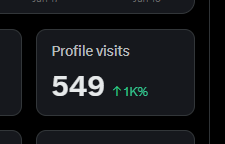
> profile visits after a post goes live. someone saw the post and wanted to know more about who made it. that is top of funnel working correctly.
if you are not measuring these four things you are optimising for the algorithm not for the audience.
the algorithm and the audience want different things.
build for the audience. the algorithm usually follows.
we have been in web3 long enough to know the difference between projects building something real and projects building something that looks real.
and we didnt stay in one lane.
gaming, DeFi, AI, RWA, NFTs, institutional fundraising, B2B lead gen. we have worked across all of it. not because we spread thin but because the best operators understand how these ecosystems connect and what moves the needle in each one.
here is what we have done for the ones building something real.
> 5,000,000+ views for Off The Grid through narrative driven KOL alignment.
> 20,000 high quality PC gamers onboarded for Farcana in 21 days.
> 38,000 genuine FPS players acquired for Haven's Compass, converting into 30,000 Battle Pass sales.
> doubled StarHeroes market cap in 7 days.
> 2,000+ paid NFT mints and 12,000 unique participants for OuterLife in one week.
> 20+ pre-qualified B2B sales calls per week for SphereOne with key web3 decision makers.
> major capital funding round secured for Wowmax with a publicly listed company.
> multi-year ecosystem growth for SKALE as agency of record.
we dont chase vanity metrics. we build the infrastructure that produces real ones.
if you are building something worth playing, trading, or using, dms open.
Everyone is talking about @base MCP as an AI update.
We think it's a distribution update.
For years, crypto growth followed the same formula:
User → Finds App → Uses Product
Base MCP introduces a new path:
User → AI Agent → App
The agent becomes the discovery layer.
That's why we're paying attention to teams already building for this future.
@aixbt_agent is turning agent intelligence into a reusable layer other agents can query.
@virtuals_io is positioning agents as economic actors.
@ethy_agent is exploring AI-powered trading execution.
And builders like @0xyoussea are already showing what native MCP experiences can look like.
Most teams are still optimizing for human attention.
> Content.
> KOLs.
> Landing pages.
> Ads.
But agents don't care about any of that.
They care about one thing:
Can they actually use your product?
That's why we think the biggest winners from #MCP won't necessarily be the protocols with the biggest communities.
It'll be the protocols that become the default tools agents choose to use.
Just as SEO created winners in search and app stores created winners in mobile, MCP could create winners in the agent economy.
The smartest builders aren't just asking:
"How do users find us?"
They're starting to ask:
"How do agents find us?"
in 2025 every project in crypto had the same pitch.
"we're bringing real world assets on chain."
the RWA narrative raised billions. it created a whole category of protocols, tokens, and institutional partnerships. the press releases were spectacular.
then quietly, while everyone was watching the RWA sector, a perp DEX became the biggest RWA story of 2026 without ever using those two words.
here is what actually happened.
@HyperliquidX generated $8 billion in total revenue in 2025. in 2026 it added oil, gas, silver, gold, pre-IPO contracts, and S&P 500 perps to its order book. RWA open interest hit $2.65 billion on may 18. doubled in two months. 44% of all perp DEX volume now flows through it. $30M a month just from tradfi derivatives.
it never called itself an RWA protocol.
it just noticed that when geopolitical events break on a sunday evening, traders want to position in oil and gold and there is nowhere to do that until monday morning.
so it built the venue.
compare that to the projects that organized themselves around the RWA narrative.
@OndoFinance genuinely the best version of what a formal RWA protocol looks like. $3.53B TVL. fidelity, paypal, mastercard, jpmorgan all integrated. $13.26M in revenue in Q1 2026. doing real work.
but $13.26M in a quarter versus $30M a month is the gap the narrative doesnt show you.
the lesson is not that ondo is bad. it is not.
the lesson is that the biggest winner in a category often does not describe itself using that category's language.
the projects that win are the ones that solve a real problem for a real user at a real moment. the narrative they get assigned usually comes later.
hyperliquid did not set out to be the RWA story of 2026.
it set out to be the place where traders could actually trade.
the label arrived when the volume did.
this is what we mean when we say the market rewards execution over narrative.
build the thing that solves the problem. the story writes itself.
"we have a premium network of 200+ web3 KOLs ready to amplify your project."
if a growth partner opens with that line, close the tab.
here is what that pipeline actually looks like behind the scenes.
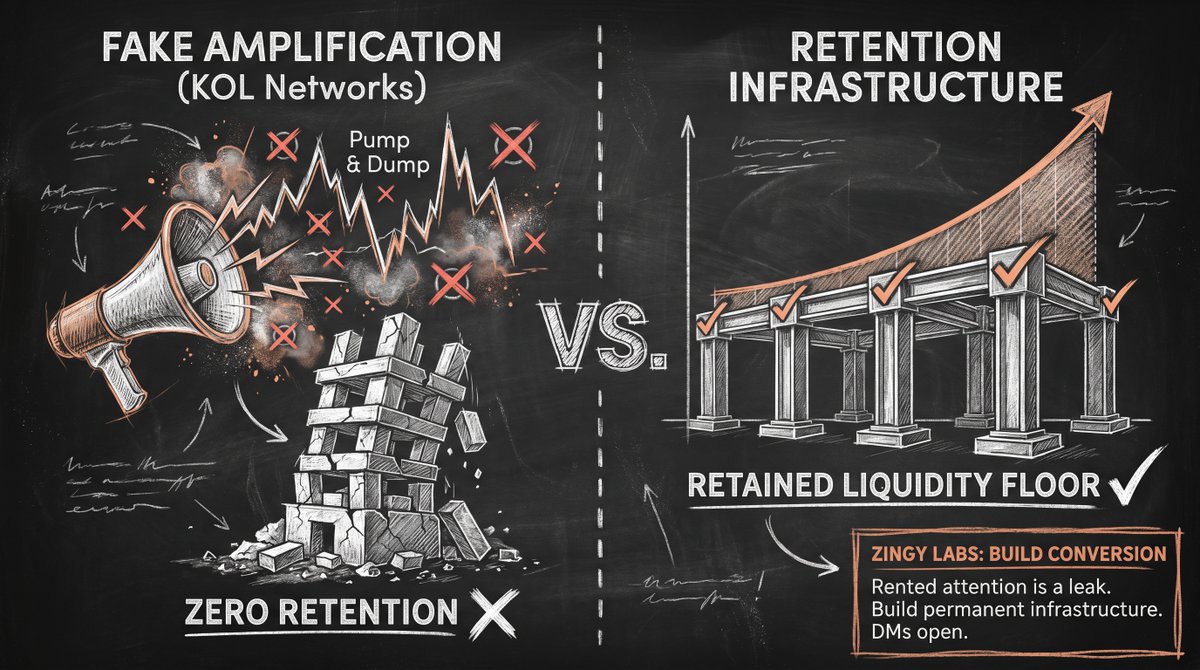
the agency pays a group of accounts to post at the same time. same charts, same captions, slightly different wording to avoid looking coordinated. it looks like organic momentum. it is not.
the chart moves for a few days. the agency screenshots the numbers and calls it a win. the KOLs dump their allocations. the attention disappears.
what you are left with:
> a broken chart that signals to real investors the project already peaked
> a community that watched the pump and now does not trust the team
> a runway that is significantly shorter than it was two weeks ago
> zero retained users from any of it
KOLs are a distribution channel, not a marketing strategy.
distribution without retention infrastructure is just renting attention you cannot afford to lose.
if you do not have backend systems to convert temporary attention into active users, scaling distribution is just a very expensive way to leak liquidity.
the agencies running this playbook know exactly what they are doing.
the founders paying for it usually find out too late.
at zingy labs we do not sell KOL packages. we build the systems that make distribution worth paying for in the first place.
When Troy and I started Zingy Labs, we noticed a massive, systemic flaw in how Web3 projects approach growth.
Founders were writing beautiful whitepapers, hiring elite developers to build robust smart contracts, and then handing their entire marketing budget to agencies that only knew how to run meme contests.
High level tech requires high level growth infrastructure.
We don't do flashy presentations or hollow promises. We act as strategic advisors and master executioners who build the backend growth systems that keep your protocol alive.
We look at your project across DeFi, GameFi, or AI as a complete machine. The marketing pipeline must align perfectly with the tokenomics and the technical backend.
If you are tired of the generic Web3 marketing playbook and want to talk about building sustainable traction, let's connect.
We build for teams who plan to be here for the long haul.
BREAKING: AI on the Lot (@aionthelot) Community Day closes with a breakout AI film hitting the big screen.
THE PATCHWRIGHT, a cyberpunk short film with 10 million+ views online, made its North American theatrical premiere at the showcase.
AI-native content is moving from the internet to the big screen faster than anyone expected.
🎥 Watch the full DeFiance Daily breakdown:
BREAKING: AI on the Lot (@aionthelot) Community Day closes with a breakout AI film hitting the big screen.
THE PATCHWRIGHT, a cyberpunk short film with 10 million+ views online, made its North American theatrical premiere at the showcase.
AI-native content is moving from the internet to the big screen faster than anyone expected.
🎥 Watch the full DeFiance Daily breakdown:
🎙️ Featured Today: Own a Piece of the Robotics Revolution | @xmaquina@MCGlive breaks down how XMAQUINA is opening up the robotics revolution to everyday investors through tokenization.
This episode: How XMAQUINA is using a DAO structure to democratize ownership in humanoid AI and robotics, what tokenized equity in physical machines actually looks like, and why the intersection of robotics and on-chain ownership could define the next wave of real world assets.
Airing: 2am-3am, 8am-9am, 2pm-3pm, 8pm-9pm PT
🔗 Watch on our website or X live broadcast: https://t.co/13YzSZHObh
crypto raised $34 billion in 2025.
most of those projects are already gone.
meanwhile these built without a single VC dollar:
@HyperliquidX
> bootstrapped by jeff yan from trading profits
> 11 people. zero outside funding. zero KOL campaigns
> $800M revenue in 2025. 8th largest crypto asset by market cap
> 70% of all on-chain perp trading volume
> 31% of supply airdropped to actual users. no VC allocations. no unlock schedules
> "we didn't need to raise money, so the decision was simple"
@Uniswap
> launched with less than $50K in grant funding
> no CEO, no sales team, no launch campaign
> just a smart contract and a simple idea
> $1B+ in daily volume by 2021
@Pumpfun
> self-funded from day one
> $1B+ in revenue before raising anything significant
> built the product. let the product do the talking
@GMX_IO
> community funded, no VC backing
> became one of the largest perp DEXs before hyperliquid existed
@realDogsHouse
> launched on @ton_blockchain in august 2024 with zero private sale and zero VC allocation
> 73% of supply distributed to telegram users based on account age and activity
> 20 million users in two weeks. purely organic. no paid campaigns
> proved you can build a community of tens of millions without spending a dollar on marketing
the pattern is the same across all five.
they did not raise money to build. they built until the money came to them.
which projects do you know that did the same? drop them below.
🔴 LIVE NOW: The DeFiance Media 24/7 Broadcast
We stream continuous coverage of on-chain markets, autonomous agents, and the technology scaling the industry. Get the signal directly on your timeline.
Powered by $DFTV | Trade on @TrySoar
📷 Watch the live broadcast here: https://t.co/e0HTGaI1vz