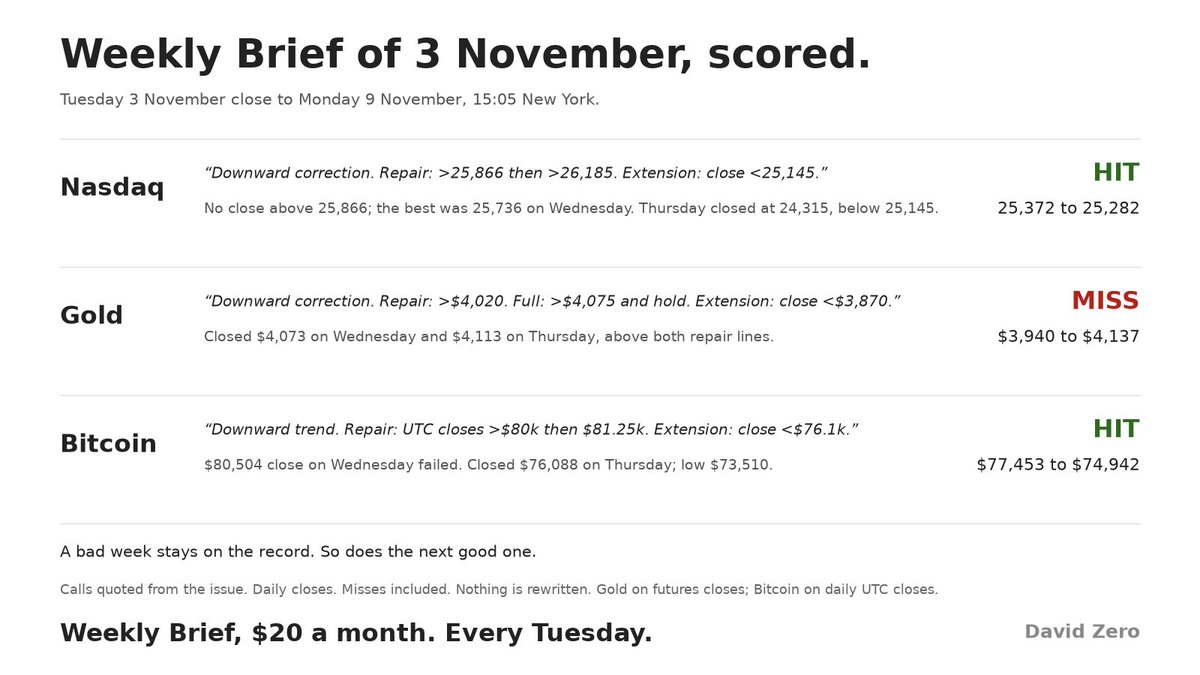
This week's card. The Weekly Brief of 3 November, scored. Nasdaq and Bitcoin went as stated. Gold did not.
Hit. Nasdaq, 25,372 to 25,282. The Brief called a downward correction, with 25,866 as the first repair line and a close below 25,145 as the extension. Nasdaq never closed above 25,866 and closed at 24,315 on Thursday.
Miss. Gold, $3,940 to $4,137. The Brief called a downward correction and set $4,020, then $4,075 and hold, as the repair lines. Gold closed at $4,073 on Wednesday and $4,113 on Thursday. The repair came, and the correction call was wrong.
Hit. Bitcoin, $77,453 to $74,942. The Brief called a downward trend, with UTC closes above $80k as the first repair and a close below $76.1k as the extension. One close at $80,504 on Wednesday failed the next day, Bitcoin closed at $76,088 on Thursday and traded down to $73,510 on Sunday.
November: 5 of 6 Brief calls held.
A bad week stays on the record. So does the next good one.
Less uncertainty. Better decisions. That is the situation. Know it first. Enter it at the right price.
Brief readers had 25,145 and $76.1k on the page before Nasdaq and Bitcoin went through them. Everyone else found out from the screen. The Weekly Brief, $20 a month, every Tuesday, 7-day free trial. Know it first. https://t.co/kUQ6hcCyBb
You can check the whole history in the free Pro Past Issues collection.
A bad week stays on the record. So does the next good one.
Less uncertainty. Better decisions. That is the situation. Know it first. Enter it at the right price.
https://t.co/cxRxBd3CX6
Market View Pro this week: gold Bearish three days running, then silver and the euro on Friday. Eight hits and three misses on the US session card. No Pro paper plan resolved.
Gold Bearish at $4,060 on Tuesday settled $4,030. Thursday's at $3,908 was $3,879. Friday's silver Bearish at $49.55 was $48.80, and the euro Bearish at 1.10522 was 1.1026.
The misses stay on the card: Monday's Bitcoin Bearish, and the Nasdaq Bearish grades on Tuesday and Wednesday.
November so far: 0 of 2 scored paper plans held. US session grades: 33 hit, 5 partial, 17 missed.
A bad week stays on the record. So does the next good one.
Less uncertainty. Better decisions. That is the situation. Know it first. Enter it at the right price.
Gold fell from $4,074 to $3,881 in one week while real yields climbed, and Pro was Bearish on it on Tuesday, Wednesday and Thursday. Know it first. https://t.co/zm2xkX3SFK
You can check the whole history in the free Elite Past Issues collection.
A bad week stays on the record. So does the next good one.
Less uncertainty. Better decisions. That is the situation. Know it first. Enter it at the right price.
https://t.co/wMQ7gKiFkR
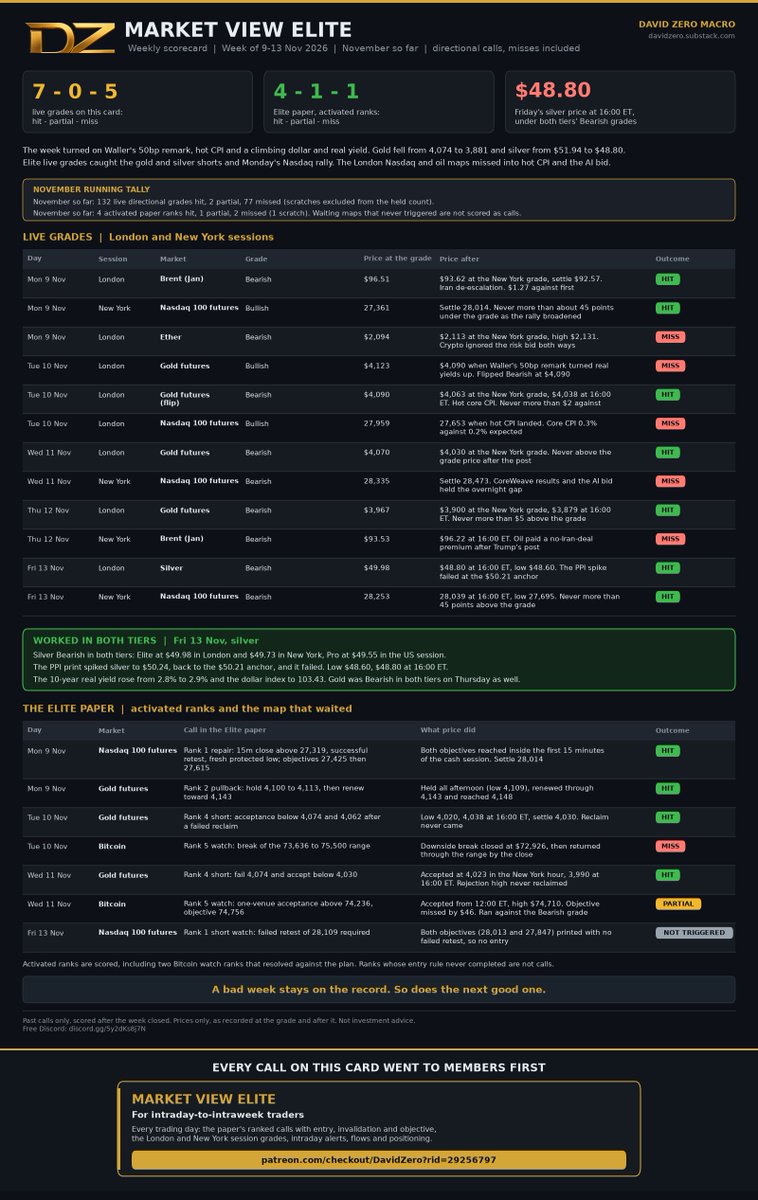
Market View Elite this week: gold and silver Bearish held through hot CPI and PPI. Seven hits and five misses on the live card.
Gold Bearish in London on Thursday at $3,967 was $3,879 at 16:00 ET. Silver Bearish on Friday at $49.98 was $48.80. Monday's New York Nasdaq Bullish at 27,361 settled at 28,014.
The misses stay on the card: Monday's London Ether, Tuesday's London gold and Nasdaq Bullish into hot CPI, Wednesday's New York Nasdaq Bearish, Thursday's New York Brent Bearish.
November so far: 132 live hits, 2 partial, 77 missed. Paper: 4 hit, 1 partial, 2 missed.
A bad week stays on the record. So does the next good one.
Less uncertainty. Better decisions. That is the situation. Know it first. Enter it at the right price.
Gold was Bearish in London on Tuesday, Wednesday and Thursday and finished Thursday at $3,879. The next session handover reaches Elite members first. Know it first. https://t.co/2nPe7vdlxX
New York close: Bitcoin $68,811 after a forced sale below $70,000. Nasdaq-100 27,943 as the chip trade broke. Gold $3,881, level as the 10-year held 5.1%. https://t.co/bdda12lD1z
DZ London Close Note: softer US PPI failed to stop the dollar as tech sold off
The dollar index closed at 103.32, just off its session high of 103.37, after opening London at 103.07. EURUSD closed at 1.1039, near its low of 1.1029, from 1.1073 at the open. GBPUSD closed at 1.3222 from 1.3238. USDJPY closed at 159.87 after touching 160.05 before lunch. Anyone who sold it on this afternoon's data gave the position back inside half an hour.
The one test of the day was the US producer-price report. October came in a tenth softer than forecast on the headline, with core in line. For a few minutes that was enough: the dollar index dropped from 103.24 to 103.08 and EURUSD jumped to 1.1070. But the market had already priced a December Fed hike after Tuesday's hot inflation report, and a tenth on one index does not move a hike that is already in the price. The dip was bought before the US cash open.
What finished it was the equity market. US technology shares sold hard after the open, with the chip and AI names leading the fall, and from 15:15 the dollar index climbed from 103.18 to its high at 15:57 while EURUSD slid to 1.1029. When a crowded trade is being cut, the money comes out in dollars, and desks that were long the dollar into the open simply held.
The cross-check is in the bond market. The US 10-year closed at 5.1%, lower after the data but not by enough to change the story, while the Gilt closed at 5.3%, the OAT at 4.9% and the Bund at 3.3%, all a touch higher on the day. Higher European yields and a stronger dollar together say this was not a flight from risk into bonds, but a repricing of everything funded against a Fed that is still expected to tighten. The yen, still carrying the widest rate gap of the majors, held just under 160 despite the stock sell-off, which is the clearest sign of how little anyone wants to own it.
The session showed that once a hike is priced, softer data buys only minutes, and an equity shock pushes money towards the dollar rather than away from it.
On 12 November the Elite New York grade was Bearish on EURUSD at 1.1090; the pair never traded above that level afterwards, closed New York at 1.1059, and today closed London at 1.1039.
The dollar's direction was settled before the data and before the tech sell-off, and those who read the bounce as a turn sold at the bottom of the afternoon to the desks that had never doubted it.
Less uncertainty. Better decisions. That is the situation. Know it first. Enter it at the right price.
A softer print bought the euro less than half an hour, and the side already holding dollars into the close kept the whole move. Be on that side before the number lands, not chasing it after. Know it first. https://t.co/TYwqROmdRt
@FirstSquawk The Nasdaq leg lower is the discount rate at work. Long yields rose after a producer price report that kept the inflation pipeline full, and long-duration growth reprices first. Chip leadership was already cracked by the Nvidia shock, so there was no cushion under the index.
@DeItaone This is not a crypto story. Long yields pushed higher again, the dollar kept firming, and Bitcoin is trading as the highest-beta end of that rate move. Miners and brokers fall harder as they are leveraged to it. Index selling around Strategy adds to a move that began in bonds.
@LizAnnSonders A small headline miss does not make this a soft print. Producer prices are running at their hottest annual pace in years and the prior month was revised up, so the pipeline into consumer prices stays full. That is why the front end kept selling and the dollar firmed.
DZ Economic Data Note: producer prices cooled to 0.3% as the annual rate hit 6.5%
Bitcoin was back above $70,000 within three minutes of the 08:30 print. It traded at $69,195 just before the release, touched $70,119 and held $69,911 by 08:39, after a week in which forced selling had pushed it below $70,000 for the first time since August. Nasdaq-100 futures lifted from 28,429 to 28,579 by 08:33 and settled near 28,522, while S&P 500 futures rose from 7,642 to 7,668 before easing to 7,660. Anyone who sold into the number on fear alone was bought back out at a worse price.
Producer prices for final demand rose 0.3% in October, against 0.4% expected, after a September rise that was revised up to 1.4%. Core prices, excluding food and energy, rose 0.3%, exactly as expected. Over the year, producer inflation climbed to 6.5% against 6.6% expected, the highest annual rate since November 2022.
The detail is less soft than the headline. Goods rose 0.5%, led by a 1.3% jump in food, while energy edged down as diesel fell. Services rose only 0.2%, and three quarters of that came from transport and warehousing, with trucking freight up 3.9%, while retail and wholesale margins shrank. The measure that strips out food, energy and trade, the closest read on underlying pipeline pressure, rose 0.5% for a second straight month. The one genuine relief sits further upstream: prices of unprocessed goods fell 3.1% as crude petroleum dropped 10.3%.
One month is noise until the detail confirms it, and here the detail confirmed nothing new. A tenth off the headline with core on consensus does not change the path of a Fed that markets already price to raise rates at the 8 to 9 December meeting. Rates eased, but only a little. The two-year yield fell about three and a half basis points to 4.8%, the 10-year about two and a half to 5.1%, and the 10-year real yield about two basis points to 2.8%. The dollar index slipped from 103.25 to 103.18, and gold rose from $3,882 to $3,904 before holding $3,897.
That is relief, not a turn. The fall in yields was a fraction of the jump hot consumer prices produced on Tuesday, and with the December hike still priced, real yields and the dollar, not this print, still set the price of Bitcoin, tech and gold.
On 10 Nov, the day core consumer prices ran hot, the US session grade called gold Bearish at $4,060; gold was $4,038 by the 16:00 close.
The traders who dumped Bitcoin and tech into 08:30 on fear alone handed their positions to the ones who knew a tenth of a point could not move the Fed.
Less uncertainty. Better decisions. That is the situation. Know it first. Enter it at the right price.
Bitcoin reclaimed $70,000 on a tenth of a point while the December hike stayed fully priced, and the edge was knowing in advance what this print could and could not change. Know it first. https://t.co/Sxb3o4bkQG
ELITE + PRO Gold Bearish on 12 Nov; $3,878 at the US close, under every grade price
ELITE + PRO Gold. Both tiers graded gold Bearish on 12 Nov, and gold closed $89 under the Elite London grade.
ELITE, London session: Bearish at $3,967, posted at 02:43 ET. After the grade went out, gold never traded more than $6 above it. The New York grade kept gold Bearish at $3,897, posted at 09:43 ET, and gold never traded above $3,894 after that. Gold fell to $3,856 in the morning and stood at $3,878 at the US close.
PRO, US session grade: Bearish at $3,908 on the 09:30 ET price stamp, published at 10:01 ET with gold near $3,872. Gold never traded more than $2 above the stamp and closed $30 under it.
US cash Treasuries reopened after the Veterans Day holiday and caught up with Tuesday's inflation shock. The 10-year yield rose from 4.9% to 5.1%, the 10-year real yield from 2.7% to 2.8%, and the dollar index from 102.97 at midnight to 103.17 with a December hike priced. When cash pays more, a metal that pays nothing loses. When the dollar rises, gold gets dearer for every other buyer. Nvidia's chief executive resigned overnight and gold got no haven bid from it.
The side was right in both tiers. The sell-rally entries never filled, because after the London grade gold never got higher than $3,972, short of the $3,981 anchor, so these are grade-to-close changes, not captured returns. On the same day, the Bearish grade on the Nasdaq was wrong in both tiers and the Bearish grade on oil was wrong in Elite. From the $3,981 midnight anchor, gold lost $103 in one session.
Less uncertainty. Better decisions. That is the situation. Know it first. Enter it at the right price.
Gold at $3,967 looked cheap to anyone who bought after Wednesday's slide. Elite said sell, and the next $89 an ounce proved it, and those buyers paid for it. Know it first. https://t.co/3Skoo3UjII
New York close: Nasdaq-100 28,289, holding as Nvidia lost its founder and money rotated into AMD and Broadcom. Gold $3,878 and Bitcoin $71,406 as the 10-year closed at 5.1%. https://t.co/JFJ5ysfJIg
DZ London Close Note: the dollar jumped as Nvidia shook the US open and the yen neared 160
The dollar index closed at 103.16, close to its session high of 103.20, after opening London at 103.03 and dipping to 102.80 before lunch. EURUSD closed at 1.1059, its session low, from 1.1075 at the open and a high of 1.1106. GBPUSD closed at 1.3233 from 1.3254. USDJPY closed at 159.99, the top of its range and a hair under 160. Anyone who took the soft London morning as the start of a dollar pullback was on the wrong side by mid-afternoon.
The move came in one block, after New York opened. Overnight Nvidia's chief executive resigned with immediate effect, and when US cash stocks opened lower on it, the dollar index went from 102.93 at 14:35 to 103.19 by 15:20, while EURUSD fell from 1.1093 to 1.1059 over the same stretch. The morning's US jobless claims, slightly above forecast at 200,000, barely moved anything. What was already priced was a December Fed hike after Tuesday's hot inflation report. What surprised was a shock to the largest stock in the market, and the dollar was the asset desks reached for.
The cross-check is in the bond market. If this had been a classic flight to safety, Treasuries would have rallied and yields fallen. Instead the US 10-year held at 5.0% and edged higher through the afternoon, the Gilt closed at 5.2% after rising through the day, the OAT at 4.8% and the Bund at 3.3%. Falling stocks with rising yields and a rising dollar means the hike pricing stayed in place and the equity scare was added on top. The yen, carrying the widest rate gap of the majors, absorbed the most of it.
The session showed that a market already positioned for a hawkish Fed treats an equity shock as one more reason to own dollars, not as a reason to buy bonds.
On 11 November the Elite London grade was Bullish on USDJPY at 158.879, and the pair reached 159.68 by the New York handover without moving more than a few pips against it; today it closed London at 159.99.
By the time the stock news reached the screens, the dollar side of the trade had already been taken, and those who came to it late were buying from the desks that were there first.
Less uncertainty. Better decisions. That is the situation. Know it first. Enter it at the right price.
The yen pressed against 160 for a second day while the crowd was still watching Nvidia, and the desks already long the dollar simply held. Stand with them before the open, not after it. Know it first. https://t.co/TYwqROmdRt
@KobeissiLetter The Huang news explains the neocloud names, not the whole tape. They are the most debt-funded bets on AI spending, so a shock at their supplier hits them hardest. It landed as a Fed speaker pushed short-dated yields sharply higher, and long-duration tech reprices first then.
@WatcherGuru Liquidations are the symptom, not the cause. A hawkish Fed speaker lifted the front end, the dollar kept climbing and gold broke at the same time. ETF money has been leaving all week, so leveraged longs sat on a market with no buyer underneath. Same risk curve, same driver.
This is the rate shock reaching gold, not a failed safe haven. Hammack said the Fed must go higher to get restrictive, and the front end repriced at once on top of this week's hot core print. Higher real yields and a firmer dollar raise the cost of holding a metal paying nothing.
DZ Economic Data Note: home resales fell 5.5% to 3.75 million, the lowest since 2010
Nasdaq-100 futures stood at 28,359 a minute before 10:00 and at 28,260 by 10:07. The housing print did not start that slide. It simply gave the bond market no reason to stop it.
Sales of existing homes fell 5.5% in October to an annual pace of 3.75 million, against about 3.87 million expected and 3.99 million in September. That is the slowest pace since August 2010. The drop was broad: the Midwest, South and West all fell, the West by 9.7%, while the Northeast held flat. Unsold homes rose to 1.59 million, a 5.1-month supply against 4.7 months in September. The median price still rose 0.4% from a year ago to $416,700, the 40th straight annual gain.
The cause is in plain sight. The 30-year mortgage rate averaged 7.33% in October, up from 6.86% in September. Sellers are holding their price and buyers are walking away, so volume freezes long before value cracks. Housing is where tighter money lands first, and this is the hike already doing its work, not a new shock.
That is why the rate chain barely flinched. The 10-year yield slipped less than a basis point and stayed above 5%, the two-year held at 4.8% and the 10-year real yield at 2.8%. The dollar index stayed near 103, gold sat flat near $3,867, still below $4,000, and Brent held near $93.
A weak housing number would normally pull yields lower. It did not, because Tuesday's hot core inflation and a December hike already set the price, and a housing slump is the expected cost of that hike, not a reason to cancel it. Until the Fed path moves, real yields and the dollar keep setting the price of gold and tech.
On 9 Nov the US session grade called the Nasdaq-100 Bullish at 27,342; futures settled at 28,014 that day, 671 points higher.
The traders who read "lowest since 2010" as a signal to buy bonds paid for a headline the market had already priced. The ones who knew where the pressure really sat kept their capital for the move that pays.
Less uncertainty. Better decisions. That is the situation. Know it first. Enter it at the right price.
Home sales sank to a 16-year low and yields still refused to fall, because the hike was in the price before the data landed. Pro shows you which pressure is already priced before you pay for it. Know it first. https://t.co/OOXVZkowfa
DZ Economic Data Note: claims rose to 200,000 while continuing claims fell
Nasdaq-100 futures were already carrying the Nvidia shock into the 08:30 print, and the jobs data gave sellers nothing new. Futures lifted from 28,086 to 28,139 in the first two minutes, then settled at 28,106 by 08:40. Anyone who paid up for that flick paid for noise.
First-time jobless claims rose to 200,000 last week, against about 195,000 expected and a revised 191,000 the week before. That is the highest since the second week of October, and still inside the narrow band claims have held for months. The detail pulled the other way: continuing claims, the people still drawing benefits, fell to 1.697 million against about 1.71 million expected and 1.717 million the week before. More people filed, but fewer stayed on benefits, which says those who lose a job are still finding the next one.
One week of claims is noise until the detail confirms it, and here the detail contradicted it. A labour market that is not cracking keeps the Fed focused on Tuesday's hot core inflation and a December hike, so the rate chain had no reason to move. It did not: the 10-year yield slipped less than half a basis point and held at 5%, the two-year stayed at 4.8% and the 10-year real yield held at 2.8%.
With the driver flat, the expressions stayed on their own stories. Gold bounced from $3,906 to $3,913 and was back at $3,902 by 08:40, still below $4,000 for a third straight session and pinned by the dollar. The dollar index held near 102.93, at its highest in 19 months. S&P 500 futures barely moved, from 7,583 to 7,586, and Brent stayed near $93.87.
A soft headline with firm detail leaves the hike pricing untouched, which is exactly why real yields and the dollar, not this print, still set the price of gold and tech.
On 11 Nov the US session grade called gold Bearish at $4,038; gold was $3,992 by the 16:00 close.
The traders who flinched at the headline traded the number; the ones who knew what was already priced traded nothing and kept their capital for the move that matters.
Less uncertainty. Better decisions. That is the situation. Know it first. Enter it at the right price.
Claims rose, the bond market shrugged and gold kept sliding under the dollar's weight, because the real decision was priced before 08:30. Know it first. https://t.co/QDyhj9ybBC
ELITE + PRO Gold. Both tiers graded gold Bearish on 11 Nov, and gold closed $78 under the Elite London grade.
ELITE, London session: Bearish at $4,070, posted at 02:47 ET with gold just under its $4,074 overnight high. After the grade went out, gold never traded above it. It was $4,030 when the New York grade took over and kept gold Bearish, and it never traded above that price either. Gold fell to $3,989 in the afternoon and stood at $3,992 at the US close.
PRO, US session grade: Bearish at $4,038 on the 09:30 ET price stamp, published at 10:02 ET with gold near $4,022. Gold never traded more than $1 above the stamp and closed $46 under it.
The US cash bond market was shut for Veterans Day, so nothing came along to undo Tuesday's rate shock. The 10-year real yield stayed at 2.7% after the hot core inflation print, a December hike stayed close to fully priced, and the dollar index climbed from 102.24 at midnight to 102.93. When cash pays more, a metal that pays nothing loses. When the dollar rises, gold gets dearer for every other buyer. Tech rallied on AI earnings, and gold saw none of that money.
The side was right in both tiers. The sell-rally entries never filled, so these are grade-to-close changes, not captured returns. On the same day, the Bearish grades on the Nasdaq and Bitcoin were wrong in both tiers. Anyone who bought Tuesday's dip in gold lost twice: once on the inflation print, and again on a holiday with no new US data at all.
Less uncertainty. Better decisions. That is the situation. Know it first. Enter it at the right price.
Elite had gold on the sell side at $4,070 before Europe opened. By the US close, $78 an ounce had gone to the side that knew first. Know it first. https://t.co/pWqA4pnbA5
New York close: gold $3,992, back under $4,000 as the dollar climbed toward 160 yen. Nasdaq-100 28,374 on a chip rebound. Bitcoin $74,576. https://t.co/sxXdPIVofY