AI training and copyright: can it be done lawfully by relying on provisions other than Article 4 DSMD, for example research- and education-specific exceptions or fair use defences? I answer this in the negative in a study just published in @EurJRR https://t.co/fI1DbalpNo
The Mio/konektra decision is out. In short, if you liked AG Szpunar’s Opinion, you’ll like the CJEU's take too. But if you hoped for definitive clarity after 15 years since Infopaq, disappointment awaits https://t.co/HFNLN2RPsx
AI training and copyright: is there a copyright exception (even beyond TDM) or open-ended fair use doctrine that covers the entirety of it? Most likely not for most cases. The result? A licensing horizon appears unavoidable @EurJRR https://t.co/fI1DbalXCW
The autumn of AI: exceptions or rather licensing? Why neither the TDM exceptions nor the three-step test cover all unlicensed AI development https://t.co/lxCTq8FwlL
A new academic paper, which has just been published by Computer Security Law Review and will be presented during a @4ipcouncil webinar on 30 October, seeks to answer this from the perspective of EU and UK law - do take a look and join the discussion! https://t.co/QXmZswE6Hl 2/2
While movie studies have taken legal action against AI developers over the unauthorized use of their content for training purposes, the implementation of genAI by the movie industry itself is also growing. But what are the relevant issues that may arise under copyright law? 1/2
The Future of the #Movie Industry in the Wake of Generative AI: A Perspective under EU and UK Copyright Law
This study maps and critically evaluates issues facing the use of AI models from a movie industry perspective.
Author: Eleonora Rosati
Read More: https://t.co/hPLmzAzaWU
🎬 𝗨𝗣𝗖𝗢𝗠𝗜𝗡𝗚 𝗪𝗘𝗕𝗜𝗡𝗔𝗥 – 𝗧𝗵𝗲 𝗙𝘂𝘁𝘂𝗿𝗲 𝗼𝗳 𝘁𝗵𝗲 𝗠𝗼𝘃𝗶𝗲 𝗜𝗻𝗱𝘂𝘀𝘁𝗿𝘆 𝗶𝗻 𝘁𝗵𝗲 𝗪𝗮𝗸𝗲 𝗼𝗳 𝗚𝗲𝗻𝗲𝗿𝗮𝘁𝗶𝘃𝗲 𝗔𝗜
AI is transforming the way films are made, distributed, and protected. From new creative tools to lawsuits over unlicensed training data...
Join us for an exclusive webinar with Prof. Dr. Eleonora Rosati, who will present the findings of her study carried out with 4iP Council.
📅 𝟯𝟬 𝗢𝗰𝘁𝗼𝗯𝗲𝗿, 𝟭𝟲:𝟬𝟬 𝗖𝗘𝗦𝗧
🖥️ Online | Free registration
Prof. Rosati will explore key copyright issues under EU and UK law, including:
🎥 AI training on protected content and the need for licensing frameworks
🎥 The protectability of AI-assisted creative works
🎥 Legal risks and potential liability from AI-generated outputs
This is a great chance to understand how copyright will shape the future of cinema in the age of AI.
👉 Register now: https://t.co/1ZPxJ7l9vC
The article is available at 4iP Council website and soon to be published in Computer Security Law Review.
#Webinar #GenerativeAI #Copyright #MovieIndustry #AIandLaw #4iPCouncil #Innovation #ArtificialIntelligence #AI
Tthe CJEU is soon due to issue its Mio/konektra judgment. The Court should maintain its approach to infringement based on originality and reject any consideration of subjective elements or even adopt a test based on recognizability https://t.co/LUvHktvoXW
An Italian celebrity, a model's "piercing eyes", and the right to privacy via trade mark law: Should actor Raoul Bova succeed in getting his registrations for 'OCCHI SPACCANTI' to prevent the further spread of embarrassing WhatsApp audios? Perhaps not https://t.co/Fuq9DzmE5n
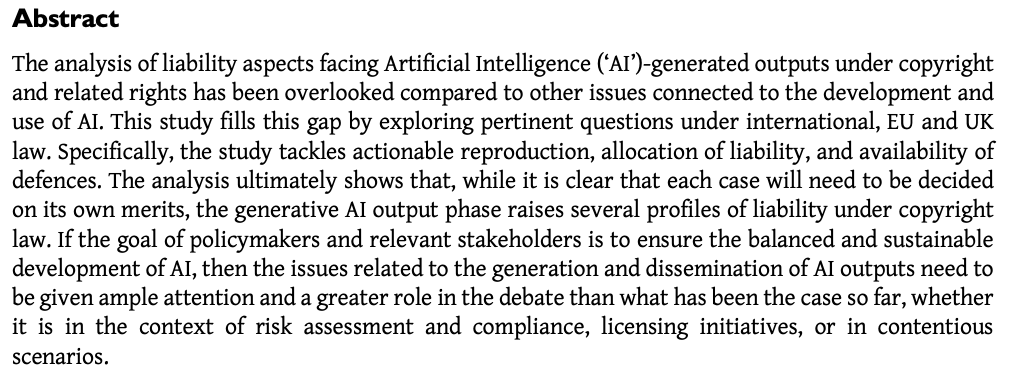
Here's the abstract of the article (published online in autumn 2024) https://t.co/8i367dOnEl All feedback welcome! Thanks to @IFPI_org, the anonymous reviewer, and the whole @EurJRR Team and @alemannoEU for hosting my work 2/2
The latest issue of @EurJRR has just been released and also features my discussion of liability aspects facing AI-generated outputs under copyright and related rights. This is an area whose relevance appears to have grown considerably over the past few months 1/2
Can unlicensed AI training be performed by relying, not on Art 4 of Directive 2019/790 (which has been also figuring prominently in the ongoing UK reform debate), but rather on other exceptions, notably those for research and education? And what about fair use doctrines? 1/4
Both questions are answered in the negative: no exception/open-ended defence fully covers unlicensed AI training activities. As a result, a licensing approach appears to be the way for AI training to be undertaken lawfully, including when done for ‘research’ and ‘learning’. 3/4
AG Emiliou has delivered his lPelham II Opinion. While the proposed definition of 'pastiche' is broadly acceptable - including the refusal to consider it a 'catch-all' concept - parts of the analysis are not relevant to the referred questions https://t.co/nekfHVI201