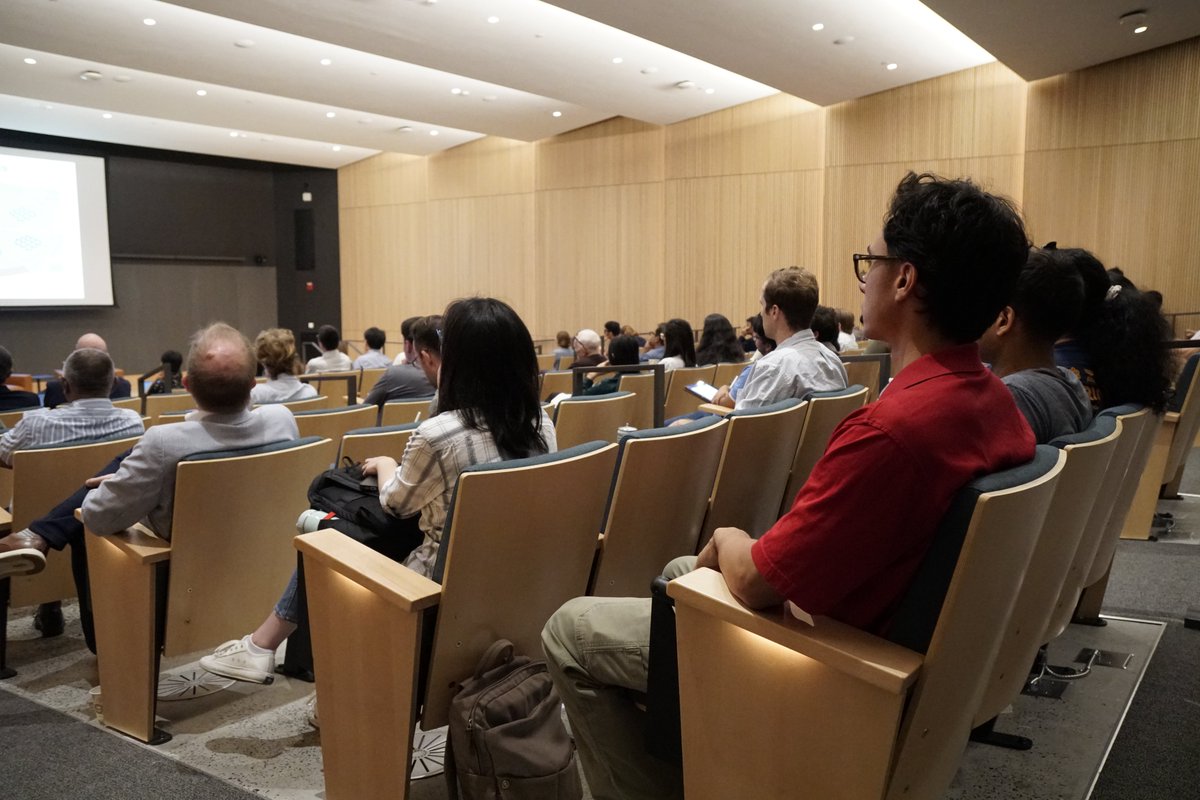
Our new dean, @nanonoodle, welcomes you to the start of the new academic year! In this video, he talks about his vision to prepare the next generation of engineers to create knowledge, invent technologies, drive economic growth, & change the world for the better. Thx @AimyWissa
Antony Jameson, the James S. McDonnell Distinguished University Professor of Aerospace Engineering, Emeritus, and professor of mechanical and aerospace engineering, emeritus, was widely regarded as a founder of computational fluid dynamics.
Went quick with this earlier because I was rushing about but let's have a proper moment for Antony Jameson, who just passed away.
He is a legend in the computational fluid dynamics field. His codes made it possible to shift from testing aircraft in wind tunnels to doing much of the work via simulation.
He co-created the Jameson–Schmidt–Turkel (JST) scheme in 1981, still a foundational algorithm for solving the Euler and Navier–Stokes equations. He produced the first inviscid flow solution for a complete aircraft, and in 1985 achieved the first Euler calculation of flow past a whole aircraft. His FLO and SYN codes were used across Boeing, Airbus, Bombardier, and Embraer,
Jameson altered the course of aviation and had a major influence on ships as well.
He leaves behind a legacy of fantastic students who have also reshaped aerospace.
There's a lovely piece here on him https://t.co/3TmUb7SGcW
"I use AI every day for learning. The key is to use it to increase, not decrease your cognitive load. To learn deeper, not faster. There is no learning without the cognitive sweat." - @random_walker
This week I had the honor of speaking to Princeton’s entire incoming undergraduate class to address their AI anxieties. I had three messages for them — good news, bad news, and a note of optimism. Here’s a condensed version.
The good news
We have enough evidence now to conclude that the shrill predictions of rapid, massive job loss were misplaced. Even in a field like software engineering where AI has been rapidly adopted, its effect has been to shift, not replace the role of the human (see the “decide-execute-deliver” framework https://t.co/8ZofeCz8yS)
Similarly, the panic about what to major in is also misplaced. There will be enduring demand for computer science, philosophy, and just about everything else. (In fact, AI companies hiring philosophers has been a big recent trend.)
The bad news
AI seems to help senior people much more than juniors. I can use AI for coding because I spent 25 years learning how to code, which lets me supervise coding agents effectively. (See my post on the “growth cycle” vs the “dependence spiral” https://t.co/79icF9hSKY)
You are in a bind — you can’t offload your skill-building to AI, but you’ll graduate into a market where employers will expect you to get work done with AI. We never faced this dilemma. As a result we haven’t figured out how to revamp our classes to help you do both. You’ll have to help us figure it out. And you’ll need to somehow resist the constant temptation to turn to the shortcut machine.
The hope
My point is not that AI is bad for learning. It’s an incredibly flexible tool. Is the internet good or bad for learning? Depends — are you using it to find research papers or waste time scrolling? I use AI every day for learning. The key is to use it to increase, not decrease your cognitive load. To learn deeper, not faster. There is no learning without the cognitive sweat. I try to make sure I’m mentally exhausted at the end of the day. I do feel that AI lets me push myself harder than I ever could before, and I have a vision that as AI continues to advance it will enable human-AI “co-superintelligence“. (I talked about this at the end of my ICML keynote. https://t.co/ZA5TBDypfl)
Current technology has worked well for experimental prototypes and small-scale quantum computing systems, says Nathalie de Leon. But to build #quantum computers at a scientifically useful scale, she said, the most basic elements must be reinvented. @NSF https://t.co/BHJBBtIA3v
Congrats to Christopher Moretti on being appointed chief reader for the AP computer science exam!
Thousands of students take the AP computer science exam every year. Moretti, a teaching faculty member, will help develop the exam and provide guidance on grading.
The Princeton-led Quantum Leap Challenge Institute will devise techniques for fabricating hardware & create training programs for the next generation of leaders in quantum science & eng. The institute will focus on the the manufacture of core components for quantum processors.
Eight NSF Quantum Leap Challenge Institutes prepare to propel U.S. quantum science with a new $290M investment. The institutes will take on some of the hardest scientific hurdles in the global race to create powerful quantum-based technologies. https://t.co/QCPvab0Wlj
Princeton researchers have created an ultrathin semiconductor that can repeatedly change its properties in response to changes in light. “The first step to creating smart materials is responsiveness,” said Saien Xie, the paper’s lead author. https://t.co/LKqT3i9A4B
Princeton professor Roy Jackson, who applied mathematical rigor to the study of flowing mixtures to shape a new era of chemical engineering, died on July 20. He was 94.⬇️
https://t.co/FDPzk5gnPs
Andrew Houck (@nanonoodle) & @adusood present opening remarks at the inaugural “Princeton Symposium on Advances in Optics and Ultrafast Science,” welcoming participants from both academia and industry.
See more about the list of speakers & event agenda : https://t.co/e9eUvNmMfT
Congratulations to @JuYiguang, whose innovation that recycles plastics into fuels and chemicals was recognized by @RandDWorld magazine. The magazine honored 100 technologies with the potential to transform a range of industries. ⬇️ https://t.co/rJoEDhUiHf
In this photo, Kevin Liu displays a robot that uses geometry to crawl, roll and shapeshift without internal controls or engine. What does this robot have in common with an ordinary ketchup bottle cap and the ancient art of origami? Read more ⬇️ https://t.co/OUaKEvOZQC
Children with #autism often have the diagnosis delayed because they also have #ADHD, which masks the condition, say Princeton researchers. Now, they have developed a tool which reliably identifies autism in children who also have been diagnosed with ADHD:
https://t.co/N6yVjZkcse
These incoming engineering students tried to use a drone to tip or tilt this basket over before it falls upon this "cactus." They made hooks for a drone that would tip the basket, then detach. The Freshman Scholars Institute @princetonebc course was taught by Claire Gmachl.
Experts in #bioengineering and #ArtificialIntelligence gathered at @omenndarlingbio on Monday for an event that encouraged participants to imagine and prepare for a future with scientists working more closely with artificial intelligence, also known as co-intelligence.
These Innovation Research Grants awarded by Princeton Engineering enable faculty members to take their research in bold new directions that address critical issues in technology, health and the environment. Read more: https://t.co/djdj6Sbq5f
These magnetically controlled robots can roll, crawl and change shape, no motor required. Their design uses magnets to give each robot its own active and inactive modes, which allows independent control. Read more about this work from the @ghpaulino lab: https://t.co/OUaKEvOZQC
Sharad Malik develops algorithms & software tools that help engineers prove computer chips & computing systems are correct, reliable, and secure. Malik was named an inaugural member of @TheOfficialACM Special Interest Group on Software Engineering Academy. https://t.co/h6IorQtdk4
What do ketchup bottle caps have to do with origami and robotics? Princeton engineers found that the same hinge keeping a ketchup cap open also explains how curved, folded shells can hold multiple stable shapes. It helped them build a new robot. Read more: https://t.co/OUaKEvOZQC
Congratulations to Athanassios Panagiotopoulos, who has been awarded the 2027 FOMMS Medal for his work pioneering computational techniques for molecular simulations used to understand sustainable solvents, surfactants and biological materials. Read more:
https://t.co/dsLxdcg7BD
In this blog post, @random_walker discusses the widespread anxiety about how we should adapt as #ArtificialIntelligence capabilities increase. It was the topic of his recent keynote address at the International Conference on Machine Learning in Seoul. https://t.co/TbavkhvSWp
Raphael Aryeetey has been named executive director of Princeton University’s @AndlingerCenter. As executive director, Aryeetey will oversee the center's core strategic and operational functions. Read more: https://t.co/fwwXRNmUGt