Ever wonder about who might be dumping canton-network:native? I ran an analysis using Codex and Astra. Good news is that most of the sell pressure is decreasing but there are some interesting names on here who continuously dump. I see you.
Note that this isn't fully complete data due to privacy but the forensics are directionally accurate.
1/ I traced fresh canton-network:native entering market-facing liquidity over the 30 days ending Sept. 15, excluding repeated Temple/MM turnover.
Verified fresh entry: 52.40M CC
Including known routers: 155.39M CC
Here’s who supplied it—and whether they sold rewards or old inventory. 🧵
2/ cBTC / BitSafe was the largest verified recurring source.
• 53.89M CC distributed
• 16.44M reached CEX/Temple routes
• 19.29M including routers
• Monetization: 30.5% strict / 35.8% broad
The largest path was 10.57M CC through e505… to Temple.
3/ Zenith
• 8.93M CC sent to Kraken
• Estimated rewards: 1.66M
• Balance change: -8.66M
• Ending balance: ~414K
The Kraken flow equaled 538% of rewards, showing that Zenith was primarily liquidating old inventory rather than only current rewards.
4/ Texture Capital
• 2.90M CC sent directly to Kraken
• 5.50M sent to an execution router
• 8.40M total market-facing
• Balance change: -8.40M
• Same-period rewards: effectively zero
This was treasury/opening-inventory disposal, not reward monetization.
5/ Beyond Central, Dfns and FCS
Beyond Central: 3.00M to Kraken, entirely old inventory.
Dfns: 2.79M to Kraken across two custody wallets. Reward rate isn’t calculable because the wallets mixed custody funds, opening inventory and rewards.
FCS: 2.12M to Kraken from operational inventory.
6/ Chainlink
• Estimated rewards: 3.73M CC
• Kraken flow: 1.41M
• Contextual monetization rate: 37.6%
• Balance change: -1.84M
Another 4.11M moved within Chainlink’s own namespace, so it was excluded from sell supply.
7/ Ubyx
• Estimated rewards: 1.43M CC
• Sent to Kraken: 1.25M
• Estimated monetization: 87.0%
• Balance change: +160K
Ubyx monetized most of its estimated rewards but remained a net accumulator because continuing rewards exceeded its net depletion.
8/ Cantor8/C8 and Yiksi
Cantor8:
• Rewards: 27.07M
• Router flow: 3.84M
• Broad monetization: 14.2%
• Net balance: +288K
Yiksi:
• Rewards: 46.06M
• Router flow: 1.20M
• Broad monetization: 2.6%
These are router entries, not verified sales.
9/ Smaller verified sources:
• Incyt: 400K to Kraken
• Moat Capital: 335K Kraken + 100K Bron
• Certora: 332K Kraken; 99.2% of its identifiable 335K inflow
• LinkPool: 250K to MEXC
• Lucky Friday: 115K to Kraken
• Nethermind: 100K to Kraken
Most were spending old inventory.
10/ Hashnote moved 89.51M CC of old principal to Bron.
That is the largest broader market-facing movement, but Canton privacy hides the quote-asset leg. It may represent conversion or execution, but it cannot be called a verified sale.
It is excluded from the strict 52.40M total.
11/ Several large reward recipients were not identifiable sellers:
• Brale: no transfer or balance change
• Ember: redistributed into app/reward wallets
• Digital Asset: funds reached a major accumulator that grew by 82.1M CC
• Cumberland, C7, Kora, Send and cETH: retained, locked or operational flows
12/ Takeaway:
The clearest recurring reward sellers were:
cBTC/BitSafe: 30.5–35.8%
Ubyx: 87.0%
Chainlink: 37.6%
Cantor8: 14.2% into routers
Yiksi: 2.6% into routers
Zenith and Texture were larger sellers, but mostly from old inventory.
13/ Direct CEX pressure fell 70.8% in the latest 7 days versus the preceding 23.
Broader route flow increased only because of Hashnote’s one-off 89.51M transfer.
So recurring visible sell pressure was decreasing, while one large private conversion distorted the broader total.
Disclaimer: Based on public on-chain data for Aug. 17–Sept. 15, 2026. “Market-facing” means CC transferred to a labeled exchange, Temple or known execution router; it does not prove a sale occurred. Private settlement legs are not visible, reward estimates may be incomplete, and repeated market-maker turnover was excluded. Not financial advice.
@YessahBlessahCC@LongViewCrypto@NoBullCryptoBen@CDemanincor
We are a small team, but undoubtedly the hardest-working one.
We are building unique research and applications on Canton because we believe its architecture offers the ideal testing ground for the agent economy—where the smarter the agents become, the more critical economic privacy becomes.
So, could you please unblock me and follow me back ?
@CantonNetwork
@akyra_0@YuvalRooz You might want to add external factors to the mint and burn mechanism, as it is a top listed coin, it will have organic buying and selling, longing and shorting, to play a role in the price. Follow our $wCC onchain data, and you will see a miniature of $CC market, like a proxy.
USD1 → @CantonNetwork.
The blockchain purpose-built for institutional finance. Privacy enabled. Leading global financial institutions at the table.
USD1 is now natively issued on Canton.
More coming this week. 🦅☝️
https://t.co/5yhkfRcsdP
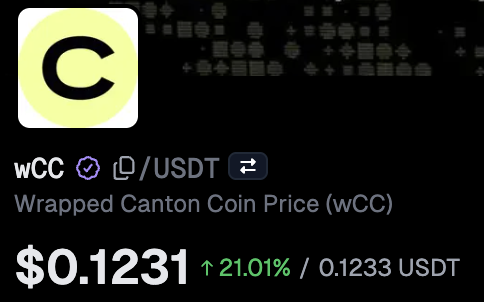
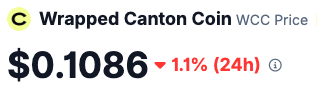
Should we look at $wCC as a canton-network:native proxy market, we have been witnessing meaningful data and thanks to the return of liquidity, $wCC is seeing a monthly high in buys, and strong pool turnover of >80%, which makes the LP capital highly efficient.
The team just refreshed the data board on @Dune
For the onchain data-curious, check it out: https://t.co/mQOuyICVbn
For months, we always see a premium on $wCC
Since the price plummet, the first few days we see a reverse premium on canton-network:native instead.
There are many occasion to acquire $wCC cheaper than buying spot canton-network:native: https://t.co/O3pxQbxQWX
NFA, DYOR. DeFi is always beautiful.
@itzamnah @LeilaniFarms GM, please invest some $ into the domain and set up a proper business email if you want to be a more convincing impersonator. You don't work at EA @itzamnah
A free market of demand matching in other ecosystems ranges between 1ish to 7% up.
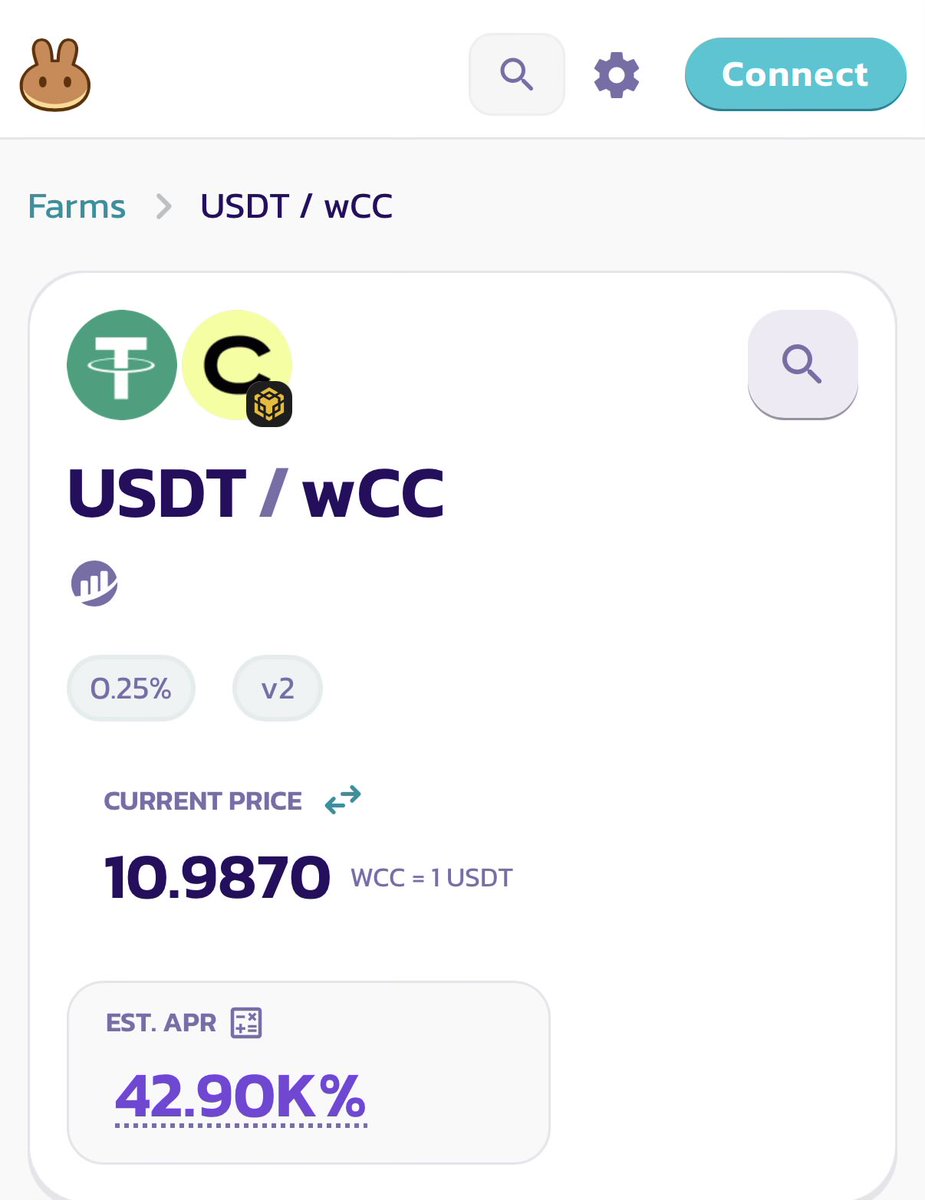
As $CC price plummets, we see today an extreme exception of 42,900% of LP APR on $wCC/ $USDT @PancakeSwap
DYOR, DeFi is beautiful. We like to see free market mechanics. Free flows of demand and supply.