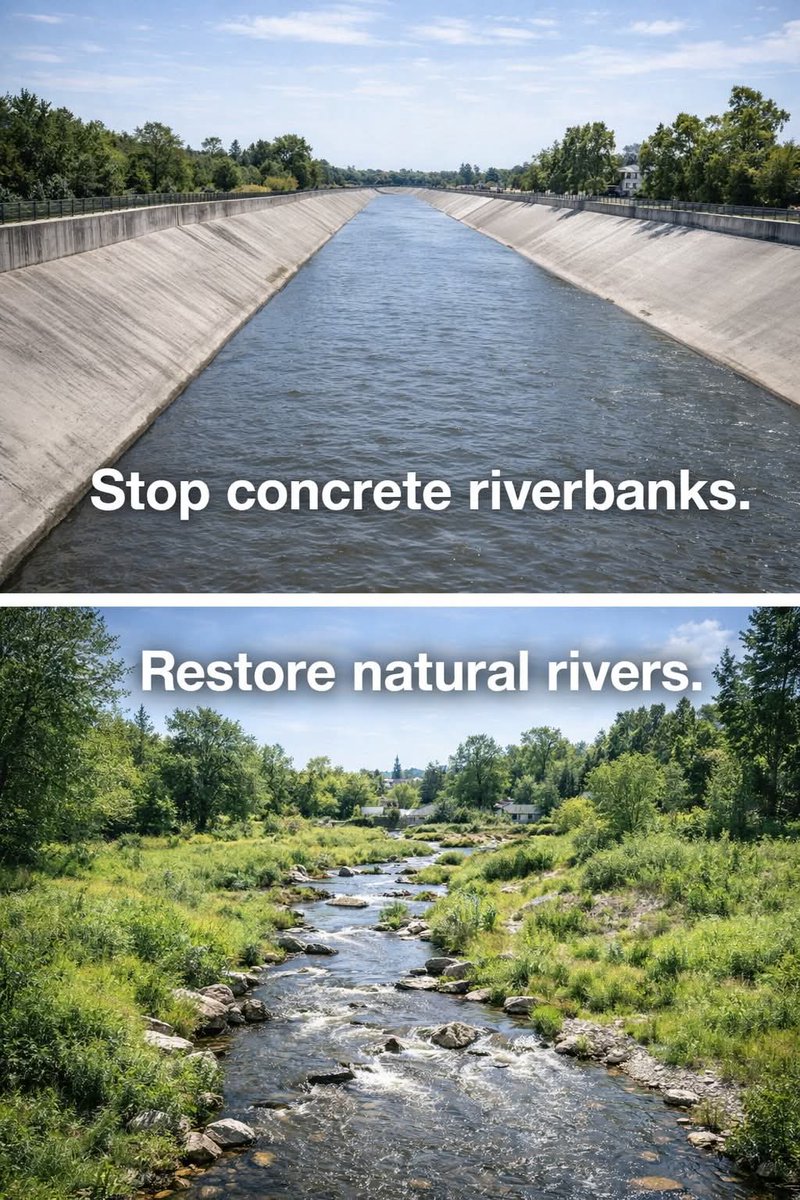
For decades, cities around the world have poured concrete over rivers, believing it would control floods, improve drainage, and modernize urban landscapes. What we didn’t realize is that concrete riverbanks silently destroy ecosystems, worsen flooding, and cost taxpayers billions in long-term damage.
Concrete channels force rivers into narrow paths, increasing water speed instead of managing it. During heavy rainfall, this fast-moving water has nowhere to spread, leading to severe urban flooding, infrastructure damage, and costly emergency response. Ironically, the very solution meant to protect cities often makes disasters worse.
Natural rivers work differently. When riverbanks are restored with vegetation, rocks, wetlands, and floodplains, water slows down naturally. This reduces flood peaks, recharges groundwater, and filters pollutants before they reach drinking water sources. Studies show that nature-based flood management can reduce flood risk by up to 40% while costing less than concrete infrastructure.
Beyond flood protection, restored rivers revive life. Fish return. Birds nest. Insects pollinate nearby farmland. Biodiversity increases, improving local food chains and ecosystem stability. Green river corridors also lower urban temperatures, helping cities fight climate change and heat waves.
There’s a strong economic case too. River restoration projects create long-term jobs, boost eco-tourism, increase nearby property values, and reduce spending on flood repairs and water treatment. Investors, city planners, and governments are now recognizing that green infrastructure outperforms gray infrastructure over time.
As climate change brings stronger storms and unpredictable rainfall, we must rethink how we design our cities. Concrete may look clean and controlled, but nature is smarter, cheaper, and more resilient.
Healthy rivers mean safer cities, stronger economies, and a livable future.
It’s time to stop concrete riverbanks—and restore natural rivers.
Source: Unknown Facts
#fblifestyle #ClimateChange #RiverRestoration #GreenInfrastructure #Sustainability #UrbanPlanning #ClimateResilience #EcoAwareness #SaveNature #SmartCities #WaterConservation
Suzanne Simard is changing the way we understand forests.
Her discoveries revealed that trees are linked by vast underground fungal networks—mycorrhizal webs that enable them to share nutrients, send warning signals, and nurture their young.
In 1997, Simard’s landmark study showed birch and fir trees trading carbon beneath the soil, overturning the belief that forests are battlegrounds of competition. Instead, she proved they form cooperative communities, with “Mother Trees”—large, older hubs—sustaining seedlings through these hidden lifelines.
Nature dubbed it the “Wood-Wide Web.”
Her work has since shaped Avatar, inspired the Pulitzer-winning The Overstory, and fueled her bestselling memoir Finding the Mother Tree, now being adapted into a film starring Amy Adams.
Yet her mission is deeply personal and urgent.
Collaborating with First Nations in British Columbia, she’s fighting to protect ancient forests and pioneer logging practices that spare Mother Trees—vital carbon reservoirs and engines of regeneration.
Some criticize her use of terms like “talk” or “mother,” but Simard stands firm: the science is undeniable. These forests are interconnected—and so are we.
“The forest can become diverse again,” she says. “But people have to understand how it works. That’s how we protect it.”
'Change Has Been Amazing' For Depleted Mountain: with New Vegetation Comes Deer, Pumas, Andean Bears
Source: Good News Network
https://t.co/IgDwitb9hA
Shared via the Google App
@SureshR96997515 Dear Suresh: PFB, a screenshot of your $LUSH coins!!! Gratitude for making #Earth#LUSH!!!
You were paid 1 EARTH $LUSH per minute for picking up litter.