It's a good decision!
ENS names and records are a form of state that is central to the Ethereum ecosystem, the state is limited in size and there is high value in it being as accessible as possible from anywhere.
It's also a semi-financial application, in the sense that buying and holding ENS names has a cost, and ENS names can become very valuable objects.
With the expanded scaling roadmap, Ethereum L1 is the ideal place for these applications.
More generally, I expect that the optimal architecture for decentralized identity and social (the general space I see ENS being in) is to have this kind of per-user account and profile data on L1, and to have special-purpose L2s, likely much simpler than full EVMs, to handle user actions (eg. actions on social platforms).
Comparing it to the current situation misses the point entirely
while the worst one (current regime) is still in power,The Argument isn’t Pahlavi is the best leader in history, compared to the current situation&realistic alternatives, he is strongest & most popular opposition.✌🏻
Almost no democratic transition leader in history had prior governing experience
Mandela in South Africa, Havel in Czechoslovakia,etc
He’s spent > 40 years planning the transition&built a serious team(Iran Prosperity Project).That’s a hell of a lot more than 0 experience.
🧵👇🏻
@ameensol why should Iranians accept the guy who never had any experience in governance and whose family killed Iranians and led to the Islamic revolution? Remember democracy isn’t about electing the best but quickly getting rid of the worst and he is not presenting any mechanism to get rid of him if he turns out to be a bad leader.
His popularity is real, not imposed& No one is forcing
Independent polls (GAMAAN etc.) consistently show him as the most popular opposition figure،usually 40%far ahead of anyone else
In the recent protests, the main chants were for him
Iranians are calling his name themselves🧵👇🏻
A liberal&progressive time-traveler trying to kill Hitler discovers they share key views on gun control, eugenics, state healthcare, silencing dissent, and removing “undesirables.”
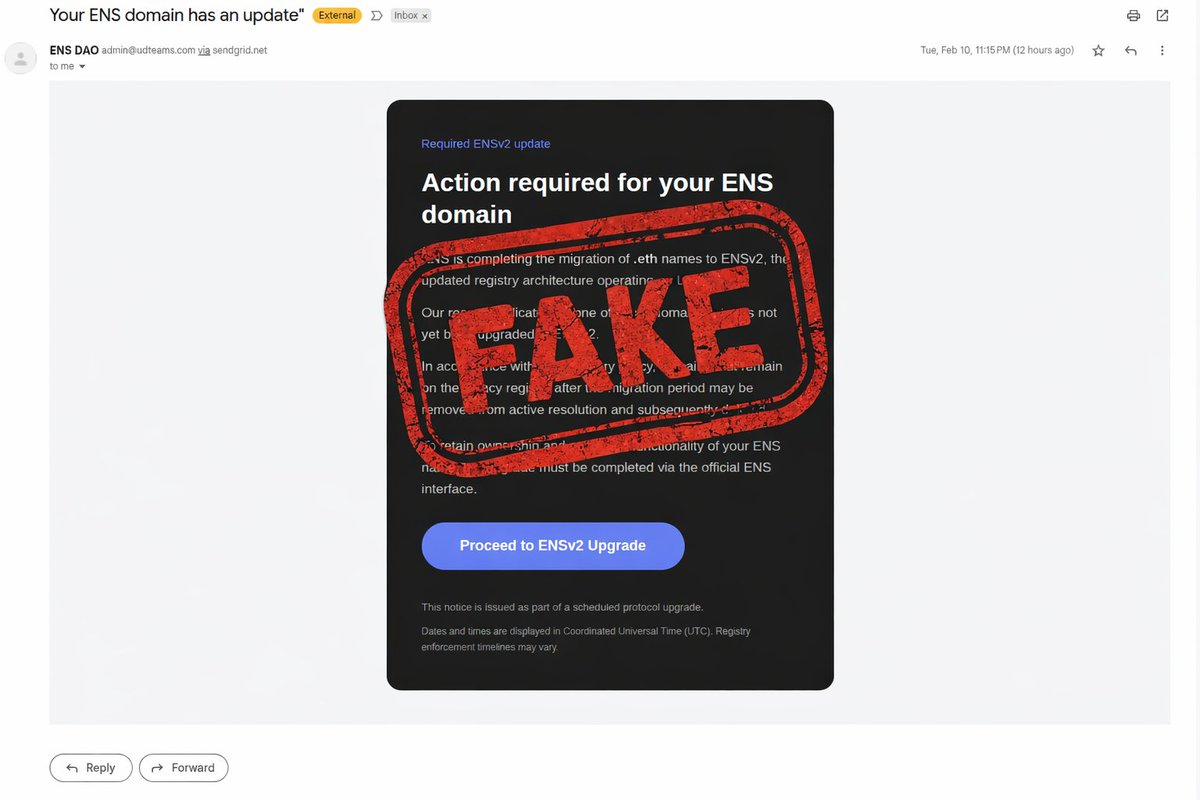
🚨 We're aware of phishing emails and fake websites circulating that reference ENSv2 and recent announcements.
Let’s be very clear:
ENS will never ask you to “upgrade,” “migrate,” or “secure” your name via email links.
Imagine a Co. hiring strictly on skill & merit. Some call this "oppression" because racial/gender %s aren't equal.
Solution?
Who pays real cost of this opaque justice?
Will competitors handicap themselves too?
Imagine a Co. hiring strictly on skill & merit. Some call this "oppression" because racial/gender %s aren't equal.
Solution?
Who pays real cost of this opaque justice?
Will competitors handicap themselves too?
In the early nineteenth century, the German philosopher Georg Wilhelm Friedrich Hegel offered one of the most ambitious visions of history ever conceived.
History, he argued, was not a random sequence of events but a rational process; a grand dialectic in which opposing forces (thesis and antithesis) collide and resolve into higher stages of development (synthesis). Through this conflict, human freedom and history gradually unfolded toward their ultimate realisation.
It was Hegel’s ideas that so inspired Karl Marx and Friedrich Engels when they wrote the Communist Manifesto. But they turned it upside down: where Hegel saw ideas driving history, Marx insisted that material conditions and class struggle were the real engine. The bourgeoisie and the proletariat became the great thesis and antithesis of the modern age. Their conflict would inevitably produce a communist synthesis in which class itself disappeared. History had a direction, and that direction justified almost any means.
This dialectical vision proved extraordinarily influential. Progressive movements inherited the belief that society advances through struggle between opposing forces, and that the current order must be overcome rather than merely improved. Conflict was no longer an unfortunate feature of politics; it was the necessary path to progress.
In the late twentieth century the same structure was applied to culture and identity. Race, gender and other categories replaced economic class as the primary axes of conflict. Oppressor and oppressed is the thesis and antithesis. And the goal is not just economic redistribution but the transformation of consciousness, language and institutions themselves.
What began as Hegel’s philosophical drama of history thus became a political method: perpetual critique, the identification of new contradictions and the insistence that reconciliation is a form of betrayal. The dialectic, once a theory of historical development, had become a permanent mode of political warfare.
@katyperry@WhiteHouse Don’t you think this war brings hope & freedom to the overwhelming majority of the Iranian people?
And don’t you think it can finally bring some healing to the hundreds of thousands of mothers and fathers who have been grieving the loss of their loved ones for the past 47 years?
@JDVance Congratulations on the birth of your son Alec, VP Vance! Wishing health and joy to your family.
For the sake of a safer world for your children, I hope you change your approach on solving the #Iran issue. A stronger stance is needed for the next generation.
Best wishes.
LATEST: 🚨 SlowMist warns a new macOS malware hijacks Telegram Desktop sessions and steals data from over a dozen crypto wallets, plus Keychain, Safari cookies, and Apple Notes.