In #Antarctica, a daily radio check or “sked” is more than a safety protocol. It’s a lifeline, a laugh, a voice from the world beyond the ice❄️📻❤️ Short featured research supported by @AntarcticSciAus@AntarcticaNZ@IMASUTAS @niwa_nz @AntaPlatform https://t.co/71pDOdnewn
Critical thinking and a flexibility to embrace AI and machine learning will be central to turning spectra into unprecedented sea-ice biogeochemical information. With @AusAntarctic and Australian Antarctic Program partners.
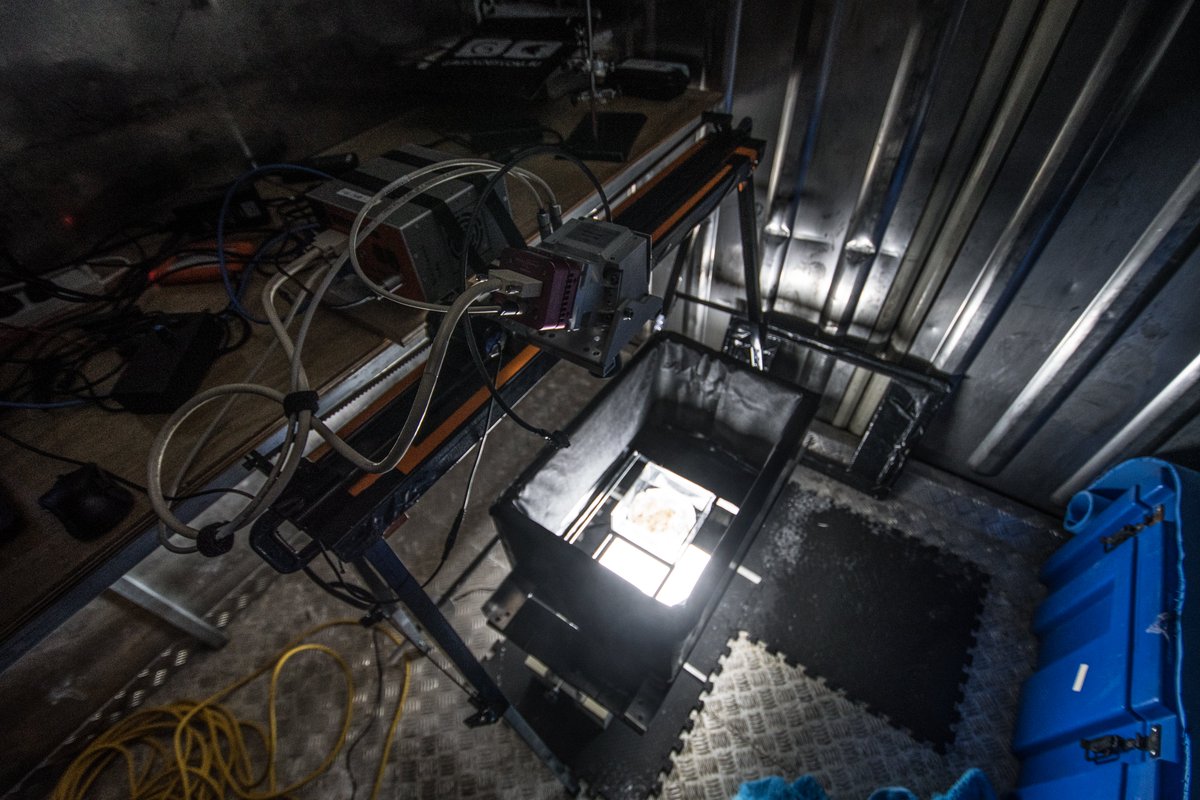
From controlled freezing experiments in our new IMAS sea ice tank facilities, where signals can be calibrated against known conditions, to potential shipborne observations in the marginal ice zone, with links up to aerial and satellite remote sensing.
❄️ 💡🌿 Looking for a new PhD candidate at @IMASUTAS, Hobart: Advancing spectral imaging techniques to quantify sea-ice biogeochemical properties across scales. From our new sea ice tank to the marginal ice zone.
Closes 1 Oct 2026 🔗 [https://t.co/3hnu0Yb9o3]
This project takes hyperspectral imaging into that gap. Novel imaging techniques let us visualise and measure biogeochemical elements of sea ice that have cascading implications for polar ecosystems.
Sea ice is one of the hardest environments on Earth to observe. Algae growing inside the ice, their pigments, minerals like gypsum forming as it freezes and releasing as it melts, all happen at scales conventional remote sensing and coring simply miss.
New paper 🚨📃‼️
Just published in Remote Sensing of Environment, we show how drone-based hyperspectral imagery in the short-wave infrared (SWIR) region can be used to map leaf water potential across a diverse native forest.
📜👉 Read more here: https://t.co/Ubgm8EhC93
Finally happy to share our publication on HIcyBot in the Oceanography journal! 🎉🤖❄️
Robots under-ice & hyperspectral imaging for environmental monitoring in Antarctica
Could this methodology be integrated in your Antarctic studies?
LINK: https://t.co/d8rmoKcbE9
🌈❄️ How does light shape fast-ice algae?
@EC_lambda used colored panels & imaging spectroscopy to track shifts in biomass, species, & photoacclimation—advancing tools for under-ice ecosystem monitoring
🔗https://t.co/kqdgCGDdc1
🔖Part of #SOOSSymposium2023@ucpress Elementa
Few months ago but... New paper out! ⚠️🗞️
Here we used an optical flow algorithm to co-register drone-based hyperspectral imagery and RGB imagery to high accuracy 🚁📈
Big thanks to co-authors @TerraLuma@EC_lambda & Darren Turner
https://t.co/CpEMIKmI82
Antarctic Governance: Australia and Japan in the Antarctic Treaty System. Professor Akiho Shibata, Kobe University. 1 May 2025, University of Tasmania. @AIIATAS @AIIANational @UTAS_ https://t.co/oC7TGxjX2j
In #Antarctica, a daily radio check or “sked” is more than a safety protocol. It’s a lifeline, a laugh, a voice from the world beyond the ice❄️📻❤️ Short featured research supported by @AntarcticSciAus@AntarcticaNZ@IMASUTAS @niwa_nz @AntaPlatform https://t.co/71pDOdnewn
In #Antarctica, a daily radio check or “sked” is more than a safety protocol. It’s a lifeline, a laugh, a voice from the world beyond the ice❄️📻❤️ Short featured research supported by @AntarcticSciAus@AntarcticaNZ@IMASUTAS @niwa_nz @AntaPlatform https://t.co/71pDOdnewn
This short film captures one such moment between our science team including @JCMontesHerrera (MX) @seafloorness and the radio comms operators from Scott Base as part of our expedition to investigate new technologies for mapping the under-ice seafloor and sympagic communities.
Our new SC met to shape the agenda of our next meeting!
⏰14–16 March 2025
📼hybrid format
📍Renaissance Tuscany Il Ciocco Resort (Italy) after @GordonConf and online via Zoom.
The final agenda will be published soon, stay tuned!
➡️ More info: https://t.co/qH06z2mv5e
Excited to share our publication on the Seasonal and ocean basin-scale assessment of amino acid δ15N trends in a Southern Ocean marine predator 🦭 ! Check out the details here : https://t.co/poOojqJa17 #SouthernOcean🇦🇶 #MarinePredators
Antarctic sea ice update 🌊🧊
Antarctic sea ice reached its max winter extent of 17.16 million sq km (6.62 million sq miles) on Sept. 19, 2024. This is the second-lowest winter max on record, @NSIDC reports, just above last year.
The next generation of scientists at the @UTAS_
will have real-world experience exploring the ocean using specialised underwater robots thanks to Hydro Tasmania 🌊⛴
Read more: https://t.co/GeMEX8AfPf
📸Hydro Tasmania