Oil markets, energy volatility, and the dysfunctional transition.
Carbon Purgatory (forthcoming, Oxford).
Assistant Professor, Stockholm School of Economics
New article out in New Political Economy:
“Performing Energy: The IEA and the Conflicting Imaginaries of Capitalist Energy Transition”
🔗 https://t.co/gvoKycIeUX
It explores how the @IEA doesn’t just model the future—it actively tries to shape it. A few key points: 🧵
Transits through the Strait of Hormuz have unsurprisingly collapsed following the ramp in attacks.
Yesterday's few transits were all dark, and while those numbers will inch higher as more dark transits are discovered and vetted we're undoubtedly heading in the wrong direction.
No, the prime reason that supply managers have formed since the very beginning of the oil market is to stabilize notoriously volatile crude oil prices that wreck investment.
Price stability and not price level have always been the main objective. If they hold prices above market equilibrium levels, they get excess supply and a bust. If they hold them too low, they get excess demand and a boom.
They try to discern what prices are consistent with stability. But they target inventory levels and not prices per se.
@Matthuber78 Part of what Greenspan is describing is an interesting episode in US oil projection history: this inflated sense from the US industry about its future. I write about that in the third section of this article: https://t.co/XDr0SFFtGI
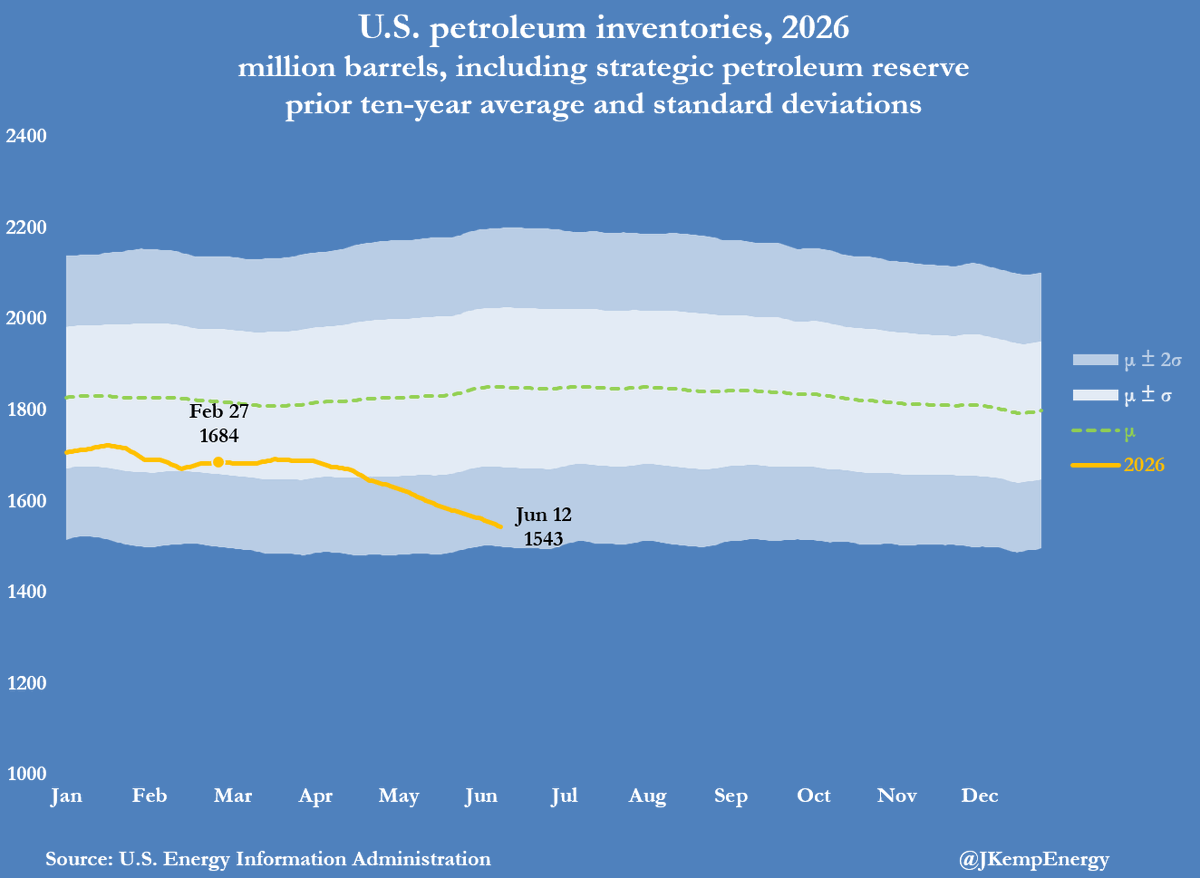
U.S. Petroleum Depletion Imposed Deadline on Hormuz War
Since the start of the war with Iran, depletion of the Strategic Petroleum Reserve (SPR) has bought time for the U.S. government to develop both diplomatic and military options to re-open the Strait of Hormuz.
The United States has explored diplomatic negotiations via Pakistan and other mediators, as well as attempts to unblock the Strait by force, organising via virtual convoys using aircraft and drones to protect tankers in the waterway.
Some tankers carrying crude, liquefied natural gas (LNG) and liquefied petroleum gas (LPG) have successfully transited as a result of diplomatic agreements or under the armed protection of the United States.
Since announcing a ceasefire in early April, the United States has pursued a mixed strategy of bombing-while-negotiating, holding talks while trying to increase the number of transits under cover of darkness.
The intention appears to have been to pressure Iran into accepting a deal while at the same time degrading Iran’s ability to threaten shipping in case the talks fail.
But with petroleum inventories at home running down rapidly, top U.S. policymakers have faced an increasingly urgent deadline to decide whether to reach an agreement with Iran or attempt to re-open the Strait fully by force.
Ultimately, the White House seems to have decided the embarrassment of a diplomatic deal achieving less than its stated war aims was a lesser evil than the potential risks from trying to force the Strait open against hostile fire ...
The maritime community is cautiously optimistic about a potential Middle Eastern peace deal, which could reopen the Strait of Hormuz. However, concerns about logistical challenges and previous cease-fire failures persist. Despite alternative routes and clandestine logistics maintaining energy flow, international energy prices have remained stable. Shipping entities are repositioning assets in anticipation of increased activity, but full resumption depends on post-conflict guarantees and mine-clearing operations.
The explosion of billionaire wealth has been one of the defining features of our time.
Globally, billionaires used to own wealth equivalent to 3% of world GDP in the 1980s.
Today: 17% of world GDP.
And the upsurge is accelerating.
تجاوز صهیونیستها به ضاحیه باردیگر نشان داد آمریکا یا ارادهای برای اجرای تعهدات خود ندارد یا توان آن را. با چراغ سبز نشان دادن به رژیم نمیتوانید امتیاز بگیرید. بازی پلیس بد و پلیس خوب قدیمی شده است.
اگر اراده و توان اجرای تعهدات خود را ندارید، سخن گفتن از ادامه مسیر ممکن نیست.
@JavierBlas It's a magic trick. Make us feel like the world is in danger. Words of destruction, doom. Then, pull back. This has happened many times now. We should be extremely critical of the words coming out of the American President's mouth. This is a performance.
The great oil reserves draw: how low can stocks go?
▪️440 million barrels drawn from reserves
▪️US SPR faces challenges at 33% capacity
▪️Declining political will to deplete scarce reserves
🖥️Full story: https://t.co/Awsy5SpHJW
@JoshYoung We have created such an incredible form of protection against oil crisis, it's working largely. But the downside is that in its complexity, it is also opaque, and so competing narratives, jawbowning prevails, instead of a cold and clear sense of where our trajectory leads.
re: Hormuz “leaking” stuff (i.e. a reported rise in dark transits)
First, a general comment: I can't stand random uncontextualized transit count figures and "oh you probably aren't counting this one"isms. Show me a time series and a list of which transits your counting specifically (to cross check against my list) or gtfo.
- there have always been dark transits
- there has been a notable uptick, as reported by Kpler, beginning late-May
- that dark transit uptick has been offset by far fewer "official" Iranian route passages
- traffic remains massively throttled, headline counts little changed
- also, this is still just functionally a stock draw at this stage so it doesn't change much.
PS: Murmurs of some fresh loadings (which could mean *production*) are much more promising, but we're still talking negligible figures and as with everything else they're being blown out of proportion.