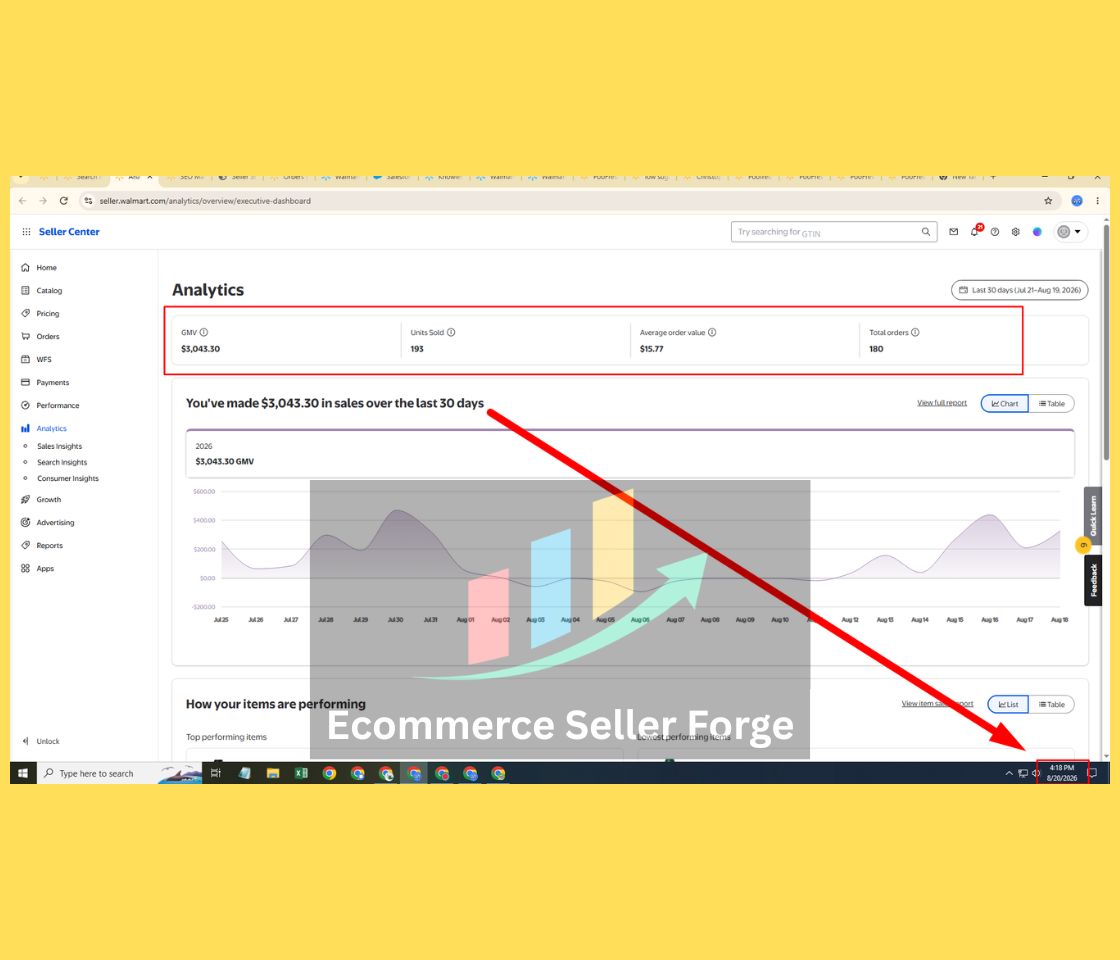
Every week I see brands spending more on Amazon...
...while making less money.
The problem usually isn't PPC.
It's everything around it.
Weak listings.
Poor keyword strategy.
Catalog issues.
Inventory problems.
Pricing decisions.
Marketplace expansion.
Disconnected data.
@mark_davis22 Exactly. And what makes this even more interesting is that the $3K+ GMV was generated through Walmart while managing fulfillment through the seller-fulfilled model not relying on WFS while keeping the account’s performance metrics healthy.
For me real win is sustainable growth.
$3K+ Walmart GMV.
$63.18 in ad spend.
But the real win? Healthy seller performance alongside the growth.
Walmart scaling isn’t just about PPC. Listings, pricing, conversion, fulfillment, and account health all matter.
That’s how I approach marketplace growth.
#WalmartMarketplace
@jordanpaid I don't use Telegram, so I couldn't get your stuff from your channel. This is a good trick to get people to comment aggressively on your post, by the way.
Seller-Fulfilled Walmart accounts require serious operational discipline.
This account is maintaining:
100% on-time delivery
0% cancellations
100% valid tracking
0% item-not-received
And still generating sales
The goal isn’t just to sell on Walmart
Grow without account at risk.
Amazon sellers:
If your brand is already successful on Amazon, Walmart could be your next growth channel.
But Walmart isn't just copying Amazon listings. Catalog, SEO, pricing, inventory, WFS, PPC & fulfillment all matter.
Helping Amazon brands expand to Walmart.
#Walmart
@Evan_Swanson_ Inventory, PPC, lead times, cash-flow cycles, returns, and reinvestment all determine how quickly a brand can actually scale.
Revenue screenshots tell only part of the story. The real question is how efficiently the business turns working capital into profitable growth.
@Evan_Swanson_ The capital requirement is one of the most overlooked parts of the “low barrier to entry” eCommerce story.
Getting a product listed is easier than ever. Building a sustainable brand is a different game.
@Evan_Swanson_ What separates strong operators is what they do with that information.
They experiment, measure, learn, and iterate — without becoming emotionally attached to the original plan.
The strongest part of building a brand is often the mindset behind it.
In eCommerce, there will always be failed tests, changing markets, unexpected customer behavior, and strategies that don’t work as planned.
I enjoy building brands not just because of the work but the mindset of people who do it
The American spirit
Disruption. Re-invention.
Running experiments. Failing. And creating something better.
You decide who to work with based on their skills and results.
There is no identity politics. There is no blaming the noble class or things outside your control.
It's people connecting not just over making money but through freedom, ownership, growth, ideas
@jake_rm_ If the same competitors repeatedly appear across high-volume branded searches, that can reveal which products are actually competing for the customer’s consideration — not just which products rank well organically.
The bigger shift isn’t whether dropshipping is “dead.”
It’s whether the model still works after you account for landed cost, delivery speed, duties, returns, customer experience, and marketplace compliance.
Cheap sourcing alone isn’t a moat anymore. The operators keep winning.
The "section 321 is going to kill dropshipping" take was wrong.
Dead wrong.
1,000,000+ parcels a day are still flowing into the US from the top China providers.
Kids in Dubai, Panama, everywhere but America are running huge dropshipping volume through under-the-radar logistics providers, and none of it slowed down.
Funds on hold with no explanation? Here's what to do:
1️⃣ Check Account Health for violations or pending verifications
2️⃣ Review your Payment Summary for reserve details
3️⃣ Open a case with specific questions about the hold
More on reserves & next steps: https://t.co/E7jse8MWi7
A phone number may seem small, but it can remove a big trust barrier.
Customers may never call, but knowing they can makes the purchase feel safer.
In eCommerce, small trust signals can have a real impact on conversion.
Funny how having a phone number on your website can completely change customers' perception of you.
Before I sold my hunting brand, I saw on Reddit threads how people were skeptical of a brand called Tidwee because there was barely anything on the About page and they didn't have a phone number to call. It came up again and again on Reddit that they didn't have a phone number to call, and people were skeptical.
On my website, on the Contact page, I put a phone number. I put it in the footer, and I got phone calls. People literally said, "I thought maybe this was a scam because the deal was too good to be true. Thanks, you've put me at ease." It didn't cost me anything to get the phone number either. Was a Google Voice number that forwarded to my iPhone.
Amazon should pay attention. If a return triggers a rating prompt, the feedback sample can naturally skew toward customers experiencing friction. That can disproportionately affect newer ASINs with small review pools. The real question is: who is being asked to rate and when?
This needs eyes from @ajassy@dharmeshmehta@amznsellerhelp
We sell decorative home goods. Customers routinely buy 2-3 finishes, keep what matches their decor, and return the rest. Normal category behavior, not dissatisfaction.
Amazon now prompts a rating on every return. So the only customers being aggressively prompted are the ones returning something, while the people who love the product barely get asked. You are only capturing one side.
Example attached below. Every written review on this product is 5 stars. The rating displays 3.6. A customer opens the page, reads glowing five star reviews, and sees a 3.6 with zero 3 or 4 star ratings. It does not make sense to anyone, seller or shopper. The rating no longer describes the product.
New ASINs with small review pools get crushed overnight with no recourse and no feedback to act on. Meanwhile Amazon incentivizes us to launch more selection. The left hand is destroying exactly what the right hand is funding.
And it hands black hats a free weapon: incentivize returns, farm ratings-only negatives, no recourse.
Reckless rollout. Please rethink it.