Je publie aujourd’hui dans La Presse sur la baisse des cotisations au RRQ. Réduire une cotisation sans ajuster les engagements actuariaux revient à déplacer le fardeau dans le temps en transférerant une partie du coût vers les cohortes plus jeunes.
https://t.co/9MimVKHhuX
Wayne, I never claimed that a snapshot of public finances could tell us the full story of a generation's lifetime, nor have I proposed a policy solution. And even if we accept that retirees have contributed to these programs throughout their lives, that doesn't answer the question of whether they've contributed enough to finance all the benefits they're receiving.
This applies not just to CPP, but to all the programs that make up our social contract: CPP and QPP, OAS and GIS, healthcare, and other government programs aimed at seniors. They all raise the same fundamental question: has each generation contributed enough over its lifetime to finance the benefits promised to it?
CPP & QPP intergenerational transfers: Earlier cohorts received substantially higher actuarial returns, creating implicit obligations (i.e., legacy debt) financed partly through subsequent generations' contributions. The portion of those contributions that finances past promises rather than equivalent pension rights can be understood as an implicit tax, not simply retirement savings.
Tax-financed benefits & healthcare: Just because you've paid taxes throughout your life doesn't necessarily mean you've prepaid your future healthcare costs or OAS benefits. Healthcare, while provided in the form of services rather than cash, still has an opportunity cost. So it's appropriate to examine healthcare and OAS through the lens of intergenerational redistribution. However, unlike CPP and QPP, these programs aren't financed through pension-specific contributions, so their intergenerational incidence must be measured separately.
The intergenerational incidence of tax-financed benefits and healthcare must therefore be assessed independently. Past tax payments don't necessarily imply that future benefits have been fully financed, and the fact that healthcare is provided as a service rather than cash doesn't eliminate its economic cost.
These promises represent claims on future public resources. To the extent that they are not backed by accumulated assets or offsetting contributions, they create an implicit social debt, meaning obligations that future taxpayers will have to finance, at least in part.
Sweden's pension reforms show that it's possible to design a system in which contributions and benefits are more closely aligned across generations. Your point about Manning actually reinforces the issue: moving toward individual retirement accounts wouldn't magically absolve us of the obligations already accumulated under the existing system. The intergenerational debt has already been passed down.
Having current workers finance current retirees isn't inherently problematic. The issue is how the system redistributes resources across generations, not simply how contributions are collected.
And yes, a snapshot doesn't quantify the lifetime fiscal balance of each generation. But these questions have been extensively studied. In Canada, the departure from intergenerational neutrality in public pensions has been documented repeatedly. The resulting implicit tax on labour income places a burden on younger workers and future generations, including the most productive among them, whose work and investment are essential to our future prosperity.
If we're serious about Canada's long-term prosperity, and I certainly am, we cannot ignore a tax burden that risks discouraging work, investment and economic growth. We need to confront the economic distortions created by these inherited obligations, rather than pretending that calling them contributions makes them disappear.
Economic growth can make those obligations easier to finance, but it cannot undo the redistribution that has already taken place.
The fundamental point is that while seniors may be fully entitled to their benefits, those benefits can involve transfers not only between today's workers and retirees, but also between generations over time.
At the very least, we should acknowledge that distinction.
You're missing the central point: intergenerational neutrality.
CPP and QPP are not simply personal savings accounts. Their base plans remain partially funded and involve redistribution across generations. Contributions don't necessarily equal the actuarial value of benefits received.
The same applies to healthcare. Calling it a life-cycle cost doesn't make it intergenerationally neutral.
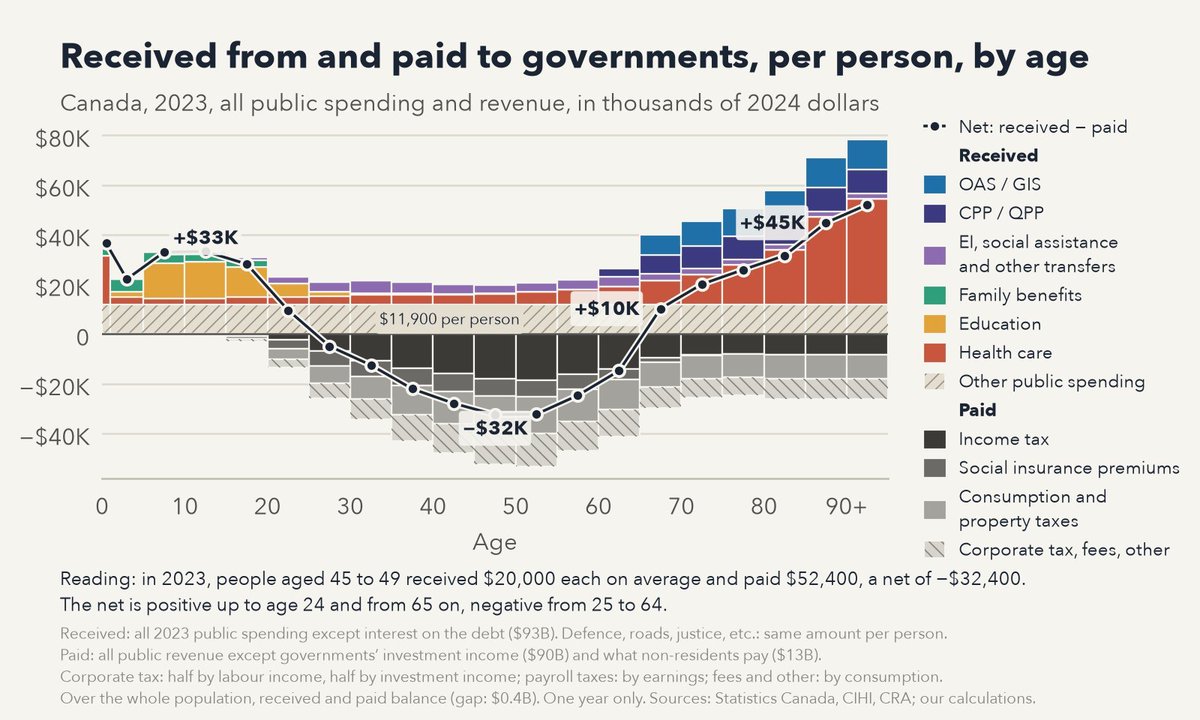
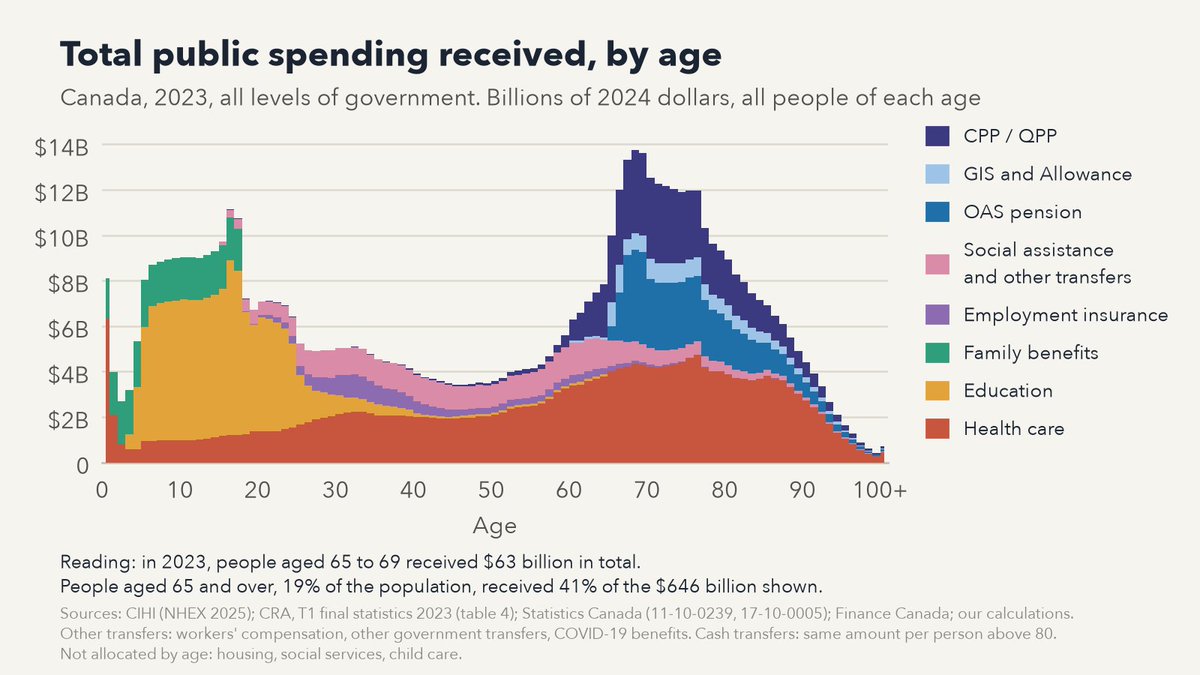
And since you brought up taxes paid by retirees, here's the full picture, including taxes, social contributions and spending across all levels of government.
The real question is who pays, who benefits, and whether the burden is fairly distributed across generations.
J’étais au micro de Mario Dumont, sur les ondes de QUB radio, pour discuter de l’avenir énergétique du Québec. Une nette majorité de Québécois appuie le développement de nos ressources pétrolières et gazières selon le nouveau sondage IEDM-Ipsos sur la question.
Il est temps d’en tenir compte. #polqc
Avant de dénoncer les conclusions d’une « étude », encore faudrait-il savoir distinguer une étude d’un sondage.
Sur le fond, le Québec consomme des hydrocarbures, mais préfère laisser aux autres l’odieux de leur production, tout en se privant des emplois, des investissements et des recettes fiscales qui en découlent.
Qu’on le veuille ou non, il n’existe toujours pas de substituts économiquement viables pour de nombreuses applications. Même les scénarios de carboneutralité prévoient une consommation résiduelle d’hydrocarbures et des investissements pour maintenir l’approvisionnement durant la transition.
Vouloir éliminer l’offre avant que des substituts viables soient disponibles, c’est risquer d’imposer des coûts économiques supérieurs à l’ensemble des gains environnementaux recherchés.
Ignorer ces contraintes ne les fait pas disparaître. C’est au mieux du déni, au pire de l’obscurantisme.
📈 74 % des Québécois appuient la construction de nouveaux pipelines.
Un soutien largement majoritaire et beaucoup plus grand que certain tente de nous faire croire.
Les Québécois comprennent l’importance de développer notre secteur énergétique. Le gouvernement devrait en faire autant.
https://t.co/lEUh89rkFB
@vix_0ii The $11,900 per person corresponds to public spending that is not targeted at any specific age group, such as defense, roads, police, or administration.
Public spending in Canada by age.
When Ottawa looks for savings, it reviews the public service and operations. Most of that isn't on this chart.
The elephant in the room is the bulge after 65: health care (red) and OAS/GIS (blue).
Reminder that Canada under the Harper government *did* raise the OAS eligibility age.
Had Trudeau not reversed this courageous reform, we would be spending $11 billion less on OAS by 2029, according to the PBO.
When OAS was created in 1952, the benefit began at age 70. Life expectancy was 68, and the ratio of workers to retirees was 8 to 1.
Eligibility is now at 65, with life expectancy at 81, and the ratio of workers to retirees down to 3 to 1.
The current system represents a massive, unjust intergenerational transfer of wealth which is obviously unsustainable.
The key issue is the lack of intergenerational neutrality. Neither CPP nor publicly funded healthcare is actuarially neutral across generations. Some cohorts receive more in benefits than they contribute, at the expense of others.
Calling these “life-cycle costs” doesn’t eliminate that redistribution. Excluding CPP or dismissing healthcare spending on those grounds simply obscures the real fiscal transfers between generations.
@kentm5180 No. CPP is not fully funded and is not actuarially neutral. It involves intergenerational redistribution, with an implicit tax on younger generations. That's precisely why including it is relevant.
@_CuspofExposure The first chart shows total spending, the second spending per person. Per-person spending keeps rising, but the population shrinks at older ages, so total spending declines.
I get this objection quite often. While CPP and QPP have evolved considerably over time, they are still not fully actuarially neutral. There is an element of intergenerational redistribution, with part of the contributions effectively functioning as an implicit tax. That makes it relevant to include them when examining public spending by age.
@trevortombe Not a paper, just some analysis I’d done that seemed particularly relevant to the current budget. I’d be happy to share the data and would love to explore collaborating on something for the MEI if you’re interested!
L’enjeu ici est celui des incitations. Lorsque les élus d’une municipalité doivent financer leurs décisions à même les impôts de leurs propres contribuables, ils sont davantage incités à en considérer les coûts. Les fusions municipales peuvent affaiblir cette responsabilité en permettant de répartir les coûts de projets locaux sur une population plus large. Elles réduisent également la concurrence entre municipalités, qui permet aux citoyens de comparer leur gestion et de s’établir ailleurs s’ils jugent qu’une autre municipalité est mieux administrée. La compétence ne fait pas tout. Les bonnes incitations sont essentielles.
Lorsque des municipalités fusionnent, les élus de la nouvelle municipalité peuvent être davantage enclins à entreprendre des projets coûteux. Pourquoi ? Parce que les contribuables des anciennes municipalités n’assument plus seuls le coût des équipements publics construits dans leur secteur. Une partie de la facture est désormais répartie entre les résidents des autres secteurs, même si ceux-ci en retirent peu de bénéfices.
Les fusions peuvent donc avoir des effets négatifs pour cette raison, entre autres, et cela n’a rien à voir avec la compétence des élus municipaux. Elles modifient plutôt les incitations auxquelles ces derniers sont confrontés, ce qui peut influencer leurs décisions de dépenses.
Par ailleurs, la concurrence entre municipalités est précieuse. Elle permet aux citoyens de comparer leur gestion et de sanctionner celles qui sont mal administrées. Les fusions réduisent cette concurrence sans pour autant garantir des économies.
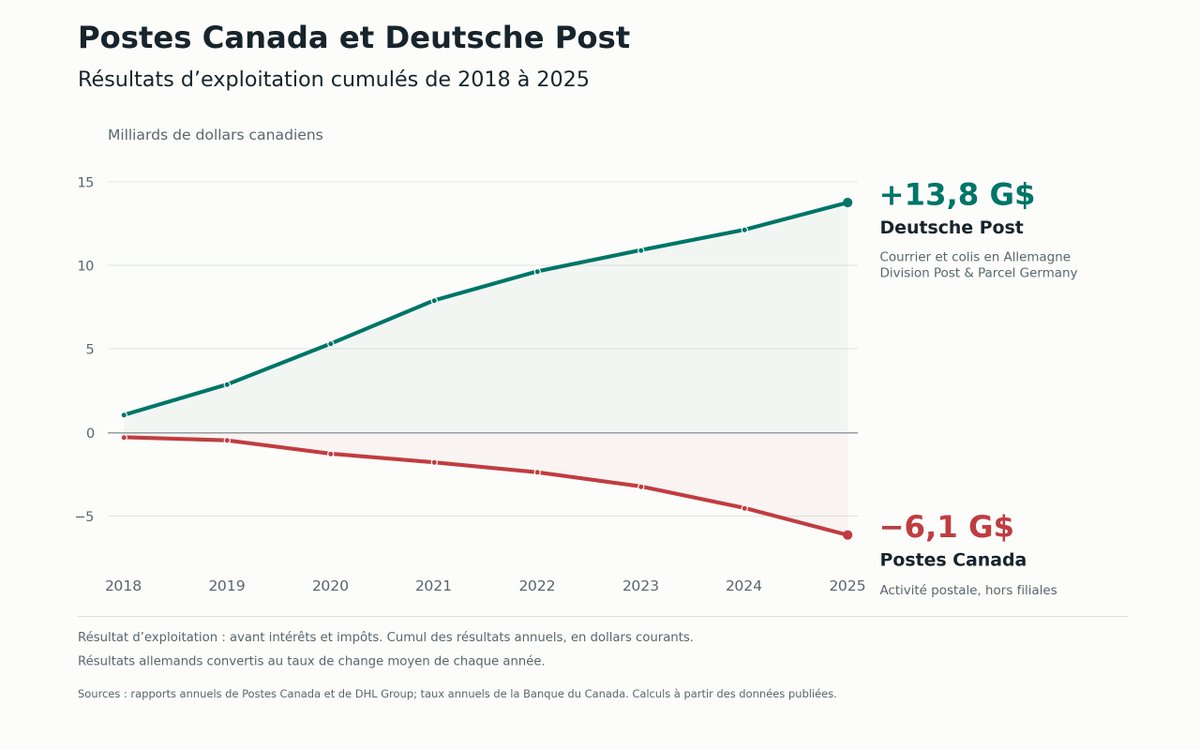
Depuis 2018, Postes Canada a accumulé 6,1 G$ de pertes d’exploitation. L’équivalent de plus de deux ponts et demi de l’Île-aux-Tourtes.
Pendant ce temps, les activités postales de Deutsche Post en Allemagne ont généré 13,8 G$ de bénéfices.
Il serait temps d’ouvrir le marché à la concurrence.
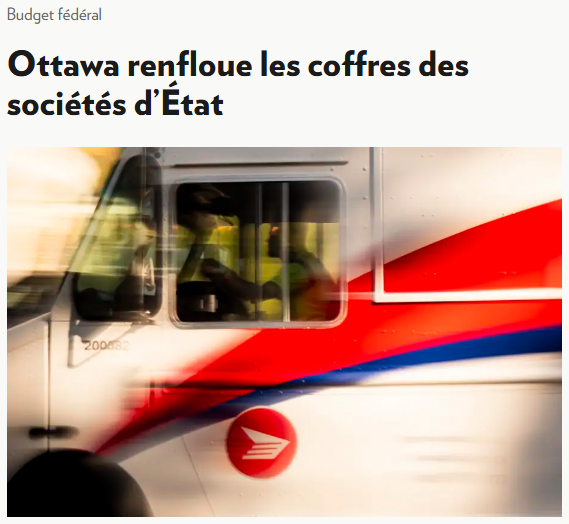
Ottawa prévoit verser 1,4 G$ à Postes Canada sur deux ans, tandis que le prix du timbre passera de 1,44 $ à 2 $ en 2027. Plutôt que de multiplier les renflouements, le Canada devrait s’inspirer de l’Allemagne et privatiser son service postal. #polcan#PostesCanada
https://t.co/xxoqpIbAjn
Pour en savoir plus, lisez notre publication sur la question :
https://t.co/grfDd92aFH
@FrankyShark Oui. L’État doit justifier ses décisions devant ceux qu’il oblige à les financer. Dans un appareil protégé de la concurrence, le confort des employés ne suffit pas à créer un droit acquis. L’argent public n’est pas une caisse destinée à satisfaire chaque revendication syndicale.