Modernizing a telecom platform is never just a technical exercise. For CSPs, it is a confidence decision: confidence in roadmap visibility, long-term viability, and the ability to innovate without risk.
Metaswitch has gone through multiple ownership changes in recent years. For many CSPs, these transitions have triggered a question: Is our Telephony Application Server still a strategic platform, or just a system to be maintained? When a TAS turns into a maintenance cash cow, innovation slows. Budgets go to keeping the lights on, while clarity about the future fades. This is what many CSPs describe as strategic orphanage.
Many legacy platforms depend on highly specialized skills. Metaswitch Rhino development relies heavily on JAIN SLEE expertise, skills that are increasingly rare. This creates a knowledge bottleneck and turns the network into a black box. Telecoms Low Code removes that dependency.
Modernization should not be framed around what's broken. It should be framed around what becomes possible next.
🔗 https://t.co/AY3nvFQLVi
#Telecoms #LowCode #NetworkModernization #ServiceDelivery #TAS
Continuous product evolution is not a matter of quarterly roadmaps and waterfall change requests.
The launch of a new service is not the end of the collaboration, but rather just the beginning. When you and your customers start to use a product, valuable data and feedback begins flowing which you can and should use to improve the user experience, to adapt the product to new and changing use cases, to individualize it for your important business and public sector customers, and to integrate third-party products and proprietary enterprise systems as requested by your customers.
This is indeed the really fun part where low code lets you do so much more.
That's why we offer all our customers a Dedicated Agile Programming Squad. Such a Dedicated Squad generally includes a scrum master, solution architect, one or more frontend and backend engineers and automated testing experts. You provide the product owner who determines the backlog. You can add your own people or third-party experts, and even integrate the Squad into your DevOps. It works full-time only for you, using our low code to continuously enhance your products or even compose completely new products.
The Dedicated Squad generally works in short sprints of max. three weeks and the results are then available to you in your development network. Imagine being able to fulfil customer requests this quickly. By continuously individualizing your offering for important customers, you can add value, justifying a premium price, and at the same time, you can improve customer retention.
The Dedicated Squad also serves as an open communications channel for knowledge transfer between us. We become more familiar with your goals and customer requirements, while your people become experts in using our low code.
This all amounts to better business outcomes for you and your customers.
🔗 More on continuous co-development with ECT: https://t.co/0GSzxjhbZW
#Telecoms #LowCode #AgileDevelopment #ContinuousDevelopment #TelecomInnovation
It's agile, so no need to write lengthy waterfall specs. It's complimentary, so you don't need to have a budget approved in advance.
That is the Joint Agile Product Development program.
We encourage all of our customers to participate in JAPD. This program allows you to collaborate with ECT as well as other partners in our ecosystem, trying out new technologies and product ideas. ECT provides the complete agile programming squad. It uses low code to implement minimum usable products in 2 to 3 week sprints.
The JAPD offers you a myriad of possibilities within one general framework. You can perform proofs of concept of existing ECT apps, for UCC and conversational commerce, or architectural innovations, like automated lifecycle management or containerization. Participation in JAPD gives you the opportunity to delve into new technological capabilities as our R&D adds them to Telecoms Low Code.
In up to 6 sprints of 2 weeks each, we compose together a MUP based on jointly agreed ideas. As the results of each sprint are then live in your development network, you can easily demonstrate each iteration to colleagues and even customers. The JAPD also provides support for market studies and business case development.
If you decide to further evolve a MUP into a complete product integrated with your backend, you can employ an ECT Dedicated Agile Programming Squad working exclusively on your project. You can supplement this Dedicated Squad with your own engineers, testers and third-party programmers, as desired.
The goal is to bring innovative products and technologies to market quickly and with as little upfront investment as possible, all for better business outcomes for CSPs and their customers.
🔗 More on the Joint Agile Product Development program: https://t.co/GmkipLdSGF
#Telecoms #LowCode #JAPD #AgileDevelopment #ProductInnovation
OTT vendors greatly outperform CSPs in market valuation, despite the fact that CSP networks provide the bandwidth that makes OTTs possible. Concentrating on bandwidth doesn't help: it delivers ever lower margins. Reselling OTT products doesn't allow differentiation, and margins are extremely low there too.
Every member of your board sees this differently.
The CEO sees CSPs have key assets OTTs don't: a regulated network, a trusted brand, and close customer relationships with a vested interest in the local economy. The answer is monetizing those advantages by offering their own products, individualized to better serve their target customers and their changing needs.
The CTO sees a network that is ready for next-generation technology and architecture, and there is always something new. The priority is implementing and continuously evolving network services agilely and flexibly, adding value to the CSP network instead of moving it out to third-party OTT products.
The CPO sees product leaders with little or no C-level representation, frustrated by telecoms networks that do not support continuous, agile product composition. The need is to realize their own strategic product vision and respond continuously to the changing needs of customers, demonstrating enhancements in sprints of 2 to 3 weeks.
Three perspectives. One common goal: better business outcomes.
Telecoms Low Code is ECT's answer to all three.
🔗 More on how ECT addresses each of these perspectives: https://t.co/Jlez9nZ7VX
#Telecoms #LowCode #BusinessOutcomes #Strategy #Innovation
Our CitizenTool is designed for no-code application composition, enabling business people without programming skills to quickly and easily compose and recompose applications.
Citizen developers use this tool to enhance and to individualize ready-to-use apps, redesigning elements of the user interfaces or changing the available feature set. The tool also enables them to compose entirely new applications based on prebuilt Packaged Business Applications.
At ECT, we continuously add new PBCs to Telecoms Low Code and professional developers can also use our low-code ExpertTool to elaborate their own PBCs. These are autonomous, ready-to-use software components that encapsulate defined generic capabilities. PBCs deliver complete operational functionalities throughout the full life-cycle of an entity. PBCs are partitioned into a cohesive set of modular components with minimal external dependencies to ensure flexibility when composing services. Interaction with other PBCs takes place only through published APIs and event channels.
Telecoms Low Code provides a private marketplace for PBCs where they can be accessed and utilized by citizen developers. It supports one-click deployment of PBCs as microservices and even composed applications are deployed with a click of a button.
By breaking up applications into PBCs developed in parallel agile sprints, you not only shorten your time-to-market for new products but also ensure steady progress and quality control.
🔗 More on PBCs and ready-to-use apps: https://t.co/G5gUQgCiY0
#Telecoms #LowCode #TelecomStrategy #NoCode #Agile
Your network has its own requirements. So does your low code platform.
We all know that telecoms networks utilize many technologies not generally found in IT networks, and CSPs have their own stringent non-functional requirements. Unlike other low-code application platforms, Telecoms Low Code is seamlessly integrated into the telecoms network, rather than being positioned in the IT realm. Its underlying technology is based on tried-and-true telecoms components, with a service execution engine and model-based, automated tools that have been used by leading CSPs for decades. Thus, Telecoms Low Code reliably supports virtually all the special requirements of the telecoms industry, allowing CSPs to easily leverage its assets to rapidly achieve value.
Telecoms Low Code doesn't make professional programmers obsolete. It provides a new way for professional developers to collaborate with business people to compose and maintain products. TLC includes two interconnected tools for each of these two groups: the CitizenTool, which empowers product professionals to build their own interfaces with no-code visual builders and packaged business capabilities; and the ExpertTool, a low-code software that enhances developers' ability to model data, expose APIs and rapidly create services.
Low code's main value proposition for CSPs is that it enables them to reduce repetitive, costly tasks in software development. By transforming the CSP's network assets into composable, packaged business capabilities, Telecoms Low Code enables development teams to be more agile and responsive. This ultimately leads to faster time-to-market for innovations and a high ROI.
Telecoms Low Code has been designed to be CSP-first, which means that the platform itself is tailored to be deployed in the CSP network, allowing CSPs to seamlessly integrate and leverage its assets.
🔗 More on Telecoms Low Code and how it is transforming telecoms service creation: https://t.co/Zu2vKWTKTF
If you work in the telecoms industry, chances are you are familiar with the term "service delivery platform", or SDP. But what about "telecoms low code"? You probably haven't heard about that one. Yet.
For more than two decades, communications service providers have relied on service delivery platforms designed for voice and messaging services. But many of these platforms are aging, having been active since the early 2000s. Often, these older SDPs have reached the end of life or end of service stage, their vendors are no longer providing new releases, and their solution-support forums have disbanded. As a result, these platforms can be costly to operate, maintain and change.
The challenges of legacy SDPs go beyond driving up costs. Like many aging technologies, legacy SDPs drive up costs because maintaining them is complex and labor-intensive. Outdated systems often require specialized and hard-to-find programming and engineering skills. Even the most basic tasks can require tremendous effort. More than once, CSPs have told us that they need to have a dozen or more engineers devoted exclusively to maintaining and adding features to existing services on obsolete platforms. Beyond driving up costs, this makes it difficult to implement improvements, because IT teams are completely occupied with keeping systems up and running.
CSPs see modern telecoms platforms as a way to increase flexibility and scalability while reducing operational costs and simplifying network integration. But they are often reluctant to change platforms, because they don't want to discontinue existing services that are bringing money in.
TLC is the natural evolution of ECT's SDP. Its underlying technology is based on tried-and-true telecoms components of SDP, including the service execution engine and model-based, automated tools that have been used by CSPs for decades. ECT's TLC builds on that foundation to enable CSPs to more easily improve customer experience, reduce costs, and accelerate time-to-market.
Using TLC with modern SDPs provides a number of advantages. With preprogrammed building-block microservices, TLC can reduce effort by 80% compared with traditional coding. Telecoms Low Code opens the door to personalized telecom service offerings that draw on automation, self-provisioning, AI-driven chatbots, etc. Because TLC allows more participants to take part in service creation, CSPs don't need to search for highly skilled specialists with deep knowledge of old standards to operate their systems. And with its southbound API integration capabilities, TLC makes it easy to integrate with open-source telecom APIs and make those APIs accessible in its low-code rule engine and UI builder.
🔗 Contact us to schedule a demo or to discuss your specific needs. https://t.co/U4A3eFTRfx
#Telecoms #ServiceDeliveryPlatform #LowCode #Migration #Innovation
If you're reselling a one-size-fits-all OTT product, you'll have great difficulty coming out on top, as most global OTTs don't care what individualization your customer might want.
Large corporates and municipalities often have their own special needs, for example for the integration of their enterprise systems into communications services. In some European countries, large organizations issue tenders for their business services on a regular basis. Such tenders are your opportunity to acquire a large number of subscribers all at once with lower acquisition costs. But it's not easy to win such tenders: they can include all kinds of new features as well as integrations with a myriad of proprietary systems and third-party products.
Even if you have developed your own product, without Telecoms Low Code, the individualization of services to meet the customer's requirements can be slow and costly. So if you want to get an entire organization to move from their current provider to your product, then you have to up the ante on cost-effectiveness, customization and flexibility.
You stand to be the big winner here using Telecoms Low Code to respond agilely to special requests and to individualize your product for each of your major accounts. And when you continuously individualize a product for a specific enterprise, you earn more and improve long-term customer retention.
At ECT, we appreciate that you have to be able to respond continuously to changing use cases and requirements to optimize customer acquisition and retention. That's why we offer continuous co-development of your products starting the day you launch them.
🔗 https://t.co/SVWsAtFp5Z
#Telecoms #LowCode #Strategy #CustomerRetention #VAS
For CSPs, downtime goes way beyond financial issues. The losses can be profound and run very deep indeed: best-case scenario, the downtime causes expensive lawsuits and reputational damage. Worst-case scenario, downtime means the loss of human life.
When an emergency strikes, people don't resort to the internet. They call 911 (or 112 or 999 or 000). They don't want to wait in a queue, and they want their call to connect quickly, regardless of how many other calls are trying the same number. Outages on emergency lines are not an option.
And downtime is expensive. Back in 2014, Gartner reported that the average cost of network downtime was about US$5,600 per minute. By 2025, outage costs appeared to be much worse. A cyberattack resulted in about US$264 million in cyber-related costs. A 15-hour cloud outage cost one company an estimated US$72 million per hour.
Regulators are paying attention. A CSP was fined £17.5 million for being ill-prepared to respond to a catastrophic failure of its emergency call handling service. A telecoms regulator warned that it intends to fine another operator NOK 50 million after four occasions in autumn 2024 when the operator made it difficult or impossible to reach the emergency services, either completely or partially.
Zero unscheduled downtime for more than a decade doesn't happen just magically. At ECT, we utilize N+N geographical redundancy with automatic failover. As unpredictable as disasters can be, our services remain available through secondary servers and multiple redundant sites, just milliseconds away when required. The majority of the few critical tickets we receive are solved by our self-healing mechanisms before our customers even notice them.
A breach of a service level agreement with us is practically unheard of. First-tier carriers offering system-critical services like 911 using ECT technology have very stringent SLAs. SLAs are an expression of trust. As a company interested in long-term partnerships, we focus on going the extra mile to make our customers feel their services are in the right hands.
🔗 More on ECT's zero unscheduled downtime track record: https://t.co/mfw0NgYSyv
#Telecoms #Reliability #SLA #NetworkResilience #Uptime
Many CSPs grew out of a process of mergers and acquisitions, ending up with heterogeneous networks with multiple legacy platforms and island solutions for various products and services.
Often the vendors of these platforms have already declared end of life or even end of service. Maintaining all these legacy platforms greatly increases operational costs and also hinders product innovation.
CSPs are continually investing heavily in the newest technology, be it IMS, VoLTE, 5G, edge computing, telco cloud, etc. However, the platforms providing services and products are often far behind and this prevents CSPs from getting the most out of their network investments.
One of the key ways to support better business outcomes for CSPs is by migrating and consolidating existing services and products onto Telecoms Low Code. We are experts in ensuring a smooth transition for all the existing users of the services, preventing churn. Moreover, with our TLC, you lower your operational costs significantly, making all services more profitable. Lastly, your future is bright when you have the ability to individualize products for key customers and further enhance them via your own citizen developers and in continuous co-development with ECT.
Moving to a platform with state-of-the-art service that is more competitive than your legacy service could mean a gross profit margin of 80%.
𝗕𝗧𝗪: 𝗘𝗖𝗧 𝗵𝗮𝘀 𝗻𝗲𝘃𝗲𝗿 𝗱𝗲𝗰𝗹𝗮𝗿𝗲𝗱 𝗲𝗻𝗱 𝗼𝗳 𝘀𝗲𝗿𝘃𝗶𝗰𝗲.
🔗 More on service migration, consolidation and modernization with ECT: https://t.co/OvWoF82nFJ
#Telecoms #ServiceMigration #LegacyModernization #LowCode #TelecomInnovation
At CSPs worldwide, CTOs are looking to implement the next generation technology and architecture. And there is always something new.
One key concern of CTOs is often the consolidation of services and simultaneous elimination of technical debt required to support legacy systems. While we also support older telecoms protocols, like INAP and CAMEL, we are also experts at migrating services from multiple legacy platforms to one TLC instance.
Perhaps you've been a bit jealous of how CIOs are able to use low code in the IT realm, responding agilely to new and changing use cases and continually optimizing the user experience. Now with our TLC, you can do the same with network, business and consumer products realized in your telecoms network and exploiting all of its potential.
Telecoms low code enables you to implement and continually evolve your network services agilely and flexibly. It facilitates the opening of network resources via APIs as well as the integration with third-party systems. Above all, it makes it much easier to realize state-of-the-art business and consumer services, adding value to your CSP network instead of moving the value out to third-party OTT products.
Our R&D is continually monitoring and implementing new standards as they become codified in our industry. We also know that few CSPs are able to uphold all standards to the book without special configurations and issues due to the historical evolution of the given network. We are flexible problem solvers, so send us your challenges.
In a nutshell, telecoms low code empowers CTOs to make even greater contributions to better business outcomes.
🔗 More on the CTO perspective and how ECT's Telecoms Low Code adds value to the CSP network: https://t.co/JNyRVTBmCK
#Telecoms #LowCode #Strategy #VAS #Innovation
Low code doesn't make professional programmers obsolete, but rather defines a new way in which professional developers collaborate with business people to compose and maintain products.
Telecoms Low Code includes two interconnected tools for each of these two groups.
The CitizenTool is designed for business people in product ideation who often have little programming knowledge. As a citizen developer, you are able to create, change and enhance products with no coding whatsoever. Using just the CitizenTool's browser-based graphical editors, you enhance and change existing applications. You can compose new apps based on prebuilt building blocks called Packaged Business Capabilities. You visualize your product ideas and demonstrate them immediately to members of your team and even to customers. This no-code approach for citizen developers ensures that tight link to business people and customers which is needed today to implement and maintain fit-for-use, commercially successful telecoms products.
The ExpertTool uses low code, improving the performance and proficiency of programmers. It allows professional developers to extend the reach of the CitizenTool by adding prebuilt PBCs. The ExpertTool includes several browser-based graphical editors for data modelling, API integration, API exposure, business logic definition and UI component definition. Each graphical editor allows the developer to use simple drag and drop to do most of the work. The ExpertTool also allows developers to add handwritten code where and when needed. Telecoms Low Code supports JavaScript/TypeScript as the unified programming language for both backend and frontend development.
Professionals use low code to make sure citizen developers always have the prebuilt components they need, and business people can use no code for composing and re-composing target applications.
Thus, Telecoms Low Code never becomes limited as you can realize even completely new and unforeseen technical requirements as they arise and wrap them in PBCs, expanding the options available for no-code application composition.
🔗 More on how ECT enables collaboration between business people and IT in telecoms: https://t.co/1fIwUTGFrE
#Telecoms #LowCode #Strategy #Innovation
Enterprises are becoming more wary of unregulated over-the-top clouds located outside their country.
A contact center offering from the local CSP is increasingly attractive to them. Enterprises view their local CSP as a guarantor of scalability, compliance and reliability, as well as of local data storage with iron-tight data security.
By implementing your services on a platform in your own CSP network, you generally achieve a five-times higher margin than by reselling a third-party OTT product. Moreover, by providing a business or public sector organization with its own individualized solution, you can gain more business subscribers with lower acquisition costs and a higher long-term retention.
For over 20 years, CSPs have been offering their own unique service number and contact center services based on ECT technology. We have often migrated legacy solutions for number translations, call distribution, interactive voice response, cloud call center agents, etc. from legacy platforms with end of life and/or end of service, helping CSPs maintain this profitable business in their own network while modernizing and tailoring services via state-of-the-art web and mobile apps composed and continually enhanced using citizen developer low code.
Together we can compose customer care services in response to the specific demands of enterprises in your market, using low code and Packaged Business Capabilities for key components, including Number Translation, Automatic Call Distribution, Wallboards, Agent Workplaces, Outbound, Interactive Voice and Video Response, Call Recording, Voice and Video Softphone, Video and Voice Conferencing, Chatbots, Integration of Third-party ASR/TTS, AI, CRM as well as OTT Communication Channels, and Conversational Commerce and Customer Care via Messaging and/or SMS.
Whether you are migrating from a legacy platform or just entering this lucrative market, we want to be at your service from the elaboration of your product positioning and business case through to the actual composition and continuous evolution of your services.
🔗 More on how ECT delivers better business outcomes with low-code contact center services: https://t.co/K4evHOnFri
#Telecoms #ContactCenter #LowCode #VAS #ServiceNumber
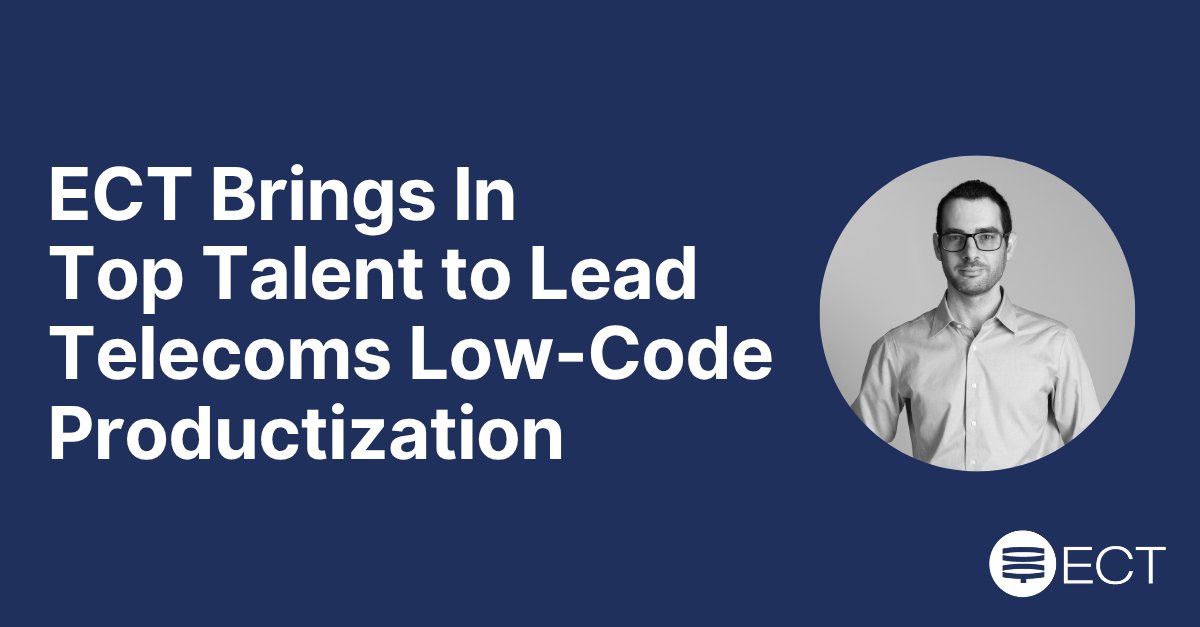
We are pleased to announce the appointment of Richard Burleigh as product manager. Burleigh will help ECT position Telecoms Low Code (TLC) as the optimal low-code alternative for the telecommunications market.
Burleigh brings more than 10 years of experience across enterprise software, consulting, and research and development. In his previous role as product manager at Mendix/Siemens, he was leading AI-assisted development, shipping many of the platform’s key AI capabilities.
Prior to that, Burleigh was a technical account manager at OutSystems, where he handled premium technical coaching, consulting, and technical account management for governments, banks, insurance companies, and other high-profile entities across Australia, Korea, Malaysia, and Indonesia.
Read the full press release: https://t.co/hJjprH8XXJ
#Telecom #PressRelease #LowCode
In the last quarter century we’ve been in this business, the four key requirements of CSPs, and, indeed, of their customers, have remained more or less unchanged: time-to-market, market responsiveness, stability and reliability as well as commercial viability.
From market study to business plan to technical specification to development to integration: the waterfall approach and how poorly it often satisfied these requirements is no wonder that many communications service providers saw themselves as Behemoths, too slow to respond to changing customer requirements in a timely fashion.
The many drawbacks associated with waterfall development, planning and implementation (including the possible misinterpretation of customer requirements and the lengthy specification process) are now avoided by applying agile methodology and DevOps principles. Due to the fast-changing needs of today's market, CSPs and their customers are now using agile methodology, at least in the IT world.
With Telecoms Low Code, CSPs can also agilely develop services in the telecoms network. Innovation and product teams can use agile iterations with validated learning through experimentation, running their build-measure-learn loops effectively using no-code application composition with only limited support, if any, required from the IT department. Via the CitizenTool, business people in product and customer experience teams build minimum viable products, getting user feedback each iteration along the way to ensure fit for use and customer acceptance.
The underlying Packaged Business Capabilities are prebuilt by professional developers and utilize the tried-and-true telecoms components of TLC, ensuring scalability and reliability.
At ECT, all development is agile. In our complementary Joint Agile Product Development Program, you can co-develop innovations with us and our ecosystem.
🔗 More on how ECT delivers operational agility for CSPs: https://t.co/HU03UXoepX
#Telecoms #LowCode #OperationalAgility #TelecomStrategy #TelecomInnovation
For more than two decades, communications service providers have relied on service delivery platforms designed for voice and messaging services. Many of these platforms are aging, having been active since the early 2000s. Often, these older SDPs have reached end of life or end of service, their vendors are no longer providing new releases, and their solution-support forums have disbanded. As a result, these platforms can be costly to operate, maintain and change. Yet many CSPs are still using them.
This reality is driving interest in migration efforts designed to move CSPs to modern, more future-proof SDP platforms. And as CSPs explore SDP modernization strategies, they are finding that there is more than one way forward.
CSPs see modern telecoms platforms as a way to increase flexibility and scalability while reducing operational costs and simplifying network integration through a modular, microservices-based design. But they are often reluctant to change platforms, because they don't want to discontinue existing services that are bringing money in.
ECT's Telecoms Low Code offers a powerful tool for simplifying and streamlining SDP migration and modernization and transitioning existing services to new platforms with minimal disruption. TLC reduces effort by 80% compared with traditional coding. CSPs don't need to search for highly skilled specialists with deep knowledge of old standards to operate their systems, and instead of just keeping existing systems up and running, the experts can focus on the creation of new services that generate new income.
TLC is the natural evolution of ECT's Service Delivery Platform. Its underlying technology is based on tried-and-true telecoms components of SDP, including the service execution engine and model-based, automated tools that have been used by CSPs for decades.
🔗 More on ECT's approach to SDP modernization and migration: https://t.co/jh2iglRD3d
#Telecoms #SDP #LowCode #Migration #Innovation
How many different platforms are you running to deliver your network services?
Most CSPs are operating a heterogeneous and expensive set of different platforms for network services. Replacing them one by one solves nothing, the complexity remains.
ECT's Telecoms Low Code provides the basis for a myriad of network functions and services on one multiservice, virtualized platform. Unlike low-code platforms for mainstream IT, it fully integrates into your network via out-of-the-box telco plug-ins. Network functions and services can be easily changed and augmented, often without any coding whatsoever.
🔗 More on low-code implementation and evolution of network functions and services: https://t.co/rPwp60Xojs
#Telecoms #LowCode #NetworkServices #VAS #Innovation
Number portability spans every generation of your network. Your solution should too.
Intelligent Networks originally introduced programmability into telecom services, enabling advanced call control, prepaid billing, and number portability. Today, CSPs are running 3G, 4G, 5G and fixed networks, often simultaneously, and a number portability solution needs to work across all of them.
A converged NP solution needs to support legacy and IP-based number portability; multi-protocol support including ENUM, INAP, CAMEL, MAP, Diameter and SIP; and flexible routing-number format adaptation. It needs REST API for real-time provisioning, a local database and caching mechanism, and a GUI for operator control and customer care.
ECT's converged Number Portability solution works with 3G, 4G, 5G and fixed network, built on the same Telecoms Low Code platform that CSPs use to ceate and individualize their broader portfolio of network services, from carrier routing and NTS to fixed-mobile unification.
🔗 More on ECT's Number Portability and 5G Network Services: https://t.co/BhqW0qSjrL
#Telecoms #NumberPortability #5G #NetworkServices #LowCode
CSPs are constantly investing in the newest network technology. But older technology for network and business services often limits their ability to capitalize on that investment.
𝗬𝗼𝘂 𝗮𝗿𝗲 𝗹𝗼𝘀𝗶𝗻𝗴 𝗲𝗻𝘁𝗲𝗿𝗽𝗿𝗶𝘀𝗲 𝘁𝗲𝗻𝗱𝗲𝗿𝘀 𝘁𝗼 𝗰𝗼𝗺𝗽𝗲𝘁𝗶𝘁𝗼𝗿𝘀 𝘄𝗵𝗼 𝗰𝗮𝗻 𝗿𝗲𝘀𝗽𝗼𝗻𝗱 𝗳𝗮𝘀𝘁𝗲𝗿.
Large corporates and public sector organizations tender for their business services. If you have to program this all from scratch or you're just reselling a one-size-fits-all OTT service, you cannot compete. You need the cost-effectiveness, innovation and flexibility of Telecoms Low Code.
🔗 https://t.co/zQ1LwHGkrj
𝗬𝗼𝘂𝗿 𝗹𝗲𝗴𝗮𝗰𝘆 𝗽𝗹𝗮𝘁𝗳𝗼𝗿𝗺𝘀 𝗮𝗿𝗲 𝗺𝗮𝗸𝗶𝗻𝗴 𝘆𝗼𝘂𝗿 𝗻𝗲𝘁𝘄𝗼𝗿𝗸 𝗶𝗻𝘃𝗲𝘀𝘁𝗺𝗲𝗻𝘁𝘀 𝗶𝗺𝗽𝗼𝘀𝘀𝗶𝗯𝗹𝗲 𝘁𝗼 𝗺𝗼𝗻𝗲𝘁𝗶𝘇𝗲.
Legacy platforms that cannot be integrated directly into the new network make end-to-end network architecture more cumbersome and inefficient. OPEX skyrockets and products cannot be enhanced. Being dependent on vendors for network services is expensive and time consuming as each item has to be specified in detail, then implemented by the vendor. Not being able to create and alter your own network services translates ultimately into higher overall OPEX, lower ARPUs for business services, and missed opportunities.
🔗 https://t.co/7n9KDgciTx
𝗬𝗼𝘂 𝗰𝗮𝗻'𝘁 𝗴𝗲𝘁 𝗮 𝗿𝗲𝘁𝘂𝗿𝗻 𝗼𝗻 𝘆𝗼𝘂𝗿 𝗻𝗲𝘁𝘄𝗼𝗿𝗸 𝗶𝗻𝘃𝗲𝘀𝘁𝗺𝗲𝗻𝘁 𝗷𝘂𝘀𝘁 𝘀𝗲𝗹𝗹𝗶𝗻𝗴 𝗯𝗮𝗻𝗱𝘄𝗶𝗱𝘁𝗵 𝗮𝗻𝗱 𝗰𝗮𝗹𝗹𝗶𝗻𝗴.
Although CSPs are constantly investing in the newest network technology, older technology for network and business services often limits their ability to capitalize on this investment. Moreover, the development of technology for services has been accelerating in leaps and bounds. Without a partner continually modernizing service creation and provision, you cannot compete successfully in the high margin market for business services.
🔗 https://t.co/97MYtbjJT0
𝗬𝗼𝘂𝗿 𝗯𝗮𝗿𝗲-𝗺𝗲𝘁𝗮𝗹 𝗽𝗹𝗮𝘁𝗳𝗼𝗿𝗺𝘀 𝗮𝗿𝗲 𝗲𝘅𝗽𝗲𝗻𝘀𝗶𝘃𝗲 𝘁𝗼 𝗺𝗮𝗶𝗻𝘁𝗮𝗶𝗻, 𝗱𝗶𝗳𝗳𝗶𝗰𝘂𝗹𝘁 𝘁𝗼 𝗲𝘅𝗽𝗮𝗻𝗱.
With all the mergers and acquisitions in telecoms, many CSPs have accumulated a heterogeneous collection of legacy platforms, many with end of life and end of service. Moreover, these are often bare-metal platforms that are extremely expensive to maintain, difficult to expand and without any no-code or low-code options for product enhancements.
🔗 https://t.co/kTJEl4ToPP
Four symptoms. One diagnosis: a platform that cannot keep up with your network.
ECT's Telecoms Low Code addresses all four, on a single virtualized platform.
#Telecoms #LowCode #Strategy #Innovation #5G
A Multi-Year Agreement and Record-High Recurring Income:
ECT Reports Strong 2025 Results, and a Focused 2026 Growth Plan
➤ In 2025, ECT signed the largest customer agreement in its history, with a total guaranteed value of €17 million.
➤ The company reports YoY operating profit growth of more than 60%, and YoY net profit after taxes growth of almost 250%.
➤ Recurring income from licenses and maintenance reached a record high.
➤ For 2026, ECT targets €20 million in total revenue and more than €1 million in earnings after taxes.
European Computer Telecoms AG (ECT), creators of Telecoms Low Code (TLC), the world’s first low-code application platform exclusively for the telecoms industry, today announced a robust 2025 performance, the renewal of its largest customer agreement through 2029, and a focused 2026 plan to accelerate the migration of legacy services, expand recurring revenue, and acquisition of major new customers.
📰 Read the full press release: https://t.co/rKN3AzCk9o
#Telecoms #PressRelease #LowCode #Innovation #2025Results #2026Plan