Dear @officialnyscng , @nimc_ng, I have been unable to complete my NYSC registration since last year November because the portal keeps saying “Account creation failed. Please ensure that your NIN is accurate and that the name provided matches the one registered with NIMC.
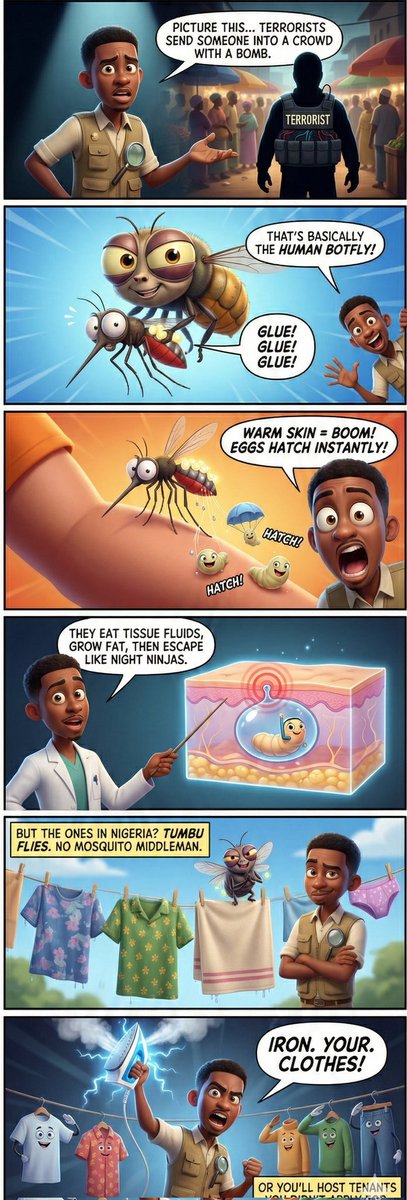
Picture this: Terrorists kidnaps someone, straps bomb onto the person and then sends the person to a crowded place where the "message" would be delivered. That's similar to how the human botfly operates.
The human botfly is the terrorist here. When it's ready to lay its eggs, the human botfly kidnaps a mosquito that's flying or resting and attaches few eggs onto the belly of the mosquito. She does this in mid-air by catching the mosquito, rapidly attaching the eggs with a quick-drying glue, and releasing it, all in a few seconds. The eggs are temperature-sensitive. They remain dormant on the mosquito and will not hatch unless the mosquito lands on a warm-blooded animal (human, dog, cow, monkey, etc.) to take a blood meal.
When the mosquito lands on a human and starts biting, the sudden rise in temperature (from the warm skin) triggers the botfly eggs to hatch almost instantly within seconds. The tiny larvae (maggots) drop from the mosquito onto the human's skin, crawl into the tiny puncture wound made by the mosquito's bite or burrow directly through intact skin using enzymatic secretions and hooked mouthparts. Once inside, it burrows into the subcutaneous layer and begins to grow.
The larva creates a small breathing hole (a tiny pore you can sometimes see) through which it sticks its breathing tubes. Over time, it grows from microscopic size to about 15–20 mm long, feeding on tissue fluids and the body's immune response. When mature, it wriggles out (often at night), drops to the ground, pupates in the soil, and emerges weeks later as an adult botfly.
HOWEVER...what I described above was just an example. What we have in Nigeria is not human botfly. It's their cousins, known as tumbu flies.
Tumbu flies don't use mosquito. They lay eggs on damp or sweaty clothing (especially underwear, baby diapers, T-shirts, towels or bedsheets) left hanging outside to dry. The eggs can survive up to 2–3 weeks on clothing waiting for a warm body. As soon as someone puts on the infested clothing or lies down on infested ground, the sudden warmth + slight pressure causes the eggs to hatch within seconds to minutes. The larvae penetrates into the skin immediately and the rest of the process is similar with that of botfly larvae.
Once their breathing hole is noticed, put anything viscous on it. It could be grease, palm oil or shea butter. This blocks their breathing holes and forces them to come out.
That's is why it's very good for you to iron your clothes, ladies and gentlemen
You people should come and see something o 😂
I boarded a bus from Maryland to Ojuelegba; my bus fare is 700. Conductor said I should give him 200 to collect 500 — cause I gave him 1K.
A woman next to me said I should give her the 200 since she’s alighting at Onikpan and her own bus fare is 300 and she paid him 500.
Now, when the conductor came into the bus (he went to ke-ro 😭) — I called his attention to the in-house transaction 😂
Na so baba tell me say make I collect my money o 😭 — say Onikpan na 500 👀
I told the woman to give me back my 200 first (say the money don even tear sef 😭) — na so she begin advise me o: “Don’t mind him o. Collect your money from him o! Don’t speak English for him o” 😂😂
Aunty, just give me back my 200, please 😭 — my strength will not carry to fight agbero 😭 IJGB innit
Last last, conductor later give me 300 Naira instead of 500 😂
Welcome to Lagos! 💛🖤