Young learners in England are facing a deepening crisis. Our Annual Report shows that disadvantaged five-year-olds are falling further behind their peers — for children with SEND, the learning gap has widened to over 20 months, the widest gap on record 🧵
https://t.co/v2P5kERnL7
New exploratory analysis examined behaviour policies from 45 state schools across three London boroughs.
We found that written policies vary in ways that align, to an extent, with outcomes linked to pupil wellbeing.
Read the full analysis: https://t.co/sb4H26PTjM
After 2 yrs’ work & thanks to generous support from @NuffieldFound , the Centre for Education Systems today launches a new library of international comparative research. It’s been carefully designed so that everyone can get what they need.
Take a look! https://t.co/skkYVuYf21
What does the reliance on private providers in early education and care mean for children in England?
In a new blog, Dr Tammy Campbell analyses the latest DfE statistics to ask if this shift is desirable for public spending and children's experiences: https://t.co/q4X5xDUBhU
"Efforts to tackle the disadvantage gap in education will only be successful within a wider effort to address the causes and effects of poverty."
Read EPI's response to the Government's Child Poverty Strategy: https://t.co/EfAiRly3pz
New from EPI & @SyncStoreUK: a summary paper on EdTech decision-making and inclusive practice drawing on roundtables with policymakers, education leaders, and MAT representatives offering insights on navigating the complex EdTech landscape.
Full paper: https://t.co/drkl3s4S3e
"Raiding mainstream funding creates a twofold risk: it undermines the capacity to deliver the very inclusion reforms the government wants while simultaneously compromising current provision."
EPI comment on the delicate balance of the Budget & school funding in today's @thetimes
What does the Budget mean for SEND funding and provision?
EPI's CEO Natalie Perera spoke to @BBCRadio4's The World Tonight about SEND reform and why expecting costs to be absorbed by existing school budgets is unrealistic.
🎧 Listen back (35:20): https://t.co/Rbu51M7Hwr
"While there is a clear and imminent need to address the rising costs of SEND provision, the Government must not cut school funding to meet these pressures."
Read EPI's response to the Budget 2025: https://t.co/M4KcGRhwlA
EPI is searching for our next CEO📣
Are you an experienced leader with a passion for education and social justice? Help us make the case for better outcomes ever more powerfully, to a wider audience and with greater impact.
Find out more: https://t.co/FA0hJCn43J
We are live with @CapitaPlc to discuss the critical financial realities schools face today, how leaders are responding to ever-tightening budgets, and exactly what support they need from policymakers to bridge the gap.
New EPI analysis, funded by @NuffieldFound, tracks student progress from school to the workplace. We found that GCSE attainment casts a long shadow, entrenching the earnings gap for disadvantaged pupils from the age of 16.
Read the full analysis: https://t.co/OvHDwyeQpr
Looking for your first start in think tanks? @EduPolicyInst are recruiting a Executive & Events Officer to join their comms, partnerships and events team! If you fancy broadening your skills, supporting policy events and having real impact - apply here:
https://t.co/dGX3YTuLir
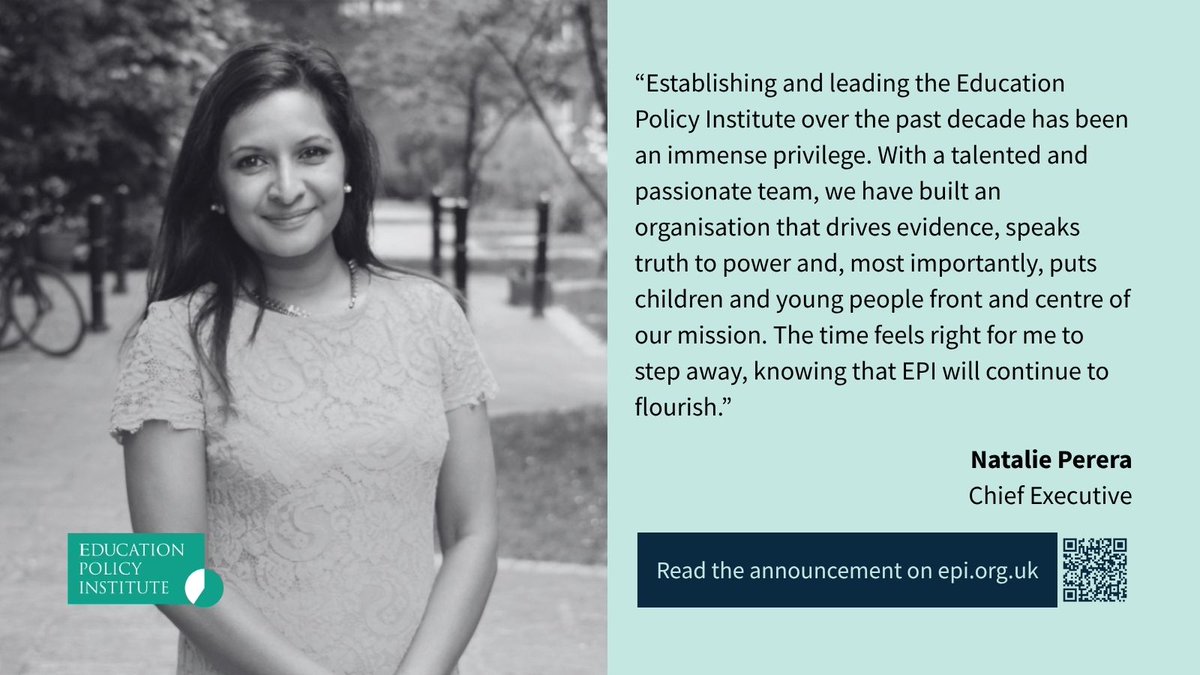
EPI's Chief Executive, Natalie Perera, will step down at the end of January after a decade at the helm. We are deeply grateful for her outstanding leadership and wish her the very best in her new role at @AQA
Read the announcement: https://t.co/M0Qw6oKKbR
'Underpinning the review, as with education policy broadly, is a lack of curiosity and ownership regarding SEND, and the children these policies affect. It has fallen short in two key areas', argues Jo Hutchinson
https://t.co/LmAcZ0AiW2
Coming up on Monday 24th November: don't forget to register for our free webinar with Caitlin Bell (@CapitaPlc), Luke Sibieta (@TheIFS), and EPI's Jon Andrews to discuss strained school finances and how policy can better respond to the diverse needs of schools.
How can we best support schools that are facing ever-tightening budgets?
Join EPI and @CapitaPlc on Monday 24th Nov to discuss the financial challenges schools face, how policy can better respond to their needs, and the role of tech.
More info: https://t.co/rluTRfLHcy
Great to see EPI's work on children missing from education recognised at the inaugural @SmartThinktanks awards. "300,000 children are missing entirely from education" was the "killer stat of the year".
Read our full report: https://t.co/vt9Ri8HRGc
"Our findings point to a maturing system that is delivering strong outcomes for those who access it, but remains uneven in who benefits."
Read EPI Senior Researcher Robbie Cruikshanks's breakdown of our new report on degree apprenticeships: https://t.co/eLEe3Hq5lg
To deliver on the potential of degree apprenticeships, we need to focus on widening participation & supporting employers in low-completion sectors. Targeted outreach & funding incentives could help more disadvantaged young people access these pathways.
https://t.co/Xg5kWoLWNs
EPI's latest report, "Degree Apprenticeships: An alternative to university?", funded by AL Elevation, finds that despite having high achievement rates and leading to competitive salaries, degree apprenticeships appear to be less inclusive than even Russell Group universities.
Exploratory analysis of the early labour market outcomes of degree apprentices appears positive. One year after completing their course, the average young degree apprentice earned around double the salary of the average graduate (£36,785 vs £18,555) in the latest available data.