Proud to announce I earned my brown belt in Jiu-Jitsu at 48 after 8 years.
I used to train 4x/week. With two little kids and multiple businesses, I’m now lucky to make it 2x - but I still train.
The lesson is that I decide who I want to be in 1, 5, or 10 years (in trading, business, or on the mats), then I do those things *today* - even if not perfectly.
This is just another season. To many more!
Have you tried reaching out to @helstech theyre reliable meta affiliates and were able to recover mine as apparently meta responds to their affiliates faster
@LyalinDotCom My daughter, almost 6, is wide awake and eager to start the day at 7:00 am. These days, there is no "quiet, calm" mornings in our home. But I wouldn't trade it!
I have no idea who at @Meta to contact about this.
My deceased mother’s acct recently re-posted a video. It appears someone has her credentials. She never posted, so it would be nice if the account could be deleted.
I reported the account as “hacked” but so far no help.
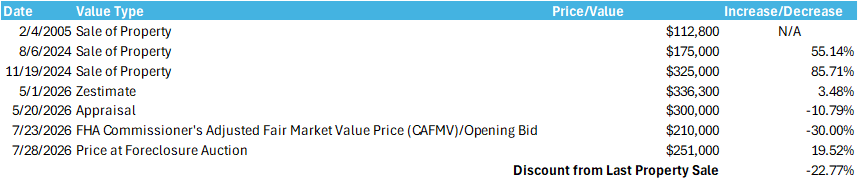
In my latest I review a recent client foreclosure sale
These agency haircuts are aggressive, and they don't give a crud about your zestimate
Foreclosure sales up 15.54% YoY and climbing
Impacts incoming
➕some thoughts on UW and Rocket
https://t.co/kuOKtz5UQw
While studying philosophy in college, Marx was assigned across multiple departments without any counterarguments. Even his core framework of capitalist exploitation went unchallenged, despite fundamentally depending on the discredited labor theory of value.
The intellectual case against Marxism was won more than a century ago. The most rigorous and devastating blows came from the Austrian School of economics – but the strange part is that hardly anyone is taught the winning arguments.
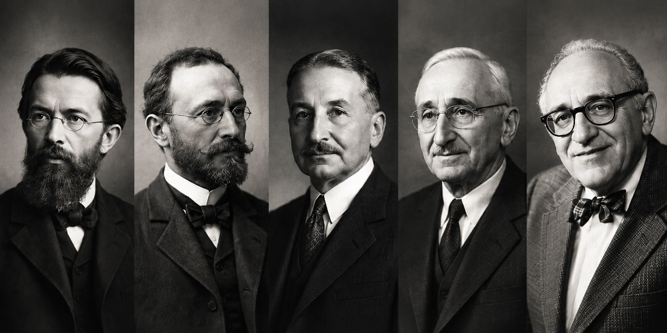
Carl Menger’s subjective theory of value, developed in the 1870s, undermined the labour theory of value on which Marx built his entire system. Eugen von Böhm-Bawerk then delivered a systematic demolition of Marx’s economics, exposing the contradictions in the theory of surplus value and the so-called transformation problem. Ludwig von Mises went further still, demonstrating that rational economic calculation is impossible under socialism because without private property and market prices there is no way to allocate resources efficiently. Friedrich Hayek later extended this into the knowledge problem: the information required to run a complex economy is dispersed and cannot be centralised. And Murray Rothbard showed how Marx misunderstood the nature of capitalism by replacing voluntary exchange and entrepreneurial creation with a false theory of exploitation based on labour value and class conflict.
These were not minor objections. They struck at the theoretical foundations of Marxism and, in the case of Mises and Hayek, correctly predicted the chronic waste, shortages, and eventual collapse of socialist economies. History confirmed their arguments on a civilisational scale.
Yet in universities, media and political debate, these critiques remain marginal. Marx is still widely taught as a serious economist and social theorist. His errors are softened, historicised, or treated as interesting starting points. The Austrian responses are rarely given equal weight. Students can pass through entire programmes in the social sciences without encountering Böhm-Bawerk’s critique or Mises’s calculation argument in any depth.
This neglect is not accidental. It reflects a deeper intellectual preference for theories that pathologise markets and legitimise expanded state power. The result is a public discourse that continues to recycle Marxist categories long after their economic foundations were shown to be unsound. The cost of that selective memory is still being paid.
Precious metals have experienced a change of character over the last few weeks and look to have put in a rounded bottom, gold on 6/30 and silver on 7/17.
I've took a starter position in silver with a cost basis around $59 and added a bit today with a retake of the 50-day. I'd like to see it hold $64.
If my thesis about rates plays out, metals will be a primary beneficiary.
I'm willing to cut and run if things turn back down.
Sometimes the side effects of a policy are hard to predict. This one isn’t.
The Free State of Florida welcomes you, high earners.
Socialism cannot tolerate freer jurisdictions. Producers leave. Successful counter-examples are fatal to the project. That’s why it must become total and inescapable - and why we fight it.
Washington passed a 9.9% tax on income above $1M.
Add 37% federal tax, plus 2.9% Medicaid tax, and the marginal tax rate is almost 50% for high earners in WA.
And with their 20% estate tax, many high earners will likely leave the state.
Wild.
I’ve been talking about this housing decline for a while now - it’s one reason why I sold my home in March and am renting.
Interesting to see the builders slashing prices.
This is really good news for home buyers and even better news for my thesis about Warsh cutting rates!
America's biggest home builders are slashing prices.
Lennar has reduced its average selling price from $511k to $377k, a nearly 25% decline (inclusive of incentives).
DR Horton has cut from $415k to $366k, a 12% decline.
Four years ago, this would have been hard to imagine.
From 2019-22, Lennar sold homes for more than $100k above DR Horton, with prices for both builders surging.
Today, after four years of price cuts, they're selling homes for nearly the same price.
That's a remarkable shift, and reflects both a weakening U.S. homebuilding market and Lennar's more aggressive push to gain market share through lower prices.
To see where prices are heading in your area, search your ZIP on Reventure: https://t.co/zlKe2138Ij
This is not a claim that inflation disappears overnight or that transitions are painless.
My claim is that the dominant force now emerging is powerful enough to change the @federalreserve's ability to start cutting rates.
Cutting rates is directionally bullish for stocks and risk assets. That is the case I made on Money Talks. The data and the examples are already visible.
I was on Money Talks with my friends Jon Arnold and @edgeofsteve last night (starting at 20:00).
On the show, I laid out my thesis for why the AI productivity boom is about to give @federalreserve chairman Warsh the cover he needs to lower interest rates - and why that may be the only thing standing between the US and a full-blown debt crisis.
Take a listen.
Thread
https://t.co/gHCyWgWBfQ
The sequence is straightforward:
AI lowers costs in "intermediate inputs" first (software, engineering hours, remote equipment, modeling). Those savings flow through to final goods and services.
The resulting rise in real supply is disinflationary cover, allowing cuts without inflation. This is what's needed to keep nominal rates from forcing a debt spiral.