@bond_dog_51 clearly it looks like google is manipulating its search results.
instead of showing the most relevant news pertaining to a difficult subject, it's showing more stale news.
Duck Duck Go is showing the latest news pertaining to that failed Treasury bond auction.
@Umee_CrossChain @bond_dog_51 I think they changes you guys are doing are a big risk but I like the direction in which you guys are taking it. Is the @Umee_CrossChain going to slowly change to the UX Chain?
@stacy_muur@MessariCrypto@twobitidiot@ethereum Honestly Lido's dominance does scare me a little bit. Could led to centralization of the Ethereum network. If Lido controls too much of the staked ETH, it could have a significant influence on the networks goverance and security...
@stacy_muur@Landshareio Great thread.
Tokenizing RWAs opens up new investment opportunities for a wider range of people, especially those who may not have been able to participate in these markets before.
The Dawn of Real-World Asset Tokenization
In a short span, the sector focusing on RWA tokenization has jumped from 22nd to 8th place among DeFi sectors, amassing a combined TVL of $2.385 billion.
What's next? And what opportunities are already open?
Let's explore ↓
As DeFi technologies continue to revolutionize the financial landscape, the potential for scaling this innovation is immense.
However, tapping into that potential requires bridging the gap between TradFi and DeFi.
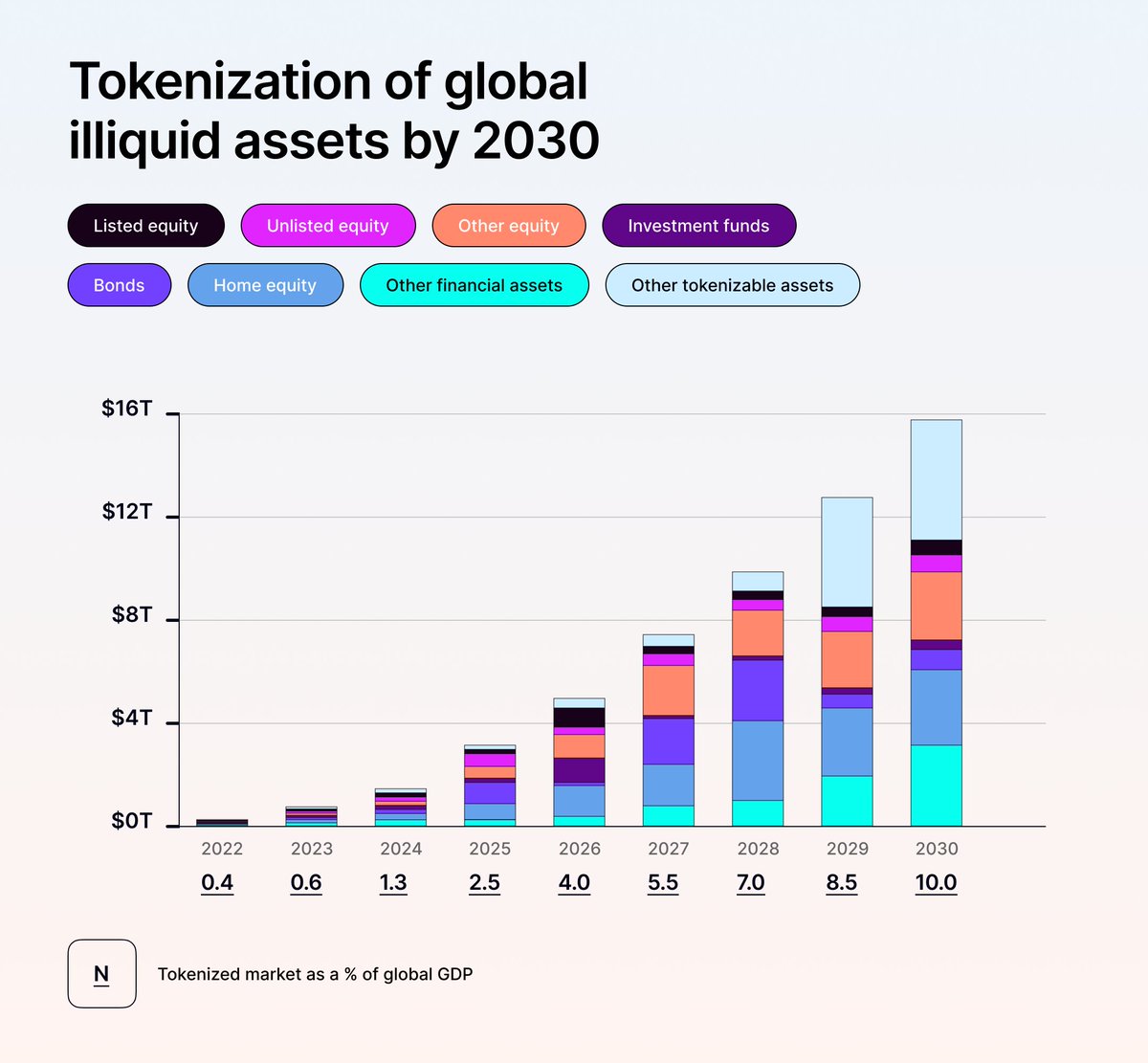
• At the moment, only 0.06% of the world's population currently engages with DeFi, underscoring the market's enormous growth potential.
• To truly scale, the DeFi sector needs to break into the $16.1 trillion market of traditional assets—a 50,000% growth opportunity!
In this realm, RWA tokenization stands out as a bridge between DeFi and TradFi. Why?
• Tokenization democratizes access to various asset classes, from bonds and commodities to real estate.
• Tokenized assets can be fractionally owned, providing more people with investment opportunities they couldn't access before.
Citi Bank and industry leaders, including @el33th4xor and @jerallaire, are already advocating for tokenization as the future.
Even companies in the S&P 500, such as BlackRock, Google, and Visa, view tokenization as a transformative force.
Tokenization in Real Estate
Real estate, a traditionally illiquid and high-barrier asset, stands to benefit immensely from tokenization.
With tokenization, investors can own a piece of real estate for as low as $50, bypassing the complications of REITs.
There's a fascinating protocol aiming to capture a share of the real estate tokenization market: @Landshareio.
They are pioneering the first-ever Security Token Offering (#STO) on BNBChain by tokenizing a property located in Missouri, US. You can actually enter the real estate market with a modest investment of just $50.
Today, #Landshare launched an awesome community initiative where you can dive into the realm of tokenized RWAs and earn rewards from a total prize pool of 35,000 $LAND tokens.
You can join the quest here → https://t.co/IxHA0ls480
@Phildeez7@Umee_CrossChain Would be cool, but i dont think they will. Umee is a permissionless lending protocol. You can do all the borrowing and lending without a central authority. Anyone can liquidate undercollateralized loans, just gotta pay the fee.
There are some great liquidation bots though.
Traditional payment processors are often the most frustrating group to work with in payments. This is because of high fees, have complex pricing structures, and make it difficult for merchants to get support. A fintech project that is taking a unique approach is @Umee_CrossChain being transparent and customer-friendly alternative to traditional payment processors.
The liquidation process is expected to take several months, and it is unclear how much money investors will recover.
Therefore, it is important that investors carefully monitor the situation in order to make informed decisions.
The liquidation of FTX's holdings have a mixed impact on the market.
On one hand, it could lead to lower prices for tokens, making them more affordable to buy.
On the other hand, the liquidation could also lead to increased volatility in the market, making it riskier to invest.