t-0 requires payment providers on the network to quote transparent rates against publicly available benchmarks, giving institutions a reliable source of FX pricing in markets where rates are hard to verify.
Does a compliance delay mean I'm stuck with a bad rate?
Imagine a $10,000 payout, sent via RTP, priced at five basis points, with no additional transaction fee on the route.
The rate for it locks the moment the payment is submitted.
If it gets held for an AML check and the market moves while it's paused, the limit on how far it can move was already set by you.
Why do so few settlement providers talk about collections?
A payout just needs a local bank willing to receive and disburse funds.
A collection needs that bank to release funds out of the country, and in some countries like Vietnam or Nigeria, that requires extra steps and approvals.
On t-0, collections work the same way as payouts, from the start.
In some African markets, what today's FX rate is depends on who you're asking.
T-0 requires its payment providers to price against public reference rates instead.
Access Better FX with t-0 Network
t-0 Network runs in both directions.
A licensed fintech in Vietnam joins the same network as a bank in the US, and both settle with each other directly.
Get access to every other licensed institution already on the network, across corridors worldwide.
t-0 already connects licensed institutions across more than 1,000 corridors, with USDT liquidity deep enough to make a Kenyan or Brazilian settlement as easy as a UK one.
Access the Network, reach out to our team.
Converting into USDT and back out, for every payment?
There's a better way: t-0 nets your balances against every counterparty on the network and settles once, on your cadence. Most payments never touch FX at all.
If you're looking to cut settlement costs in emerging markets, this is the infrastructure built for it.
Book a call with our team.
Naira, shillings, cedis, kwacha and rand all trade in markets that are shallower and more fragmented than the dollar or the euro.
To guarantee they can clear transactions in these currencies at all, banks hold capital in pre-funded correspondent accounts, tied up and earning nothing.
t-0 lets institutions net that exposure instead of pre-funding it. They transact against each other up to agreed limits and clear only the net balance on their own cadence.
Rates are quoted live, book a call to price up your African corridors.
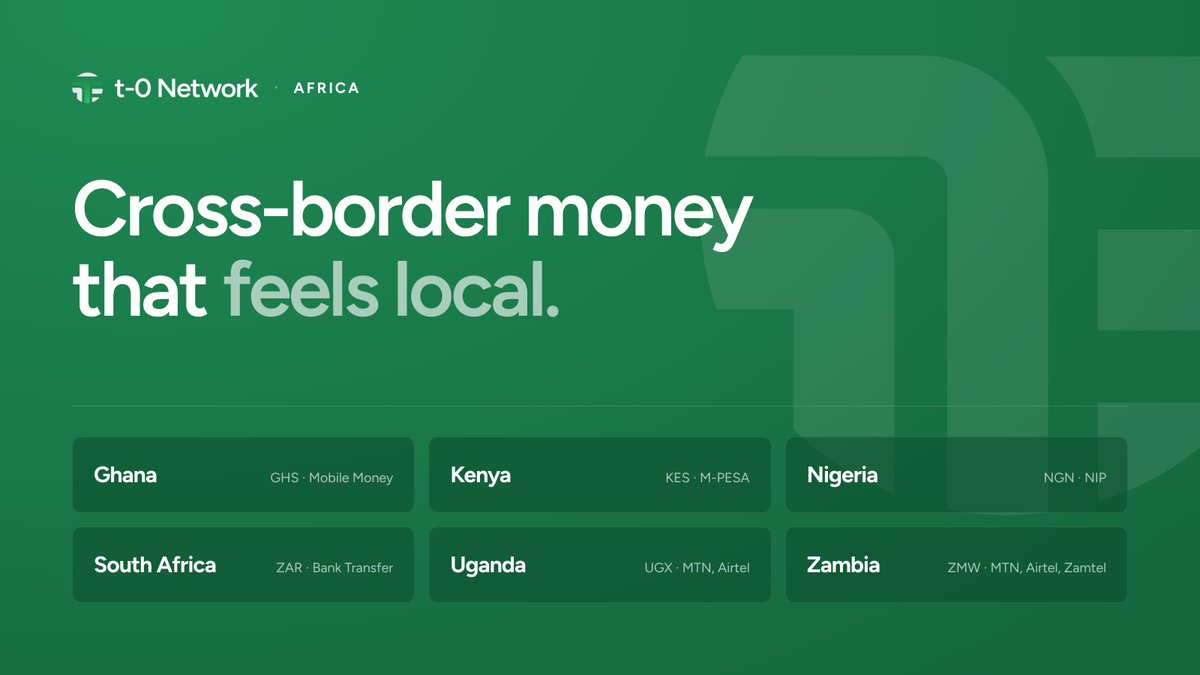
Six markets across Africa, each with full collection and pay-out.
Every payout and collection lands through the rails people already use:
- M-PESA in Kenya
- NIP in Nigeria
- Bank Transfer in South Africa
- Mobile Money in Ghana, Uganda and Zambia
Nothing new for the end customer to download or learn.
t-0 allows you to settle the difference between institutions in USDT.
t-0 Network makes cross‑border money movement feel local.
The customer sending money still sees pesos, reais, or soles land in a familiar account. What changes is what happens behind that transaction, and how much of it survives the trip.
t-0 is live in Argentina, Brazil, Chile, Colombia, Mexico, and Peru. Reach out to see live rates for your corridor.
Connect to six markets in Latin America, with full collection and pay-out in each.
Every payout lands in the local currency, through the rail locals already use, without a new wallet, or anything the end customer has to learn.
t-0 settles the difference between institutions in USDT.
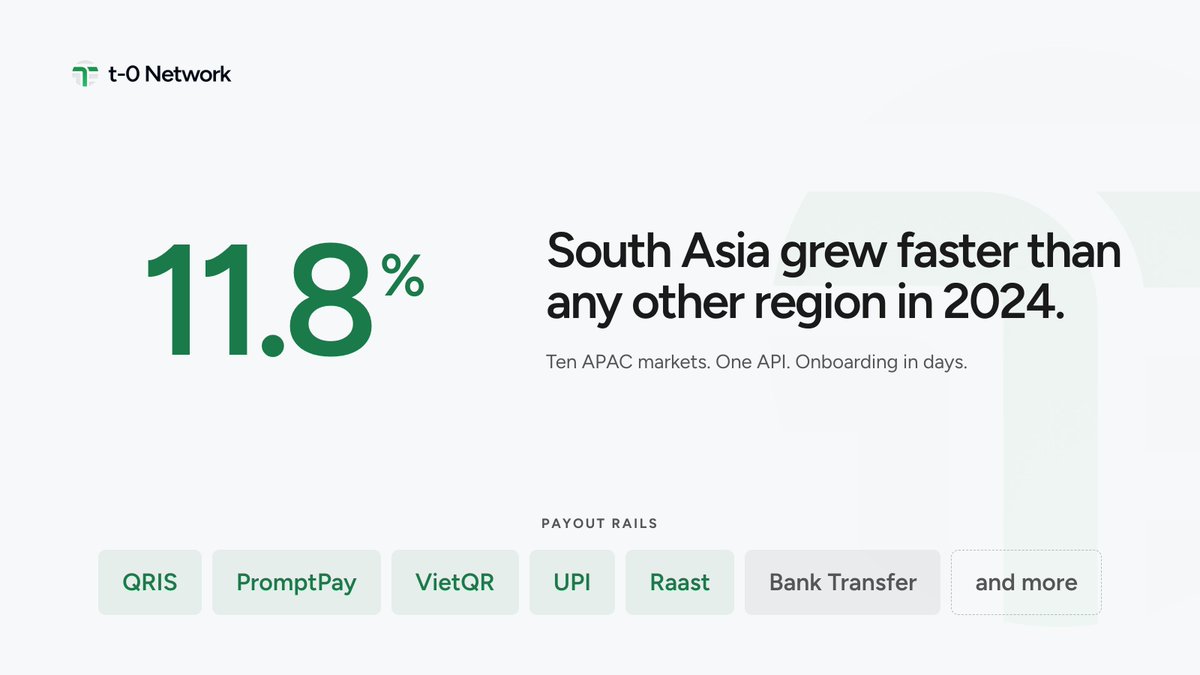
South Asia registered the highest remittance growth of any region in 2024, at 11.8 percent, driven by flows to India, Pakistan, and Bangladesh.
The flows are growing, but the infrastructure handling them, in most cases, is not keeping up.
If your institution has APAC flow running through correspondent chains, it is costing you in margin and settlement time on every transaction.
t-0 settles in USDT between licensed institutions and pays out via QRIS, PromptPay, VietQR, UPI, and Raast.
Ten markets, one API, onboarding in days.
Come with one corridor and a cost. We'll show you what it looks like on our end.
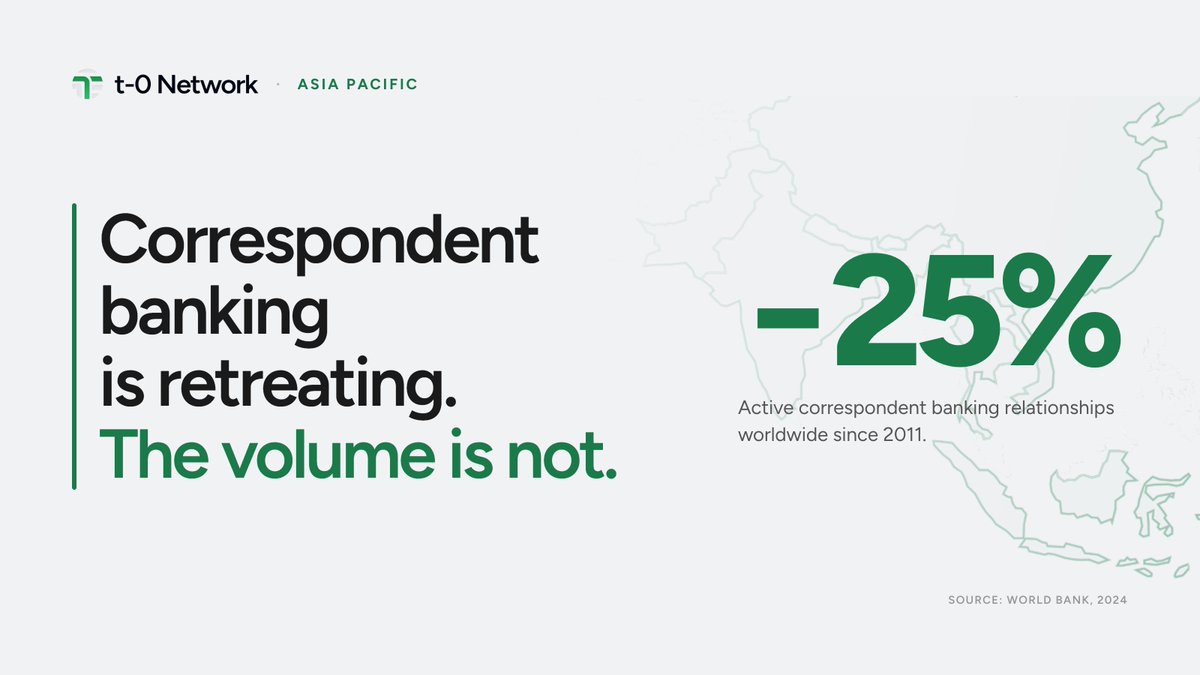
The number of active correspondent banking relationships globally has declined by 25% since 2011.
Banks are exiting not because the flows are decreasing, but because the cost of staying exceeds what the relationship returns.
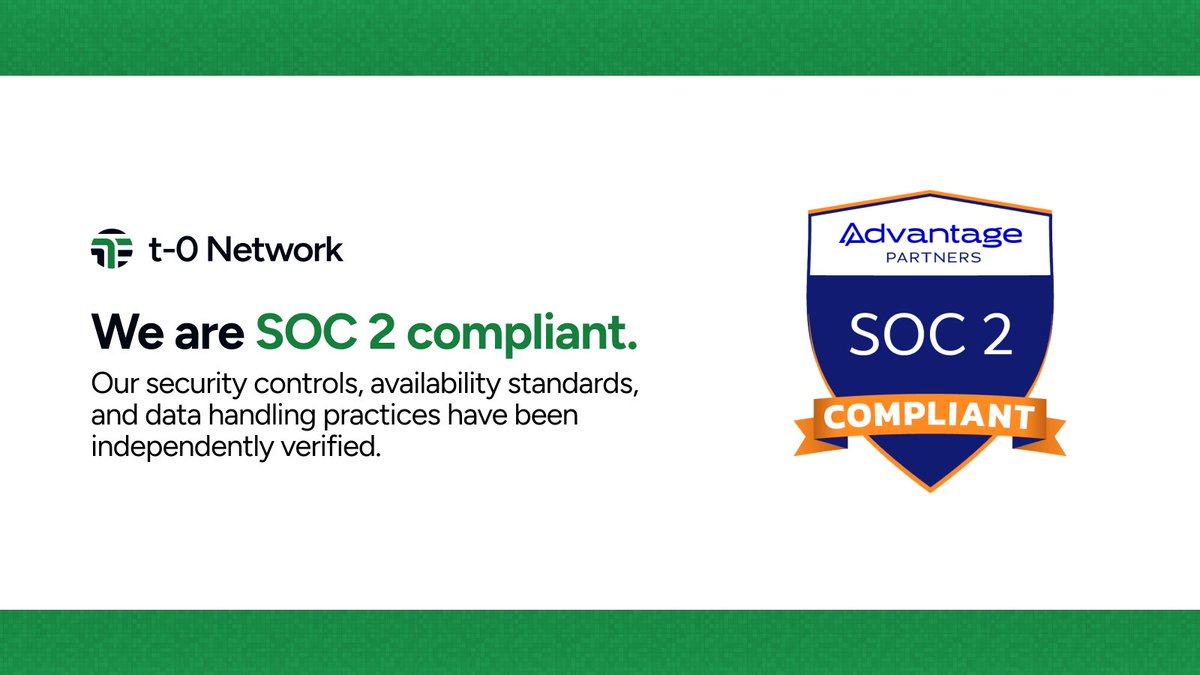
t-0 Network is now SOC 2 compliant.
This milestone reflects our commitment to meeting the security standards that licensed financial institutions require from their partners.
We partnered with Advantage Partners & Vanta to seamlessly guide us through the compliance process.
Juniper Research projects cross-border B2B stablecoin payments will reach $5 trillion by 2035.
That's a 373x increase from today.
Stablecoins are becoming institutional payment rails. Correspondent banking is the architecture being displaced.
t-0 was built for this.