🔥 chefs are already cooking on top of frame transactions (eip-8141), a native AA proposal for the hegota upgrade
trouble keeping up? forkcast now displays dependent eips (including those not yet merged):
EPF7 applications are open. Deadline is May 13.
If you want to work on core Ethereum protocol — client development, testing, specs, research — this is the program for you.
This is where issuance enters the conversation🙈
... which reduces the incentive to spin up new validators
February summary: https://t.co/8fQiJxVzlM
On-chain data: https://t.co/oXh39V6KAe
8/8
Thread on #Ethereum validator consolidation progress 🧵
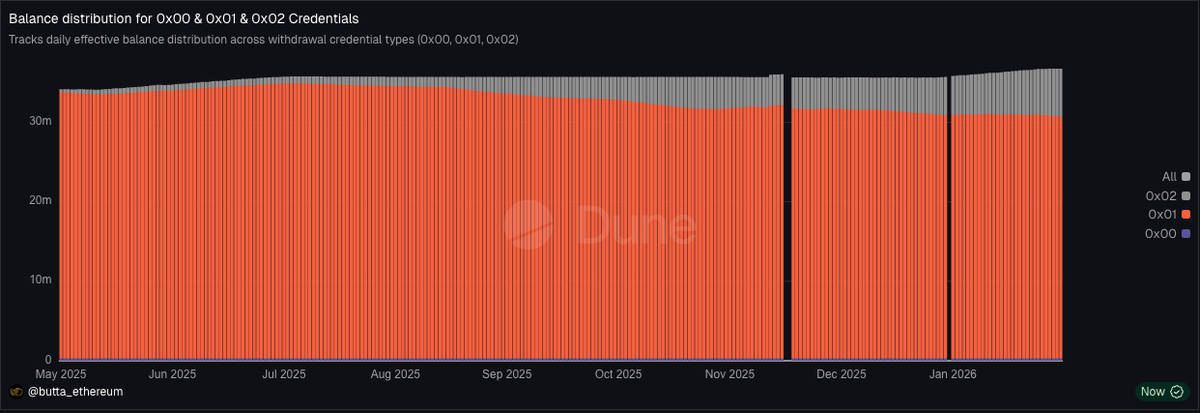
Only 0.86% of validators have 0x02 credentials, but they hold ~16% of all staked ETH.
Why?
Average 0x02 balance is ~700 ETH vs 32 ETH for standard validators.
(1/8)
Ethereum's validator set was still growing. 🖼️
Today: a different picture. 🖼️
Here's where consolidation toward the 128k target stands, what changed, who's moving, and why issuance keeps coming up. 🧵
Thanks @nixorokish for reviewing 🥰
1/8
So where does this leave us?
Consolidation works but it just can't close the gap alone.
A new validator launched at 32 ETH grows the validator set whether it has 0x02 credentials or not.
That means the big operators have to consolidate: @LidoFinance , @coinbase , @binance , @ether_fi, @krakenfx.
Together they're ~50% of network stake.
7/8
Year-end 2026 projection, base case:
- 0x02 stake share: 45% to 52%
- Validator count: ~500k to ~620k
- Target: 128k
Even if every tracked commitment executes, 128k is unlikely in 2026.
Year-end gap: +370k to +490k validators above target.
6/8
Blockers have shifted from technical to structural:
- Reward gap during consolidations (~1d 3h)
- Bear-market conditions reduce urgency for marginal gains
- Non-custodial stake is hardest to move because end users decide
Knowledge gaps closed. Execution is the bottleneck.
5/8
the @EFprotocol team published an EIP Champion's Handbook today:
Getting a feature into the protocol through a decentralized governance process can be fucking hard. These resources aim to help EIP champions give their features the best shot at getting included
INCLUDING - how to go about getting feedback from the rest of the ecosystem and make sure that the feature will get adoption
@llamaonthebrink We have a whole program with 5 courses from beginner to advanced. All open and contributions welcomed!
https://t.co/puCgmzWfq3
https://t.co/xUmFWLGXw9
Due to EIP-8141 (native AA), I've been deeply engaging with the ACD process, and there's some truth to what Dankrad is saying in that it feels like the people with decision making powers -- the client devs -- are somewhat detached from real-world usage of Ethereum.
However, I found that it's not that those people don't care -- it's just that their day-to-day job as client devs simply don't provide them with the opportunities to interact with application-layer builders and end users as much as, say, someone like me whose job is to build and sell commercial solutions do.
So how do we bridge the gap between 1) Ethereum's major decisions are made by client devs, and 2) client devs don't get to learn much from application builders and users? That's the key question the EF has to solve.
On the other hand, I also feel that application-layer builders need to take matters into their own hands more. You can criticize the ACD process all your want, but it IS open. All the meetings are announced in advance (https://t.co/Dc06GKoFVB), free for all to join, and recorded for all to watch. When you do engage with the process, like I've been for the past month for native AA, you find that the client devs DO LISTEN. They are not crazy people with evil agendas -- they just don't know what they don't know, just like the rest of us.
So yes, EF should keep improving the process, but before you complain about Ethereum heading in the wrong direction, ask yourself if you have ever TRIED to engage. Ethereum is for all of us and we all share responsibilities for making it better.
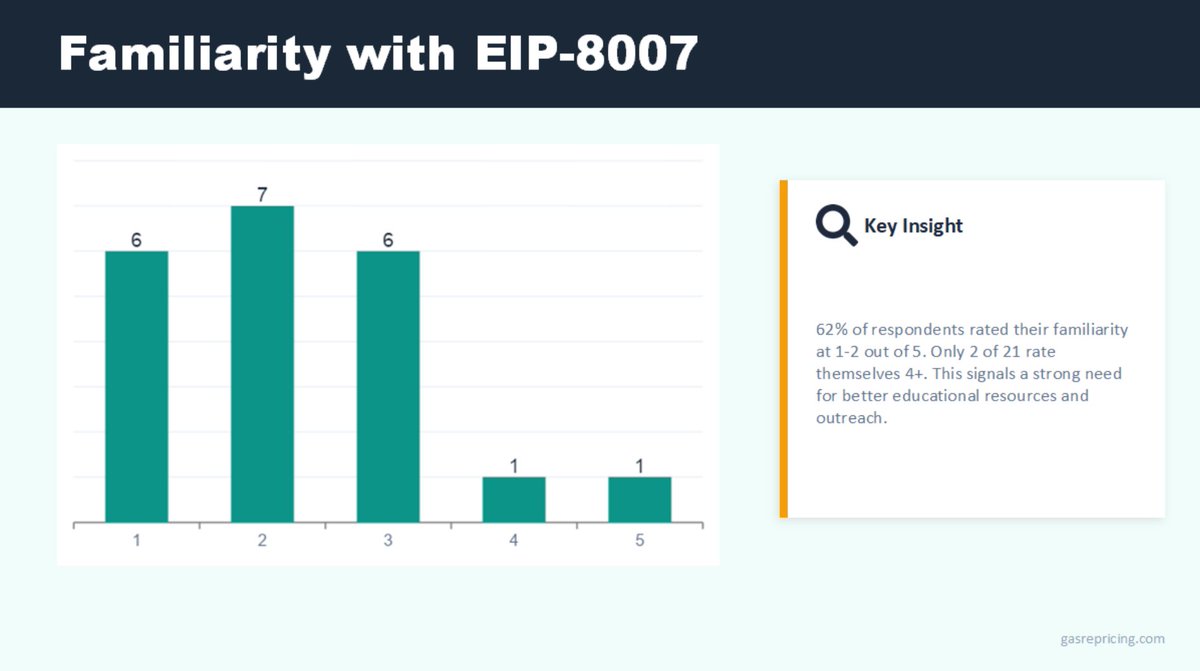
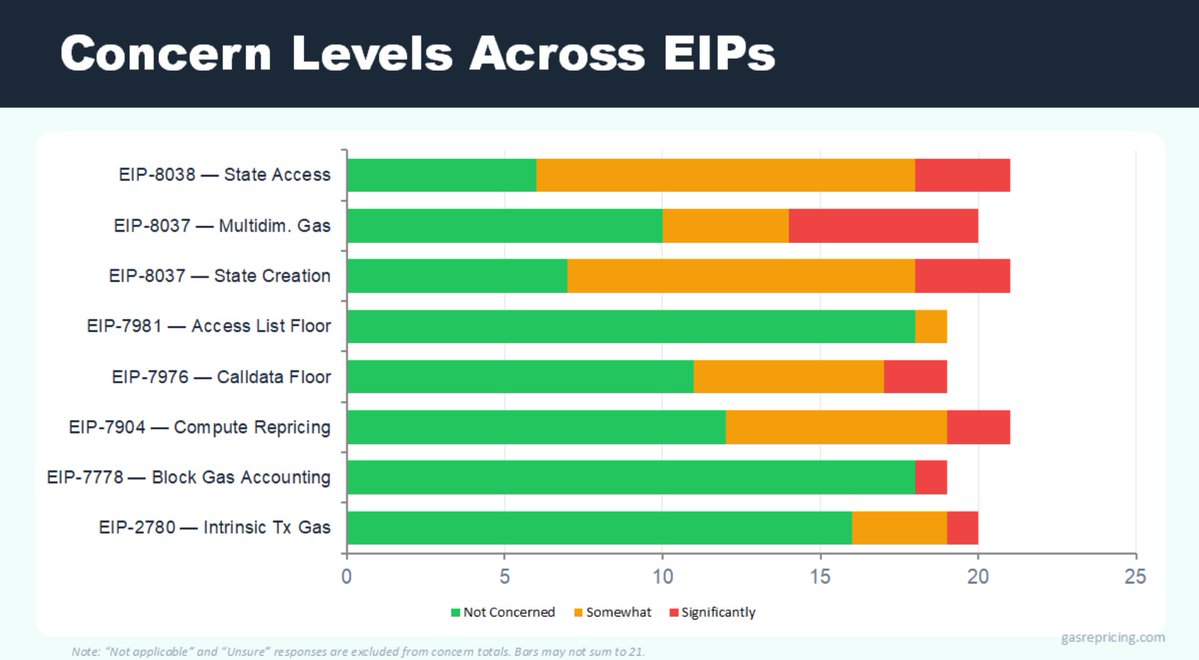
1/ We surveyed 21 stakeholders across 16 major DeFi & protocol teams on Ethereum's gas repricing meta EIP-8007
Here's what builders actually think about each proposal👇
8/ Takeaways
→ Complexity over cost: builders fear the unknown optimization surface more than higher fees
→ Tooling gaps: Asks for devnet testing and framework integration
→ Tx gas limit pressure: the limit isn't rising alongside these changes
→ Aggregate interaction risk: ship separately to reduce risk surface