@CutMyTaxUK@TheBluetrot Of course the ones leaving Scotland are the ones more likely to be anti-Indy so are the SNP impoverishing their way to independence …
CANZUK can build a shared peaceful nuclear supply chain: Canada and Australia expand uranium production and fuel collaboration, the UK supplies enrichment via Urenco plus Rolls-Royce SMR tech, and Canada advances its new enrichment policy framework alongside CANDU and SMR experience. Align regulations to cut red tape, run joint workforce training and mobility schemes, share Indigenous engagement models, and pool private capital for builds and R&D. Preferential trade in materials and technology would speed deployment and strengthen energy security across all four.
1. After thousands of migrants crossed into Ceuta from Morocco this week, Italy threatened to “suspend Schengen with Spain.”
It just can’t.
Under EU law, no Member State can unilaterally suspend another’s participation in Schengen.
🦔AI companies are bulk-buying rare books, scanning them through high-speed machines that cut the spines off, and shredding the originals. A service called ISBNdb facilitates orders of up to a million books and keeps buyers anonymous. Pre-2022 books are premium because they're free of AI-generated text. A federal judge ruled the practice is fair use because eliminating the original means only one copy exists at a time. Anthropic hired the former head of Google Books partnerships to obtain "all the books in the world."
My Take
This got to me. A bookseller told 404 Media that rare books with almost no surviving copies are being fed into this pipeline. Books that survived wars, fires, and centuries of handling are being shredded so an AI can learn to write a better marketing email.
ISBNdb's website literally says "'AI company destroys two million books' is not a headline that generates sympathy," and they still built an entire business around making it happen quietly. They offer NDAs as a feature. They coach clients to call it "digital preservation."
I've covered AI companies scraping the internet, torrenting libraries, and stealing music. This is worse because it's irreversible. You can re-upload a website. You can reprint a bestseller. You can't replace the last three copies of an 18th-century botanical text once someone shreds them for training data. And the judge said it's legal. So it's going to accelerate.
"We shred rare books and offer NDAs so nobody finds out" is a legitimate business model in 2026. What a timeline.
Hedgie🤗
Quite right. A Swiss-type solution is the best compromise of all
Gibraltar should show Burnham a softer Brexit is the only option https://t.co/aXX1xHLHBo via @ft
Gute Verträge verbinden, ohne ein Land an fremde Regeln zu binden. Das neue Abkommen mit Grossbritannien stärkt den Handel und respektiert zugleich die demokratische Eigenständigkeit der Schweiz.
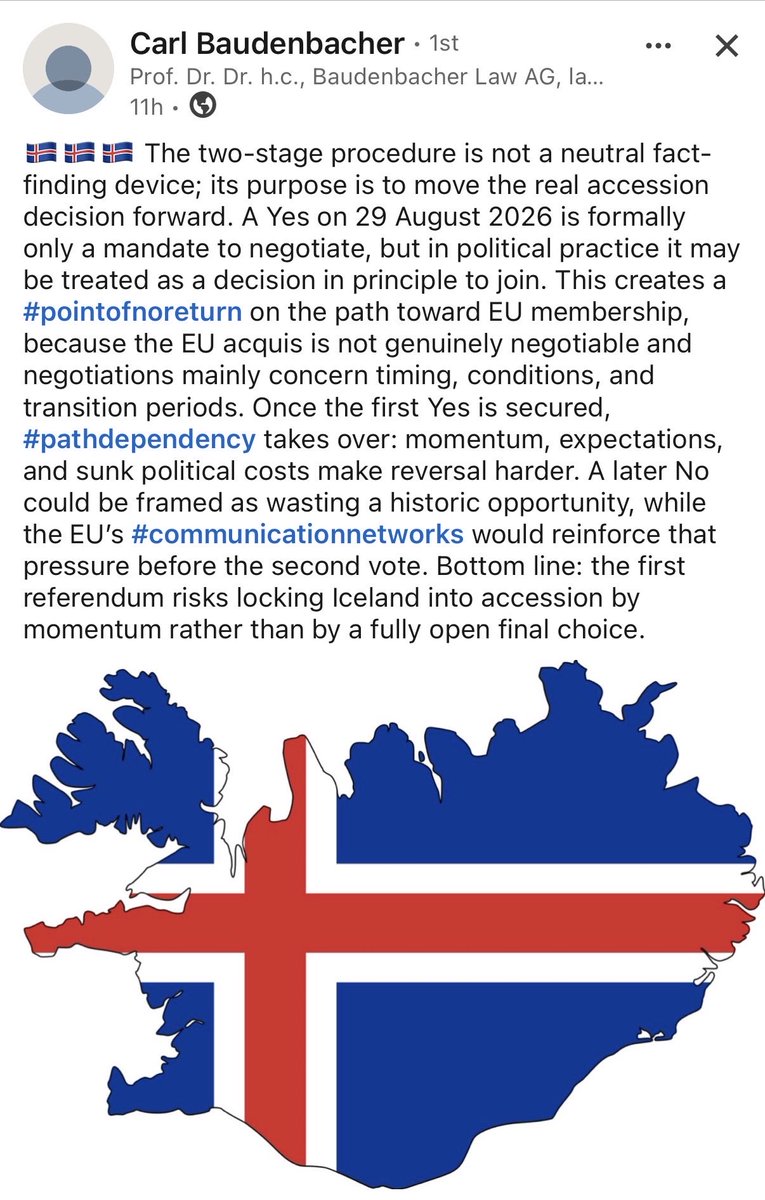
Björn Bjarnason fjallar hér, með réttu, um það hve vanbúin þjóðaratkvæðagreiðslan um framhald aðildarviðræðna við ESB er. Já-sinnar vita ekkert hvað þeir eru að kjósa um. Þau halda að það verði einhver samningur í boði, annar en gildandi regluverk sambandsins sem er á heimasíðu ESB og enginn af þeim hefur gert hina minnstu tilraun til að finna, opna eða lesa
https://t.co/CDrT2uwhmy
'Sources close to the creditors have told the BBC that in the event of full nationalisation, they would pursue payment in full of the outstanding debts as has happened in previous cases, which could leave the government with a multi-billion-pound bill.'
If Thames Water is nationalised through an act of Parliament which specifies the compensation regime in the legislation, then under parliamentary sovereignty, that compensation regime *is* legal. Parliament could legislate to pay them a pound if it wanted to.
It seems to me that the only serious legal challenge against such an act of Parliament would be under the European Convention on Human Rights.
This is what happened when the Callaghan government nationalised shipbuilding. The owners went to Strasbourg to claim the Labour government had not paid them enough for their companies.
And it is precisely what the Attlee government feared about signing the ECHR in the first place, and why they only did so with the right to private property taken out (it was then put back in by Churchill after Labour lost the 1951 election).
https://t.co/IC6iEwXxQz