New PFP unlocked: Pitfall 🫡
Really like the style on this one.
If you're holding a Pitfall, don't forget you get 3 free tickets from Sol Raffle too.
@raffledotsol
Payments are broken for most global entrepreneur and merchant outside of US.
What if you can start selling by just copy and pasting a prompt?
With PingBusiness, you can collect payments globally without a USD bank account and not worry about tax & compliance.
money is entering Arbitrum faster. Base is holding it better
let's look at bridge traffic (7 days):
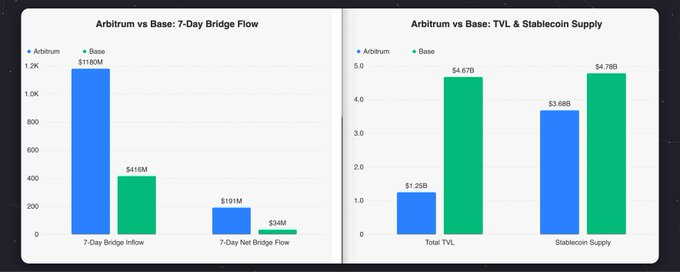
‣ 7d Bridge Inflow ➛ Arbitrum: $1.18B — Base: $415.63M
‣ 7d Bridge Outflow ➛ Arbitrum: $989.52M — Base: $381.63M
‣ 7d Net Flow ➛ Arbitrum: $190.92M — Base: $34M
‣ Net Flow / TVL ➛ Arbitrum: 15.3% — Base: 0.7%
Arbitrum is pulling in 2.8x more bridge inflow than Base. net capital inflow is 5.6x higher. relative to its own size, the money entering Arbitrum is far more meaningful
➛ but when you look at existing accumulation the picture flips:
‣ Total TVL ➛ Arbitrum: $1.41B — Base: $4.67B
‣ USD Stablecoin Supply ➛ Arbitrum: $4.78B — Base: $3.68B
‣ 7d TVL Growth ➛ Arbitrum: +6.76% — Base: +2.02%
Base has 3.7x Arbitrum's TVL. it's taking in less new capital but managing to hold what it has — and growing at 6.76% weekly versus Arbitrum's 2.02%
➛ so what does this mean?
two different L2 growth strategies:
➛ Arbitrum's model: high turnover
‣ major institutional inflow wave with the Robinhood Chain launch (late June)
‣ DRIP incentive program ($40M) pumping active DeFi activity
‣ $1.18B bridge inflow in 7 days capital comes in, trades, but some leaves
‣ stablecoin supply below Base ($3.68B vs $4.78B) circulating capital is more "temporary"
➛ Base's model: low turnover, high accumulation
‣ users accustomed to staying on Base directly through Coinbase's distribution advantage
‣ 96% of x402 payments run on Base
‣ less bridge traffic ➛ capital arrives with less "exit" intent
‣ $4.78B stablecoin ➛ capital on Base is more in "hold and use" mode
the difference between "enters fast" and "holds well" determines the next move
Arbitrum's challenge: retaining incoming capital.
$1.18B inflow ➛ $989.52M outflow ➛ 16.2% retention.
of every $100 that comes in, $84 leaves
Base's challenge: attracting new capital.
growing existing $4.67B TVL with just $415M inflow requires higher volume bridge activity
➛ which of these two strategies is more sustainable?
the answer depends on which phase you're in:
growth phase (Arbitrum): high incentives + high inflow ➛ capturing market share
maturation phase (Base): low incentives + high retention ➛ efficiently deploying accumulated capital
there may be no winner in DeFi's L2 war.
but there are two different growth dynamics and knowing which phase each chain is in matters more than deciding where to put your capital
Is the AI stock sector done correcting, or is there more pain coming?
Honest answer: I don't know if it's done. Nobody does. If I could call the bottom on this, I wouldn't be writing posts, I'd be sitting on a trillion dollars.
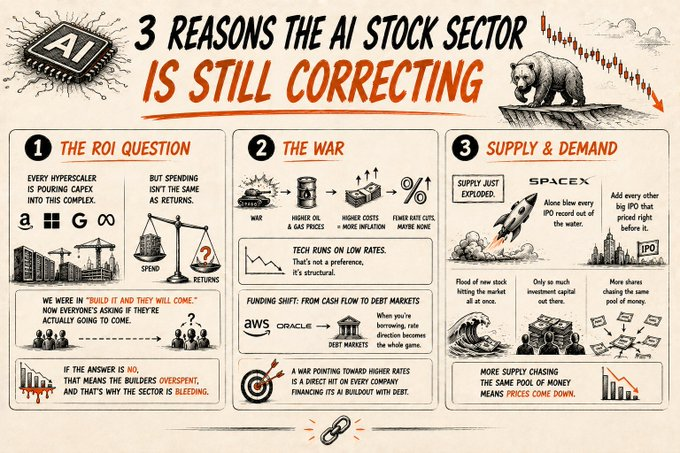
What I do know is why it's correcting. Three reasons, and none of them are going away overnight.
First, the ROI question.
Every hyperscaler is pouring capex into this complex. Chips, GPUs, data centers, electrical power, the whole stack. Memory companies, semiconductors, equipment manufacturers, energy, all of it juiced up by the same spending wave.
But spending isn't the same as returns. The real question the market is asking right now is simple. Are companies actually making more money from all this compute, or are they just paying for it?
We were in a build it and they will come phase. Now everyone's asking if they're actually going to come. If the answer is no, that means the builders overspent, and that's exactly why the sector is bleeding right now.
Second, the war.
War means higher oil and gas prices. Higher gas prices mean higher costs everywhere. That means more inflation, and more inflation means fewer rate cuts, maybe none.
Tech runs on low rates. That's not a preference, it's structural. Look at who's funding this AI buildout now. Amazon, Oracle, companies like that are going to the debt markets instead of funding capex out of free cash flow. That's a real shift.
When you're borrowing instead of self-funding, rate direction stops being background noise and becomes the whole game. A war pointing toward higher rates is a direct hit on every company financing its AI buildout with debt.
Third, supply and demand.
The stock market is still just a market. Supply and demand. And supply just exploded.
SpaceX alone blew every IPO record out of the water. Add every other big IPO that priced right before it, and you've got a flood of new stock hitting the market at once.
There's only so much investment capital out there. Nobody's creating new demand to match the new supply. More shares chasing the same pool of money means one thing: prices come down, even without anything changing on the demand side.
So that's the setup. An ROI question nobody's answered yet, a war pushing rates in the wrong direction for anyone leveraging up, and a supply glut from the biggest IPO wave in years. None of these resolve fast, and none of them are really about AI itself. They're about the money underneath it.
Banks entering crypto infrastructure is a bigger story than most people realize.
Sberbank's move into crypto services isn't about hype—it's about recognizing long-term demand from institutions and businesses.
For DeFi, this raises an interesting question:
Will traditional banks compete with decentralized finance, or eventually integrate with it?
Personally, I think we'll see a hybrid future where both coexist.
The best cinematic universes are designed for rewatches.
Not because the action is exciting...
But because every rewatch reveals something new.
A foreshadowing line.
A hidden symbol.
A cameo you completely missed.
That's what separates good storytelling from great storytelling.
Movies become much more rewarding when every scene has a purpose.
Which film gave you the biggest "How did I miss that?" moment?
Blockchain could quietly solve one of the biggest problems in live music: ticket fraud.
Fake tickets, bots, and scalpers have frustrated concert fans for years.
Blockchain-based ticketing won't eliminate every issue, but it can make ownership more transparent and reduce counterfeit sales.
The technology itself isn't the exciting part.
The better fan experience is.
I'd happily use blockchain tickets if it meant fewer scams and fairer access.
Would you?
A great album isn't just a collection of good songs.
It tells a story.
The intro sets the mood.
The transitions feel intentional.
The closing track leaves you with something to remember.
Crypto doesn't just change finance—it could reshape how artists connect with fans.
One trend I'm watching closely is the rise of tokenized fan communities. Instead of relying solely on streaming platforms, artists are experimenting with memberships, exclusive content