👋 I'm Eighteen — product ops by day, AI tinkerer by night.
🧠 I write about LLMs, AI agents, and how to turn them into real workflows & monetization — not hype decks.
我是 Eighteen。白天做产品运营,业余折腾 AI。 这里主要写大模型、Agent,以及怎么把它们变成能落地的流程和变现,不写空话。
📌 What you'll see here:
✨ sharp takes after I read something worth arguing with
🛠️ practical agent / workflow notes
📈 later: digital systems & digital economy
你会看到:
跟读后的观点(有同意,也有不同意)
可复用的 Agent / 工作流笔记
后续会聊数字系统与数字经济
🌱 Not a guru. Still figuring it out in public. 不是导师号,只是公开把这件事想清楚、做明白。
🚀 If that's your lane, follow along — let's talk. 合拍就关注,我们慢慢把这事聊透。
This three-layer split is the missing ops diagram for agent products.
LLM does open-ended work. A decision layer handles routing / risk / “are we done?”. Deterministic code keeps the hard constraints: file perms, spend caps, tool allowlists.
If every micro-decision still burns a full LLM call, unit cost explodes. Separate “work” from “decide,” and keep enforcement in code — that’s how agents stay both useful and billable.
这三层拆分,才是 Agent 产品该有的运营图。
LLM 做开放式工作;决策层管路由 / 风险 /「做完没」;确定性代码握住硬约束:文件权限、花费上限、工具白名单。
如果每个微决策都还在烧一整次 LLM,单位成本会爆。把「做事」和「做决定」分开,执行权留在代码里——Agent 才能既好用,又能算得过账。
@zcode_ai For builders, “open” only counts when defaults are safe and uploads are auditable. That’s the same lens as model routing: trust and unit risk before the logo.
@zRdianjiao For builders, “open” only counts when defaults are safe and uploads are auditable. That’s the same lens as model routing: trust and unit risk before the logo.
Same agent job. Wildly different bills. 💸
September’s model drops are loud. The money question is quieter: who do you pay to think — and who do you pay to grind?
Rough map (order-of-magnitude — verify official pricing before you bet):
🧠 GPT-6 Astra — flagship brain · $$$
Critical judgment & high-stakes decisions. Use it as the CEO, not as full-time labor.
⚙️ Gemini 3.8 Flash — production workflow · $$
High-frequency agent steps inside a real product. The value seat on the assembly line.
🛠️ DeepSeek V4.1-Flash — cheap agent labor · $
Automation, terminal work, multi-step trials & scale.
In some reported setups, output cost lands an order of magnitude under flagship.
My take: winners route models. Losers pick teams.
When you still need expensive: compliance, security-sensitive work, brand-required clients, and decisions where one wrong move is costly.
This week’s experiment: pick one real workflow → run flagship → run Flash/low-cost → log cost + success rate.
What % of your calls are still using a cannon to kill a mosquito? 🦟
---
同一个 Agent 任务,账单可以差一个数量级。💸
九月新模型很吵。真正赚钱的问题更安静:谁付钱负责「想」,谁付钱负责「干」?
量级对照(以官网为准):
🧠 GPT-6 Astra — 旗舰大脑 · $$$
关键判断、高风险决策。适合当 CEO,不适合全程打工。
⚙️ Gemini 3.8 Flash — 生产型工作流 · $$
产品内高频 Agent 步骤。流水线上的性价比工位。
🛠️ DeepSeek V4.1-Flash — 便宜 Agent 劳动力 · $
自动化、终端、多步试错与放量。
报道口径下,部分场景输出成本可比旗舰低一个数量级以上。
我的判断:会路由的人赚钱,会站队的人烧钱。
什么时候必须用贵的:合规、安全敏感、客户要品牌背书、一步错就很贵的决策。
本周实验:挑 1 条真实流程 → 旗舰跑一遍 → 低价档跑一遍 → 记成本与成功率。
你有几成调用,还在用大炮打蚊子?🦟
The real gap isn’t “which model is smarter.”
It’s who pays for thinking vs who pays for grinding.
真正拉开差距的不是「谁更聪明」,
而是谁付钱负责想、谁付钱负责干。
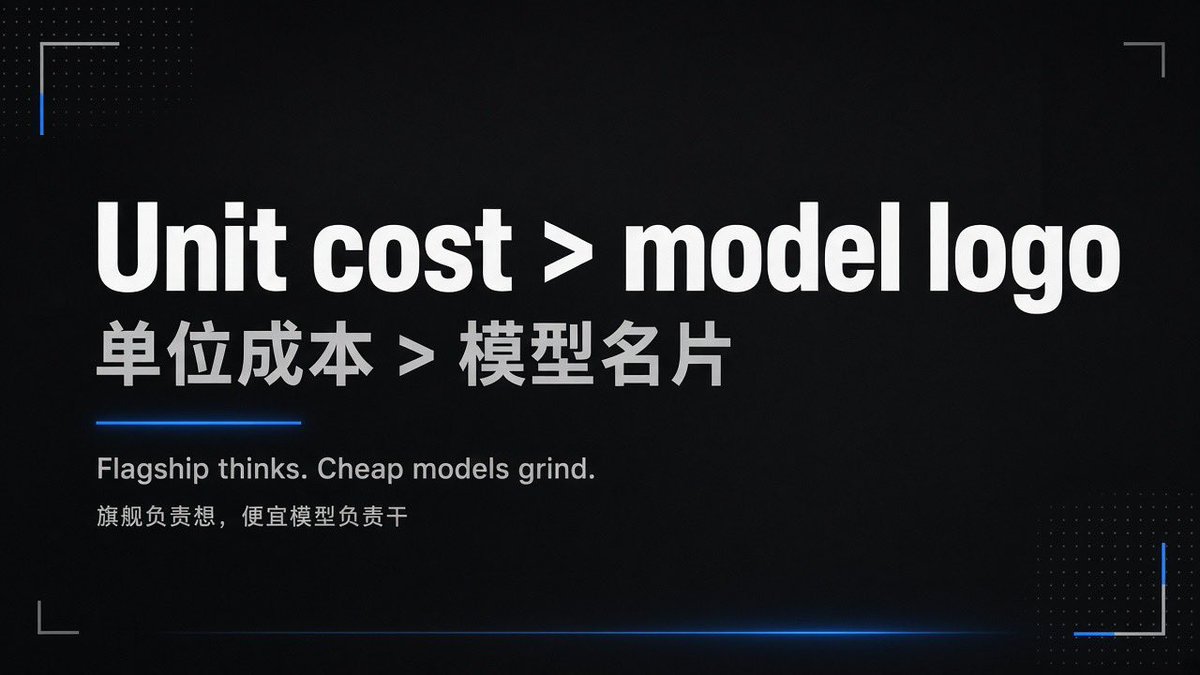
Flagship = brain. Flash/open = assembly line.
旗舰当大脑,便宜模型当流水线。
#AIAgents#LLM