🚨 HIRING: THE ELITE CRYPTO SHILLER / ALPHA CALLER 🚨
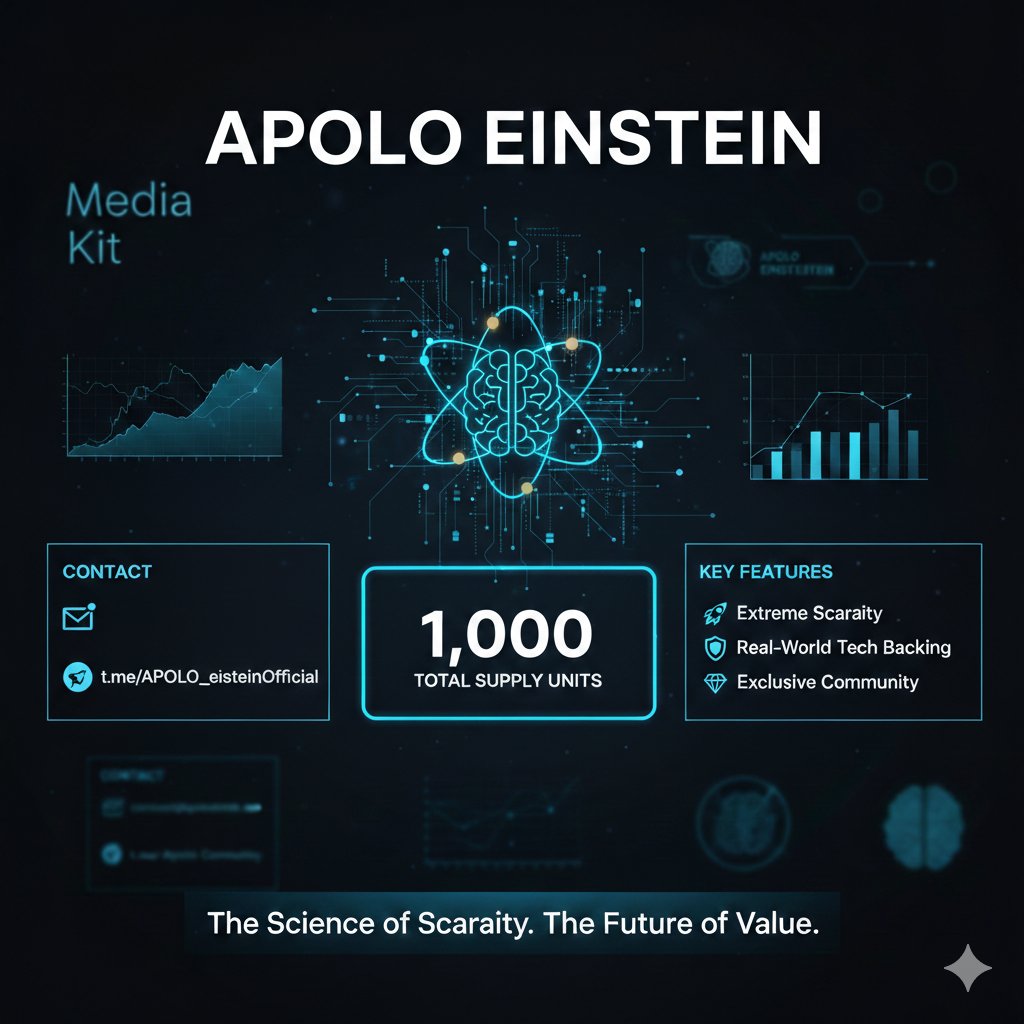
Apolo Einstein is redefining digital scarcity. This is not a meme; it’s a technological ecosystem backed by real inventions and scientific validation.
THE ASSET: * Supply: ONLY 1,000 TOKENS (Scarcity is our DNA).
Target: The 0.1% of investors who understand mathematical density and high-value assets.
WHAT WE NEED: 🔥 Precision Striker: Someone who can move volume organically and maintain chart health.
🔥 Inner Circle Access: Direct reach to Whale/Alpha private groups and top-tier callers.
🔥 Professional Narrative: No "to the moon" spam. We need strategic storytelling about scarcity and innovation.
THE JOB: * 14-day intensive sprint.
Performance-based rewards (Milestones).
We are looking for ONE specialist. Prove you are the best in the game.
OFFICIAL CHANNEL: https://t.co/cMlo1u5q27
📩 Send your track record and tactical proposal via DM.
#ApoloEinstein #AlphaCalls #CryptoWhale #GemHunter #1000Supply #Web3 #Scarcity
Dear Mr. Bezos / Blue Origin Engineering Team,
I am a technical specialist with 28 years of experience in structural engineering and mechanical problem-solving. I am reaching out to share a recovery concept that could revolutionize how we handle orbital boosters upon their return to sea, eliminating the two biggest enemies of reusability: corrosion and impact damage.
The Concept: The Hydrophobic Deep-Pocket Recovery System
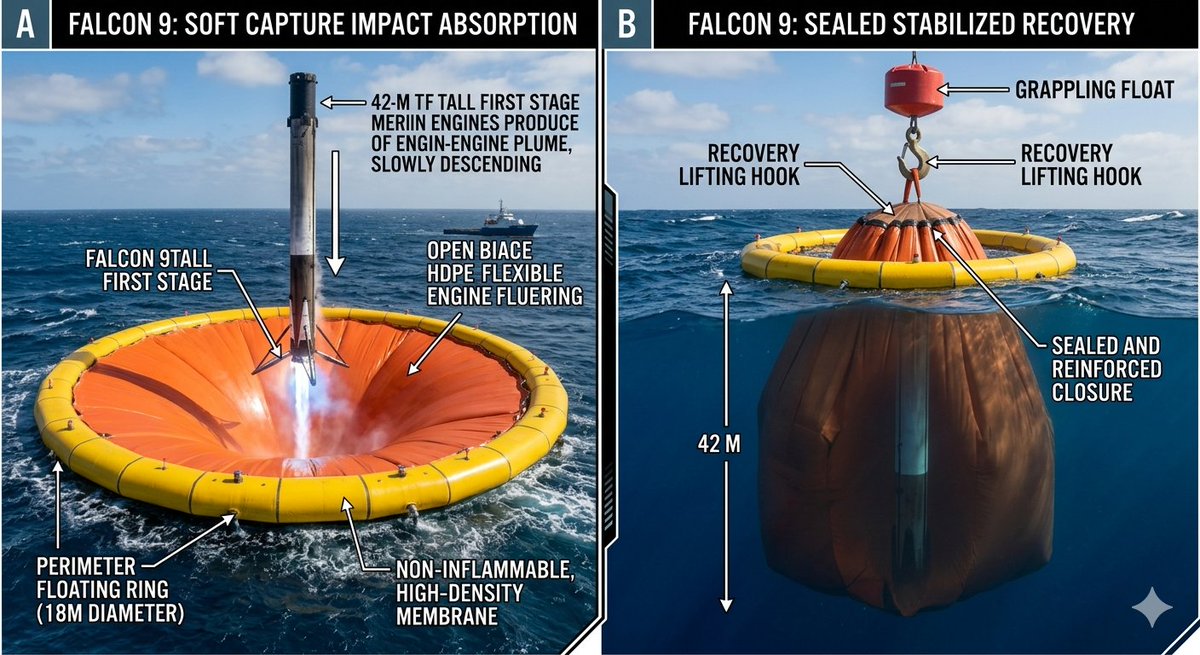
Instead of a rigid steel platform, I propose a Floating Perimeter Ring supporting a High-Density Polyethylene (HDPE) Membrane.
Soft Landing: The booster lands inside this non-flammable membrane. The mass of water underneath acts as a natural, variable-rate shock absorber, distributing landing forces across the entire airframe.
Zero Saltwater Contact: The membrane creates a physical barrier, keeping the Merlin/BE-4 engines and critical avionics completely dry and free from corrosive spray.
Self-Stabilizing: By utilizing the booster's own low center of gravity, the "pocket" allows the engine section to sit below the waterline, creating a "weighted keel" effect that prevents tipping during high-sea states.
Automated Recovery: Once seated, the membrane can be hermetically sealed and tethered to a grappling float, allowing for a simple crane extraction back at port.
Innovation doesn't always require more complex robotics; sometimes, it requires better physics. I have already conceptualized the structural logistics for this system and would be glad to discuss the technical implementation with your team.
I believe this could be the key to achieving a truly "land, refuel, and launch" turnaround for the New Glenn or future vehicles.
Best regards,
Jonathan Jara Mayne
Cel: +56966565772
Construction Tech & Civil Works Administrator
Dear Mr. Bezos / Blue Origin Engineering Team,
I am a technical specialist with 28 years of experience in structural engineering and mechanical problem-solving. I am reaching out to share a recovery concept that could revolutionize how we handle orbital boosters upon their return to sea, eliminating the two biggest enemies of reusability: corrosion and impact damage.
The Concept: The Hydrophobic Deep-Pocket Recovery System
Instead of a rigid steel platform, I propose a Floating Perimeter Ring supporting a High-Density Polyethylene (HDPE) Membrane.
Soft Landing: The booster lands inside this non-flammable membrane. The mass of water underneath acts as a natural, variable-rate shock absorber, distributing landing forces across the entire airframe.
Zero Saltwater Contact: The membrane creates a physical barrier, keeping the Merlin/BE-4 engines and critical avionics completely dry and free from corrosive spray.
Self-Stabilizing: By utilizing the booster's own low center of gravity, the "pocket" allows the engine section to sit below the waterline, creating a "weighted keel" effect that prevents tipping during high-sea states.
Automated Recovery: Once seated, the membrane can be hermetically sealed and tethered to a grappling float, allowing for a simple crane extraction back at port.
Innovation doesn't always require more complex robotics; sometimes, it requires better physics. I have already conceptualized the structural logistics for this system and would be glad to discuss the technical implementation with your team.
I believe this could be the key to achieving a truly "land, refuel, and launch" turnaround for the New Glenn or future vehicles.
Best regards,
Jonathan Jara Mayne
+56966565772
Construction Tech & Civil Works Administrator
Dear Elon,
Please answer this idea.
While making toast for my kids, I came up with an idea for the Falcon 9 sea recovery. It’s a high-density hydrophobic membrane system with a gravity-well stabilization. It eliminates saltwater corrosion and secures the rocket using fluid physics instead of complex deck robots.
I’d love for you to take a look. I don’t mind about fame; I just want to see it implemented so we can keep pushing technology forward and reach other planets.
Best regards,
Jonathan Jara Mayne
Problem Solver
Chile.
Dear Elon,
While making toast for my kids, I came up with an idea for the Falcon 9 sea recovery. It’s a high-density hydrophobic membrane system with a gravity-well stabilization. It eliminates saltwater corrosion and secures the rocket using fluid physics instead of complex deck robots.
I’d love for you to take a look. I don’t care about fame; I just want to see it implemented so we can keep pushing technology forward and reach other planets.
Best regards,
Jonathan Jara Mayne
Problem Solver
Chile.
Dear Elon,
While making toast for my kids, I came up with an idea for the Falcon 9 sea recovery. It’s a high-density hydrophobic membrane system with a gravity-well stabilization. It eliminates saltwater corrosion and secures the rocket using fluid physics instead of complex deck robots.
I’d love for you to take a look. I don’t care about fame; I just want to see it implemented so we can keep pushing technology forward and reach other planets.
Best regards,
Jonathan Jara Mayne
Problem Solver
Chile.
Dear Elon,
While making toast for my kids, I came up with an idea for the Falcon 9 sea recovery. It’s a high-density hydrophobic membrane system with a gravity-well stabilization. It eliminates saltwater corrosion and secures the rocket using fluid physics instead of complex deck robots.
I’d love for you to take a look. I don’t care about fame; I just want to see it implemented so we can keep pushing technology forward and reach other planets.
Best regards,
Jonathan Jara Mayne
Problem Solver
Chile.
Dear Elon,
While making toast for my kids, I came up with an idea for the Falcon 9 sea recovery. It’s a high-density hydrophobic membrane system with a gravity-well stabilization. It eliminates saltwater corrosion and secures the rocket using fluid physics instead of complex deck robots.
I’d love for you to take a look. I don’t care about fame; I just want to see it implemented so we can keep pushing technology forward and reach other planets.
Best regards,
Jonathan Jara Mayne
Problem Solver
Chile.
Anatoly Yakovenko: The Man Who Compressed Time ⚡
An Engineer’s DNA:
Anatoly spent over a decade at Qualcomm working on operating systems and wireless networks. His genius didn't come from a finance background, but from understanding how information flows through high-speed systems.
The "Eureka" Moment:
The idea for Solana was born after a caffeine-fueled dream. Anatoly realized that if a blockchain had an internal clock (Proof of History), nodes wouldn't have to wait to constantly talk to each other to agree on time. This would allow for speeds similar to a centralized database without losing decentralization.
The Rebirth of Solana:
After facing various technical hurdles and market crashes, under Anatoly’s leadership, Solana (SOL) has positioned itself as the fastest and most efficient network. It has become the primary home for the new wave of institutional and retail adoption thanks to its near-zero transaction costs.
Charles Hoskinson: The Scientist Seeking Perfection 💡
A Controversial Departure:
Charles was one of the 8 original co-founders of Ethereum. However, he left the project due to philosophical differences with Vitalik: Charles wanted Ethereum to be a commercial, for-profit entity, while Vitalik insisted on a non-profit foundation.
Cardano and the Scientific Method:
In 2015, he founded IOHK and began developing Cardano (ADA). His approach is unique: no update is implemented without first being "Peer-Reviewed" by mathematicians and computer scientists. It is known as the "Blockchain of Scientists."
Social Vision:
Hoskinson has focused much of his effort on Africa, aiming to digitalize identities and payment systems in developing nations. For him, cryptography isn't just about trading; it’s a tool for social justice, transparent governance, and economic empowerment for the "unbanked."
Brian Armstrong: The Engineer Who Brought Crypto to Wall Street 📈
From Airbnb to the NASDAQ:
While working as a software engineer at Airbnb, Brian Armstrong noticed how inefficient it was to move money to countries in South America or Africa. In 2012, he coded the original Coinbase prototype in his spare time with a clear mission: to create an open financial system for the world.
The Fight for Legitimacy:
While other exchanges operated in "grey areas," Brian decided that Coinbase would be the gold standard for regulatory compliance. It was a risky bet that slowed down initial growth, but it paid off in 2021 when Coinbase became the first crypto company to go public on the NASDAQ.
The Global Impact:
Brian has been the ultimate bridge between traditional finance and the crypto world. His focus on a clean, simple user interface allowed millions of non-technical people to buy their first Satoshi safely. He remains a vocal advocate for clear crypto legislation globally.
Vitalik Buterin: The Genius Who Turned Blockchain into a World Computer 💎
A Vision Beyond Money:
Vitalik didn’t see Bitcoin just as "digital gold." For this Russian-born prodigy, blockchain was a blank canvas. At 17, he co-founded Bitcoin Magazine, but he soon realized Bitcoin’s limitations: it was incredibly difficult to program complex applications on top of it.
The Birth of Ethereum:
In 2013, at just 19 years old, he published the Ethereum Whitepaper. His idea was revolutionary: add a programming language to the blockchain to enable Smart Contracts. After being told by Bitcoin developers that his idea was too ambitious, he decided to build his own network.
Legacy and Evolution:
Vitalik has guided Ethereum through historic transitions, most notably "The Merge," which reduced the network's energy consumption by 99%. Despite his immense wealth, he maintains an austere lifestyle, focusing on philanthropy and solving the "Blockchain Trilemma." Without his vision, DeFi, NFTs, and the modern dApp ecosystem simply would not exist.
Changpeng Zhao (CZ): The Man Who Bet His House on the Future 🔶
The Origin of a Giant:
Before becoming the most influential figure in the crypto space, CZ was an immigrant working double shifts at McDonald’s and gas stations in Canada to support his family. He studied computer science, but his destiny changed in 2013 during a poker game where he heard about Bitcoin for the very first time.
The Historic Gamble:
Unlike others who invested cautiously, CZ sold his apartment in Shanghai in 2014 to buy BTC at an average price of $600. Shortly after, the price plummeted to $200. He didn't blink. He didn't sell. That "Diamond Hand" mentality became the foundation of his fortune.
The Binance Empire:
In 2017, he launched Binance after a successful ICO. His strategy was simple: speed of execution and relentless customer focus. In just six months, Binance went from a startup to the largest exchange on the planet. Despite the massive regulatory challenges he faced in later years, his philosophy of "Keep Building" became the anthem of an entire industry.
Key Takeaway: CZ prioritized user security by creating the SAFU fund, proving that in crypto, user trust is the most valuable asset.
En Apolo Einstein, nuestro primer invento ya es una realidad. 🏗️🔋
Hemos diseñado una pulidora de concreto a batería para que los trabajadores de la construcción ya no tengan que romperse las manos en la obra. La eficiencia se une a la dignidad humana.
$APOLO: Más que un simple token. Un legado de innovación.
💎 Solo 1,000 unidades para siempre.
#ApoloEinstein #UtilidadReal #TecnologíaConstrucción #Escasez
At Apolo Einstein, our first invention is officially here. 🏗️🔋
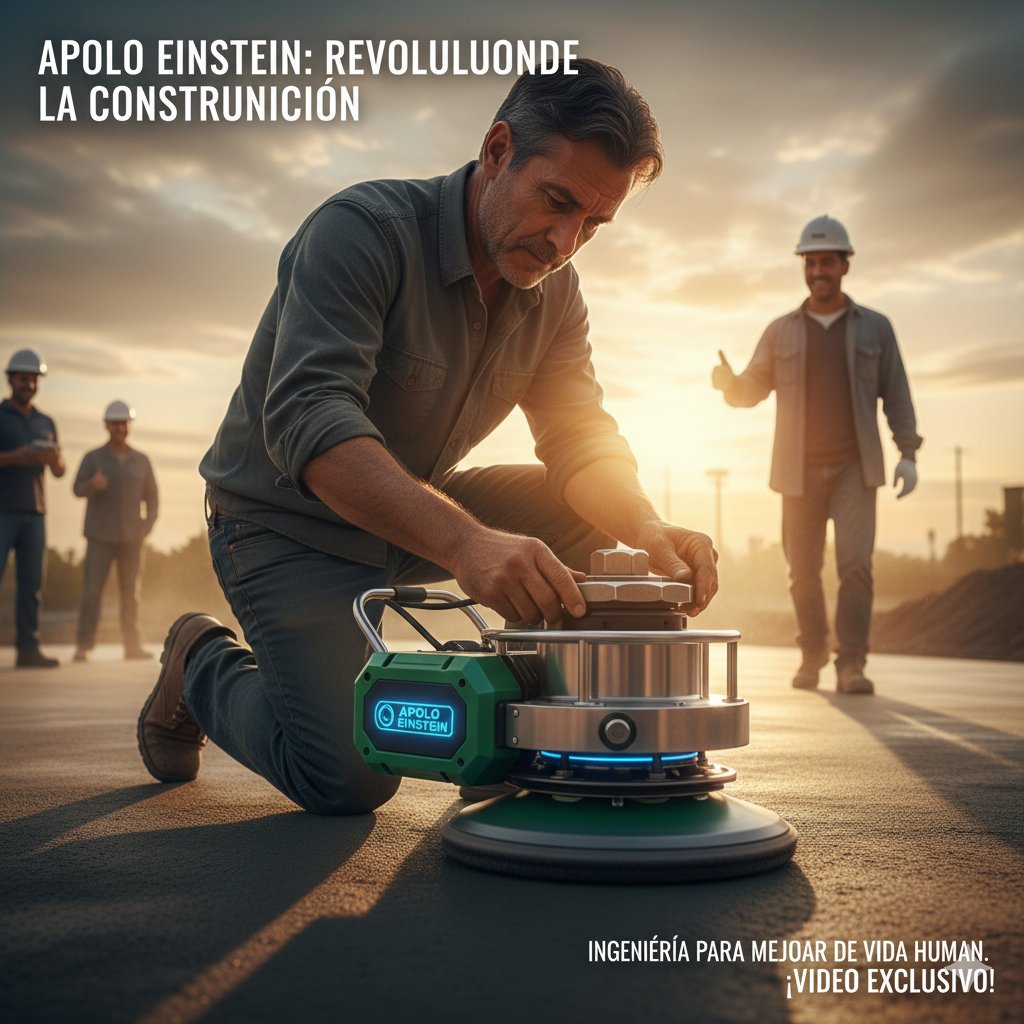
We’ve engineered a battery-powered concrete polisher so construction workers no longer have to break their hands on the job. Efficiency meets human dignity.
$APOLO: More than just a token. A legacy of innovation.
💎 Only 1,000 units forever.
#ApoloEinstein #RealUtility #ConstructionTech #Scarcity
At Apolo Einstein, our first invention is officially here. 🏗️🔋
We’ve engineered a battery-powered concrete polisher so construction workers no longer have to break their hands on the job. Efficiency meets human dignity.
$APOLO: More than just a token. A legacy of innovation.
💎 Only 1,000 units forever.
#ApoloEinstein #RealUtility #ConstructionTech #Scarcity