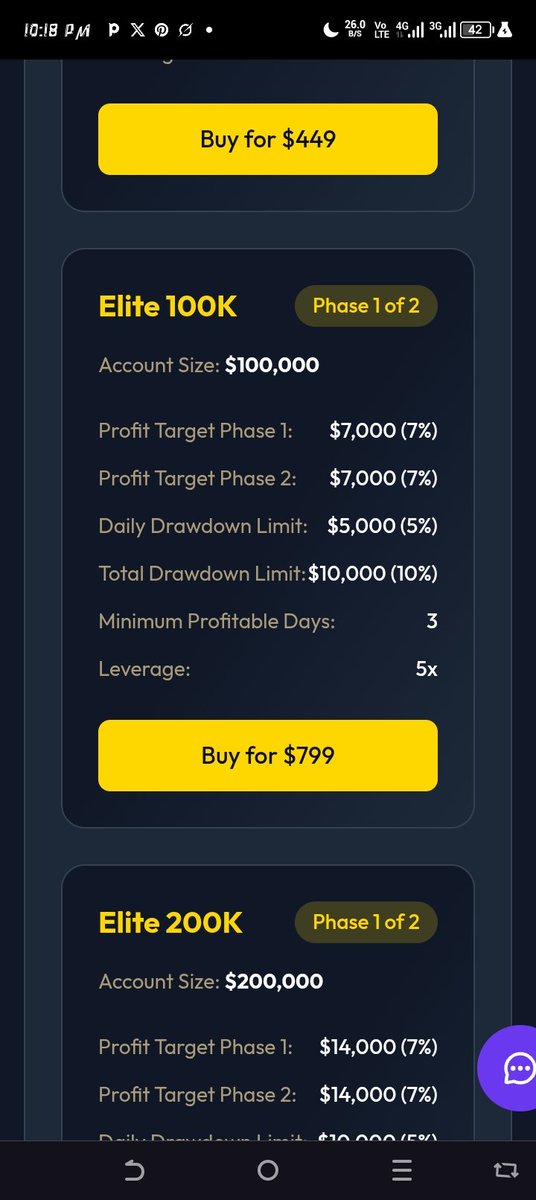
Are you a trader and you are Tired of prop firms killing your vibe with strict rules and small capital?
Are Struggling with limited capital, endless rules, and slow payouts? I feel you.
PropFunded AI is changing they came with this limited offer:
Buy 2 Funded Accounts and Get 3 FREE instantly!
No KYC hassles, No Consistency Rule, High-Frequency Trading allowed, and truly Instant Withdrawals.
Built for serious traders who want flexibility to actually win. This could be your breakthrough moment!
Sign up now using My referral link in the comments 👇🏿
#PropFundedAI #PropTrading #FundedTrader
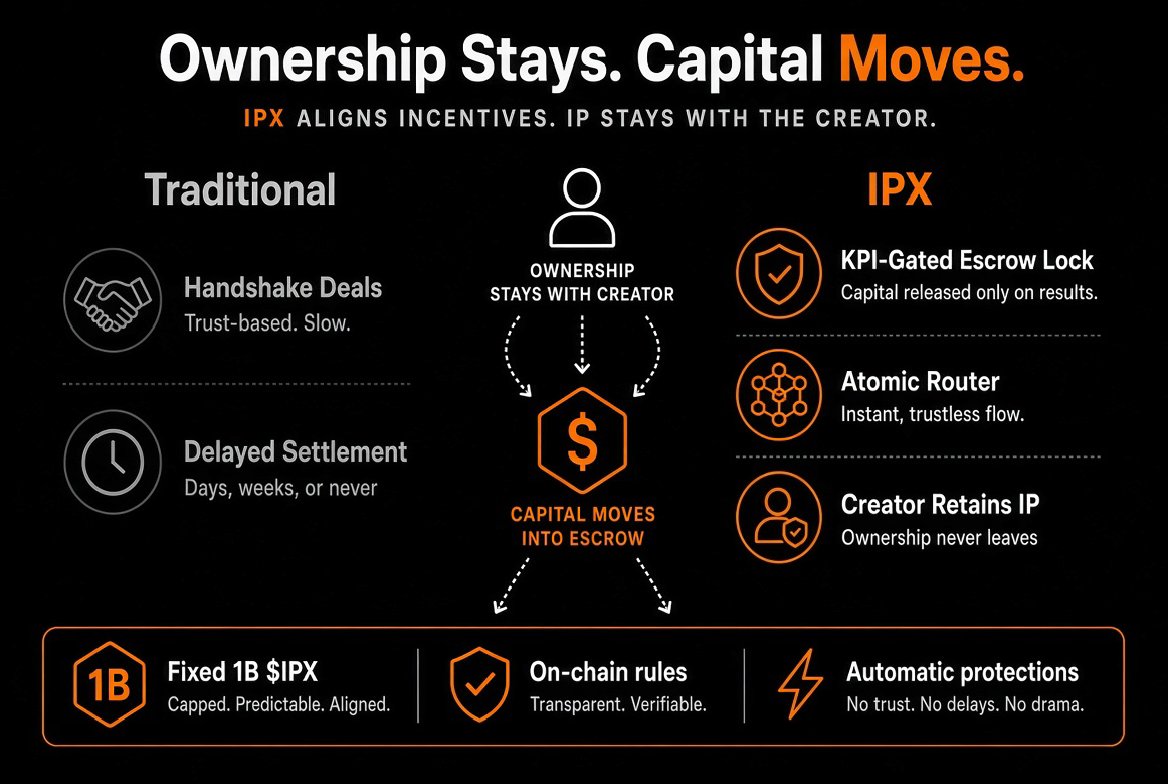
Traditional IP financing has a quiet cost that rarely shows up in the pitch deck: once capital arrives, control usually leaves with it.
On @IPXExchange the rules try to separate the two. A creator sets a production goal. Members fund it through the atomic router. The production capital moves into KPI-gated escrow and only releases when on-chain verification confirms the contracted milestones. It does not land in the creator’s wallet first. If the raise stalls or is cancelled, buyers can redeem from the remaining pool. Team allocations are locked out of that redemption.
The creator keeps the underlying IP, the final cut, and the long-term rights. What changes is the settlement layer. Successful raises graduate automatically and the project token trades against $IPX. $IPX is fixed at 1,000,000,000 with no mint and no burn. Later revenue (when it exists) can enter through Bridge rails and be routed on-chain instead of sitting in Net-90 waterfalls.
The design choice is making capital protection, milestone release, and the failure path automatic and auditable rather than negotiated after the fact. Creators retain ownership. Members receive membership rights and a transparent claim on real revenue if the project earns. Whether that contract holds under real production pressure is the practical test.
https://t.co/8TcxyZykV8
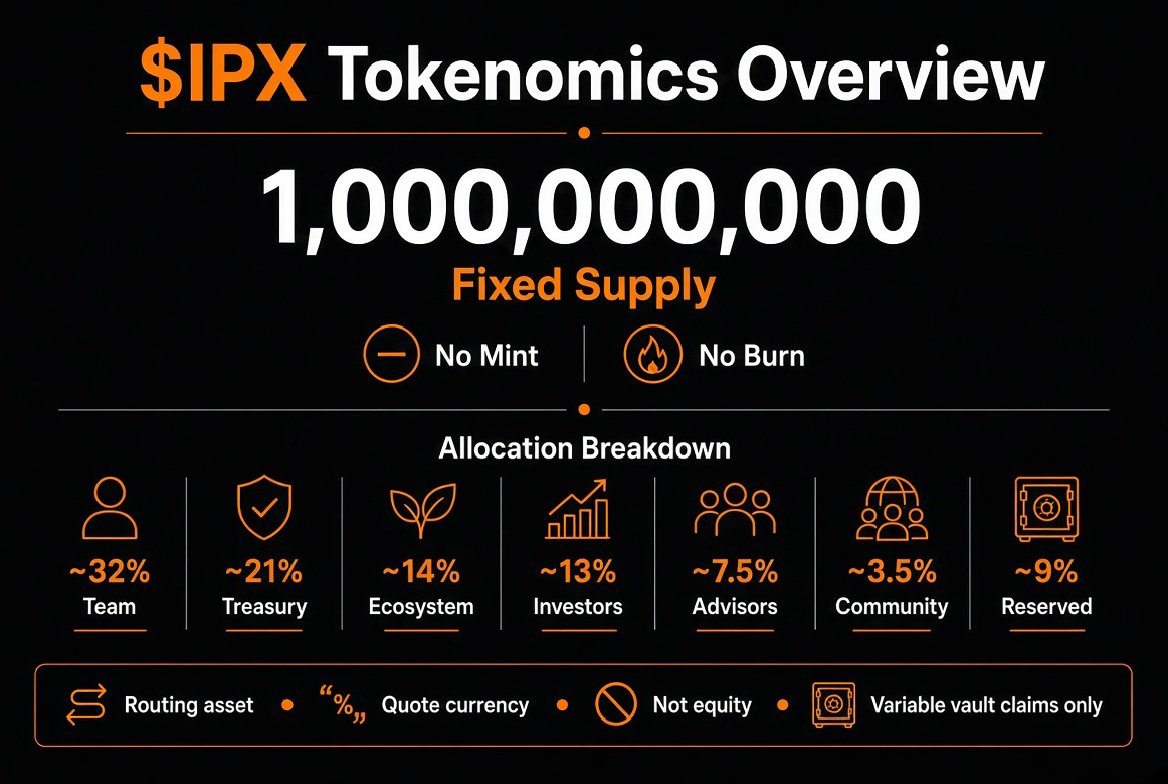
What the $IPX tokenomics actually specify on @IPXExchange:
Total supply is fixed at 1,000,000,000. It was created once at genesis. The contract has no mint function and no burn function, so supply cannot grow or shrink. Roughly 24.5% was unlocked on day one; the rest sits in on-chain vesting contracts.
High-level allocation (from the public token page):
• Team & core contributors ~31.9% (fully locked at genesis)
• Treasury & operations ~21%
• Ecosystem (grants, partnerships, bounties) ~14%
• Investors ~12.9% (locked)
• Advisors & service providers ~7.5%
• Community airdrop ~3.5% (locked)
• Reserved for future rounds ~9.2% (locked)
$IPX is the routing asset and the quote currency for every project raise, graduation, and secondary market. It is not equity in the company. It does not carry governance rights. Stakers can claim a variable share of what the Protocol Vault actually receives — if the vault receives nothing in a period, the claim is zero. Longer lock-ups increase weight; they do not create a fixed yield.
The design keeps the protocol token as infrastructure with a hard cap rather than an inflationary instrument. Whether the vesting and allocation structure holds up under real usage is something that can be verified on-chain over time.
https://t.co/8TcxyZykV8
What “membership” actually means on @IPXExchange:
It is not equity and it is not a promised yield. The platform is explicit about that. When you buy a project token you are joining that IP’s community with three concrete things: on-chain membership rights, proportional rewards from real project revenue when it exists, and access to perks and experiences the creator chooses to unlock.
The revenue path is the part that differs from a normal fan club. Streaming royalties, licensing fees, ticket sales, sponsorships, and merchandise can be routed on-chain. Holders receive a share of the portion allocated to token holders. The percentage is set at launch and visible in the project’s tokenomics. Rewards are not fixed and depend on whether the project actually earns.
On the protection side, the same system still applies: production capital starts in KPI-gated escrow, purchases settle atomically through the router, and failed or stalled raises allow buyers to redeem from the remaining pool. After graduation the project token trades against $IPX. $IPX itself is fixed at 1B supply with no mint and no burn.
The design tries to turn passive audiences into members who have both access and a transparent claim on real economics, while keeping creators in control of the underlying IP. The open question is how many projects will generate meaningful revenue and how consistently that revenue will actually flow through the on-chain rails.
https://t.co/8TcxyZySKG
One part of @IPXExchange that gets less attention than the raise mechanics is what happens after the project starts earning.
Traditional entertainment still moves money the old way: sponsorship wires, licensing checks, ticket sales, and distribution payments sit in bank accounts for weeks or months before anyone sees their share. IPX is wiring that flow on-chain through Bridge (Stripe).
Projects can receive off-chain revenue into a non-custodial Bridge virtual account. Incoming USD is automatically converted to USDC and sent to the project’s smart contracts on Base. From there the settlement engine can route it in real time to the relevant parties no Net-90, no manual waterfall spreadsheet, no waiting for a quarterly statement.
This sits on top of the rest of the system: production capital still starts in KPI-gated escrow, successful raises still graduate into secondary markets priced in $IPX, and $IPX remains a fixed 1B-supply asset with no mint and no burn. The Bridge piece is the part that tries to connect actual entertainment revenue to the on-chain membership layer instead of leaving them in separate worlds.
Whether studios and rights holders actually route meaningful revenue through it is the practical test. The rails are designed to make that path available without requiring everyone to become a crypto user first.
https://t.co/8TcxyZySKG
I really Spent time in the IPX docs, today
nd Here is the part that actually stands out for me
Most “tokenized IP” projects hand capital to the creator and hope. @IPXExchange does the opposite by design.
A
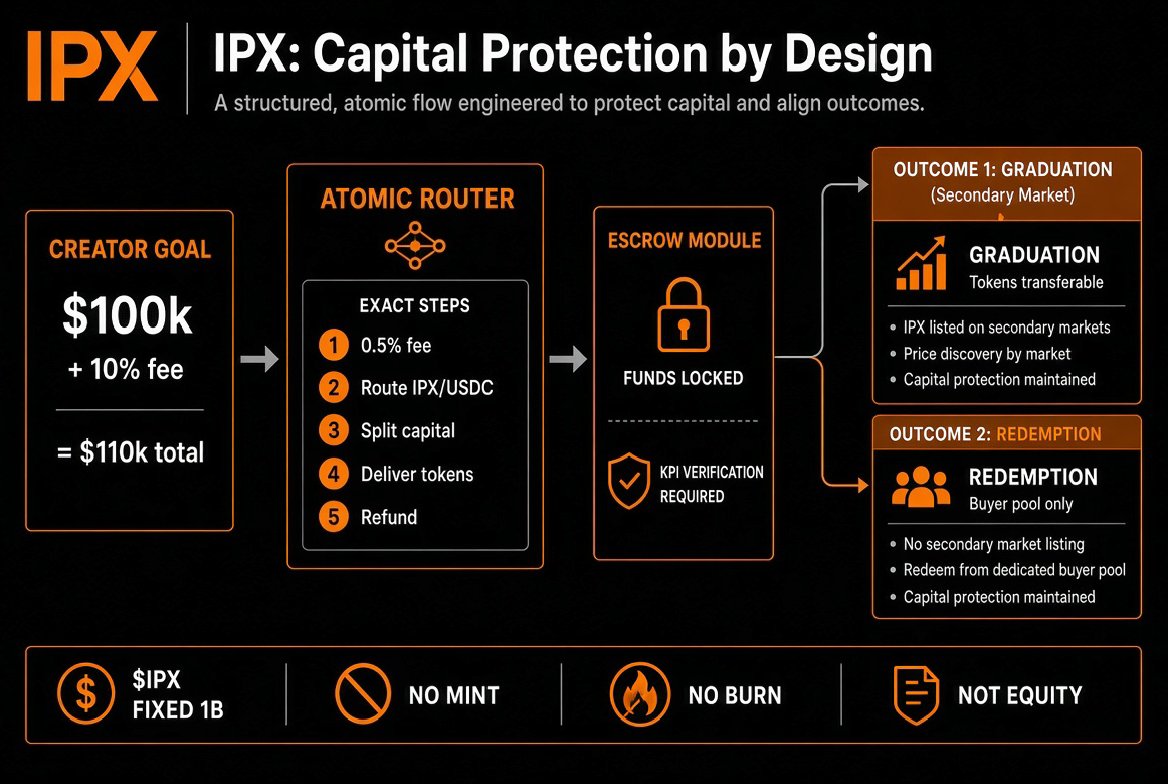
Creator posts a production goal. Say $100,000. The system adds a 10% cashout fee, so graduation requires $110,000. Buyers pay in USDC or $IPX. The atomic router settles the whole thing in a single transaction: takes the 0.5% fee, routes through the IPX/USDC pool, splits the exact amounts needed for production escrow and graduation liquidity, delivers the project tokens, and refunds any leftover.
The production money never touches the creator’s wallet. It sits in KPI-gated escrow and only moves when milestones are verified on-chain. Hit the number and automatic graduation and the project token opens a secondary market priced in $IPX. Miss it or stall → buyers can redeem their proportional share of whatever remains. Team and creator allocations are locked out of that redemption pool.
$IPX is capped at 1,000,000,000, created once, no mint function, no burn function. It is the routing asset and the quote currency for every project. It is not equity and it does not promise a fixed yield. Stakers only claim a variable share of what the Protocol Vault actually receives.
The design choice that feels different is making capital protection, graduation, and the failure path automatic and on-chain rather than left to discretion. Creators still keep ownership of the IP. Members get membership rights and a path to real revenue later if the project earns. Whether that combination holds up in practice is the real test.
https://t.co/8TcxyZykV8
My take on how @IPXExchange actually works after reading the docs and mechanics:
It is not a classic launchpad. Capital is protected by design.
Creator sets goal (example: $100k). Total to graduate = goal + 10% cashout fee. Every buy settles atomically via the router: 0.5% fee, route through IPX/USDC, split for production escrow + graduation liquidity, deliver tokens. Production funds stay locked in KPI-gated escrow until milestones clear. They never go straight to the creator.
Success → automatic graduation, project token trades against $IPX. Failure → buyers redeem from remaining pool (team locked out). Bonding curve gives continuous liquidity on the way up and down.
$IPX is infrastructure: fixed 1B supply, no mint, no burn. It routes every purchase and prices every secondary market. Creators keep the IP. Members get membership rights and a claim on real revenue when it exists (via Bridge rails).
The interesting part is the combination of atomic settlement, milestone escrow, and fixed-supply routing asset. That’s rarer than the marketing suggests.
https://t.co/8TcxyZySKG
The numbers behind a raise on @IPXExchange:
Creator sets $100,000 production goal.
Platform adds 10% cashout fee → $110,000 total needed to graduate.
Every purchase:
• 0.5% router fee
• Atomic settlement in one transaction
• Production capital → KPI-gated escrow (never to creator directly)
• $IPX collected for graduation liquidity
Hit goal → project graduates, token trades against $IPX.
Fail or stall → buyers redeem proportionally from remaining pool (team locked out).
$IPX: 1,000,000,000 fixed supply. No mint. No burn.
Secondary fees: 85% to project token stakers, 15% to treasury.
Protocol Vault: 85% claimable by $IPX stakers (variable, not fixed).
Creators keep the IP. Members get membership rights + real revenue path when it exists. Rules are public. Settlement is on-chain. Built on Base.
https://t.co/8TcxyZykV8
Step-by-step: what actually happens when you buy a project token on @IPXExchange
You send USDC or $IPX.
The atomic router handles everything in one transaction: takes the 0.5% fee, routes through the IPX/USDC pool, splits capital into the exact USDC needed for production + the $IPX needed for graduation, delivers the project tokens, and refunds any unused amount.
Production capital moves into KPI-gated escrow. It only releases when milestones are verified on-chain. It never goes straight to the creator.
Hit the goal andproject graduates automatically. Its token opens a secondary market priced in $IPX.
Miss or stall and you can redeem your tokens for a proportional share of the remaining pool. Team allocations can’t touch it.
Worked example: $100k production goal + 10% cashout fee = $110k total to graduate. $IPX stays fixed at 1B supply, no mint, no burn.
Creators keep ownership. Members get membership rights and a path to real revenue later. The rules are public and the settlement is atomic.
https://t.co/8TcxyZykV8
My BTC sits idle while stables earn somewhere else and borrowing means another protocol entirely.
Arch Prime collapses all of that into one self-custodied account earn on everything, borrow against the whole portfolio, trade, and leverage without selling. The fees that used to leak across five apps stay with you.
They just acquired Horizon (home financing), and pre-deposits are next. Early spots matter.
It Took me under 2 minutes:
https://t.co/HdFcBD9wxT
Introducing Prividium Connect.
Institutions can now privately exchange assets across blockchains without a trusted intermediary.
For the $ZK economy, this opens an opportunity across global financial markets.
Institutions can now exchange assets privately across the chains they already run, with a ZK proof enforcing the deal instead of a middleman. If the deadline passes, each side gets its assets back automatically.
For the first time, that kind of institutional adoption has a path to the $ZK economy the fee switch is built and being audited, and the proposed Fee Flow (if approved) would convert interop fees into $ZK per governance.
The L2 everyone wrote off keeps shipping for banks.
Introducing Prividium Connect.
Institutions can now privately exchange assets across blockchains without a trusted intermediary.
For the $ZK economy, this opens an opportunity across global financial markets.