Prediction markets are supposed to surface truth faster than headlines.
Most still ask the wrong question: “Will this happen… or not?” Trepa asks a sharper one: “How close can you get?” Here’s why that single change rewires incentives, where Trepa actually sits in the design space, and the real trade-offs no one talks about. A public-good map for builders.
Happy Veterans Day to those in the United States 🇺🇸
And a special shout-out to the veterans amongst you, including @Casper_Network's Core Protocol Head of Engineering, Ed Hastings.
Thank you for your service! 🫡
🔥 XP Union Vault is heating up right now!
Staking demand has completely blown past expectations 😳
Participants are pouring in and the pool is filling up fast in real time.
More people are joining as we speak — if you haven't jumped in yet, now's the time!
✅ How to participate
1. Stake XP in the Xphere Union Vault
2. Follow the Xphere X
3. Join the Xphere Telegram
4. Submit the Google Form
Don't miss this momentum!
👉 https://t.co/QycOty2Qbl
Just secured early access to @ForgeLaunchHQ —
Forge is a permissionless ERC-20 token launcher on Base. Deploy a token in one transaction — no coding, no liquidity needed. Forge handles everything: token creation, Uniswap V3 pool setup, and fee distribution. 🟢
888 NFT spots · token airdrop coming soon.
#Forge #Base #DeFi · https://t.co/OFyACXdDbj
The true scale of @zksync isn't found in a list of logos, but in the exponential math of its connectivity.
We often focus on individual partnerships, yet we overlook how institutional networks actually compound.
When SWIFT moved from 230 banks to 11,000, it wasn't just "more users" it was a total transformation of global liquidity corridors.
The ZKsync network is mirroring this exact trajectory. 10 institutions create 45 potential connections; 100 institutions create nearly 5,000.
This is why the migration of Cari Network ($600B+ deposits) and Deutsche Bank is so significant. They aren't just joining a chain; they are anchoring a new global settlement layer.
At the center of this architecture sits $ZK. It isn't just a ticker, it is the native gas for the ZKsync Gateway, the engine that bundles these institutional Prividium zones before settling them on Ethereum.
As governance matures, $ZK holders aren't just "voting"; they are directing the economic parameters of what is becoming the internet of finance.
If 35+ institutions are already in active evaluation, we are no longer discussing "if" the network effects will kick in. We are discussing the speed of the inevitable.
Question for you guys:
Does the industry underestimate the friction-loss when 5,000+ settlement corridors move from T+3 to cryptographic real-time?
DANGO ✓✓ FIH ✓✓
Title: Onchain Rewards Become More Valuable When They Are Usable
Most reward systems in Web3 stop at distribution.
Users earn points. Activity gets tracked. The rewards exist, but interaction around them remains limited. The system measures participation without extending its utility.
@FIH_USD1 is shifting beyond that model with $FIHPT on opBNB.
Points are no longer isolated records inside a closed platform. They now exist onchain with fast settlement, low transaction cost, and transparent movement. Rewards become active components of the ecosystem instead of static numbers on a dashboard.
This changes user behavior.
Low fees remove hesitation around interaction. Fast confirmation keeps participation continuous. More users stay active because execution feels immediate rather than delayed by cost or friction.
DANGO strengthens this transition at the interaction layer.
Trading, lending, and borrowing remain accessible through simplified flows that reduce operational complexity for users entering the ecosystem. As activity around $FIHPT grows, interaction remains clear and usable instead of fragmented.
The mechanism is precise.
Rewards become more effective when users can interact with them freely and continuously.
Web3 adoption depends on turning participation into usable onchain behavior, not isolated engagement metrics.
The infrastructure is no longer experimental.
It is becoming operational.
@myk_goncharov @sanity_united Hello sir,
please pay your old ambassador please I really need it my dad died and my mom really support and am broke please
GN.
One thing the market teaches quietly over time:
The goal isn’t to predict every move.
It’s to survive long enough to compound good decisions.
That’s why structure matters so much.
Clear risk.
Controlled exposure.
Capital deployed with intention.
The people who last aren’t always the smartest traders.
Usually, they’re just the ones who understand risk better.
Rest up. @TermMaxFi
Tomoland didn’t just create hype around The Blueprint… now the utility phase is starting..
Blueprint holder verification is officially live.
If you minted early, this is where your position inside the ecosystem starts becoming more meaningful.
A lot of people only saw The Blueprint as “another NFT mint,” but holders are beginning to understand it was really early access into the TOMO ecosystem before the wider expansion.
Now verified holders step into a different layer of the community:
⚡️ holder recognition
⚡️ ecosystem positioning
⚡️ future rewards & partner opportunities
⚡️ access tied to the growing TOMO infrastructure
And honestly, this is where being early matters most.
The interesting part about @tomoland_app is that they’re not building around speculation alone.
They’re building a creator ecosystem where people can create experiences, own their identity, participate in gameplay, and grow alongside the platform itself.
The more I explore the app, the more I see why this ecosystem keeps getting attention.
From Arena PvP battles to creator worlds, NPC creation tools, social events, and now holder verification… it actually feels like the ecosystem is progressing step by step instead of standing still after mint day.
And the backing here is serious too 👀
BUD Technologies collaboration
30M+ downloads
15M+ creators
Advisors connected to Animoca Brands, Oasys, and more.
That combination of gaming infrastructure + creator ownership is hard to ignore long term.
If you already hold a Blueprint, go verify and secure your holder role now..
And if you missed mint day… secondary is already live 👀
Apple App: https://t.co/YAbCWspx8K
Google Play: https://t.co/s8sYDqC73o
@TheCreatorFi #TomolandMay7
Numbers worth paying attention to.
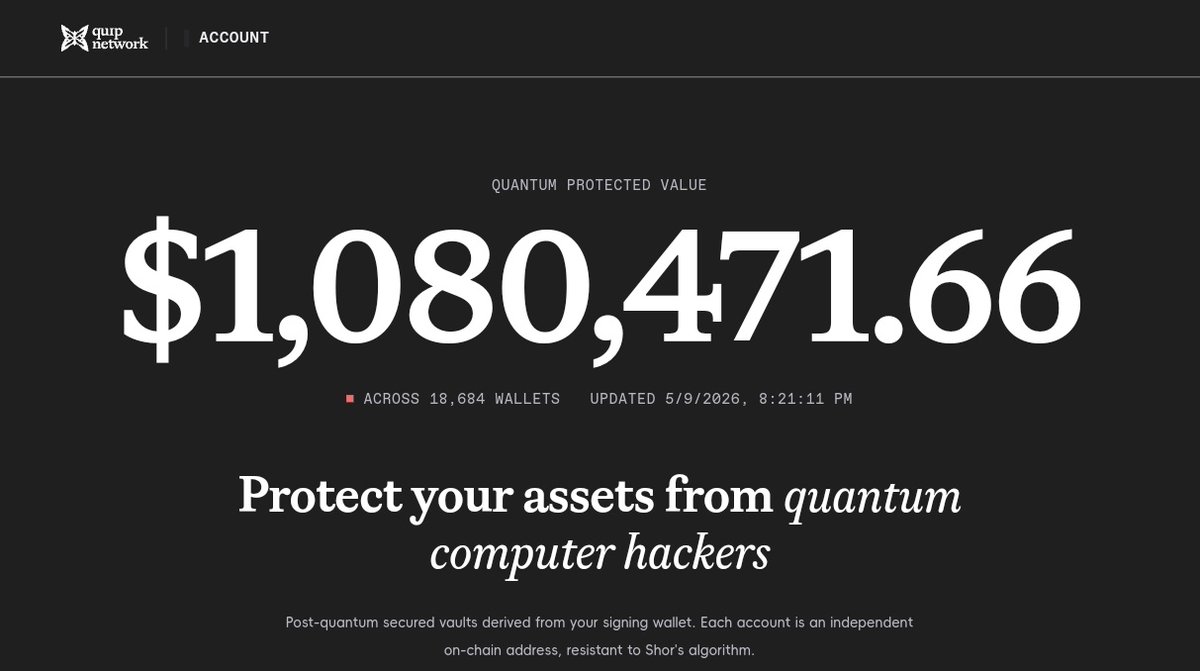
When @quipnetwork launched their Quantum-Proof Vaults following the April 2026 testnet launch the total value secured sat at $372,356.
Today that number reads $1,080,471.66.
That is not testnet activity inflated by points farming. That is real capital that real people chose to move into a quantum protection layer that did not exist five weeks ago.
The vault is currently in public beta. That context makes the number more impressive not less. Early adopters moved real capital into an experimental protection layer before it was fully production hardened.
Think about what that decision actually means for the people making it. They are not speculating on a future token. They are making a present security decision about assets they already own. They looked at the quantum threat landscape, looked at what @quipnetwork built and decided the protection was worth acting on now rather than waiting.
That behavioral signal is more meaningful than any TVL milestone in a yield farming protocol. Yield chasers move capital for returns. These depositors moved capital for protection.
The vault crossed one million dollars in quantum protected value before mainnet launches. Before the $QUIP token exists. Before most of the industry has even started the conversation this network was built to answer.
That is not hype getting ahead of the technology. That is the technology getting ahead of the hype.
Source: https://t.co/qwyopusnqB
Prediction markets are supposed to surface truth faster than headlines.
Most still ask the wrong question: “Will this happen… or not?” Trepa asks a sharper one: “How close can you get?” Here’s why that single change rewires incentives, where Trepa actually sits in the design space, and the real trade-offs no one talks about. A public-good map for builders.
Curious to hear different perspectives 👇
What interests you more in the RWA space right now?
Is it
• Tokenized gold?
• Tokenized real estate?
• Tokenized commodities?
@BiGODToken has definitely made me pay closer attention to the digital gold narrative.
#BIGOD#RWA
I find great delight in talking about progress.
@BiGODToken had a seminar today on a very big stage. It was about Blockchain and decentralized management in the digital area.
As a #BIGOD community member, I look forward to attending a IRL event hosted by BIGOD.
One of the least discussed inefficiencies in global finance is that institutions spend enormous amounts of capital protecting themselves from coordination failure rather than deploying that capital productively.
A significant portion of liquidity in the banking system exists not because it needs to move but because counterparties can not safely assume synchronized state across fragmented infrastructure. So capital gets pre positioned across correspondent networks, settlement windows expand to absorb uncertainty, and reconciliation layers multiply simply to maintain operational confidence between institutions.
This is why financial infrastructure tends to accumulate intermediaries over time.
Not because the system is irrational, but because every intermediary historically reduced some coordination risk that institutions could not otherwise verify themselves.
What makes architectures like Prividium on @zksync interesting is that they approach the problem from a different direction entirely.
Instead of trying to eliminate institutional control boundaries, they preserve them while changing how verification works underneath.
Execution environments remain institution controlled. Sensitive transaction data remains private. But transaction validity no longer depends entirely on bilateral trust assumptions or external reconciliation processes. Verification becomes cryptographic, and settlement anchors to Ethereum.
That distinction sounds subtle, but operationally, it changes where financial systems absorb risk.
Historically, institutions buffered uncertainty with trapped liquidity, delayed settlement, duplicated ledgers, and layered oversight processes. If shared verification becomes reliable enough, some of those buffers stop being structurally necessary in the same way.
The implications are larger than faster payments.
It potentially changes how institutions think about capital allocation, counterparty coordination, and even the amount of infrastructure dedicated purely to proving that records between systems match.
The interesting signal is that multiple institutions appear to be converging toward this architecture independently.
Cari Network represents five U.S. regional banks with more than $600B in combined deposits. Deutsche Bank built the Memento ZK Chain. BitGo integrated institutional custody into Prividium infrastructure. ADI Chain is operational with First Abu Dhabi Bank.
Different institutions. Different jurisdictions. Similar infrastructure conclusions.
Once institutions begin coordinating through shared verification layers, network effects compound differently than they do in isolated systems. Each additional participant increases the number of possible coordination pathways available to every other participant already connected.
Within that architecture, $ZK functions as the native asset of the @zksync network: governing protocol decisions and serving as the native gas token for ZKsync Gateway settlement coordination.
The deeper shift here is not institutions “using blockchain.”
It is the possibility that financial coordination itself becomes increasingly verifiable instead of increasingly intermediated.
Most people still think crypto payments are complicated until they actually use @moovexyz
Cross-chain transfers, swaps, wallet handles, rewards, all in one place.
This is the kind of simplicity that can onboard the next billion users into Web3.
The nostro/vostro problem alone is wild. Hundreds of billions parked "just in case" a payment clears in the right corridor. That's not liquidity management, that's capital punishment. ZK settlement makes just-in-time liquidity actually possible.