Accepted paper @JEcology ⬇️ How #LiDAR data acquired from airborne (🚁🛩) sensors can help us unveil ghosts from the past (i.e. ancient human activities) & thus capture time-lagged #biodiversity changes in the #forest understory 🍀☘🌱🌿🌳🌲🌳🌲| A 🧵
📰 https://t.co/qcKiSbUtNj
Conservation cannot only protect habitats where species once lived – it must include the places where they will relocate in a warming world. @shawan_c@EkoLogIt@MonashUni https://t.co/3G9wftM1rK
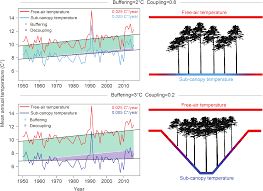
@Gemenne@franceinfo@EkoLogIt Ainsi, dans le cadre du changement climatique, il y a tout intérêt à limiter le débroussaillement au stricte necessaire pour de pas fragiliser les microclimats, clé de l'adaptation face aux aléas extrêmes.
@Gemenne@franceinfo@EkoLogIt Les études ont notamment montré que le microclimat forestier est fonction de la hauteur de la canopée, de la densité du sous bois et du contexte édaphotopographique avec une expression totale à partir de 50m de la frange boisée.
I am so proud of this paper ⬇️ recently published in PNAS 🤩 Four years in the making and countless computing hours to get bioclimatic velocities from #SDMs that were tailored to each species & study from which we extracted empirical species range shift rates
Climate niche models underestimate the speed with which species move in response to climate change, according to comparisons between the models and observed shifts for more than 3,500 species. Median rates were four times faster than predicted. In PNAS: https://t.co/7fvGgcBaYl
Climate niche models underestimate the speed with which species move in response to climate change, according to comparisons between the models and observed shifts for more than 3,500 species. Median rates were four times faster than predicted. In PNAS: https://t.co/7fvGgcBaYl
Genetic diversity matters for species on the move in response to climate change ⬇️
We found that genetic diversity interacts w/ the velocity of climate change to explain the velocity at which species shift their range positions over time
https://t.co/Vun9pw9d8j
Thermophilisation of plant communities in response to #CC is 5× faster on alpine summits than in forests or grasslands across 🇪🇺
This corroborates former findings on the greater likelihood for upslope than poleward range shifts of plants 🌳🌲☘️🌾🪻🌼
https://t.co/7uGisplNae
Climate change has already reshaped the bioclimatic space of extreme events in the Arctic 🌐❄️ Arctic biodiversity has entered a new era of bioclimatic extremes w/ more droughts, greater winter-warming 📈 & more rain-on-snow events 💧❄️
https://t.co/4Enj81kjJb
Just published ⬇️
The CESABINAR #12 featuring the BIOSHIFTS group will start in about 2 hours (at 3 pm CET). Here are the info you need to join the webinar:
Zoom link:
https://t.co/EIMKcYOS2r
Secret key:
486426
On Thursday 11th December, at 3 PM CET, we will present results from our #CESAB working group #BIOSHIFTS on species range shifts in response to climate change 🌡📈🌳🦔🦉🐝🦎🐟🐚🦈
CESABINAR #12
Find the Zoom link on the webpage of #FRB below & attend 😊
https://t.co/3CRTOYd9j1
On Thursday 11th December, at 3 PM CET, we will present results from our #CESAB working group #BIOSHIFTS on species range shifts in response to climate change 🌡📈🌳🦔🦉🐝🦎🐟🐚🦈
CESABINAR #12
Find the Zoom link on the webpage of #FRB below & attend 😊
https://t.co/3CRTOYd9j1
Study area shape matters when tracking species range shifts & we may underestimate longitudinal range shifts to the benefit of latitudinal range shifts, potentially undermining drivers other than T°C 🌡
🌐🌏🌎🌍🧪🐠🐍🦋🦉🦇🌳🌲
https://t.co/P7uCAjPL4a
In our new article (Midolo et al., Ecology Letters), we show that plant species richness in European plant communities generally decreased between the 1960s and 1980s. However, since the 1990s, this trend seems to have stopped or even reversed. https://t.co/ieQk0M6RCh
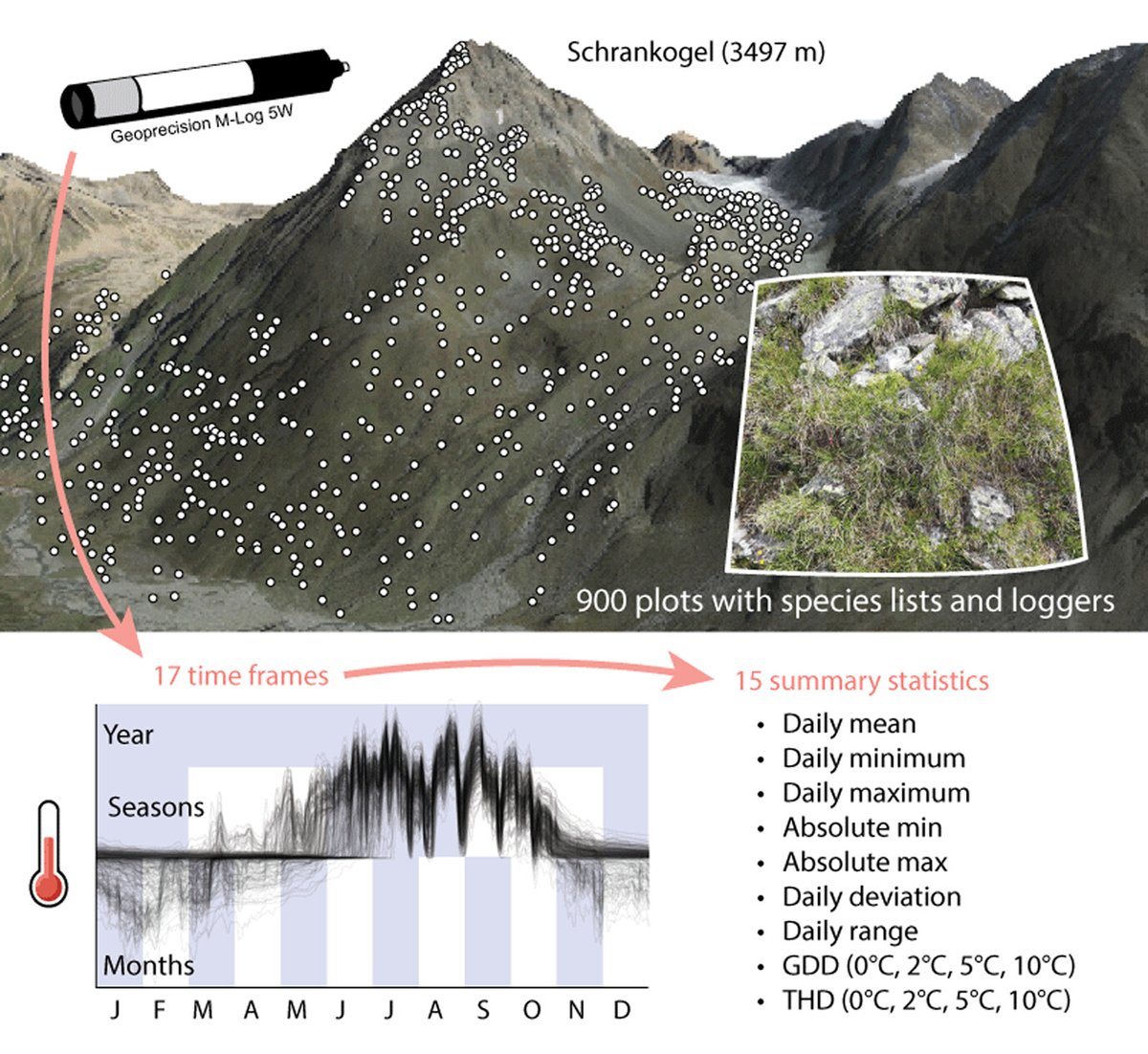
How to not be swamped by microclimate data?
The rise of microclimate data may have opened Pandora’s box. Gone are the days of simple bioclimatic variables — now heads spin trying to summarize these timeseries.
A much-needed paper by Krystof Chytry:
🔗 https://t.co/R9jrcNGD3l
Yesterday, we had a webinar organised by the #PEPR#FORESTT on the use of species distribution models #SDMs w/ application in forestry 🌳🌲 You can watch 📹 16 talks, including 1 on the impacts of microclimatic processes for species (re)distribution ⬇️
https://t.co/aossmD5CLr
Happy to have contributed to this nice study just published in #GCB on plants' phenological shifts across 🇨🇳: we used data from herbarium specimens to generate time series of 🌸 time at the species level & infer phenological shifts
🌺🌸💮🏵🌎🌐🍁🍂
https://t.co/CAyol8YFgW
Our University #UPJV just made it, this year, for the very 1st time, to the Shangai ranking of universities 🌎🌐
It turns out that the only academic subject appearing on the list of subject ranking is #Ecology 🌳🍁🪻🌱🦌🦔🦇🦉
We are pretty proud of us at #EDYSAN 😀
@UPJV_Univ
Do biodiversity drivers have no long-term effects? 🚨Still the dominant assumption.
We propose a paradigm shift in Trends in Ecol & Evol: 🔗 https://t.co/asd1ZhkqWL
Many thanks to @EkoLogIt , @RonanMarrec, @FranzEssl1, @IngolfKuhn, @t_ergon
Why relying on the "equlilibrium assumption", i.e., biodiversity being in an equilibrium state w/ its environmental conditions, to model biodiversity changes?
➡️ We propose a paradigm shift: embracing the quasi-permanent non-equilibrium state 🤯
https://t.co/CsmRj59YX1