Mischief, times two! Lenny and Sulwe aren’t related by birth — their mothers, Lima Lima and Sonje, are both orphans rescued and raised through our Orphans’ Project — but they could be mistaken for twins. They are constantly embroiled in fun and drama, either teaming up together or ganging up on one another.
Learn more about our pioneering Orphans’ Project at: https://t.co/ViiEh1dqjs
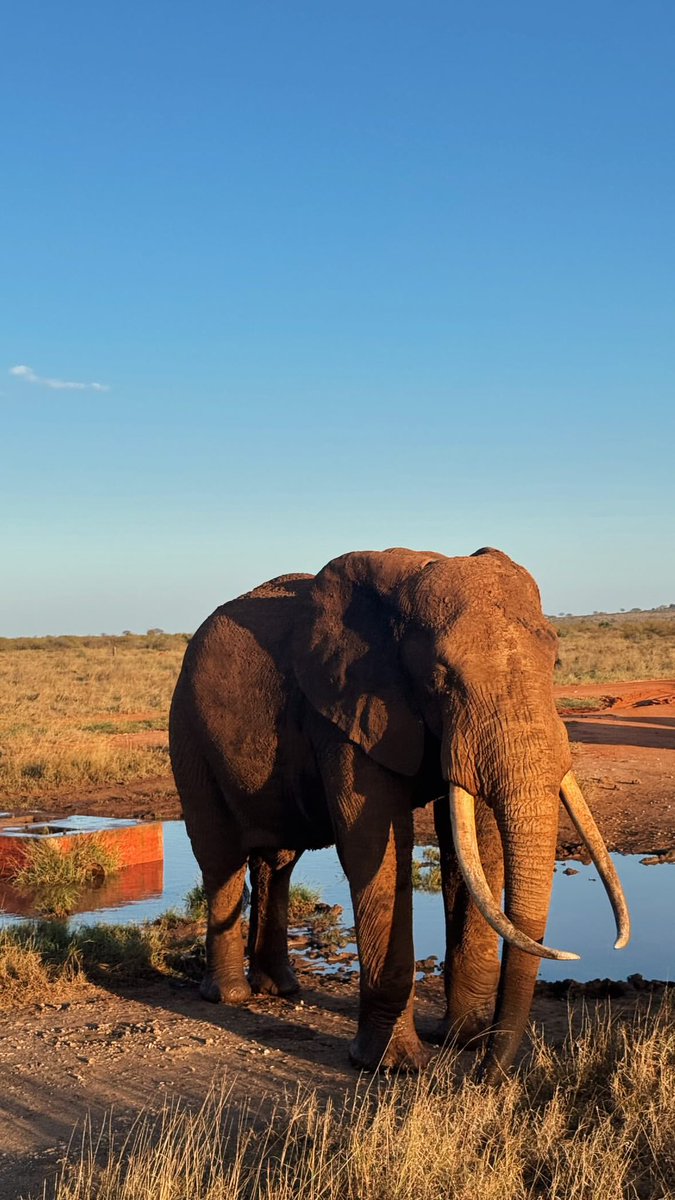
Treating elephants often requires patience, perseverance, and a measure of good luck. Such was the case with this speared tusker, who took us on a Tsavo odyssey spanning a month and over a hundred kilometres before we were able to give him the help he needed.
Read the full story here: https://t.co/4rUQK8q1P3
#VetVoices #TuskerTuesday
Scott got to see Maia and Guille playing what appeared to be "Queen of the Mountain" atop a very muddy hill. He didn't want to get closer and risk distracting them from their fun, but he described it for us instead. Read more: https://t.co/hIEpKVF3pN
Photo of Mara, also muddy
@PeterLeafsFan@SaugaCityCartel@CTVNews Might wanna read the Online News Act your government passed, dingus lol or the $600 million over the 5 years the libtards passed to help news organizations struggling to adapt to a digital age, that started in 2018.
There’s nothing quite like an African sky at dusk. As the sun dips below the horizon, the landscape is bathed in hues of pink and purple, creating the perfect backdrop to Galana.
This time of day holds a special magic, a peaceful interlude before night falls and nature’s nocturnal dwellers come to life. For Galana, an ex-orphan now living wild, it’s just another evening in the wilderness she calls home. https://t.co/QF9DvCt35C
#RescueRaiseRewild
African elephants primarily spend their time in family groups, in Tsavo varying in size from 3 to 25 individuals. Composed mainly of closely related female elephants and their non-adult offspring, these groups are led by a dominant matriarch, usually the oldest and most experienced female.
Occasionally, different family groups join together to create larger congregations, which can further combine with bull elephants to form extensive “clans”. These sizable aggregations may consist of 500 to 1000 individuals and are typically centered around a particularly vital resource.
The footage captures an aggregation of several hundred elephants gathering on a relatively open plain in the Tsavo Conservation Area. In the dry season, the elephants spread out across wide areas in their family groups, feeding on shrubs and bark. However, when the rains commence, there is a rapid growth of grass in the open plains. The large quantities of grass growth attracts huge herds of elephants that prefer this as a food source and as a »Social Arena«
In Tsavo, elephant aggregations utilize the large grassy plains and abundant vegetation growth for a time to socialize. With an abundance of resources, these large “clans” can socialize, exchange crucial information, and potentially find suitable mates. This can be done without competition over food resources as the falling rains have provided plenty.
A 2003 study found that large elephant herds exhibit much higher levels of vocal communication, further enforcing the idea that these gatherings serve as important times for socializing.
Research have found that the arrival of the rains and the growth of vegetation coincide with many females coming into oestrus. These open clearings then become important mating arenas where female elephants can find a suitable mate.
Additionally, the most physically fit bull elephants in the area have a higher chance of mating with a high number of females. Older bulls use this as an opportunity to exert dominance, find mates, and ensure their genes are passed on to future generations.
For the younger elephants it is an important learning process where they are able to observe the mating rituals of the older more experienced elephants. For young bulls, this could be on how to intimidate rivals, and how to mate with the females. For the young cows they could learn how to avoid unsuitable young bulls and ensure they only mate with the most physically fit elephant.
These congregations, in times of plenty, could, therefore, play a vital role in ensuring most females mate with the most healthy and physically fit bull, providing an evolutionary advantage for elephants as a whole.
Once the rains cease and vegetation resources dwindle, the aggregations gradually break up into their closely related family groups. They then follow their respective matriarchs in search of food elsewhere.
📝Tsavo Trust
📸 Nick Haller
🎥 Roan Carr-Hartley
Ndotto takes a moment to enjoy a peaceful dust bath. These tranquil moments are a reminder of the simple joys that nature provides and the sanctuary that allows our orphans to feel safe and at peace.
Support Ndotto and others like him as they grow, thrive, and prepare for their journey back to the wild: https://t.co/bLHU93tQlq
Our Kaluku orphans know how to enjoy an afternoon rest! Over the years, this special haven has welcomed a variety of orphans, from antelopes and rhinos to ostriches and elephants.
Since 2018, Kaluku has become a sanctuary for the tiniest and most vulnerable neonate elephants. Here they receive the dedicated and specialist care they need to survive, before going on to join older orphans at one of our reintegration units.
Learn more at: https://t.co/ViiEh1dqjs
After dinner, Bambi, Guille, and Maia were near each other, as is almost always the case at mealtime. We generally separate the elephants a little when feeding them because it prevents too much “sharing,” which we all know that Guillermina is prone to do. In this case, she was successful in finding some after-dinner scraps.
Guille was making her chirps and cute noises, which got Bambi excited. Maia heard Bambi’s rumbles and made her way over. As soon as those two girls were distracted, Guille started eating their food. In other words, she got the party started and, while the other elephants played and vocalized, she used that to her advantage and took a few large bites of hay.
You can see that Bambi puts her head down on the fence at one point. When elephants get really silly, they will sometimes squish their heads into the ground. What Bambi is doing here is a version of that. She’s being very light and very social, enjoying her friends and an early evening meal.
P.S.: Progress continues to be made with all of the pieces that need to be in place before bringing Pupy and Kenya to sanctuary. As we’ve said before, it takes a village to move an elephant, and our team is working closely with those at the Mendoza and Buenos Aires ecoparques. There are lots of moving parts involved, and your generosity makes it all come together. If you would like to be a part of giving Kenya and Pupy a new life at Elephant Sanctuary Brazil, we invite you to make a gift today.
Ruth, a 66-year-old Asian #elephant at Buttonwood Park Zoo, in New Bedford, Massachusetts, has entered hospice care. Ruth has foot issues and arthritis and the zoo's veterinarian says, "I want to be doing more to keep her comfortable, but we are almost maxed out on the things that we can do."
Listen to some of Ruth's story in this news article: https://t.co/Jzvj0oyF1a
Photo of Ruth posted by Buttonwood Park Zoo
Yesterday, the news reported that Sonia’s death at Karachi Safari Park was caused by sepsis due to a chronic foot infection. She was only 19 years old, and likely suffered from this infection years prior.
As facilities around the world recognize the complex needs of captive #elephants, many create plans to expand their habitats and offer more forms of enrichment. Most of the time, the general public is satisfied with these plans for improvement without considering how much space and specialized care is actually necessary for elephants’ well-being.
We must stop settling for small improvements from zoos and advocate for the expansive space, autonomy, and specialized care that sanctuaries can provide. Sonia’s death is the result of settling for better instead of striving for the best.
https://t.co/H6JOFe2Ug8
Photo of Sonia posted by Four Paws
Sign up for our monthly e-newsletter and get elephant news and updates straight to your inbox! 🐘 It's one of the best ways to make sure you don't miss a thing.
👉https://t.co/CjlNbdWmeK